Overview
AI-powered applications increasingly generate text-based insights, data analyses, and recommendations—yet present them through static markdown, plain text outputs, or basic chatbot interfaces. This creates a presentation gap: valuable AI-generated insights remain locked in non-visual formats requiring manual transformation into shareable reports, client-ready presentations, or executive dashboards. Teams copy AI outputs into PowerPoint, designers manually format data visualizations, and knowledge workers spend hours translating AI assistance into communicable formats.
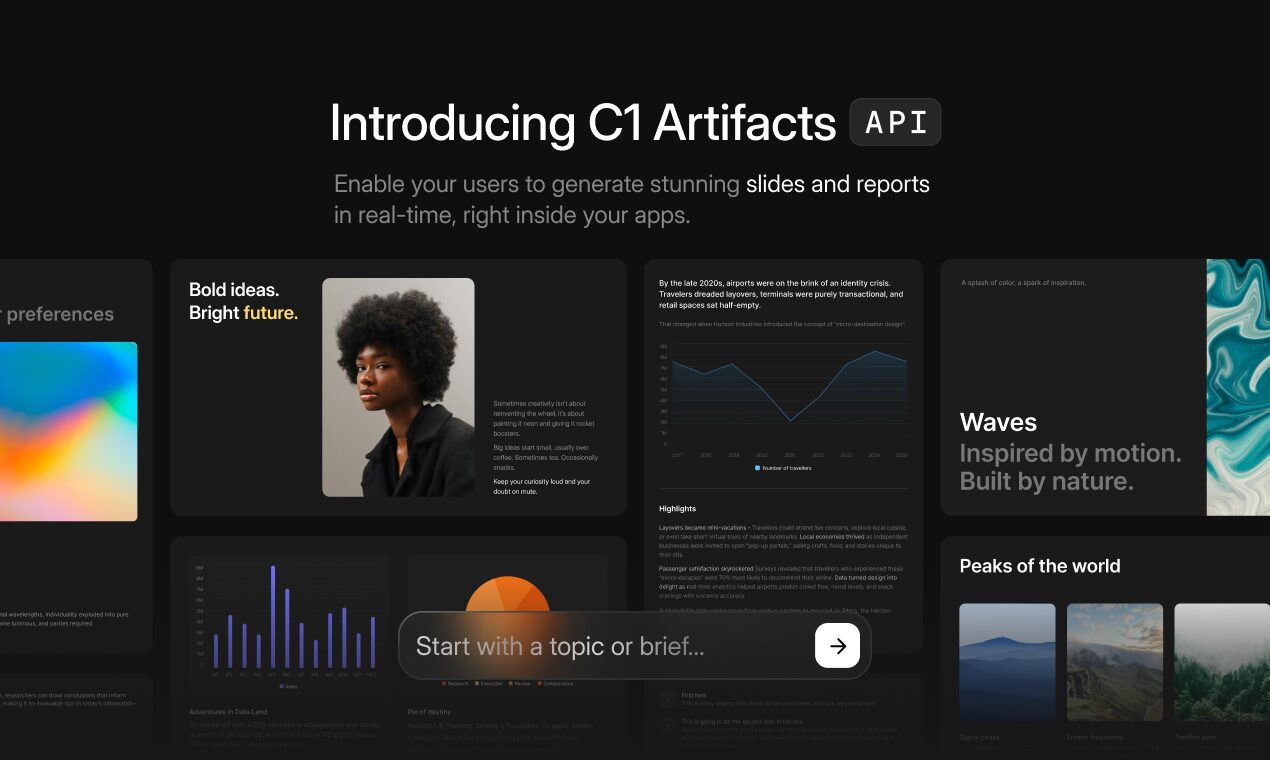
C1 Artifacts API by Thesys addresses this through Generative UI technology that enables AI applications to output interactive slides and reports directly within existing platforms. Rather than generating text descriptions of insights, C1-powered applications create fully formatted, brand-aligned presentations and reports that users edit conversationally, share instantly, and customize in real-time—all without leaving their primary workflow. The API targets developers building AI-powered platforms (analytics tools, business intelligence systems, AI copilots, SaaS applications) seeking to transform their AI outputs from text into visually compelling, interactive documents.
Key Features
C1 Artifacts API delivers comprehensive Generative UI capabilities specifically optimized for slides and reports generation within AI applications:
- Real-Time Interactive Slide Generation: Applications send natural language prompts to C1’s Artifacts endpoint (e.g., “Create a Q3 sales presentation highlighting revenue trends and top-performing regions”). The API generates complete slide decks with intelligent layouts, charts synthesized from provided data, formatted text, and visual hierarchy—streaming progressively as content materializes rather than after full generation completes.
- Conversational Editing Workflow: Generated artifacts aren’t static outputs. Users edit presentations through follow-up prompts: “Add a competitive analysis slide,” “Change chart type to bar graph,” “Emphasize cost savings in executive summary.” C1 processes edit instructions against current presentation state, modifying specific elements while preserving overall coherence—enabling iterative refinement through natural language rather than manual slide editing.
- Brand-Adaptive Theming: Generated slides automatically adapt to custom brand guidelines configured through C1’s styling system. Organizations define color palettes, typography hierarchies, logo placements, and design patterns once; C1 applies these consistently across all generated presentations. Dark mode support activates automatically based on user preferences without separate configuration.
- OpenAI-Compatible Integration: C1 implements OpenAI’s API structure, enabling drop-in replacement for existing OpenAI integrations. Developers change base URL from
api.openai.comtoapi.thesys.dev/v1/embedand replace markdown renderers with<C1Component>React component—minimal code changes transform text-based AI apps into Generative UI platforms. - Progressive UI Streaming: Unlike traditional API patterns returning complete responses, C1 streams UI components as they generate. Charts appear, populate with data progressively, and animate into view while subsequent slides continue generating—creating responsive user experience without waiting for full presentation completion.
- Interactive Component Library: Generated presentations include charts with interactive tooltips revealing underlying data, clickable elements triggering follow-up AI conversations, forms collecting user input to refine subsequent content, and embedded media (images, videos, diagrams) sourced intelligently from prompts and context.
- Model Context Protocol (MCP) Support: C1 integrates with MCP, Anthropic’s standard for connecting AI models to external tools and data sources. Applications leverage MCP servers to provide C1 with real-time business data, analytics systems, CRM information, or custom databases—enabling presentations grounded in current organizational data rather than static training knowledge.
- Enterprise Error Resilience: C1 abstracts LLM provider reliability challenges through automatic retries, fallback routing across providers, and real-time detection of incomplete or malformed responses. If primary LLM provider experiences downtime, C1 automatically routes to backup models; if LLM generates invalid UI code, C1 detects and repairs in real-time—preventing end-user experience degradation from upstream failures.
- Framework-Agnostic Integration: Beyond React SDK, C1 supports integration with Vercel AI SDK, CopilotKit, LangChain, LangGraph, AutoGen, CrewAI, and Mastra through documented examples and compatibility layers. Developers building on any major AI framework can incorporate Generative UI capabilities without platform lock-in.
- Instant Sharing Infrastructure: Generated presentations export as shareable links, enabling instant distribution to stakeholders, clients, or team members. Recipients view interactive presentations in browsers without requiring application access, authentication, or software installation.
How It Works
C1 Artifacts API operates through streamlined integration pattern transforming AI applications from text generators to UI creators.
Implementation begins with API configuration. Developers integrate C1 using familiar OpenAI SDK patterns—replacing OpenAI base URL with `api.thesys.dev/v1/embed` while retaining existing authentication, request structuring, and error handling logic. For frontend integration, developers replace markdown rendering components (typically `<Markdown>` or similar) with C1's `<C1Component>` React component.
Once integrated, application workflow transforms: when users prompt AI application (“Analyze Q3 performance and create executive presentation”), the application routes request to C1 Artifacts endpoint rather than standard chat completion endpoint. The prompt includes user instruction plus contextual data—analytics results, business metrics, performance trends, comparative figures.
C1 processes this input through Generative UI pipeline: understanding presentation intent (executive briefing vs detailed analysis vs sales deck), structuring content hierarchy (title slide, overview, detailed sections, conclusions), selecting appropriate visualizations for data types (line charts for trends, bar charts for comparisons, tables for detailed breakdowns), generating formatted text with appropriate executive vs technical tone, and assembling slides following brand theme rules.
The API streams generated presentation back to application: <C1Component> receives streaming data and renders slides progressively—title slide appears, populates with company branding and presentation title; overview slide materializes with key metrics visualized; detailed sections generate with charts, explanatory text, and data tables; conclusion slide summarizes insights and recommendations. This streaming happens in seconds, creating perception of real-time creation.
Users interact with generated presentation through two pathways: direct manipulation (clicking interactive chart elements, expanding sections, navigating between slides) or conversational editing (prompting “Add slide comparing performance to last quarter,” “Change executive summary tone to be more optimistic,” “Include competitive positioning analysis”). Edit prompts route back through C1 which modifies presentation state and streams updates—new slides insert, existing content refines, visualizations transform—without regenerating entire presentation.
For production deployment, C1’s error handling operates transparently: if OpenAI GPT-4 experiences API timeout, C1 automatically retries via Anthropic Claude; if LLM generates incomplete React component code, C1 detects syntax errors and repairs autonomously; if stream interrupts, C1 resumes from last successful component—ensuring reliable user experience despite underlying infrastructure variability.
Organizations customize C1 through theme configuration defining brand colors, typography, spacing rules, and component styling. Once configured, all generated presentations automatically inherit these specifications—maintaining brand consistency across thousands of AI-generated decks without manual designer intervention.
Use Cases
C1 Artifacts API addresses diverse scenarios where AI-powered applications benefit from transforming insights into shareable presentations:
- Analytics Platform Reporting: Business intelligence tools integrate C1 enabling users to prompt “Create board presentation from Q3 dashboard” and receive polished slide deck synthesizing key metrics, trend analyses, and performance comparisons—transforming static dashboard data into executive-ready presentations without manual export/formatting.
- AI Copilot Output Enhancement: Enterprise copilots assisting with strategic planning, market research, or competitive analysis use C1 to present findings as structured reports and presentations rather than conversational text. Users conducting research receive final outputs as shareable decks suitable for stakeholder distribution.
- SaaS Application Embedded Reporting: Project management platforms, CRM systems, marketing automation tools integrate C1 enabling users to generate customized reports and presentations directly within applications—”Create client proposal from campaign data,” “Generate project status update for stakeholders”—without switching to external presentation software.
- Educational Platform Content Generation: Learning management systems and AI tutoring platforms use C1 to generate interactive lesson materials, visual explanations, and assessment summaries—transforming educational content from text-based responses into engaging, visual learning resources.
- Customer Success Automation: Customer success teams deploy AI copilots generating customized business reviews, ROI reports, and renewal presentations for clients—C1 transforms client-specific usage data, performance metrics, and value realization analyses into polished presentations accelerating customer communication.
- Data Science Workflow Integration: Jupyter notebooks, data analysis platforms, and ML development environments integrate C1 enabling data scientists to transform analytical findings into stakeholder presentations—”Create executive summary of model performance analysis” generates slides explaining methodology, results, and business implications without manual deck creation.
Advantages
- Transforms AI from Text to Visuals: Enables AI applications to output shareable presentations and reports instead of limiting responses to text or markdown, dramatically improving communication of complex insights.
- Conversational Presentation Editing: Users refine generated presentations through natural language rather than manual slide manipulation, maintaining flow within AI conversation rather than switching to presentation software.
- Minimal Integration Complexity: OpenAI-compatible API enables drop-in replacement for existing integrations requiring minimal code changes—often as simple as baseURL modification and component swap.
- Progressive Streaming UX: Real-time UI generation creates responsive experience where presentations appear as they generate rather than after completion, improving perceived performance and user engagement.
- Enterprise Reliability: Automatic provider fallback, error detection, and response repair ensure consistent user experience despite upstream LLM provider variability—critical for production applications serving paying customers.
- Brand Consistency at Scale: Theme configuration ensures all AI-generated presentations automatically conform to brand guidelines without per-generation customization or manual designer review—enabling brand-compliant AI outputs at volume.
- Framework Flexibility: Integration examples for major AI frameworks (Vercel AI SDK, LangChain, CrewAI, CopilotKit) prevent vendor lock-in and support diverse development stacks.
- Instant Shareability: Generated presentations export as links enabling immediate stakeholder distribution without file attachments, version control coordination, or access permission configuration.
Considerations
- Developer-Centric Platform: C1 is API infrastructure for developers building AI applications, not end-user presentation software. Organizations without development resources or technical integration capability cannot directly leverage C1 without engaging developers or technical partners.
- Application Integration Requirement: C1 functionality requires embedding within existing AI applications rather than operating standalone. Teams seeking presentation generation tool for direct use should evaluate end-user presentation platforms rather than API infrastructure.
- API Learning Curve: While OpenAI-compatible design reduces barriers, developers unfamiliar with streaming APIs, React rendering patterns, or Generative UI concepts require initial learning investment before productive implementation.
- Generated Content Constraints: AI-generated presentations reflect prompt quality, data completeness, and brand configuration accuracy. Organizations expecting publication-ready output without iteration may encounter refinement requirements comparable to other AI content generation tools.
- Cost Management Considerations: API-based pricing model charges per generation. Applications experiencing high presentation generation volume should model costs and implement appropriate usage controls, caching strategies, or tier management to prevent unexpected expense scaling.
How It Compare
C1 Artifacts API operates in an emerging category—Generative UI infrastructure for developers—positioned distinctly from both end-user presentation tools and general AI frameworks:
Standalone Presentation Platforms (Beautiful.ai, Pitch, Gamma, Tome): These end-user tools enable individuals and teams to create presentations directly through web interfaces. Beautiful.ai provides AI-powered DesignerBot generating slides from prompts with automated layout adaptation, extensive template library, and Smart Slides adjusting formatting dynamically. Pitch emphasizes real-time collaboration with team editing, commenting, slide assignments, modern templates, and seamless sharing. Gamma delivers AI presentation generation from documents or prompts, interactive blocks, and analytics. Tome focuses on AI storytelling with immersive layouts and narrative structure. All excel as standalone presentation software serving creators directly. C1 operates fundamentally differently: it’s infrastructure API enabling developers to embed presentation generation inside other applications. Users never interact with C1 directly—they experience C1’s capabilities through analytics platforms, AI copilots, or SaaS tools integrating the API. The comparison: Beautiful.ai/Pitch/Gamma/Tome are destinations for presentation creation; C1 is invisible infrastructure powering presentation generation within existing applications.
AI Presentation Add-Ons (Plus AI, Slides AI, Magic Slides, DocGPT.AI): These tools extend Google Slides or PowerPoint with AI generation capabilities. Plus AI for Google Slides adds prompt-to-presentation generation, slide editing, theme design, and remixing tools within Slides interface. DocGPT.AI offers multi-model access (GPT-4, Claude, Gemini) for Google Slides with automatic image placement and speaker notes. SlidesAI converts text to presentations with various design options. These add-ons enhance existing presentation software with AI capabilities. C1 differs through platform-agnostic architecture—rather than extending specific presentation software, C1 generates presentations within any application developers choose to integrate it: business intelligence dashboards, AI agents, SaaS platforms, custom applications. Plus AI enhances Google Slides; C1 enables any application to become presentation generator.
Generative UI Frameworks (Vercel AI SDK, CopilotKit): Vercel AI SDK provides infrastructure for building AI-powered interfaces with streaming, tool calling, and framework integrations. CopilotKit delivers components for AI copilot interfaces including chat, generative UI, and agent orchestration. Both offer primitives for developers building AI applications with interactive UI. C1 differentiates through specialized focus on slides and reports generation—while Vercel/CopilotKit provide general Generative UI building blocks, C1 offers domain-specific API optimized for presentation creation with built-in layout intelligence, brand theming, chart generation, and editing workflows specific to slides/reports. The relationship: Vercel/CopilotKit + C1 integration documented in examples enables best-of-both—framework flexibility with presentation specialization.
Traditional Presentation APIs (Google Slides API, PowerPoint API, Pitch API): Major presentation platforms offer APIs for programmatic creation and modification. Google Slides API enables creating, reading, and updating slides through REST calls. These APIs require developers to construct presentations element-by-element through explicit positioning, styling, and content specification. C1 inverts this: rather than imperative “add rectangle at x,y with these dimensions, this color, this text,” developers send prompts and C1 generates complete presentations including intelligent layout decisions, appropriate visualizations, and coherent design—AI-driven declarative generation vs manual imperative construction.
C1’s competitive positioning emphasizes embedded AI presentation generation: developers integrate C1 into existing AI applications transforming text-based outputs into visual presentations through conversational interface, OpenAI-compatible simplicity, progressive streaming for responsive UX, and brand-consistent theming. For development teams building analytics platforms, AI copilots, business intelligence tools, or any AI application where insights currently output as text but stakeholders need presentations—C1 delivers specialized infrastructure unavailable in general frameworks or end-user tools.
Final Thoughts
AI application proliferation creates presentation gap: sophisticated AI generates valuable insights delivered as text walls requiring manual transformation into shareable formats. This friction limits AI utility—insights remain locked in conversational interfaces rather than flowing into stakeholder communications, client deliverables, or executive briefings. C1 Artifacts API addresses this through Generative UI specialization enabling AI applications to output presentations directly, maintaining context within AI workflow rather than forcing users to external tools.
For development teams building AI-powered platforms—particularly analytics systems, business intelligence dashboards, AI copilots, or vertical SaaS applications—C1 represents infrastructure gap-filler transforming text-based AI into presentation-generating capability. The OpenAI-compatible integration pattern, progressive streaming UX, brand-adaptive theming, and MCP support deliver production-ready presentation generation without months of custom development. As AI applications mature from conversational assistants toward comprehensive work platforms, the ability to generate shareable outputs (presentations, reports, visualizations) becomes table stakes rather than differentiator. C1 provides this infrastructure layer, enabling developers to focus on domain logic while delegating presentation generation to specialized API—accelerating path from AI insight to stakeholder communication.