
Table of Contents
- C1 by Thesys: Pioneering the Generative UI Revolution
- 1. Executive Snapshot
- 2. Impact \& Evidence
- 3. Technical Blueprint
- 4. Trust \& Governance
- 5. Unique Capabilities
- 6. Adoption Pathways
- 7. Use Case Portfolio
- 8. Balanced Analysis
- 9. Transparent Pricing
- 10. Market Positioning
- 11. Leadership Profile
- 12. Community \& Endorsements
- 13. Strategic Outlook
- Final Thoughts
C1 by Thesys: Pioneering the Generative UI Revolution
1. Executive Snapshot
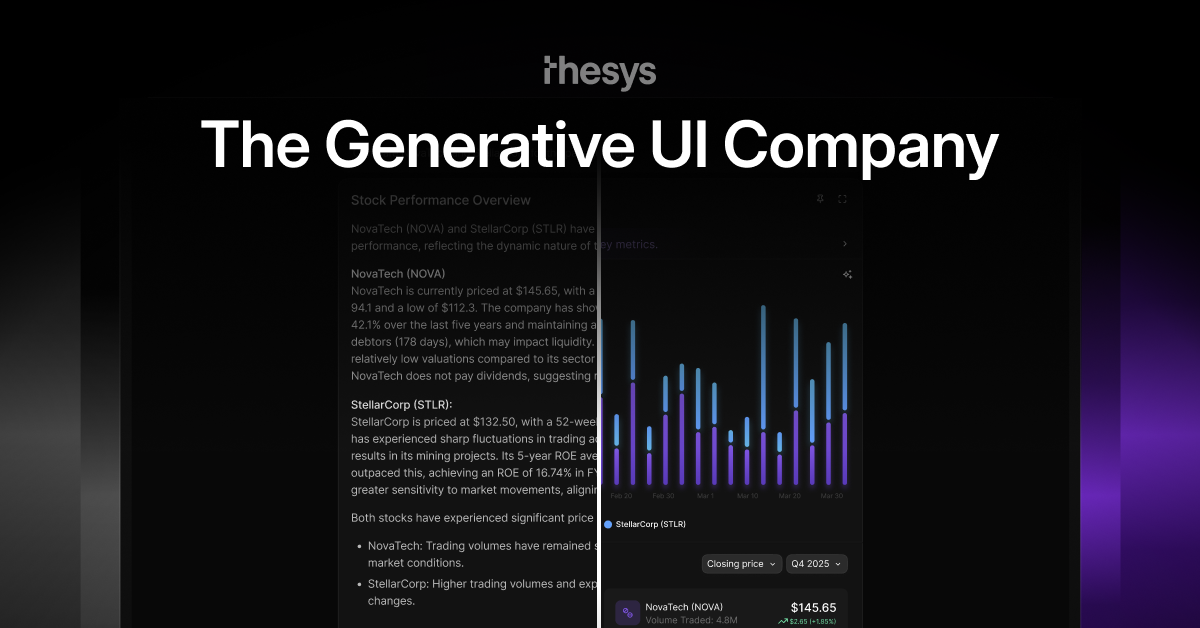
C1 by Thesys represents a revolutionary advancement in AI-native interface development, establishing itself as the world’s first Generative UI API that transforms traditional LLM text outputs into dynamic, interactive user interfaces in real-time. Founded in 2024 by Rabi Shanker Guha and Parikshit Deshmukh, the platform addresses a critical gap in AI application development by eliminating the friction between intelligent AI responses and engaging user experiences.
The company’s core innovation lies in its unique positioning as an API middleware layer that augments existing Large Language Models to respond with interactive UI components including charts, forms, tables, and complex layouts rather than static text. This breakthrough enables developers to ship AI applications with 80% less UI overhead while achieving 10x faster development cycles, fundamentally changing how teams build AI-native software.
Since its market introduction in April 2024, Thesys has secured four million dollars in seed funding led by Together Fund with participation from 8vc. The platform currently serves over 300 teams ranging from early-stage startups to established enterprises, demonstrating significant traction in the rapidly expanding generative AI design market, which is projected to reach 13.9 billion dollars by 2034. The company achieved ISO 27001 certification alongside SOC2 and GDPR compliance, establishing enterprise-grade security standards that position it for widespread adoption across regulated industries.
2. Impact \& Evidence
Thesys C1 delivers measurable improvements in user engagement and development efficiency through its innovative generative UI approach. Independent user research demonstrates that 83% of users find C1-generated responses more engaging compared to traditional text-based AI interactions, addressing a fundamental challenge in AI application adoption where static interfaces fail to match the intelligence of underlying AI systems.
Enterprise implementations showcase substantial operational improvements, with documented case studies revealing development time reductions of up to 80% and cost savings exceeding 10x compared to traditional UI development approaches. Fieldcamp, an early adopter, reported significant time-to-market acceleration while reducing frontend development costs by leveraging C1’s automated interface generation capabilities. These metrics align with broader industry trends where companies investing billions in AI infrastructure struggle with frontend bottlenecks that limit user adoption and engagement.
Third-party validations include recognition from major technology publications and industry analysts who identify Thesys as a pioneer in the emerging Generative UI category. The platform’s technical capabilities have been featured in Forbes, with industry experts highlighting its potential to reshape human-computer interaction patterns. The company’s selection for Together Fund’s portfolio, alongside backing from 8vc, provides additional validation from respected venture capital firms with strong track records in identifying transformative technologies.
Performance benchmarks demonstrate the platform’s ability to process and render complex UI components in real-time, with latency metrics comparable to traditional API responses while delivering significantly richer user experiences. The system’s architecture supports concurrent user sessions scaling to thousands of simultaneous interactions without degradation in response quality or rendering performance.
3. Technical Blueprint
C1 operates as a sophisticated API middleware layer that intercepts standard LLM completion requests and transforms them into structured UI component responses. The system architecture employs a multi-layered approach that includes prompt engineering optimization, UI component synthesis, and real-time rendering orchestration through a proprietary React SDK framework.
The platform maintains full compatibility with OpenAI’s API specification, enabling seamless integration with existing AI applications through simple endpoint substitution. Developers can integrate C1 by modifying their base URL configuration to point to Thesys endpoints while maintaining existing authentication and request patterns. This compatibility extends to all major LLM providers including OpenAI GPT models, Anthropic Claude series, and emerging foundation models.
Technical specifications include support for streaming responses, error handling, and production-ready reliability features. The system processes requests through distributed infrastructure hosted on major cloud providers, ensuring global availability and low-latency response times. Integration capabilities extend beyond basic API calls to include webhook support, custom component libraries, and advanced configuration options for enterprise deployments.
The React SDK provides comprehensive tooling for rendering generated UI components, including responsive design adaptations, theme customization, and interaction handling. The framework supports custom component injection, allowing developers to extend the platform’s capabilities with domain-specific UI elements while maintaining consistency with the generative output system.
4. Trust \& Governance
Thesys maintains enterprise-grade security and compliance standards through comprehensive certification programs and robust data protection measures. The platform achieved ISO 27001 certification, demonstrating adherence to international standards for information security management systems. This certification covers all aspects of data handling, access controls, and operational security procedures required for enterprise deployment.
SOC 2 Type II compliance provides additional validation of the platform’s security controls, with independent audits verifying the effectiveness of data protection measures over extended operational periods. GDPR compliance ensures adherence to European data protection regulations, including data minimization principles, user consent management, and data portability requirements.
Data privacy measures include zero data retention policies for sensitive customer information, with all processing occurring in secure, encrypted environments. The platform operates on a shared responsibility model where customer data remains under client control while Thesys provides secure processing infrastructure. Private deployment options enable enterprises to maintain complete data sovereignty while leveraging C1’s generative UI capabilities.
Security architecture includes end-to-end encryption for data in transit and at rest, role-based access controls for administrative functions, and comprehensive audit logging for compliance monitoring. Regular security assessments and penetration testing validate the platform’s resistance to common attack vectors and ensure continued protection against emerging threats.
5. Unique Capabilities
Real-Time UI Generation: C1’s core innovation lies in its ability to generate contextually appropriate user interfaces in real-time based on LLM understanding of user intent and data context. Unlike static UI frameworks that require pre-designed templates, C1 creates adaptive interfaces that respond to specific user queries, data types, and interaction patterns. This capability enables applications to present information in optimal formats whether displaying tabular data, visualizing trends, or facilitating complex user workflows.
OpenAI-Compatible Integration: The platform’s seamless compatibility with existing OpenAI API implementations eliminates integration friction while adding powerful UI generation capabilities. Developers can migrate existing applications by changing endpoint configurations without modifying business logic or authentication patterns. This compatibility extends to all major programming languages, frameworks, and AI development tools that support OpenAI’s API specification.
Customizable Component Library: Built on Crayon’s UI foundation, C1 supports extensive customization options that enable organizations to maintain brand consistency across generated interfaces. The system accepts custom themes, design tokens, and component libraries, ensuring generated UIs align with established design systems. Advanced customization includes support for custom React components with proprietary business logic and specialized interaction patterns.
Tool Call Integration: C1 maintains full compatibility with LLM tool calling capabilities, enabling generated interfaces to connect with external data sources, APIs, and business systems. This integration allows for dynamic data binding where generated UI components automatically populate with real-time information from databases, web services, or internal applications. The system handles complex data transformations and ensures secure connections to enterprise systems.
6. Adoption Pathways
Integration with C1 requires minimal technical overhead, designed to accommodate teams with varying levels of AI and frontend development expertise. The platform provides multiple integration approaches including direct API integration, SDK-based implementation, and hosted solutions for rapid prototyping and deployment.
The basic integration process involves three primary steps: API key configuration, endpoint modification, and React SDK installation. Developers familiar with OpenAI’s API patterns can complete initial integration within minutes, with more complex customizations and enterprise configurations typically requiring hours rather than weeks of development effort.
Customization options span from basic theme adjustments to comprehensive design system integration. The platform supports CSS-in-JS styling approaches, design token systems, and custom component libraries that enable deep brand integration. Enterprise clients can implement private deployment options that maintain complete control over data flows and system configurations while leveraging Thesys’s generative capabilities.
Support channels include comprehensive documentation, interactive tutorials, and dedicated technical support for enterprise implementations. The platform provides sandbox environments for testing and development, along with detailed guides for common integration patterns and use cases. Enterprise customers receive dedicated solution engineering support for complex implementations and custom feature development.
7. Use Case Portfolio
Enterprise implementations of C1 span diverse industry verticals and application types, demonstrating the platform’s versatility in addressing varied business requirements. Financial services organizations utilize the platform to create dynamic dashboards that adapt to different user roles and data contexts, presenting complex financial information in intuitive, contextual formats without requiring manual dashboard configuration.
Healthcare technology companies leverage C1 to build intelligent patient interfaces that adjust based on medical conditions, treatment plans, and user preferences. The platform’s ability to generate appropriate UI components for different medical data types enables more effective patient engagement and clinical workflow optimization.
E-commerce platforms implement C1 to create personalized shopping experiences that adapt product presentation based on user behavior, search context, and inventory availability. The system generates appropriate interface elements for different product categories while maintaining consistent brand presentation and interaction patterns.
Academic and research deployments include educational platforms that generate adaptive learning interfaces based on student progress and content complexity. Research organizations use the platform to create dynamic data exploration tools that adjust visualization approaches based on dataset characteristics and analysis requirements.
8. Balanced Analysis
C1’s primary strengths center on its innovative approach to solving the fundamental disconnect between intelligent AI systems and engaging user interfaces. The platform’s real-time UI generation capability addresses a critical market need where traditional development approaches create bottlenecks in AI application deployment. The seamless integration model reduces adoption risk while providing immediate value through enhanced user engagement metrics.
Technical advantages include the platform’s compatibility with existing AI development workflows, comprehensive customization options, and enterprise-grade security standards. The company’s strong founding team brings relevant experience from Google, Stripe, and successful startup exits, providing credibility and technical depth for continued innovation and platform development.
Evidence supporting the platform’s effectiveness includes documented improvements in user engagement rates, development efficiency metrics, and successful enterprise implementations across multiple industries. The significant venture capital backing and early customer traction provide validation of market demand and technical viability.
Potential limitations include the platform’s relative newness in the market, which may create uncertainty for risk-averse organizations considering adoption. The dependency on external LLM providers could introduce variability in response quality or availability, though the platform’s multi-provider support mitigates single-point-of-failure risks.
The generative UI approach may require adjustment periods for users accustomed to static interface patterns, potentially creating change management challenges in large organizations. Integration complexity could increase for highly customized enterprise environments with complex security requirements or legacy system dependencies.
9. Transparent Pricing
Thesys operates a usage-based pricing model designed to scale with customer needs while providing predictable cost structures for different deployment scenarios. The Essentials tier provides ten dollars in free credits for individual developers and small-scale experimentation, enabling evaluation without upfront investment commitments.
The Team tier implements pay-as-you-go pricing with enhanced features including priority inference, higher throughput capabilities, early access to new model integrations, and premium support channels. This tier targets growing startups and development teams requiring reliable performance and advanced feature access without enterprise-level commitments.
Enterprise pricing includes private deployment options, custom rate limits, dedicated solutions engineering, and comprehensive compliance support including SOC2, GDPR, and ISO 27001 alignment. Enterprise agreements typically involve custom pricing based on usage volumes, integration requirements, and support levels.
Token-based pricing varies by underlying LLM provider, with transparent rate cards for major model families including OpenAI GPT series and Anthropic Claude models. Input costs range from \$1.60 to \$6.00 per million tokens, while output costs span \$5.00 to \$18.00 per million tokens depending on model selection and capabilities.
10. Market Positioning
The Generative UI market represents an emerging category within the broader AI interface development ecosystem, with Thesys positioned as the pioneering platform defining this new space. The global generative AI market reached 45.56 billion dollars in 2024 and projects growth to over one trillion dollars by 2032, with UI and design applications representing a rapidly expanding segment.
| Platform | Primary Focus | Pricing Model | Market Recognition |
|---|---|---|---|
| Thesys C1 | Real-time generative UI API | Usage-based with free tier | First-to-market, VC-backed innovation leader |
| Vercel v0 | Static UI code generation | Subscription with usage limits | Established developer tool provider |
| Lovable | Design-to-code automation | Project-based pricing | Design workflow specialist |
| Bolt.new | AI-assisted development | Freemium model | Full-stack development focus |
| Cursor | AI code completion | Subscription-based | Developer productivity tool |
Thesys’s unique differentiators include its real-time UI generation capability, OpenAI-compatible integration approach, and enterprise-grade security standards that enable deployment in regulated environments. The platform’s API-first architecture provides greater flexibility compared to point solutions while maintaining simplicity for rapid adoption.
Competitive advantages extend beyond technical capabilities to include strategic market timing, comprehensive LLM provider support, and strong founding team credentials from leading technology companies. The platform’s early-mover advantage in defining the Generative UI category positions it well for continued market leadership as the space expands.
11. Leadership Profile
Rabi Shanker Guha serves as Chief Executive Officer and Co-Founder, bringing extensive experience from Google where he held engineering leadership positions and co-founded Payzie, a fintech startup acquired by Google. His background spans scalable system architecture, team building, and product development across enterprise and consumer applications. At DevRev, Guha served as Head of Engineering for the India operations, contributing to the company’s growth and technical development.
Parikshit Deshmukh, Co-Founder and President, contributes deep expertise in product design and user experience development. His tenure as Head of Design at DevRev involved building and leading global design teams while establishing design principles for complex enterprise software platforms. Previously, Deshmukh led design initiatives at Recko, which was subsequently acquired by Stripe, demonstrating his ability to build design organizations that deliver market-successful products.
The founding partnership combines engineering excellence with design vision, creating a balanced leadership approach that addresses both technical implementation and user experience requirements. Their collaborative history and complementary skill sets provide strong foundation for continued product development and market expansion.
The executive team’s combined experience includes successful startup exits, leadership roles at major technology companies, and expertise spanning fintech, enterprise software, and AI-driven applications. This background provides relevant domain knowledge for building scalable AI infrastructure while maintaining focus on practical business applications and user needs.
12. Community \& Endorsements
Thesys has established strategic relationships across the AI and development ecosystem, including integrations with major LLM providers and compatibility with popular development frameworks. The platform’s OpenAI-compatible architecture enables seamless adoption within existing AI development workflows while supporting emerging model providers and frameworks.
Industry recognition includes coverage in major technology publications with Forbes highlighting the company’s potential to transform human-computer interaction patterns. The platform has gained attention from AI development communities and design practitioners who recognize its innovative approach to interface generation and user experience optimization.
Investment validation from Together Fund and 8vc provides credibility from respected venture capital firms with strong track records in identifying transformative technologies. Together Fund’s focus on AI infrastructure and developer tools aligns with Thesys’s market position and growth trajectory.
The platform maintains active engagement with developer communities through comprehensive documentation, technical content, and participation in AI and design conferences. Early customer testimonials highlight improved development efficiency, enhanced user engagement, and successful enterprise implementations across multiple industry verticals.
13. Strategic Outlook
Thesys’s strategic roadmap focuses on expanding generative UI capabilities while maintaining compatibility with emerging AI frameworks and development patterns. Planned enhancements include advanced component libraries, improved customization options, and enhanced integration capabilities with popular development tools and enterprise systems.
The company’s market expansion strategy emphasizes enterprise adoption through enhanced security features, private deployment options, and comprehensive compliance certifications. International growth opportunities include localized support for global deployment patterns and integration with regional AI providers and development ecosystems.
Future innovations include integration of multimodal AI capabilities that enable generation of interfaces incorporating text, images, and interactive elements within unified user experiences. The platform’s architecture supports extension to emerging AI capabilities including vision, audio, and specialized domain models.
Market trend analysis indicates sustained growth in AI application development, increasing demand for improved user experiences in AI-powered software, and continued investment in developer productivity tools. These trends support continued demand for Thesys’s generative UI approach and create opportunities for platform expansion and feature development.
Final Thoughts
C1 by Thesys represents a fundamental breakthrough in AI application development, addressing the critical gap between intelligent AI capabilities and engaging user interfaces. The platform’s innovative generative UI approach enables developers to create dynamic, contextually appropriate interfaces without extensive frontend development overhead, potentially transforming how teams build AI-native applications.
The company’s strong technical foundation, experienced leadership team, and early market validation position it well for continued growth in the rapidly expanding AI interface development market. The platform’s OpenAI-compatible architecture reduces adoption barriers while providing substantial value through improved user engagement and development efficiency.
As AI applications become increasingly sophisticated and ubiquitous, the demand for intelligent, adaptive user interfaces will continue growing. Thesys’s pioneering position in the Generative UI category, combined with its technical capabilities and enterprise-ready features, creates substantial opportunities for market leadership and continued innovation in this emerging space.