Overview
Ever had a brilliant app idea but lacked the coding skills to bring it to life? Enter CatDoes, a revolutionary platform that uses a multi-agent AI approach to build and deploy production-ready apps from simple text prompts. Unlike standard code assistants, CatDoes employs a team of specialized agents to handle every stage of development—from requirements gathering to App Store submission. With the release of v3, the platform has expanded beyond mobile to include web deployments, first-class GitHub integration, and a new daily credit system, making it one of the most comprehensive text-to-app solutions available for founders and creators.
Key Features
CatDoes packs a suite of powerful features designed to streamline the app development process from concept to launch.
- Multi-Agent AI Pipeline: Instead of a single model, CatDoes uses a team of specialized agents (Requirements, Designer, Software, and Release agents) that collaborate to build your app, ensuring higher quality code and cohesive design.
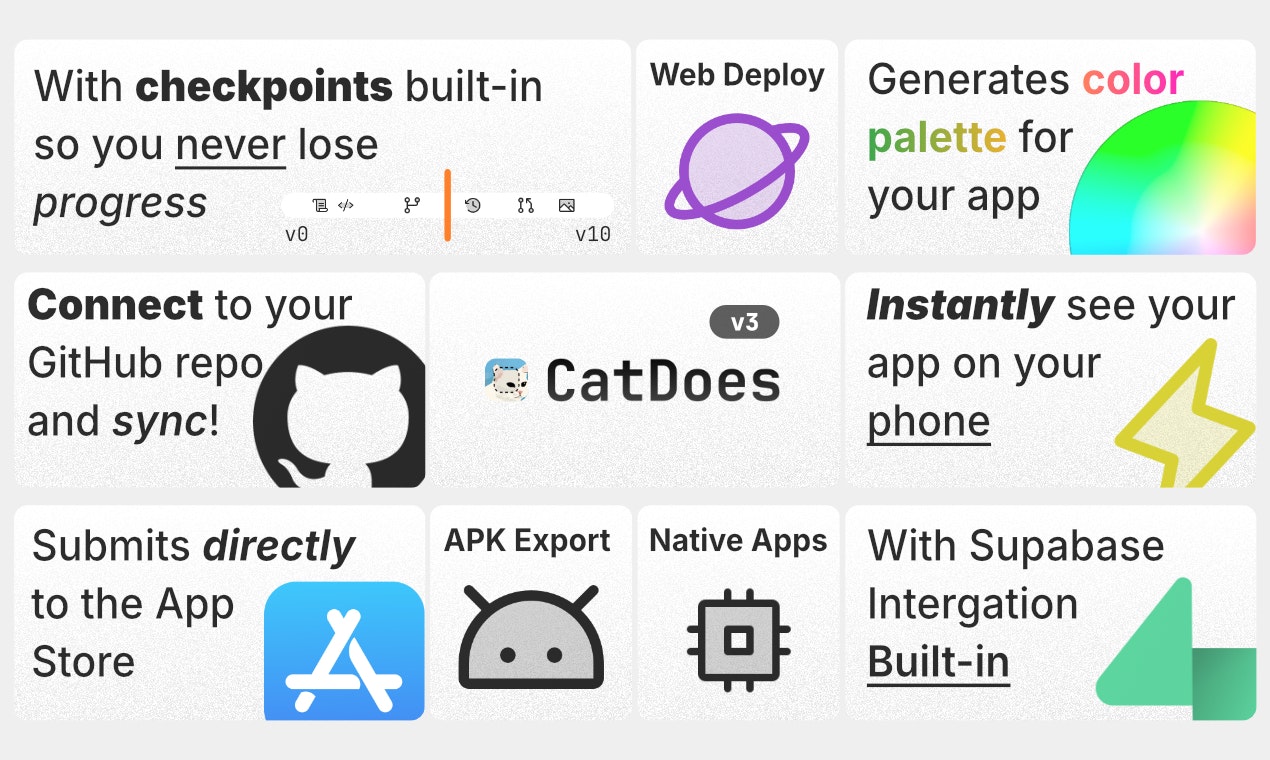
- iOS, Android, and Web Deployments: Build once and deploy everywhere. CatDoes supports native builds for iOS and Android (via React Native Expo), and with v3, you can now instantly deploy your project as a fully functional live web application.
- First-Class GitHub Integration: Gain full ownership of your code. You can sync your entire project with a remote GitHub repository, enabling version control, developer collaboration, and manual refinements whenever needed.
- Integrated Backend with Supabase: The platform automatically handles backend infrastructure, setting up authentication and databases via Supabase so your app is functional, not just a visual prototype.
- Daily Credits & Checkpoints: The v3 update introduces daily credits for risk-free experimentation and a “Checkpoints” system that acts like video game save slots, allowing you to safely iterate and revert changes.
How It Works
The magic of CatDoes lies in its straightforward, conversational process which turns your words into a working application.
You start by describing your app idea in plain English. The Requirements Agent interviews you to clarify features, followed by the Designer Agent which creates the UI/UX. The Software Agent then writes the code, implementing logic and connecting the Supabase backend. Once the build is complete, the Release Agent guides you through publishing to the Apple App Store and Google Play Store, or deploying directly to the web. If you connect your GitHub account, every line of code is synced to your repository, giving you a professional-grade codebase you can export or extend manually.
Use Cases
So, who is this powerful tool for? CatDoes is a perfect fit for a wide range of users looking to build applications efficiently.
- Solo Founders: Quickly ship a Minimum Viable Product (MVP) for both mobile and web to test business ideas without hiring a dev team.
- Small Businesses: Create custom internal tools, booking systems, or customer-facing loyalty apps to streamline operations.
- Non-Engineers & Prototypers: Empower designers and marketers to build high-fidelity, functional prototypes that run on real devices via QR code.
Pros & Cons
Like any tool, CatDoes has its unique strengths and some limitations to consider.
Advantages
- True Native Mobile Support: unlike many AI builders that only output React web apps, CatDoes builds real native binaries for iOS and Android.
- Code Ownership: The GitHub sync ensures you are never locked into the platform; you own the source code (React Native/Expo).
- End-to-End Automation: Handles the intimidating complexity of App Store deployment and backend setup automatically.
Disadvantages
- Prompt Dependency: The quality of the initial output relies heavily on how clearly the user can articulate their requirements.
- Complex Logic Limitations: While great for standard CRUD apps and business tools, highly specialized or experimental technologies (like AR/VR or complex gaming physics) may still require manual coding.
How Does It Compare?
The AI app-building space is moving fast. Here is how CatDoes v3 stacks up against key competitors:
- vs. Bolt.new & Lovable:
- Bolt/Lovable: Excellent for building web applications (React/Next.js) with instant previews.
- CatDoes: Differentiates by focusing on Native Mobile Apps (iOS/Android) in addition to web. If you need a real app in the App Store, CatDoes is the better choice.
- vs. FlutterFlow:
- FlutterFlow: A powerful low-code visual builder that generates Flutter code. It offers granular control but has a steeper learning curve.
- CatDoes: A No-Code/Chat-First experience. You don’t drag-and-drop components; you simply ask for them. Best for users who want speed over pixel-perfect manual control.
- vs. Glide & Softr:
- Glide/Softr: Best for building apps strictly from existing data sources (Google Sheets/Airtable) with rigid templates.
- CatDoes: Builds custom interfaces and logic from scratch based on your prompt, offering far more design flexibility than template-based tools.
Final Thoughts
CatDoes v3 represents a significant leap forward in democratizing software creation. By combining a sophisticated multi-agent AI system with the ability to deploy native mobile apps and web apps simultaneously, it solves the “deployment gap” that plagues many other AI coding tools. While it may not replace senior engineers for highly complex enterprise systems, it is arguably the fastest path for founders and non-technical creators to go from a text prompt to a downloadable app on a user’s phone. If you want to turn an idea into reality without touching an IDE, CatDoes is undoubtedly worth exploring.