Table of Contents
Overview
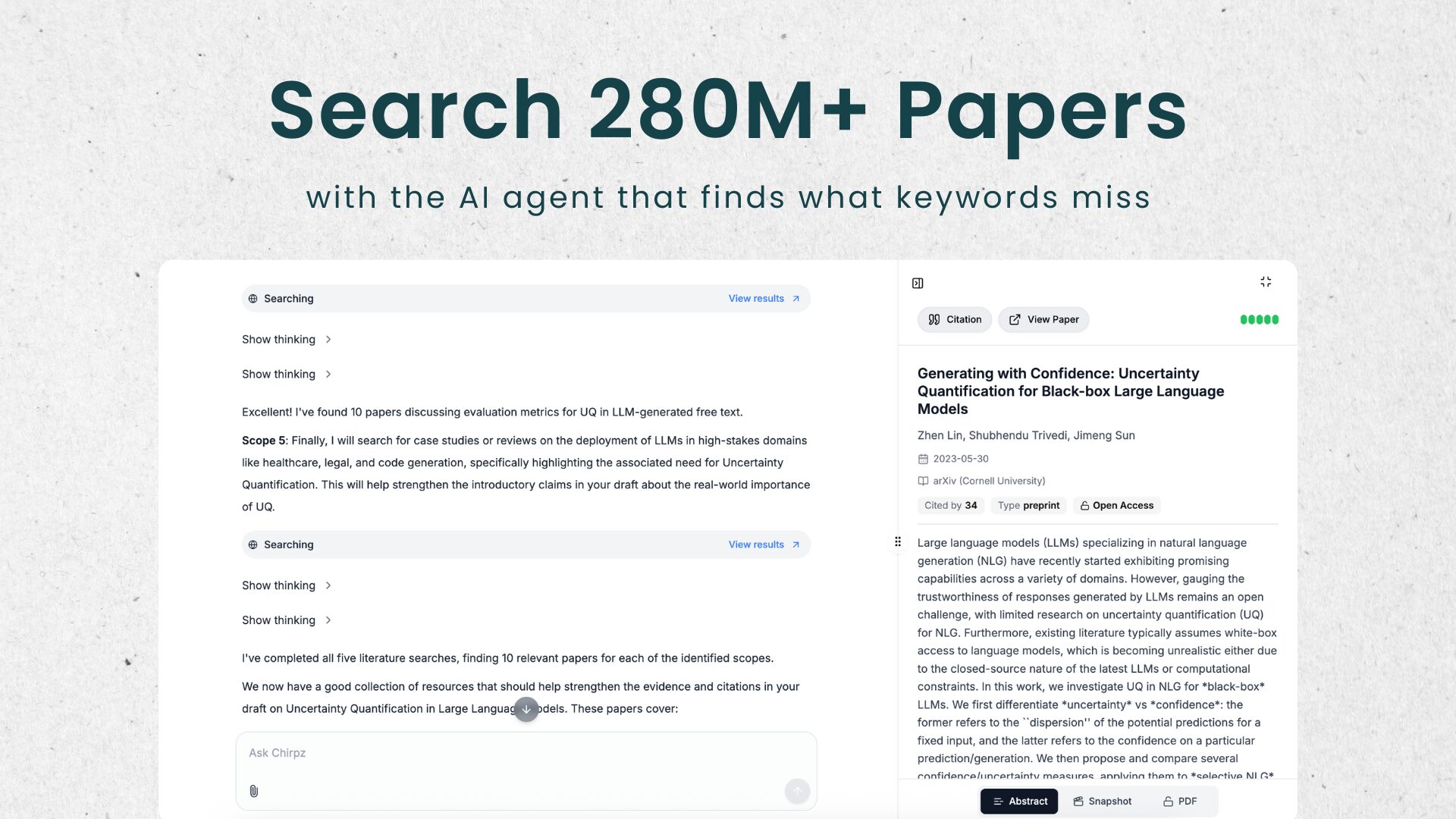
Unlike standard search engines, Chirpz Agent understands the underlying intent of your research. Whether you are asking a complex natural-language question or uploading a PDF draft, the AI agent “scopes” your specific scientific context to surface the most relevant work first. Its standout feature is the Citation Discovery Agent, which proactively identifies gaps in your manuscript where supporting evidence is missing—effectively pre-auditing your work before it reaches peer reviewers. By combining real-time database access with zero-hallucination guarantees, Chirpz ensures that every recommended paper is authentic and cite-ready with complete metadata and BibTeX support.
Key Features
- Contextual Search Engine: Queries 280M+ academic papers using natural language, understanding complex scientific nuances that traditional keyword searches miss.
- Draft Analysis & Gap Detection: Analyzes uploaded drafts (PDF/.docx) to highlight specific sections lacking empirical support or missing critical foundational papers.
- AI Relevance Ranking: Filters search results using proprietary algorithms that prioritize papers based on their conceptual fit to your current work, not just citation counts.
- In-Editor @cite Tool: Allows researchers to type “@cite” while writing to instantly receive a ranked list of relevant papers with metadata that can be inserted with one click.
- Verified Metadata & Exports: Provides instant access to abstracts, author lists, and journal info, with single-click exporting for BibTeX, Mendeley, and Zotero.
- AI Snapshots (Summaries): Generates objective summaries of every discovered paper, highlighting key contributions and relevance to help you skip the skimming phase.
- Zero-Hallucination Guarantee: Every result is mapped directly to a source DOI and verified metadata, preventing the inclusion of non-existent citations.
- Structured Literature Review Flow: Guides users through asking questions, scoping topics, discovering connections, and reviewing impactful work in a logical sequence.
How It Works
A typical session starts with the user either typing a specific research query (e.g., “latest advances in diffusion models for medical imaging”) or uploading a current project draft. The Chirpz Agent then extracts the “research scope” and begins a real-time crawl of its 280M+ paper index. Results appear as a ranked list with “AI Snapshots” that explain why each paper is important to your work specifically. While writing in the integrated editor, users can use the “@cite” command to find proof for a specific sentence. Once the review or citation list is complete, it can be exported as a professional bibliography.
Use Cases
- Grant Proposal Development: Rapidly identifying current state-of-the-art research and ensuring all claims are supported by the most recent literature.
- Literature Review Acceleration: Consolidating months of discovery into hours by having the AI filter the “noise” and present only high-relevance papers.
- Peer Review Preparation: Using the “Gap Detection” tool to find and fix missing citations before submitting a paper to a high-impact journal.
- Emerging Tech Monitoring: Setting the agent to track specific competitive research areas in pharma or hardware R&D.
Pros and Cons
- Pros: The draft analysis feature is a significant innovation for academic integrity. The 280M+ database is one of the largest integrated indexes available. One-click citation export saves hours of manual formatting.
- Cons: Advanced “Deep Review” and unlimited queries are restricted to the Pro plan. Relies on its own internal ranking, which may differ from a user’s manual filtering preference.
Pricing
- Free Starter: Includes 200 free credits per month, allowing for basic literature discovery and standard AI summaries.
- Pro Plan: Pricing varies by institution/individual. Unlocks unlimited search requests, advanced draft gap analysis, and priority access to the newest AI models.
- Institutional Plans: Available for research labs and universities with centralized citation management and collaborative workspace features.
How Does It Compare?
- Elicit: Known for data extraction and structured analysis. Chirpz is more “agent-like,” focusing on the writing and citing workflow and proactive gap detection within your drafts.
- Consensus: Specializes in finding “Yes/No” answers to research questions with paper-quality metrics. Chirpz is broader, focusing on comprehensive discovery and full bibliography management.
- Semantic Scholar: A massive search engine. Chirpz acts as an intelligent overlay for this type of data, adding AI ranking and in-document citation tools that Semantic Scholar lacks.
- Paperguide: A direct competitor in the “all-in-one” research space. Chirpz distinguishes itself with its specific focus on “Unseen Literature” (finding the connections you might miss) and its sleek, command-based editor integration.
- Connected Papers: Excellent for visual mapping. Chirpz is better for text-based discovery and the direct transition from “searching” to “citing.”
Final Thoughts
Chirpz Agent is the definitive “Scientific Co-Pilot” of 2026, shifting the focus from finding more information to finding the right information. In an era of information overload and academic pressure, its ability to pre-identify citation gaps is its most valuable asset, potentially lowering rejection rates for academic submissions. By grounding its AI in a massive, verified database, Chirpz restores trust in automated research tools, making it an essential platform for PhD candidates, career researchers, and R&D professionals alike.