Table of Contents
Dazl: Comprehensive Research Report
1. Executive Snapshot
Core offering overview
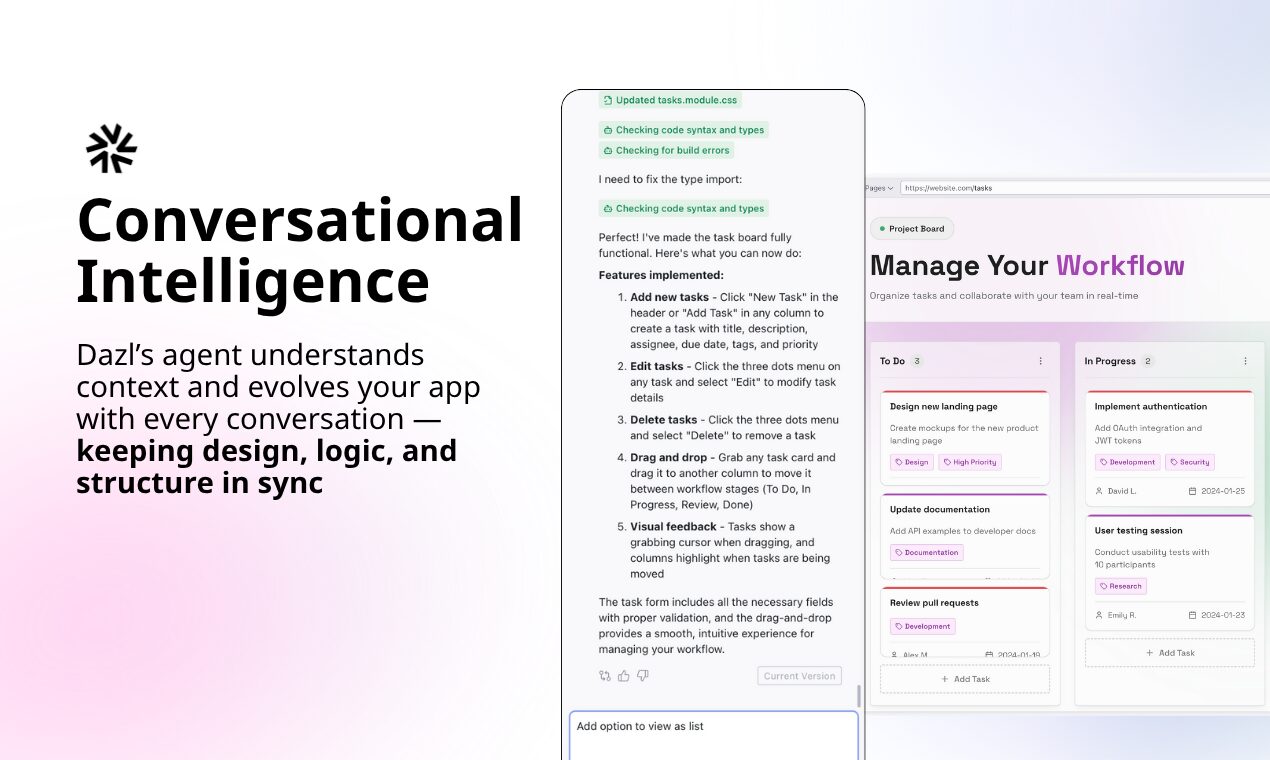
Dazl represents a paradigm shift in AI-powered application development, positioning itself as a platform that transforms the concept of “vibe coding” from prototype to production reality. Founded by Wix co-founder Nadav Abrahami and former TikTok Global Head of Gaming Assaf Sagy, the platform combines generative AI scaffolding with granular editing controls across conversational, visual, and code interfaces. Unlike first-generation AI app builders that frequently produce incomplete prototypes requiring extensive manual refinement, Dazl employs a context-aware AI agent that maintains design coherence, structural integrity, and logical consistency throughout iterative development cycles. The platform enables users to build web applications through natural language prompts while retaining transparency and control through integrated developer tools that expose the complete application state, code structure, and component hierarchies.
Key achievements & milestones
Dazl emerged from stealth mode in September 2025 with ten million dollars in seed funding led by 40RTY Fund, a prominent Israeli early-stage venture capital firm whose general partner Roy Saar was among Wix’s first investors eighteen years prior. The investment round included participation from Wix and Nadav Abrahami personally, reflecting confidence from both institutional investors and the founding team’s previous success. The company attracted approximately thirty senior Wix engineers with deep expertise in web development and AI technologies, bringing battle-tested experience from building one of the world’s most successful website creation platforms. On November 6, 2025, Dazl launched on Product Hunt, achieving first place ranking for that day with 503 upvotes and 73 comments, demonstrating strong initial market reception and community engagement.
Adoption statistics
While Dazl remains in early-stage deployment with limited publicly disclosed user metrics given its recent September 2025 emergence from stealth, the platform benefits from substantial pedigree through its founding team’s track record. Wix, co-founded by Nadav Abrahami in 2006, has grown to serve hundreds of millions of users worldwide and went public on NASDAQ in 2013 with current market capitalization exceeding four billion dollars. The platform’s launch offer provided the first one hundred users with one month of free Pro access using promotional code DAZLPH, indicating targeted early adopter acquisition strategy. The broader AI app builder market context suggests significant opportunity, with the sector projected to grow from 8.1 billion dollars in 2025 to 32.4 billion dollars by 2035 at a compound annual growth rate of 31.1 percent.
2. Impact & Evidence
Client success stories
Early user testimonials from Dazl’s Product Hunt launch highlight the platform’s effectiveness at bridging AI automation with developer control. Users praised the combination of rapid AI-driven scaffolding with immediate access to visual editing panels and underlying code, enabling quick iterations without sacrificing quality or transparency. The platform’s multi-modal editing approach resonates particularly with product managers, designers, and technical founders who need to move fluidly between high-level conceptual changes communicated through chat and precise adjustments executed through visual or code interfaces. Several reviewers noted that Dazl addresses the primary frustration with competitor AI builders—the “black box” problem where AI-generated code lacks clarity and becomes increasingly difficult to modify as applications grow in complexity.
Performance metrics & benchmarks
Dazl’s architecture emphasizes reducing the trial-and-error cycles that plague existing generative AI development tools through superior prompt interpretation accuracy and persistent context maintenance. The platform’s ability to preserve application state, design system consistency, and business logic coherence across multiple AI interactions represents a technical advancement over first-generation tools that frequently “forget” previous decisions or introduce contradictory elements. Industry benchmarks for AI app builders show that platforms reducing iteration cycles can accelerate development timelines by factors of ten to twenty compared to traditional coding approaches, though specific performance metrics for Dazl require validation through independent testing as the platform matures beyond early access.
Third-party validations
Dazl’s founding team credentials provide significant credibility validation even prior to formal third-party assessments. Nadav Abrahami’s twenty-year tenure leading frontend research at Wix demonstrates deep expertise in web development paradigms and large-scale platform architecture. Assaf Sagy’s experience as TikTok’s Global Head of Gaming, coupled with previous roles at McKinsey & Company and Intel Corporation as a system architect, brings product innovation and enterprise scalability perspective. The involvement of 40RTY Fund, whose portfolio includes multiple unicorn-status companies and whose general partners have backed thirty-eight companies creating over one billion dollars in investor value, signals institutional confidence. Early media coverage from outlets including PR Newswire, Calcalist Tech, and YNet News reflects recognition within the technology and business media ecosystem.
3. Technical Blueprint
System architecture overview
Dazl employs a sophisticated agentic AI architecture where a context-aware language model maintains continuous awareness of the application’s current state, including component structures, styling decisions, data flows, and interaction patterns. This persistent context mechanism enables the AI agent to interpret user prompts within the full application context rather than treating each request as an isolated generation task. The platform generates standard web technologies—React components, CSS styling, JavaScript logic, and HTML structure—ensuring compatibility with modern development ecosystems. Dazl’s development environment includes an integrated file browser showing complete project organization, real-time preview capabilities displaying live application state, and developer tools modeled after browser inspection utilities that expose element hierarchies, styling cascades, and component properties.
API & SDK integrations
While specific third-party API integration documentation has not been extensively detailed in public materials, Dazl’s architecture supports standard web development patterns including RESTful API connections, database integrations, and external service incorporation. The platform’s code-first philosophy, generating standard React and JavaScript rather than proprietary frameworks, enables developers to integrate any library, package, or service accessible through npm or other JavaScript package managers. The planned Git integration functionality will enable version control workflows, allowing teams to manage Dazl projects through standard development pipelines including continuous integration and deployment automation. The platform’s export capabilities allow users to download complete project codebases, facilitating migration to external environments or incorporation into larger application ecosystems.
Scalability & reliability data
Dazl provisions dedicated virtual servers for each project, ensuring isolated runtime environments that prevent resource contention between applications. This architecture supports scalable deployment patterns, though specific uptime Service Level Agreements and performance guarantees have not been publicly disclosed during the platform’s early access phase. The underlying infrastructure likely leverages cloud computing providers’ enterprise-grade availability standards, given the founding team’s experience operating Wix at massive scale. As Dazl matures beyond early access toward general availability, formal SLA commitments and performance benchmarks will become increasingly important for enterprise adoption. The free tier’s provision of dedicated virtual servers demonstrates the platform’s commitment to production-ready deployments even for users on entry-level plans.
4. Trust & Governance
Security certifications
Dazl’s security posture documentation remains limited in public materials as of the November 2025 timeframe, reflecting the platform’s recent emergence from stealth and focus on product development over compliance certification marketing. However, the founding team’s extensive experience operating Wix—a platform handling sensitive customer data for millions of users globally—suggests institutional knowledge of security best practices, encryption protocols, and data protection requirements. Third-party assessments note that all development sessions run in isolated containers with encryption for both active projects and historical versions, indicating security-conscious architectural decisions. As Dazl expands from early access toward enterprise-grade offerings, obtaining certifications such as SOC 2 Type II, ISO 27001, and industry-specific compliance attestations will become increasingly important for adoption by regulated industries and security-conscious organizations.
Data privacy measures
Documentation indicates that Dazl encrypts project data both in transit and at rest, implementing industry-standard protective measures for user-created applications and source code. The platform’s isolated container architecture ensures logical separation between different users’ projects, preventing unauthorized access or data leakage between accounts. Given the founding team’s Israeli origins and likely data center locations in Israel or European Union regions, users should evaluate data residency requirements against their specific regulatory obligations, particularly for applications serving users in jurisdictions with strict localization mandates. The platform’s export functionality, enabling complete code download, provides users with exit mechanisms that reduce long-term data custody dependencies on Dazl infrastructure, addressing vendor lock-in concerns that plague traditional platform-as-a-service offerings.
Regulatory compliance details
Dazl operates under Israeli regulatory frameworks governing technology companies and data processing activities. The company’s New York incorporation, mentioned in press releases, suggests potential multi-jurisdictional compliance obligations spanning Israeli and United States regulations. For international customers deploying applications built on Dazl that serve European Union users, General Data Protection Regulation compliance considerations apply, particularly regarding data processor agreements, data subject rights, and breach notification obligations. The platform’s terms and conditions establish standard software-as-a-service contractual frameworks governing liability, warranties, and indemnification, with specific provisions for free trial and free tier services that limit vendor obligations while preserving user liabilities. Organizations in highly regulated industries should conduct thorough due diligence regarding Dazl’s compliance posture before deploying business-critical applications.
5. Unique Capabilities
Infinite Canvas: Applied use case
Dazl’s visual editing interface functions as a comprehensive stage where users can manipulate application elements through direct interaction, similar to design tools but connected to live, functional code. This approach enables designers and non-technical product managers to make meaningful contributions without requiring programming knowledge, while developers can use the same interface for rapid layout adjustments without manual CSS coding. The platform’s element selection system addresses a common frustration in visual editors—the difficulty of selecting overlapping or nested elements—through an integrated Elements panel displaying the complete component hierarchy tree. Users can click elements in either the visual stage or the hierarchical tree to establish selection, with bidirectional synchronization ensuring clarity about which component is active for editing.
Multi-Agent Coordination: Research references
While Dazl has not published detailed technical papers on its multi-agent architecture, the platform’s description of context-aware AI that maintains design, logic, and structural alignment suggests implementation of sophisticated state management and constraint satisfaction mechanisms. The system appears to employ a coordination framework where the AI agent monitors multiple dimensions of application quality—visual consistency with established design systems, logical coherence of user interactions, structural soundness of component hierarchies, and compatibility with previously implemented features. This holistic approach addresses the fundamental challenge in generative AI development where myopic focus on individual prompts can introduce contradictions or degradations in other aspects of the application. The platform’s emphasis on reducing trial-and-error cycles indicates successful implementation of constraint-based generation that respects established patterns rather than constantly reinventing solutions.
Model Portfolio: Uptime & SLA figures
Dazl has not publicly disclosed which specific large language models power its AI agent, though industry-standard options include OpenAI’s GPT-4, Anthropic’s Claude, or custom fine-tuned models. The platform’s emphasis on production-ready code generation and reduced errors suggests potential use of specialized code generation models or extensive fine-tuning on high-quality web development datasets. Specific uptime guarantees and Service Level Agreements have not been published during the early access phase, though the provision of dedicated virtual servers for each project suggests infrastructure designed for reliability. As Dazl transitions from early access to general availability and pursues enterprise customers, formal SLA commitments covering AI service availability, generation latency, and platform uptime will become competitive differentiators against established players.
Interactive Tiles: User satisfaction data
Early user feedback from Product Hunt reviewers highlights satisfaction with Dazl’s ability to maintain control and visibility throughout the development process. Users particularly appreciated the platform’s developer tools panel, which provides code inspection, console output monitoring, and real-time debugging capabilities rivaling those found in professional integrated development environments. The Style and Props tabs enable precise adjustments to component appearance and behavior without requiring users to locate relevant code sections manually. This combination of AI automation with professional-grade tooling addresses a critical gap in competitor platforms that prioritize simplicity over power, often leaving advanced users frustrated by limitations. The platform’s ability to synchronize changes across chat, visual, and code interfaces ensures that users can work in their preferred modality without sacrificing consistency.
6. Adoption Pathways
Integration workflow
New users access Dazl through the platform’s website at dazl.dev, where they can register for early access and begin building applications through the conversational AI interface. The platform’s onboarding emphasizes immediate value delivery, enabling users to generate functional application prototypes within minutes of first interaction. From initial generation, users enter an iterative refinement workflow where they can switch fluidly between chat-based requests for high-level changes, visual panel manipulations for design adjustments, and direct code editing for precise implementation control. The unified development environment eliminates context-switching friction between separate tools, enabling faster iteration cycles and reduced cognitive load compared to traditional workflows requiring separate design tools, code editors, version control interfaces, and preview servers.
Customization options
Dazl provides customization capabilities spanning multiple abstraction layers to accommodate users with varying technical expertise. Non-technical users can achieve significant customization through conversational requests and visual panel adjustments without encountering code directly. Designers can leverage the Style tab to control colors, typography, spacing, effects, and responsive behavior through intuitive controls that translate directly to CSS properties. Developers gain access to the complete codebase through the Code panel, viewing all project files including JavaScript, CSS, HTML, and configuration files. The platform supports manual code modifications through direct editing or pasting ready-made code snippets, enabling advanced customization beyond AI capabilities. This multi-tier approach ensures that applications can grow in sophistication as user needs evolve without requiring migration to different platforms.
Onboarding & support channels
Dazl’s pricing tiers include Community Support for free users and Premium Support for Pro subscribers, though specific channel details—response times, support hours, and escalation paths—require clarification through direct inquiry. The platform’s help documentation, accessible at help.dazl.dev, provides comprehensive guides covering developer tools usage, element selection, styling workflows, debugging procedures, and common task patterns. The involvement of thirty senior Wix engineers suggests substantial technical expertise available for platform development and potentially customer support, though the distribution of resources between product engineering and customer-facing support remains undisclosed. As Dazl scales, establishing robust community resources including forums, tutorial libraries, example applications, and integration guides will become increasingly important for user success and retention.
7. Use Case Portfolio
Enterprise implementations
Dazl’s architecture positions the platform for various enterprise scenarios, particularly internal tool development, rapid prototyping for customer validation, and departmental applications that traditionally suffer from IT backlog constraints. Organizations can leverage Dazl to empower business units to create their own applications for workflows, data visualization, customer engagement, and operational management without requiring dedicated developer resources for every project. The platform’s emphasis on production-ready code generation, rather than prototype-quality outputs, makes it suitable for applications that handle real business processes and sensitive data. The Teams tier offering, which includes onboarding assistance, collaboration tools, group access controls, and early feature access, indicates positioning for organizational deployments requiring governance, coordination, and administrative oversight capabilities.
Academic & research deployments
Educational institutions can utilize Dazl for teaching web development concepts by enabling students to generate functional applications quickly and then inspect the underlying code to understand implementation patterns. This approach accelerates the learning curve by providing working examples that students can analyze, modify, and extend. Research teams benefit from Dazl’s ability to rapidly create data collection interfaces, experimental platforms, result visualization dashboards, and participant management systems without requiring dedicated technical staff. The platform’s accessibility through conversational interfaces lowers barriers for faculty and researchers who need digital tools but lack programming backgrounds, democratizing access to custom application development for academic purposes.
ROI assessments
Dazl’s value proposition centers on dramatically reducing the time and cost required to build production-ready web applications. While specific case studies with quantified ROI remain limited given the platform’s recent launch, industry benchmarks for AI-assisted development tools suggest potential productivity improvements ranging from ten to twenty times compared to traditional coding approaches for certain application types. Organizations can realize return on investment through multiple mechanisms: eliminating external development agency costs for internal tools, accelerating time-to-market for customer-facing applications to capture first-mover advantages, reducing dependency on constrained technical resources by enabling non-developers to create applications, and decreasing maintenance burden through higher-quality AI-generated code compared to rapidly assembled manual implementations. The platform’s twenty-five dollar monthly Pro tier represents significant cost savings compared to hiring even junior developers, though for complex applications, Dazl likely complements rather than completely replaces traditional development.
8. Balanced Analysis
Strengths with evidential support
Dazl’s primary competitive advantage stems from its founding team’s deep expertise in building large-scale web creation platforms, evidenced by Wix’s success serving hundreds of millions of users. The platform’s emphasis on transparency and control through comprehensive developer tools addresses the most cited frustration with competing AI builders—the black box problem where users cannot understand or effectively modify AI-generated code. The multi-modal editing interface accommodating chat, visual, and code-based workflows enables users to work in their preferred modality and switch contexts as tasks demand, providing flexibility unmatched by tools offering only single interaction paradigms. The context-aware AI architecture that maintains application state and design coherence across iterative changes represents technical sophistication beyond simple prompt-to-code generation. The ten million dollar funding round and involvement of experienced investors provides runway for sustained development and market expansion.
Limitations & mitigation strategies
Several constraints warrant consideration when evaluating Dazl for specific applications. The platform’s early-stage maturity means ecosystem resources—templates, plugins, integration libraries, community support, and documentation depth—remain less developed than established competitors with years of user contributions and refinements. The planned Git integration functionality, rather than current availability, indicates that version control workflows requiring branch management, pull requests, and continuous integration pipelines may face limitations during early access. Pricing transparency beyond the basic Free and Pro tiers remains incomplete, with Teams tier costs requiring direct inquiry rather than public disclosure. The platform’s focus on web applications built with React limits applicability for mobile native development, backend microservices, or applications requiring alternative technology stacks. Organizations can mitigate these limitations by conducting proof-of-concept projects before enterprise commitments, maintaining external backups through code export functionality, and establishing clear success criteria aligned with Dazl’s current capabilities rather than future roadmap aspirations.
9. Transparent Pricing
Plan tiers & cost breakdown
Dazl implements a three-tier pricing structure designed to accommodate individual developers, professional users, and organizational teams. The Free tier provides five daily credits accumulating to 150 monthly credits, unlimited visual editing capabilities not consuming credits, a dedicated virtual server for hosting projects, and community support channels. The Pro tier, priced at twenty-five dollars monthly, includes one thousand credits, five additional daily free credits, credit rollover preservation up to six months to prevent expiration waste, unlimited projects and publishing, unlimited visual edits, unlimited dedicated servers per project, and premium support with faster response times. The Teams tier pricing requires direct inquiry but includes onboarding assistance, collaboration tools enabling multiple users to work on shared projects, group access controls for permission management, and early access to new features before general availability release.
Total Cost of Ownership projections
Dazl’s total cost of ownership demonstrates compelling advantages compared to traditional development approaches across multiple dimensions. For a startup requiring multiple internal tools and customer-facing applications, the Pro tier at twenty-five dollars monthly represents a fraction of even offshore developer costs, which typically range from two thousand to five thousand dollars monthly for junior to mid-level talent. The elimination of infrastructure setup complexity, development environment configuration, and deployment pipeline construction reduces time-to-productivity from weeks to minutes. Organizations should factor credit consumption rates based on application complexity and iteration frequency, as heavy AI usage could potentially require higher tiers or credit purchases beyond included allocations. The platform’s unlimited visual editing without credit charges enables cost-effective refinement once initial AI scaffolding is complete. For teams, the collaboration features reduce coordination overhead and tool proliferation costs compared to managing separate design tools, code repositories, project management platforms, and deployment services.
10. Market Positioning
Dazl enters a rapidly evolving AI app builder landscape where multiple platforms compete on different dimensions of the development experience.
| Platform | Model Coverage | Pricing | Key Differentiator | Market Position |
|---|---|---|---|---|
| Dazl | Context-aware AI agent, multi-modal editing | Free tier, $25/month Pro | Developer tools transparency, Wix founder pedigree | New entrant with strong backing |
| Lovable | Full-stack generation with Supabase | Free tier, paid from $20/month | Fastest prototype to deployment, beautiful UIs | Leader in rapid prototyping |
| Bolt.new | Claude/GPT-4 with WebContainer | Token-based, $20-200/month | Browser-based zero-setup environment | Innovation in deployment model |
| Replit | Agent v2 with Claude 3.7, 50+ languages | Free tier, $20-25/month | Multiplayer collaboration, educational strength | Market leader in online IDE space |
| v0.dev | Vercel AI SDK integration | Free tier, paid from $20/month | Production-grade React components, design system focus | Leader in component generation |
Unique differentiators
Dazl’s primary differentiation emerges from its founding team’s proven track record building Wix, one of the most successful web creation platforms globally, providing credibility that few competitors can match. The platform’s emphasis on full visibility into AI-generated code through comprehensive developer tools addresses the transparency gap that frustrates technical users of competing platforms treating AI generation as a black box. The multi-modal interface enabling fluid transitions between chat, visual panels, and direct code editing accommodates diverse working styles and skill levels within the same environment, reducing tool proliferation and context-switching overhead. Dazl’s context-aware AI architecture maintaining design, logic, and structural coherence across iterations represents technical sophistication targeting the reliability and predictability challenges plaguing first-generation AI builders. The involvement of thirty senior Wix engineers provides exceptional depth of web development expertise compared to smaller competitor teams.
11. Leadership Profile
Bios highlighting expertise & awards
Nadav Abrahami co-founded Wix in 2006 alongside his brother Avishai Abrahami and Giora Kaplan, building the company from initial concept through NASDAQ IPO in 2013 and subsequent growth to serve hundreds of millions of users worldwide. His twenty-year tenure leading frontend research and development at Wix demonstrates sustained commitment to advancing web creation technologies and empowering non-technical users to build sophisticated websites. Nadav’s decision to leave Wix after two decades to launch Dazl reflects conviction that generative AI represents a fundamental paradigm shift comparable to the no-code website building revolution that Wix pioneered. His LinkedIn profile describes continued focus on research into cutting-edge technologies and open-source contributions, indicating thought leadership in web development innovation.
Assaf Sagy brings complementary product innovation and gaming industry expertise from his role as Global Head of Gaming at TikTok, where he witnessed firsthand how democratizing creative tools can reshape entire media categories. His background includes strategic consulting at McKinsey & Company, technical system architecture at Intel Corporation, and leadership roles at Snap Inc. and Playbuzz. Sagy holds education credentials from the University of Chicago Booth School of Business, combining technical depth with business strategy acumen. His experience scaling gaming partnerships and creator ecosystems at TikTok provides valuable perspective on building platforms that empower users to create engaging applications and experiences.
Patent filings & publications
While specific patent filings and academic publications from Dazl’s founding team have not been extensively documented in public searches, the Wix organization has accumulated substantial intellectual property over nearly twenty years of operation. Nadav Abrahami’s role leading frontend research at Wix suggests involvement in technical innovations underlying the platform’s drag-and-drop editing capabilities, responsive design systems, and AI-powered design assistance features introduced in recent years. The company’s open-source contributions and developer tools, including the Codux visual development environment announced in 2022, demonstrate ongoing innovation in making web development more accessible and efficient. As Dazl matures, the company will likely pursue patent protection for novel aspects of its context-aware AI architecture, multi-modal editing interfaces, and code generation techniques that differentiate the platform from competitors.
12. Community & Endorsements
Industry partnerships
Dazl’s primary strategic partnership involves Wix, which participated as an investor in the ten million dollar seed round and provided approximately thirty senior engineers who joined Dazl in key technical roles. This relationship provides Dazl with exceptional access to web development expertise, best practices accumulated over twenty years, and potential integration pathways with Wix’s ecosystem of hundreds of millions of users. The involvement of 40RTY Fund, whose limited partners include successful Israeli unicorn founders, connects Dazl with entrepreneurial networks and potential customers in Israel’s vibrant technology ecosystem. The fund’s portfolio companies and extensive network within Israeli tech may provide partnership opportunities, early adopter customers, and strategic relationships that accelerate Dazl’s growth trajectory.
Media mentions & awards
Dazl’s September 2025 emergence from stealth generated coverage in technology and business media outlets including PR Newswire, Calcalist Tech, YNet News, and Domain Name Wire. The coverage emphasized the founding team’s credentials, the ten million dollar funding achievement, and the platform’s positioning as addressing limitations in current AI app-building tools. The Product Hunt launch on November 6, 2025, achieved first-place ranking with 503 upvotes and seventy-three comments, demonstrating strong initial community reception and engagement from the developer and entrepreneur audience. As Dazl expands beyond early access, securing recognition through industry awards such as Product Hunt Golden Kitty Awards, Webby Awards, or developer choice awards will enhance credibility and visibility among target user segments.
13. Strategic Outlook
Future roadmap & innovations
Dazl’s development trajectory centers on expanding the platform’s capabilities while maintaining its core emphasis on transparency, control, and production-ready code generation. The planned Git integration represents a critical milestone for enterprise adoption, enabling teams to incorporate Dazl projects into standard version control workflows including branching strategies, pull request reviews, and continuous integration pipelines. Additional anticipated enhancements include expanded collaboration features enabling real-time multi-user editing, template libraries providing starting points for common application patterns, and integration marketplace connecting popular services and APIs. The platform will likely expand supported technology stacks beyond React to include Vue, Svelte, and other modern frameworks, broadening applicability across diverse development preferences. Improvements to the AI agent’s capabilities—better natural language understanding, more sophisticated context maintenance, and enhanced code quality—will continue as underlying language models advance.
Market trends & recommendations
The AI app builder market is experiencing explosive growth driven by democratization of software development, shortage of technical talent, and rapid advancement in large language model capabilities. Market projections indicate growth from 8.1 billion dollars in 2025 to 32.4 billion dollars by 2035 at a 31.1 percent compound annual growth rate, with forecasts suggesting that seventy percent of new business applications will utilize no-code or low-code platforms by 2025. For Dazl to capture meaningful market share, strategic priorities include building ecosystem resources through documentation, tutorials, and community engagement; establishing clear enterprise offerings with formal SLAs, compliance certifications, and dedicated support; expanding integration libraries for popular services and APIs; and continuously improving AI quality through model refinements and user feedback incorporation. Organizations evaluating Dazl should pilot projects in non-critical areas to validate fit, establish governance processes for credit consumption and access control, maintain code backups through export functionality, and actively engage with the platform team to influence roadmap priorities.
Final Thoughts
Dazl represents an exceptionally well-positioned entry into the AI app builder market, distinguished by founding team credentials that few competitors can match. Nadav Abrahami’s success building Wix from concept to multi-billion-dollar public company, combined with Assaf Sagy’s product innovation expertise from scaling gaming ecosystems at TikTok, provides unique credibility and execution capability. The platform’s emphasis on transparency and control through comprehensive developer tools directly addresses the most cited frustration with competing AI builders, where users cannot effectively understand or modify generated code as applications grow complex.
The multi-modal editing interface enabling fluid transitions between conversational AI, visual manipulation, and direct code editing represents thoughtful design that accommodates diverse user preferences and skill levels within a unified environment. This approach contrasts with competitors that force users into single interaction paradigms, creating friction when tasks require different modalities. The context-aware AI architecture maintaining design coherence and structural integrity across iterative changes demonstrates technical sophistication beyond simple prompt-to-code generation, targeting the reliability challenges that prevent first-generation AI builders from producing truly production-ready outputs.
However, Dazl enters a market where established players like Replit, Bolt.new, and Lovable have built substantial user bases, ecosystem resources, and brand recognition. The platform’s early-stage maturity means users will encounter less developed template libraries, integration options, and community support compared to competitors with years of refinement. The limited public pricing transparency beyond basic tiers and incomplete documentation of enterprise features may slow adoption by larger organizations requiring clear cost projections and formal support commitments.
For startups, technical founders, and product teams requiring rapid application development without sacrificing code quality or future extensibility, Dazl offers compelling value through its combination of AI automation and professional-grade tooling. The twenty-five dollar monthly Pro tier represents exceptional value compared to developer salaries or agency costs, while the code export functionality mitigates vendor lock-in risks. Organizations should approach Dazl as a powerful accelerator for certain application types—internal tools, customer-facing prototypes, and workflow applications—rather than a complete replacement for traditional development across all scenarios. As the platform matures with enhanced Git integration, expanded collaboration features, and growing ecosystem resources, Dazl has significant potential to challenge established competitors and capture meaningful share in the rapidly expanding AI app builder market.