Devlop Ai
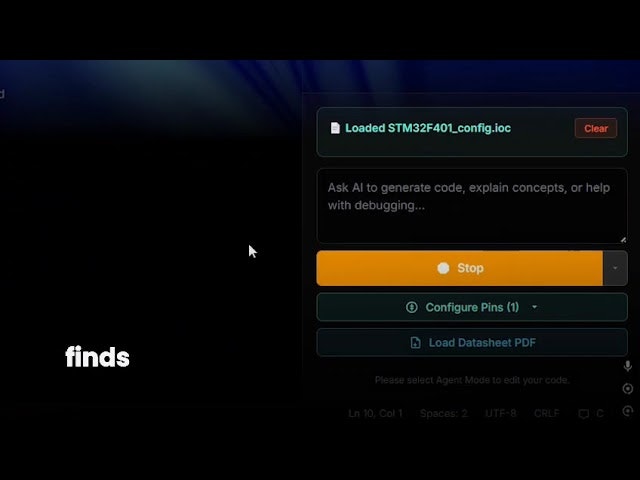
Devlop Ai is an AI-powered Integrated Development Environment (IDE) built specifically for embedded systems engineers working with STM32 microcontrollers. Unlike generic AI coding assistants that often hallucinate non-existent registers, Devlop Ai is “hardware-aware.” It integrates directly with STM32 configuration files and datasheets to generate code that is guaranteed to match the specific pinout and architecture of the board, streamlining the transition from hardware design to flashing firmware.
Core Features
- Hardware-Aware Code Generation: Generates C/C++ code that strictly adheres to the STM32 M4 and M7 architecture, respecting specific register maps and HAL (Hardware Abstraction Layer) definitions.
- CubeMX Integration: Natively imports
.iocconfiguration files to visualize pin layouts and ensure the AI understands the exact physical constraints of the hardware. - AI Pin Configuration: Intelligent agent suggests optimal pin assignments for peripherals (SPI, I2C, UART) based on signal integrity and conflict avoidance.
- One-Click Toolchain: Features a fully integrated compiler and flasher, allowing users to burn firmware to the board directly from the chat interface without setting up Makefiles or external loaders.
- Datasheet RAG: Users can upload specific component datasheets (e.g., for a sensor), allowing the AI to read timing diagrams and register tables to write accurate drivers automatically.
How It Works
The workflow begins with the user defining the hardware context—either by uploading an existing CubeMX .ioc file or asking the AI to recommend a pinout for specific requirements (e.g., “I need 3 UARTs and 1 SPI”). The user then prompts the AI to write functionality, such as “Write a driver for the MPU6050 sensor using interrupts.” The AI generates the code, verifying it against the hardware constraints. Finally, the user clicks “Flash,” and the IDE compiles the binary and uploads it to the connected STM32 device via ST-Link.
Use Cases
- Rapid Prototyping: quickly bringing up a new development board and verifying peripheral connections without reading 1,000+ pages of documentation.
- Driver Development: Automating the tedious process of writing register-level drivers for external sensors or displays.
- Legacy Code Migration: Refactoring older STM32 firmware stacks to modern HAL implementations.
- Education: Helping students and junior engineers understand complex clock trees and register configurations through interactive explanations.
Pros & Cons
- Pros: Hallucination reduction through hardware awareness; Unified workflow eliminates switching between CubeMX, VS Code, and programmer tools; Datasheet analysis saves hours of manual reading; One-click deployment lowers the barrier to entry for beginners.
- Cons: Limited Hardware Support (currently focused on STM32 M4/M7, excluding ESP32 or AVR); Desktop Application required (no web-based compiler); New Ecosystem means fewer community plugins than VS Code; Abstraction Risk where reliance on AI may reduce deep understanding of underlying hardware constraints over time.
Pricing
- Free Tier: Access to basic generation and flashing features.
- Premium Tiers: Likely required for advanced datasheet processing and higher usage limits (specific pricing is evolving post-launch).
How Does It Compare?
Devlop Ai targets the friction between “Hardware Config” and “Software Logic,” competing with both traditional IDEs and modern AI copilots.
- STM32CubeIDE (STMicroelectronics)
The industry standard, free, and official IDE. It is robust but manual—you must know exactly which HAL function to call. Devlop Ai acts as a layer above this, writing the boilerplate code for you. While CubeIDE has some “AI” features (STM32Cube.AI), those are for running neural networks on the chip, not for writing the firmware code itself. - GitHub Copilot / Cursor
General-purpose AI coding tools. They are excellent at standard C++ logic but often fail at embedded specifics (e.g., they might suggest a function for an Arduino when you are using an STM32). Devlop Ai differs by having the specific “context” of your board’s.iocfile, preventing it from inventing pins that don’t exist. -
PlatformIO
A popular extension for VS Code that simplifies library management and multi-platform compiling. PlatformIO is great for build system management but lacks the “Generative AI” core. Devlop Ai is less about managing libraries and more about generating the source code from natural language. -
Keil MDK / IAR
Traditional, high-cost enterprise IDEs known for their debuggers and safety certifications. Devlop Ai does not yet compete with the advanced debugging and trace capabilities of these tools, focusing instead on the creation and prototyping phase of development.
Final Thoughts
Devlop Ai represents a significant step forward for “Edge AI” development—not just running AI on chips, but using AI to program the chips. It effectively lowers the incredibly steep learning curve of embedded engineering. While it may not yet replace the heavy-duty debugging tools required for safety-critical automotive firmware, it is an immediate game-changer for prototyping, hobbyist projects, and driver development where looking up register addresses is the primary bottleneck.