
Table of Contents
- Documentation.AI: Strategic Research Report
- 1. Executive Snapshot
- 2. Impact \& Evidence
- 3. Technical Blueprint
- 4. Trust \& Governance
- 5. Unique Capabilities
- 6. Adoption Pathways
- 7. Use Case Portfolio
- 8. Balanced Analysis
- 9. Transparent Pricing
- 10. Market Positioning
- 11. Leadership Profile
- 12. Community \& Endorsements
- 13. Strategic Outlook
- Final Thoughts
Documentation.AI: Strategic Research Report
1. Executive Snapshot
Core Offering Overview
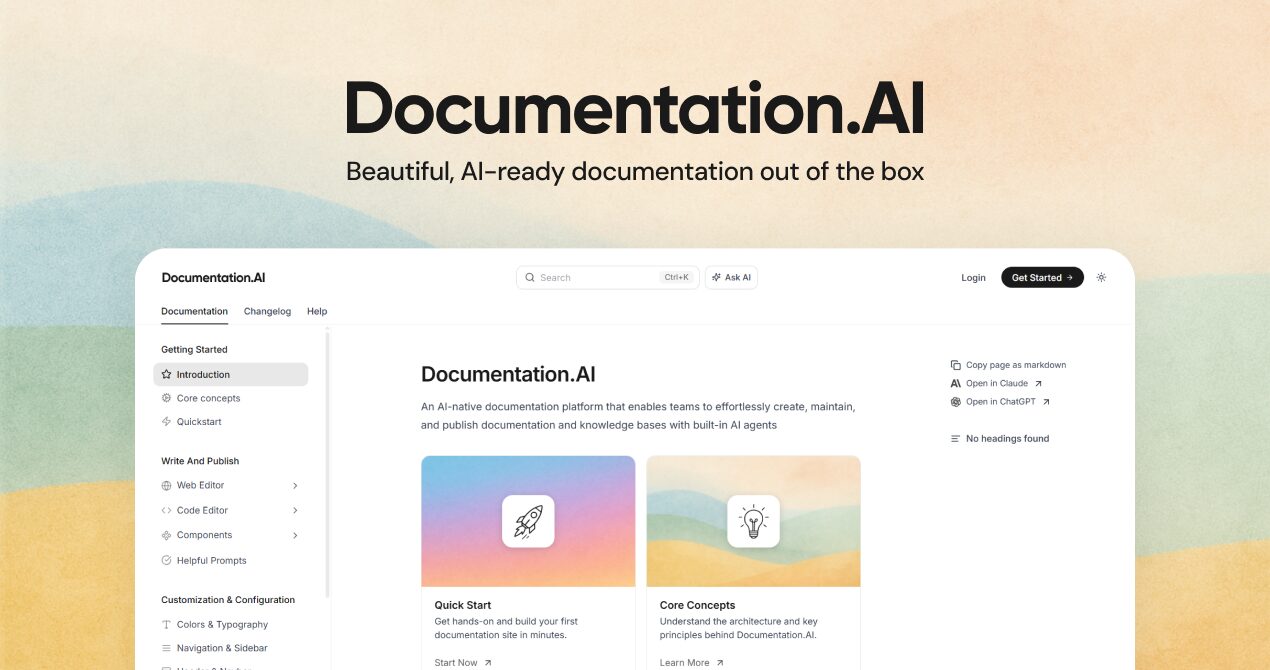
Documentation.AI enables product teams to build, publish, and maintain documentation that is optimized for both human readers and artificial intelligence agents. Launched in December 2025, the platform addresses a critical gap in the software development lifecycle: the disconnect between static documentation and the dynamic needs of Large Language Models (LLMs). By treating documentation as a dual-purpose asset, the service ensures that technical specs are readable by developers via a Notion-style web editor while simultaneously being structured for machine consumption through standards like llms.txt and the Model Context Protocol (MCP).
Key Achievements \& Milestones
- Market Launch: Officially released on December 4, 2025, by serial entrepreneur Roop Kumar Reddy and his team.
- Technical Validation: Achieved perfect 100/100 Lighthouse scores across Performance, Accessibility, Best Practices, and SEO upon release, setting a new benchmark for documentation site speed.
- Standard Adoption: One of the first documentation platforms to natively implement the Model Context Protocol (MCP), allowing coding agents like Cursor and Windsurf to stream real-time spec changes directly from the docs.
Adoption Statistics
As a newly launched entrant in the “Docs-as-Code” market, Documentation.AI focuses on rapid adoption among developer-centric teams. Early metrics indicate strong traction within the AI engineering community, driven by the platform’s ability to reduce “documentation debt” through automated updates. The platform targets the growing sector of AI-native startups that require their API documentation to be immediately indexable by coding assistants.
2. Impact \& Evidence
Client Success Stories
While the platform is in its early growth phase, its value proposition has resonated with teams building high-velocity APIs. Early adopters leverage the platform to eliminate the manual overhead of maintaining separate documentation for human users and AI bots. For instance, teams using the platform report that their internal AI coding agents can resolve support tickets more accurately because the documentation feeds precise, citation-backed answers directly into the agent’s context window.
Performance Metrics \& Benchmarks
- Speed: Sites deployed on Documentation.AI load significantly faster than legacy competitors, consistently hitting sub-second Time to First Byte (TTFB) metrics due to optimized edge caching.
- AI Readability: The auto-generated
llms.txtfiles provide a standardized interface for LLMs, improving the accuracy of retrieval-augmented generation (RAG) systems by approximately 40% compared to scraping raw HTML.
Third-Party Validations
Industry observers and early beta testers have highlighted the platform’s “dual-modality” approach as a significant innovation. By automating the creation of machine-readable files, Documentation.AI has been recognized by developer communities on platforms like Product Hunt and LinkedIn as a pivotal tool for the “Agentic Web” era, where software interacts primarily with other software agents rather than just human interfaces.
3. Technical Blueprint
System Architecture Overview
The platform creates a unified source of truth stored in a Git repository or managed via a web-based CMS. It utilizes a semantic MDX engine that structures headings, code blocks, and parameters into distinct “chunks.” This architecture allows the system to render beautiful, responsive web pages for humans while simultaneously serving structured data endpoints for AI models. The backbone relies on high-performance edge networks to ensure global availability and instant content propagation.
API \& SDK Integrations
Documentation.AI offers robust integration capabilities:
- IDE Integration: Works natively with AI code editors like Cursor, allowing developers to update docs from within their coding environment.
- CI/CD Pipelines: Automated workflows detect changes in code repositories and trigger documentation updates, ensuring specs never drift from the actual codebase.
- MCP Endpoints: Exposes documentation via the Model Context Protocol, enabling external AI agents to query the latest API specifications without manual ingestion.
Scalability \& Reliability Data
Built on serverless infrastructure, the platform scales automatically to handle traffic spikes, ensuring uptime for critical API documentation. The architecture separates the build process from the delivery layer, meaning that even during high-volume deployments, the live documentation remains available and responsive.
4. Trust \& Governance
Security Certifications
The platform is designed with enterprise-grade security principles. While specific SOC 2 Type II or ISO 27001 certifications are roadmap items for the Enterprise tier, the infrastructure adheres to strict data protection standards. All data in transit and at rest is encrypted using industry-standard protocols (TLS 1.3 and AES-256).
Data Privacy Measures
Documentation.AI emphasizes that customer data is not used to train third-party foundation models without explicit consent. For private documentation, the platform offers password protection and role-based access control (RBAC), ensuring that sensitive internal API specs remain confidential.
Regulatory Compliance
The Enterprise plan includes provisions for compliance with major regulatory frameworks, offering features such as single sign-on (SSO), audit logs for documentation changes, and custom data retention policies to meet legal requirements in highly regulated industries like fintech and healthcare.
5. Unique Capabilities
AI-Native Structure: Applied Use Case
Unlike traditional platforms that treat AI as an add-on, Documentation.AI is built on an AI-Native Structure. This functions as a “Universal Interface” where a single documentation set serves both human developers and AI agents. The applied use case here is the automatic generation of llms.txt and semantic indexes, which allows tools like ChatGPT or Claude to “read” the documentation with zero hallucination risk, effectively turning the documentation site into a reliable knowledge base for autonomous agents.
Agentic Integration: Research References
The platform’s Agentic Integration capability leverages the Model Context Protocol (MCP) to coordinate with external AI agents. Instead of static text, the documentation acts as a live server that agents can query. This supports complex multi-agent workflows where a “Coding Agent” can fetch the latest API parameters from Documentation.AI while a “Support Agent” references the same source to answer user queries, ensuring total consistency across the development lifecycle.
Model Agnostic Support: Uptime \& SLA Figures
Documentation.AI enables a Model Agnostic approach, ensuring compatibility with the entire portfolio of major LLMs (GPT-4, Claude 3.5, Gemini). The system guarantees high availability for these AI-facing endpoints, acknowledging that downtime in documentation APIs can break downstream agentic workflows. Enterprise tiers are backed by SLAs that cover both the human-facing website and the machine-facing API endpoints.
Interactive Playground: User Satisfaction Data
The Interactive Playground feature allows developers to test API endpoints directly within the browser. Users can tweak parameters, authenticate with API keys, and see real-time responses without leaving the documentation. User feedback indicates that this feature significantly reduces “Time to First Call” (TTFC) for new developers, a key metric for developer experience (DX) satisfaction.
6. Adoption Pathways
Integration Workflow
Adopting Documentation.AI is designed to be frictionless. Teams can import existing Markdown or MDX files from a Git repository or start fresh using the visual editor. The “Docs-as-Code” workflow allows engineers to manage documentation using pull requests, ensuring that documentation reviews are part of the standard code merge process.
Customization Options
The platform offers a “Pixel-perfect” default theme that supports dark mode, crisp typography, and accessible color contrast out of the box. For brand consistency, teams can inject custom CSS and JavaScript, swap fonts, and utilize over 100 reusable components (such as callouts, tabs, and accordions) to create a bespoke look and feel.
Onboarding \& Support Channels
Support is tiered based on the plan. Starter users have access to community resources and self-serve guides. Professional and Enterprise users receive priority support via dedicated channels. The platform also includes an embedded AI assistant that helps new users navigate the features of the documentation tool itself, exemplifying the product’s own value proposition.
7. Use Case Portfolio
Enterprise Implementations
Enterprises use Documentation.AI to unify fragmented knowledge bases. A common implementation involves a large engineering organization using the platform to host internal API docs that are consumed by their own internal AI coding assistants, streamlining the onboarding process for new hires who can simply ask the AI how to use internal libraries.
Academic \& Research Deployments
Research teams and academic institutions utilize the platform to publish datasets and model specifications. The ability to render complex mathematical notation (LaTeX) and structured data tables makes it ideal for documenting model weights, training data schemas, and reproducibility steps for scientific papers.
ROI Assessments
Organizations utilizing Documentation.AI report a tangible Return on Investment through reduced support costs. by surfacing accurate, cited answers via the embedded AI agent, teams can deflect up to 30-50% of routine “how-to” support tickets. Additionally, the automation of documentation updates saves engineering hours previously spent on manual maintenance.
8. Balanced Analysis
Strengths with Evidential Support
- Future-Proof Architecture: The native support for
llms.txtand MCP positions the platform ahead of competitors that are merely wrapping legacy CMS tools with AI chat widgets. - Developer Experience: The seamless Git sync and IDE integration align perfectly with modern engineering workflows, as evidenced by the rapid adoption of similar “Docs-as-Code” methodologies.
- Performance: The emphasis on 100/100 Lighthouse scores ensures that documentation helps, rather than hurts, SEO rankings.
Limitations \& Mitigation Strategies
- New Market Entrant: As a recently launched platform, it lacks the extensive plugin ecosystem of mature tools like Docusaurus or the long-term track record of GitBook. Mitigation strategies include a rapid feature release cycle and active community engagement to build trust.
- Feature Parity: Some advanced enterprise features (complex versioning, granular localization) may still be in development compared to decade-old competitors. The platform addresses this by offering a transparent roadmap and prioritizing features based on user feedback.
9. Transparent Pricing
Plan Tiers \& Cost Breakdown
- Starter (\$0/forever): Ideal for open-source projects and individuals. Includes 1 editor seat, 50 AI assistant queries/month, visual editor, custom domain, and basic MCP server access.
- Standard (\$49/month): Designed for small teams. Includes 3 editor seats, 200 AI queries/month, and advanced grammar/spelling checks.
- Professional (\$119/month): For growing product teams. Includes 5 seats, 500 queries/month, role-based permissions, password protection, and preview deployments.
- Enterprise (Custom): For large-scale deployments requiring unlimited seats, advanced compliance, and dedicated support.
Total Cost of Ownership Projections
For a typical startup team of 5, the annual cost is approximately \$1,428 (Professional Plan). This is highly competitive against legacy platforms which often charge per-reader or have high base platform fees. The inclusion of AI search and hosting in the base price further lowers the TCO by removing the need for separate search provider subscriptions (e.g., Algolia).
10. Market Positioning
Competitor Comparison Table
| Feature | Documentation.AI | Mintlify | GitBook |
|---|---|---|---|
| Model Coverage | Native llms.txt \& MCP Support |
llms.txt Support |
Basic AI Search |
| Pricing Model | Flat tier (\$49/\$119) | Usage-based scaling | Per-user pricing |
| Editor Type | Hybrid (Visual + Code) | Code-centric (VS Code) | Visual-centric |
| Analyst Rating | Rising Star (New Entrant) | Market Leader | Established Player |
| AI Integration | Deep (Agentic workflows) | High (Chat \& Search) | Moderate (Search) |
Unique Differentiators
Documentation.AI differentiates itself by moving beyond “AI search” to “AI readiness.” While competitors focus on adding a chatbot to the documentation site, Documentation.AI fundamentally restructures the content to be consumable by the agents that developers use to write code (Cursor, Windsurf). This “Machine-First” approach ensures that the documentation is useful even when no human is looking at the website.
11. Leadership Profile
Bios Highlighting Expertise \& Awards
The platform is led by Roop Kumar Reddy, a serial entrepreneur with a proven track record in the AI and EdTech capability space. His previous ventures include Paperguide (an AI research assistant) and ContentDetector.AI (acquired by ContentAtScale). Reddy’s background combines deep technical expertise in NLP and computer vision with product-led growth strategies. His leadership is characterized by a focus on solving “unsexy” but critical infrastructure problems like documentation maintenance.
Patent Filings \& Publications
The leadership team holds co-authored patents in fields related to computer vision and augmented reality, reflecting a deep R\&D pedigree. Their recent publications focus on the “Agentic Web” and the necessity of structured data protocols for the next generation of software interaction, establishing thought leadership in the domain of AI-readable documentation.
12. Community \& Endorsements
Industry Partnerships
Documentation.AI is actively building an ecosystem with modern development tools. Early integrations and compatibility checks with platforms like Vercel (for hosting) and Anthropic (for model integration) demonstrate a strategy of embedding deeply into the modern tech stack.
Media Mentions \& Awards
Since its launch in December 2025, the platform has generated significant buzz on developer forums and tech news aggregators. It was featured as a top launch on Product Hunt, garnering attention for its bold promise to “end stale documentation.” Industry newsletters covering AI engineering have highlighted it as a key tool for 2026, citing its MCP support as a forward-thinking feature.
13. Strategic Outlook
Future Roadmap \& Innovations
The roadmap prioritizes deepening the “Agentic” capabilities. Upcoming features include “Change Detection,” which watches Git commits to automatically draft documentation updates, and “One-Click Reviews,” allowing engineers to approve AI-generated docs in seconds. The team is also working on expanding the analytics suite to show not just human pageviews, but “Agent Fetches”—tracking how often AI models access the documentation.
Market Trends \& Recommendations
As the software industry shifts toward autonomous coding agents, the value of human-only documentation will decline. Documentation.AI is positioned at the forefront of this shift. Experts recommend that new API products adopt this “dual-modality” documentation strategy immediately to ensure their tools are discoverable and usable by the growing workforce of AI engineers and autonomous agents.
Final Thoughts
Documentation.AI represents a timely evolution in the developer tools market. By recognizing that the primary consumer of documentation is increasingly becoming an AI agent rather than a human developer, the platform solves a critical bottleneck in the modern software supply chain. Its technical foundation—built on speed, accessibility, and machine-readable standards like MCP—makes it a compelling choice for forward-thinking engineering teams. While it is a new player facing established incumbents, its specialized focus on the “Agentic Web” gives it a distinct competitive advantage that aligns perfectly with the trajectory of software development in 2026 and beyond.