
Table of Contents
Overview
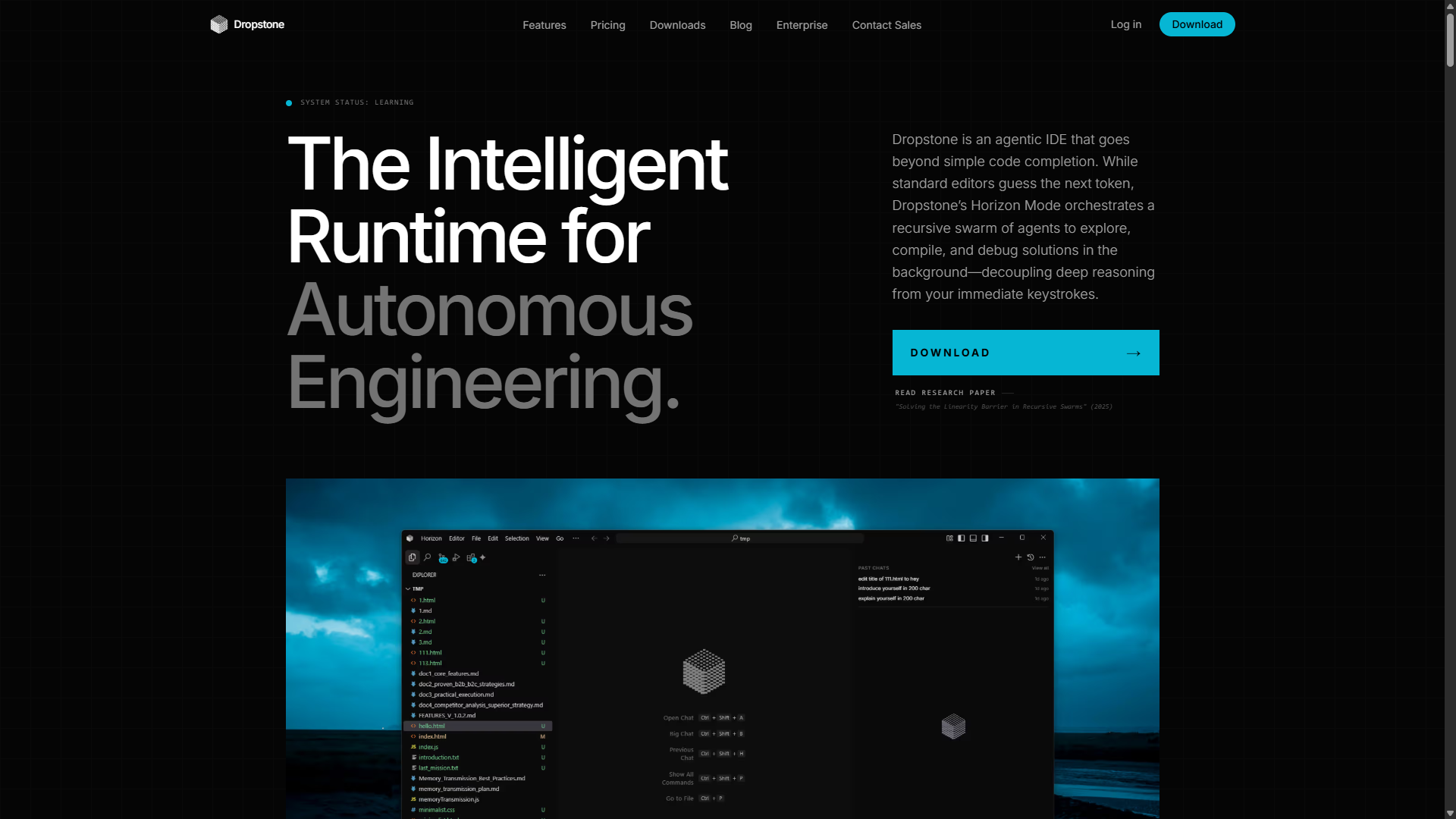
The cutting-edge AI-driven software development landscape has evolved rapidly. Today, we examine Dropstone, an emerging desktop application marketed as a generational recursive self-improvement AI for autonomous programming. This desktop application offers a pre-AGI architecture designed to learn, evolve, and program with reduced manual intervention. For developers seeking to accelerate development cycles, Dropstone presents an AI-assisted programming approach.
Key Features
Dropstone incorporates several innovative features within the AI development landscape:
Generational Recursive Self-Improvement AI: The core technology features AI that continuously learns and adapts its programming capabilities over time, following established recursive self-improvement principles in AI research.
Desktop Application: Compatible with Windows x64 and macOS Apple Silicon, providing a local development environment for autonomous programming tasks.
MCP Server and Computer Use API Integration: Connects with Model Context Protocol servers and Computer Use API for comprehensive system interaction during development tasks.
Local Model Support with Claude Integration: Offers support for local Ollama models alongside Claude Code integration for flexible AI model deployment.
Agent Mode: Features autonomous operation where the AI can execute programming tasks with minimal human intervention once properly configured.
Project Analysis Capabilities: Scans and analyzes project files ranging from small to large codebases to understand code architecture, dependencies, and system relationships.
Analytics Dashboard: Provides performance comparison capabilities across different AI models for development optimization.
Token Processing: Premium tiers offer expanded token processing capabilities for handling complex, large-scale development projects.
How It Works
Dropstone operates through a sophisticated AI architecture designed for continuous learning and improvement. The system begins by conducting comprehensive analysis of project files to understand code structure, file relationships, and potential system-wide impacts.
The self-improving agent automates coding, debugging, and development processes through machine learning optimization. In Agent Mode, it can execute tasks autonomously while integrating multiple AI models to enhance performance and provide comprehensive development solutions.
Use Cases
Dropstone’s autonomous programming capabilities support various development scenarios:
Software Development Automation: Technology companies can utilize Dropstone to streamline software development workflows, from initial development through debugging processes.
Development Team Enhancement: Product and engineering teams can integrate Dropstone for AI-powered development assistance, helping streamline complex tasks while enabling developers to focus on higher-level architectural decisions.
Rapid Prototyping: Quickly implement new concepts without extensive manual coding, enabling faster experimentation and iteration cycles.
AI Model Performance Analysis: Developers can utilize analytics features to monitor and compare AI model performance within development pipelines.
Large-Scale Development Operations: Handle extensive token processing for debugging and optimization in complex development projects.
Advantages and Considerations
Strengths:
- Enables autonomous programming capabilities to reduce manual development effort
- Features recursive self-improvement for progressively enhanced performance
- Supports multiple local models and expanded token processing for scalability
- Provides rapid project file analysis for thorough codebase understanding
- Offers accessible entry point through free tier options
Limitations:
- Currently limited to desktop platforms (Windows x64 and macOS Apple Silicon)
- As an emerging tool, users may encounter occasional stability issues during development
- Advanced features require premium subscriptions for full functionality
- Limited web or mobile access options
How Does It Compare?
The AI-assisted development tools landscape in 2024 includes several established competitors:
Cursor: A popular VS Code-based AI editor offering inline code completion, chat functionality, and codebase understanding. Priced at \$20/month for Pro features, Cursor provides seamless integration with existing VS Code workflows.
Windsurf: Codeium’s AI-powered IDE featuring “Cascade” mode for multi-file editing and autonomous task execution. Available at \$15/month, Windsurf emphasizes agentic AI capabilities with strong automation features.
Claude Code: Anthropic’s development environment with Model Context Protocol integration, offering terminal-based AI assistance and comprehensive codebase analysis. Requires Claude Pro subscription at \$20/month.
GitHub Copilot: Microsoft’s widely-adopted AI coding assistant with broad IDE integration including VS Code, JetBrains, and others. Pricing starts at \$10/month for individuals and \$19/month for businesses.
JetBrains AI Assistant: Integrated AI assistance within JetBrains IDEs, offering context-aware completions and development workflow integration. Available through JetBrains subscription plans.
Dropstone differentiates itself through its focus on recursive self-improvement and desktop-native architecture, though it faces competition from more established tools with proven track records and broader ecosystem integration.
Pricing Structure
Dropstone offers tiered pricing with free access to basic functionality. Premium tiers provide expanded token processing, enhanced model access, and advanced autonomous features. Specific pricing details should be verified directly with Dropstone’s official channels.
Important Considerations
When evaluating AI-powered development tools, consider factors including integration with existing workflows, model accuracy and reliability, data privacy policies, and long-term support commitments. As an emerging platform, Dropstone’s long-term viability and feature stability should be assessed based on actual usage rather than marketing claims.
For developers considering AI-assisted programming tools, established alternatives like Cursor, GitHub Copilot, and JetBrains AI Assistant offer proven reliability and extensive ecosystem support. Dropstone may appeal to users specifically interested in recursive self-improvement AI concepts and desktop-native development environments.
The autonomous programming field continues evolving rapidly, with new tools regularly entering the market. Thorough evaluation of actual capabilities, rather than promotional materials, remains essential for making informed development tool choices.