Table of Contents
Overview
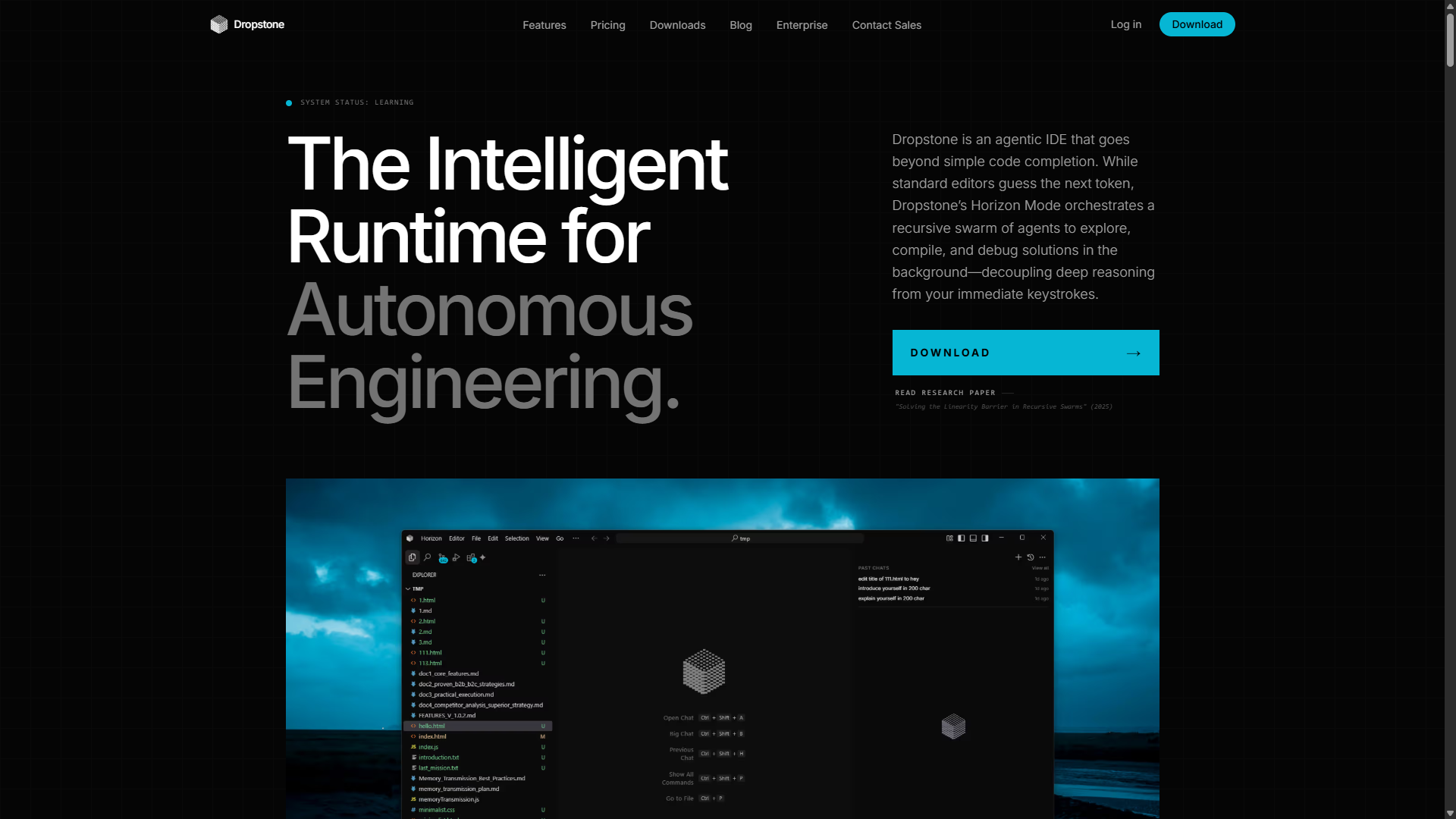
Traditional development environments treat each coding session as an isolated event—you begin each day starting from scratch, and the AI assistant has no memory of your project’s unique patterns or your personal development style. Dropstone fundamentally redefines this paradigm as the world’s first self-learning AI IDE that maintains persistent memory across development sessions, continuously learning from your workflow and recursively improving its own capabilities. Powered by sophisticated integrations including MCP Server, Computer Use API, unlimited Ollama model support, Claude Code integration, and an innovative Agent Mode, Dropstone transforms software development from a solitary task into a genuine collaboration with an AI partner that genuinely understands your code, remembers your preferences, and evolves alongside your projects.
Key Features
Dropstone delivers sophisticated capabilities specifically designed to elevate AI-assisted development:
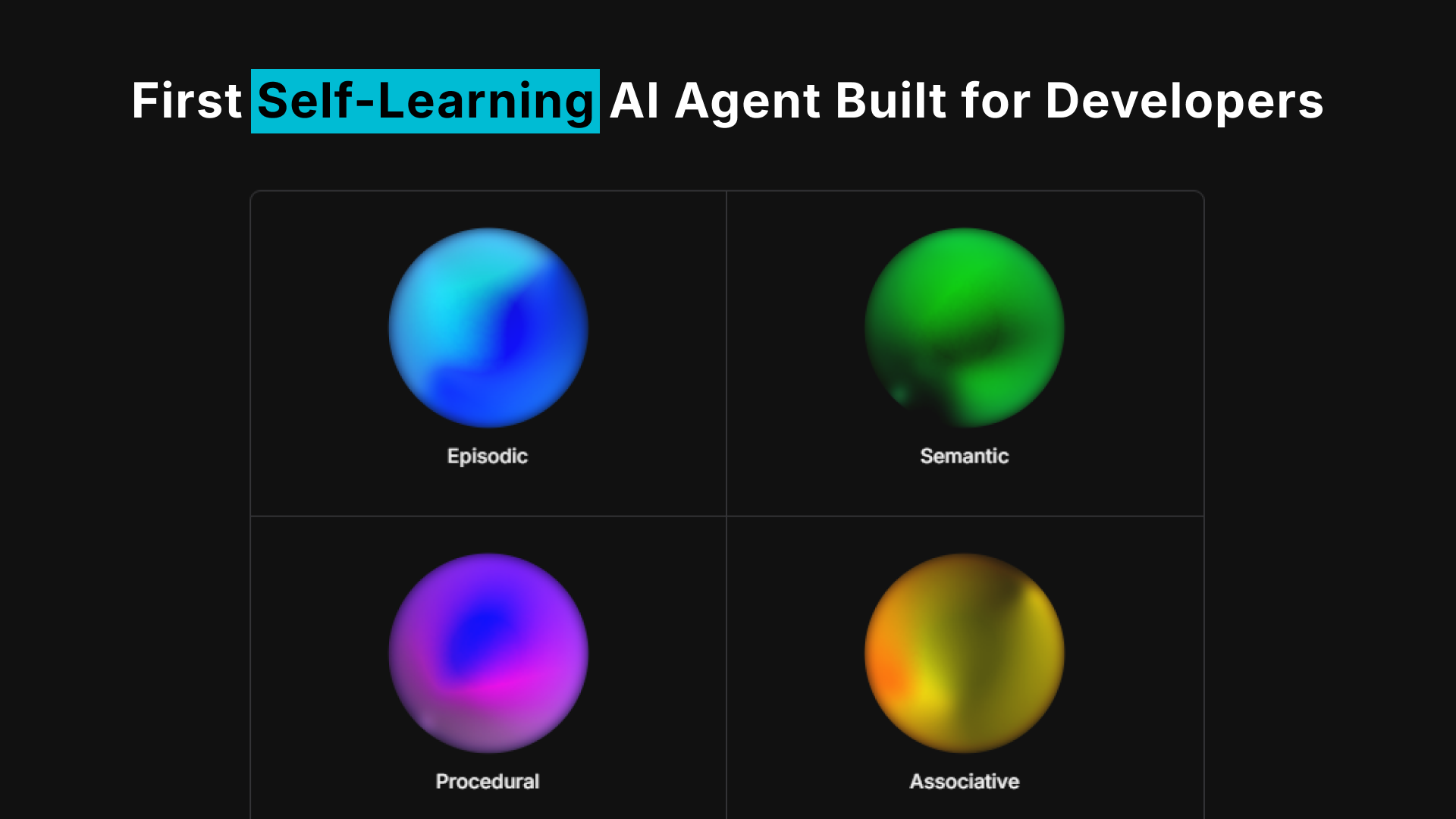
- Persistent AI Memory: Implements a four-sector memory architecture (episodic, semantic, procedural, associative) that builds comprehensive long-term memory across development sessions, enabling the AI to retain project context and understand your unique workflow patterns over extended periods.
- Multiple LLM Support: Provides flexibility to integrate a diverse range of large language models, including unlimited Ollama instance support, Claude Code integration, and custom model connections, allowing you to select the optimal AI model for your specific development requirements.
Agent Mode: Enables advanced autonomous AI agents to tackle complex programming tasks directly within the IDE, performing multi-step operations and iterating until tasks reach completion without requiring constant human intervention.
Workflow Adaptation: Continuously analyzes your coding patterns, architectural preferences, and development style, progressively refining its suggestions and assistance to become increasingly intuitive and aligned with your personal approach.
Session Intelligence: Maintains context from current and historical development sessions, delivering highly contextual suggestions informed by your complete project history rather than just the current workspace state.
Code Collaboration: Transforms the development process into a dynamic partnership between human developer and intelligent AI, enhancing both productivity and sophisticated problem-solving capabilities.
MCP Deep Integration: Features comprehensive integration with MCP Server and Computer Use API, providing enhanced system-level capabilities and seamless interaction with your development environment.
How It Works
Dropstone operates through a sophisticated architecture that combines persistent learning with advanced code analysis:
Continuous pattern observation forms the foundation: as you code, Dropstone continuously analyzes your development patterns, architectural decisions, and coding habits in real-time. This observation isn’t limited to the current session; instead, the platform builds persistent long-term memory, maintaining context and understanding of your preferred approaches, project history, and coding conventions across multiple development sessions. This persistent intelligence enables adaptive assistance—Dropstone’s suggestions and AI assistance progressively adapt to your unique style, becoming increasingly personalized and helpful over time. The platform seamlessly integrates external language models including Ollama, Claude Code, and other LLM providers, allowing you to leverage their computational power directly within your development environment. Its Agent Mode facilitates autonomous task execution, where specialized agents can be assigned specific programming objectives—refactoring, testing, documentation—and execute these tasks with minimal human oversight, making your workflow more efficient and intelligent. The combination of persistent memory, autonomous agents, and multi-model support creates an IDE that doesn’t merely assist but actively participates in your development process, learning and improving from every interaction.
Use Cases
Dropstone’s distinctive combination of persistent learning and autonomous capabilities makes it ideal for numerous development scenarios:
- Long-Term Project Development: Maintain continuity across extended projects where historical context and established coding patterns significantly accelerate development velocity.
Sophisticated Pair Programming: Experience a new form of AI pair programming where your partner remembers past discussions, understands project evolution, and offers contextually informed suggestions based on your entire development history.
Multi-Session Memory-Augmented Development: Leverage an IDE that retains knowledge from previous coding sessions, eliminating repetitive context-setting and enabling immediate productive work when resuming projects.
Autonomous Agent-Based Task Automation: Integrate specialized AI agents into your workflow to handle task-specific responsibilities—testing, documentation, refactoring—enabling focused work on high-level architectural decisions.
Complex Codebase Evolution: Efficiently manage the evolution of large, complex codebases where understanding interdependencies and maintaining consistency across modifications requires sophisticated contextual awareness.
Collaborative Team Development: Foster genuine collaborative coding environments where human developers and AI intelligence work in synchronized partnership, combining human creativity with AI-driven efficiency.
Pros & Cons
Advantages
- Cross-Session Persistent Memory: Builds genuine long-term memory that survives across development sessions, learning from your specific workflow and adapting assistance to your unique development style and preferences.
Flexible AI Model Integration: Supports multiple language models including unlimited Ollama instances and Claude Code integration, providing exceptional flexibility to select the optimal AI model for each development challenge.
Sophisticated Agent Workflow: Features an innovative Agent Mode enabling AI-driven autonomy for complex multi-step tasks, significantly enhancing productivity through intelligent automation.
Deep System Integration: Leverages MCP Server and Computer Use API to provide robust, system-level capabilities that extend far beyond typical IDE plugins, enabling genuine system integration.
Intelligent Code Partnership: Transforms development into a collaborative intelligence multiplier where human creativity and AI-driven efficiency combine to amplify overall productivity and code quality.
Disadvantages
Early-Stage Platform Maturity: As a recently-launched IDE (October 2025), Dropstone continues evolving with features and stability still being refined compared to established development environments with years of optimization.
Initial Onboarding Requirements: Users may experience an initial learning curve to effectively leverage its advanced AI features and to adapt their workflows to maximize the platform’s recursive self-improvement capabilities.
System Resource Requirements: The advanced AI capabilities, persistent memory architecture, and continuous code analysis require substantial system resources—CPU, RAM, and storage—which may challenge developers on resource-constrained systems.
Documentation and Support Maturity: As a new platform, comprehensive documentation, community resources, and enterprise support infrastructure are still developing, potentially affecting quick resolution of technical issues.
How Does It Compare?
Dropstone occupies an increasingly distinctive position within the 2025 AI-assisted development landscape. Understanding its differentiation requires recognizing that existing competitors operate with substantially different architectural philosophies and serve different developer priorities.
GitHub Copilot, the market-leading AI coding assistant, provides comprehensive IDE integration across Visual Studio Code, Visual Studio, and JetBrains environments. As of 2025, Copilot has evolved significantly beyond simple code completion to include Copilot Agent mode for autonomous multi-file operations, Copilot CLI for terminal workflows, and support for multiple advanced models including GPT-5, Claude Opus 4.1, and Gemini 2.5. However, Copilot’s architecture remains fundamentally conversation-scoped—it maintains context within individual sessions but doesn’t build persistent learning across separate development sessions the way Dropstone does. Copilot optimizes for team collaboration within GitHub-centric workflows rather than individual developer learning.
Cursor, the AI-native IDE based on Visual Studio Code architecture, specializes in responsive, fast code editing with native multi-model support and codebase indexing. Cursor provides strong session-based context awareness and a Composer mode for multi-file edits, but like Copilot, Cursor’s learning doesn’t persist across development sessions. Cursor optimizes for editing speed and responsiveness rather than long-term project learning.
Claude Code CLI represents a conversational approach to AI-assisted development, providing natural language-driven code interaction with comprehensive project context understanding. While Claude Code offers sophisticated project awareness, it lacks explicit agent autonomy and operates primarily in conversational rather than persistent learning mode. Claude Code serves developers who prioritize natural language interaction.
JetBrains AI Assistant integrates deeply with the JetBrains IDE ecosystem, recently adding Junie agent mode (2025) and multi-model support including GPT-5. However, JetBrains AI remains fundamentally a plugin layered on existing IDEs rather than a purpose-built AI-centric development environment. JetBrains AI is optimized for enterprise teams already invested in JetBrains infrastructure.
Aider provides terminal-based AI pair programming with full codebase mapping and automatic git integration. While Aider maintains a comprehensive codebase map for context awareness, it doesn’t implement persistent cross-session learning architecture like Dropstone.
Dropstone’s distinctive positioning emerges from combining four elements typically found in isolation across competitors: (1) persistent memory that survives and learns across development sessions, (2) recursive self-improvement architecture that progressively enhances its own capabilities, (3) desktop-native IDE design rather than plugin-based integration, and (4) unrestricted LLM flexibility through MCP integration. This combination—long-term learning plus autonomous agents plus desktop architecture plus model flexibility—represents a genuinely different architectural approach to AI-assisted development. Rather than optimizing for rapid response times (Cursor), team collaboration (Copilot), or conversational interaction (Claude Code), Dropstone optimizes for developers building complex long-term projects where the AI partner’s deep contextual understanding and autonomous capability matter most.
Final Thoughts
Dropstone represents a meaningful innovation in AI-assisted development by reconceptualizing how development environments interact with AI. Rather than treating AI as a session-scoped assistant, it positions AI as a persistent learning partner that genuinely evolves with your code. Its commitment to cross-session persistent memory, recursive self-improvement, flexible model support through MCP integration, and agent-based autonomy positions it as more than just another development tool—it’s an evolving collaborative partner designed specifically for long-term, complex project development.
For individual developers, small teams, or organizations managing sophisticated long-term codebases where understanding deep contextual requirements and project history significantly impact productivity, Dropstone offers a compelling alternative to traditional IDE-plugin approaches. While the platform remains early-stage with typical new-product considerations around stability and documentation maturity, its innovative architecture and genuine persistent learning capabilities warrant serious evaluation for developers seeking an IDE that actively improves through understanding your unique development patterns and project evolution.