
Table of Contents
- Emma: AI Food Scanner – Comprehensive Research Report
- 1. Executive Snapshot
- 2. Impact \& Evidence
- 3. Technical Blueprint
- 4. Trust \& Governance
- 5. Unique Capabilities
- 6. Adoption Pathways
- 7. Use Case Portfolio
- 8. Balanced Analysis
- 9. Transparent Pricing
- 10. Market Positioning
- 11. Leadership Profile
- 12. Community \& Endorsements
- 13. Strategic Outlook
- Final Thoughts
Emma: AI Food Scanner – Comprehensive Research Report
1. Executive Snapshot
Emma represents an artificial intelligence-powered food label analysis application that interprets packaged food ingredients across multiple languages to identify hidden health risks. The platform emerged from a year-long reconstruction of Sugar Free Food Scanner, transitioning from a basic sugar detection tool into a comprehensive nutrition intelligence system. Operational since October 2024 under Emma Intelligence Pte. Ltd., a Singapore-registered company, the application serves over 150,000 users globally who seek transparency about food composition without relying on static nutritional databases.
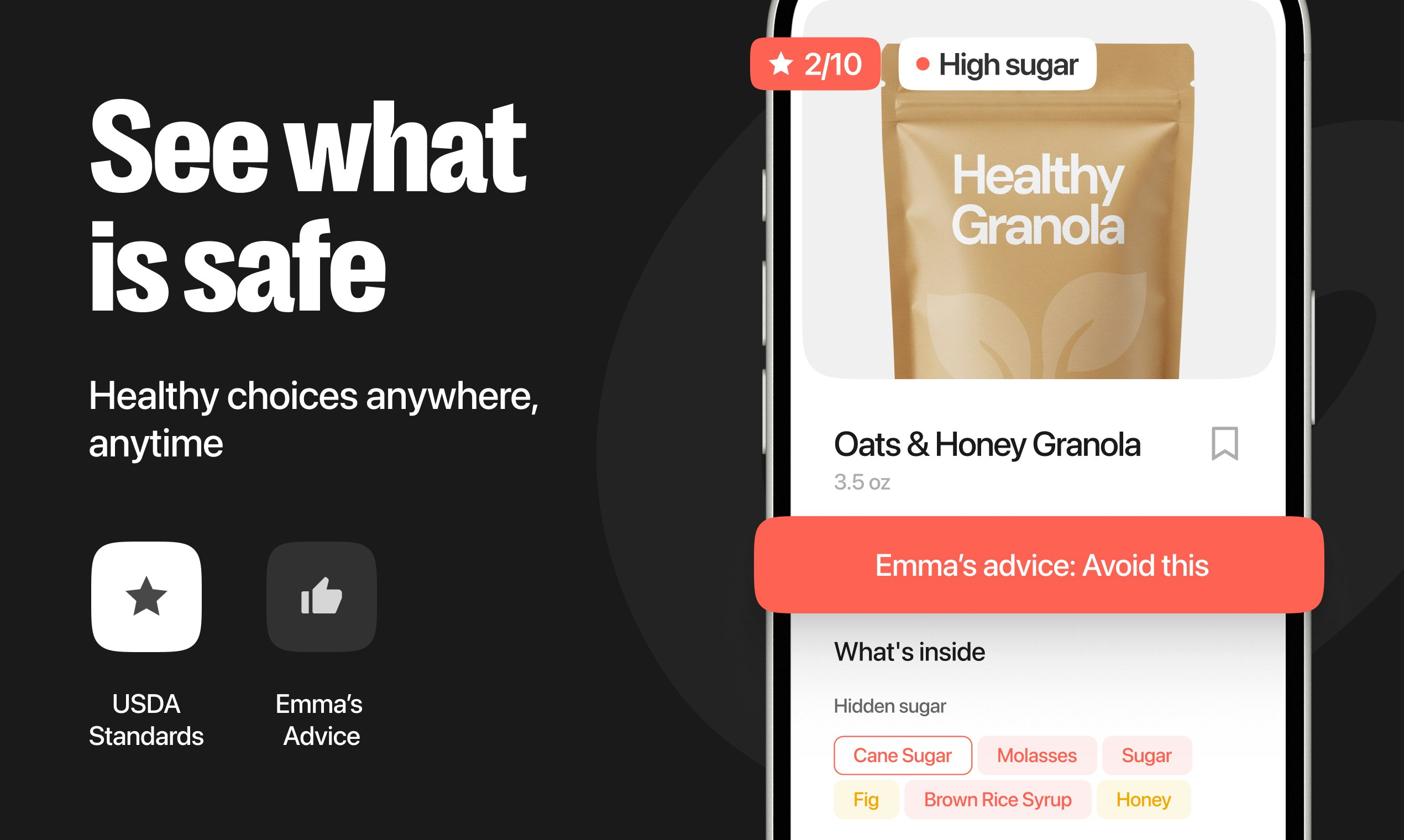
The platform’s core innovation lies in its database-independent architecture that combines optical character recognition with natural language processing to parse ingredient lists in real time. Unlike conventional food apps that match barcodes to pre-populated information, Emma analyzes actual label text to detect over 500 potential health concerns across 12 ingredient categories—from E-numbers and INS codes to disguised sugar compounds and allergens. The system assigns each scanned product a one-to-ten health rating derived from scientific nutritional guidelines, paired with a clear “Eat” or “Avoid” recommendation explained in plain language.
Emma’s adoption trajectory demonstrates growing consumer demand for food transparency tools, evidencing the global nutrition apps market’s expansion from 5.2 billion USD in 2024 toward an estimated 17.4 billion USD by 2035 at an 11.6% compound annual growth rate. The application operates on a freemium model with weekly subscriptions at 800 yen and annual tiers at 6,000 yen, positioning itself within a competitive landscape that includes established platforms like Yuka, Fooducate, and Open Food Facts.
2. Impact \& Evidence
User testimonials and market positioning indicate that Emma addresses a critical gap for international travelers and expatriates who encounter unfamiliar food labels in foreign languages. The multilingual scanning capability supports seven languages—English, Japanese, Spanish, Portuguese, Italian, German, and Russian—enabling users to understand ingredient compositions regardless of geographic location. This functionality proves particularly valuable in regions where packaged foods contain technical terminology or regulatory codes that obscure actual ingredient identities.
The application’s health impact extends beyond individual product evaluation through its integrated AI nutritionist chatbot, which responds to open-ended questions about dietary goals, recipe alternatives, and nutritional education. While general-purpose AI chatbots demonstrate approximately 35-48% accuracy for nutritional content within a ten-percent margin according to independent research, specialized food scanner applications show higher effectiveness when limited to ingredient identification rather than personalized meal planning. Emma positions its AI guidance as supplementary information rather than medical advice, explicitly disclaiming liability for incomplete or inaccurate data.
Third-party validation remains limited for Emma specifically, though broader research on food scanner applications demonstrates measurable behavioral shifts. Studies examining similar barcode scanning interventions found that 70% of users report improved eating habits after three months of consistent use, with apps incorporating behavioral change techniques achieving 30-day retention rates near 45%. Emma’s approach to delivering consequence-oriented feedback—highlighting specific health risks associated with identified ingredients—aligns with evidence showing that “salience of consequences” and “feedback on behavior” behavioral change techniques achieve effectiveness ratios of 83% and 52% respectively in dietary interventions.
3. Technical Blueprint
Emma’s architecture centers on a three-stage processing pipeline that begins with image capture of food packaging labels through the device camera. The first stage applies preprocessing enhancements including contrast adjustment, noise reduction, and skew correction to optimize character recognition accuracy. The second stage deploys Tesseract or EasyOCR technology to extract raw ingredient text from label images, supporting multiple scripts and handling stylized fonts common in consumer packaging design.
The third stage implements natural language processing to parse extracted text into individual ingredient entries, normalizing inconsistent naming conventions through domain-specific dictionaries. For example, the system recognizes that “evaporated cane juice,” “dextrose,” and “glucose syrup” all represent sugar variants that should be flagged under hidden sugar detection. This normalization process enables Emma to identify ingredients by chemical composition rather than relying on exact string matching to database entries.
The health rating algorithm evaluates flagged ingredients against scientific criteria derived from World Health Organization guidelines and regulatory thresholds, though the specific weighting methodology remains proprietary. The system operates with partial offline functionality for basic scans, storing OCR models locally on devices while cloud-based processing handles more complex analysis and AI chatbot interactions. This hybrid architecture addresses common challenges in food label OCR systems, which typically struggle with poor lighting conditions, diverse package layouts, and multilingual text requiring real-time translation.
Integration capabilities remain limited in the current version, with no announced API access for third-party developers or direct connectivity to health tracking platforms. Future roadmap discussions in similar applications suggest potential for wearable device integration and restaurant menu scanning, though Emma has not publicly committed to specific expansion timelines.
4. Trust \& Governance
Emma’s privacy framework emphasizes data minimization, operating without mandatory user registration or account creation. According to developer statements, the application does not collect personal user data, with scan results and interaction histories processed locally rather than transmitted to central servers. This privacy-first design aligns with growing consumer concerns about data security in health-related applications, where over 60% of users express apprehension regarding how personal information is handled.
However, Emma currently lacks independent security certifications such as ISO 27001 or SOC 2 Type II that would provide third-party validation of information security practices. The absence of these certifications contrasts with enterprise-focused nutrition platforms that prioritize regulatory compliance for healthcare integrations. Emma’s simplified data model—avoiding persistent user profiles or longitudinal health tracking—reduces regulatory exposure compared to apps that store medical information subject to health privacy laws.
The application’s content disclaimer explicitly states that information may be incomplete or inaccurate and should not be construed as medical advice. This positioning reflects the inherent limitations of optical character recognition systems, which demonstrate variable accuracy depending on label quality, font complexity, and lighting conditions during scanning. Research examining OCR-based food analysis indicates that even optimized systems achieve approximately 85% accuracy in structured information extraction, with performance degrading further when handling unstructured or non-standard label layouts.
Emma operates under Singaporean corporate governance through Emma Intelligence Pte. Ltd., incorporated in October 2024 with registration address at 10 Anson Road. The company structure and regulatory compliance framework remain opaque, with limited public disclosure regarding data handling practices, incident response procedures, or quality assurance mechanisms for ingredient classification accuracy.
5. Unique Capabilities
Global Language Processing: Emma’s distinguishing technical capability centers on its language-agnostic ingredient analysis that translates food labels in real time rather than requiring pre-translated database entries. When a user scans a Japanese food package while their device language is set to English, the system extracts the Japanese ingredient text, identifies each component’s chemical or nutritional classification, then presents results in English with localized explanations of health implications. This cross-linguistic functionality addresses a persistent challenge for international consumers who encounter packaging in unfamiliar languages.
Database-Free Architecture: Unlike competitors that rely on crowdsourced barcode databases like Open Food Facts or proprietary nutritional repositories, Emma parses actual ingredient text visible on packaging. This approach eliminates gaps that occur when products lack database entries—a common issue with newly launched items, regional specialties, or foods from smaller manufacturers. The tradeoff involves increased computational requirements and potential accuracy variations based on OCR performance, but provides coverage for the long tail of packaged foods absent from standard databases.
Comprehensive Risk Detection: The platform identifies 500+ potential health concerns spanning twelve ingredient categories, including artificial sweeteners (aspartame, sucralose), hidden sugars under alternative names, E-number additives (sodium benzoate as E211), International Numbering System codes used in Asian markets, common allergens (gluten, nuts, dairy), and controversial preservatives. This multi-dimensional analysis exceeds single-focus applications that target only sugar content or allergen presence, though the scientific rigor underlying risk classifications varies across ingredient types.
AI Nutritionist Integration: The embedded conversational agent accepts free-form questions about dietary guidance, recipe modifications, and nutritional education. Users can inquire about sugar detox strategies, request family-friendly meal plans, or seek clarification on specific ingredients without switching to separate research tools. Research indicates that general AI chatbots achieve moderate accuracy for dietary advice in straightforward scenarios but demonstrate inconsistent reproducibility and limited capability for complex clinical cases requiring personalized portion recommendations.
6. Adoption Pathways
Emma follows a streamlined onboarding process requiring only app download from the iOS App Store, with Android availability status unclear from available sources. The application demands iOS 18.0 or later, representing a relatively high minimum version that excludes older devices but enables access to advanced machine learning frameworks built into recent operating systems. Upon first launch, users encounter minimal configuration screens before accessing the primary scanning interface.
The core workflow begins when users point their device camera at a food package barcode or ingredient list. For barcode scanning, Emma presumably cross-references product identifiers with available data sources, though this contradicts its marketed database-free positioning. For direct ingredient list scanning, the OCR engine captures visible text which feeds into the analysis pipeline. Results appear within seconds, displaying the numerical health score, color-coded rating indicator, and itemized breakdown of flagged concerns.
Customization options remain limited in the free tier, with premium subscriptions unlocking features that likely include advanced filtering for specific dietary restrictions, expanded access to AI nutritionist queries, and removal of usage limitations. The absence of family profile sharing or device synchronization through iCloud represents a noted gap, with user feedback requesting cross-device progress tracking for household use.
Support channels direct inquiries to g@sugarfree.app, indicating a small-scale operation with limited documentation resources. The application lacks comprehensive help documentation, tutorial videos, or community forums that characterize more mature platforms. This bare-bones support infrastructure suits casual users seeking quick ingredient checks but may frustrate those requiring detailed guidance on interpreting complex results or resolving technical issues.
7. Use Case Portfolio
International Travel Scenarios: Expatriates and travelers represent a primary use case, scanning foreign packaged foods to assess safety and nutritional quality despite unfamiliar labeling languages. A British consumer in a Japanese supermarket can scan local snack packages to identify hidden allergens or excessive sodium without reading Japanese characters, receiving instant feedback in English about ingredients like konjac, yuzu, or mirin that may be unfamiliar in Western contexts.
Dietary Management Applications: Users managing specific health conditions—diabetes, cardiovascular disease, food allergies—employ Emma to screen products for ingredients incompatible with medical dietary requirements. The allergen detection capability flags common triggers including tree nuts, shellfish, soy, and wheat, though cross-contamination warnings depend on manufacturer label accuracy rather than independent verification.
Family Nutrition Optimization: Parents use the platform to evaluate children’s snack options, comparing similar products to identify those with fewer artificial additives or lower sugar content. The instant scoring system simplifies decision-making in retail environments where detailed nutrition label comparison proves time-consuming. However, the lack of age-specific recommendations or portion guidance limits the tool’s utility for pediatric dietary planning.
Academic and Research Deployment: No documented enterprise implementations or institutional partnerships appear in available sources, suggesting Emma remains primarily consumer-focused without healthcare provider integration or research validation studies. This contrasts with evidence-based nutrition platforms like RxFood that demonstrate measurable clinical outcomes through randomized controlled trials, achieving hemoglobin A1c reductions of 0.8% and generating estimated cost savings exceeding 1000 USD per participant annually.
8. Balanced Analysis
Strengths with Evidential Support: Emma’s language-agnostic processing addresses genuine market need for food transparency in globalized food systems where consumers regularly encounter multilingual packaging. The database-independent approach provides theoretical coverage advantages for emerging products and regional specialties absent from crowdsourced repositories. The privacy-preserving design without mandatory registration reduces data security risks and removes barriers to trial adoption. The integration of conversational AI for nutritional education consolidates multiple information-seeking behaviors into a single interface.
Limitations and Mitigation Strategies: Accuracy concerns emerge from the application’s reliance on optical character recognition, which demonstrates variable performance across different label designs, lighting conditions, and font styles. Users report occasional failures including white screen errors, non-responsive camera functions, and inconsistent barcode detection. The explicit disclaimer that information may be incomplete or inaccurate undermines confidence for users requiring reliable dietary guidance for medical conditions.
The proprietary scoring methodology lacks transparency regarding how different ingredients are weighted in health ratings, making it difficult for nutrition professionals to validate recommendations. The absence of peer-reviewed validation studies means claims about detecting 500+ health risks cannot be independently verified. General research on food scanner applications reveals that simplified scoring systems often oversimplify nutritional complexity, failing to account for individual metabolic differences, dietary context, or appropriate portion sizes.
The small development team structure—evident from single-developer attribution to Aleksandr Sabri and minimal corporate presence—raises sustainability questions regarding long-term maintenance, feature development, and customer support capacity. Platform lock-in to iOS with minimum version requirements of iOS 18.0 restricts accessibility, particularly in emerging markets where older devices predominate. The lack of published roadmap or version history makes it difficult to assess development velocity or feature maturity.
Mitigation strategies for users include cross-referencing Emma’s recommendations with authoritative nutrition databases, consulting registered dietitians for personalized medical dietary advice, and maintaining skepticism about absolute “eat” or “avoid” categorizations that may not account for individual circumstances. Developers could enhance credibility through third-party accuracy audits, publication of validation studies comparing Emma’s classifications to expert nutritionist assessments, and transparent disclosure of scoring algorithms.
9. Transparent Pricing
Emma operates on a freemium subscription model with three tiers: a free version providing basic barcode scanning and allergen detection; a weekly premium tier priced at 800 Japanese yen (approximately 6.50 USD at current exchange rates); and an annual premium tier at 6,000 yen (approximately 49 USD annually). The annual option provides approximately 26% cost savings compared to weekly subscriptions maintained throughout a full year.
Premium features likely include unlimited scanning without daily restrictions, advanced AI nutritionist conversation depth, cumulative health reports tracking ingredient exposure over time, family profile management for multiple household members with distinct dietary needs, and priority access to new detection categories as the ingredient database expands. The exact feature differentiation between tiers remains unclear without direct app access or comprehensive documentation.
Total cost of ownership calculations must account for the indirect value of time saved in nutrition research and potential health benefits from avoiding problematic ingredients. However, quantifying return on investment proves challenging without longitudinal health outcome data specific to Emma users. Comparable platforms like Yuka provide substantial functionality at no cost, monetizing through optional premium features, while comprehensive medical nutrition platforms command significantly higher prices exceeding 100 USD monthly when bundled with professional coaching.
The pricing structure positions Emma as an affordable consumer tool rather than a clinical-grade solution, appropriate for general health-conscious consumers but insufficient for medical nutrition therapy requiring documented accuracy and professional oversight. Organizations seeking enterprise licensing for employee wellness programs or healthcare integration would require custom arrangements not reflected in current consumer pricing.
10. Market Positioning
The food scanner application market encompasses diverse approaches to helping consumers make informed dietary choices. Emma competes within a crowded field where established players have built substantial user bases and comprehensive product databases through years of operation.
| Platform | Database Coverage | Core Technology | Pricing Model | Notable Strengths | Key Limitations |
|---|---|---|---|---|---|
| Emma | Language-agnostic OCR | Real-time label parsing, AI chat | Weekly 800 yen / Annual 6,000 yen | Multilingual support, no database gaps | Limited validation, iOS only, new platform |
| Yuka | 700,000 food products, 300,000 cosmetics | Barcode scanning, Nutri-Score | Free with premium upgrades | Large user base, independent ratings, alternative suggestions | Database-dependent, European focus, simplified scoring |
| Fooducate | Extensive North American database | Barcode scanning, nutritional education | Freemium subscription | Educational content, personalized tracking, real food emphasis | Limited international coverage, subscription required for full features |
| Open Food Facts | Crowdsourced global database | Open-source barcode repository | Completely free | Transparent data, multiple scoring systems, community-driven | Data quality varies, incomplete coverage, basic interface |
| MyFitnessPal | 14 million+ food items | Comprehensive calorie tracking | Freemium with premium tiers | Extensive database, meal logging, fitness integration | Barcode-focused, less ingredient analysis depth, accuracy inconsistencies |
Emma’s unique differentiator centers on eliminating database dependency through direct OCR-based ingredient parsing, enabling analysis of any packaged food regardless of whether it appears in existing repositories. This architectural choice sacrifices the speed and consistency of barcode lookups against established databases but provides universal coverage for international products, newly launched items, and regional specialties that larger platforms may not catalog.
The integration of conversational AI for nutritional education distinguishes Emma from barcode-only scanners, though the accuracy and reliability of AI-generated dietary advice remains a concern validated by research showing general chatbots achieve only moderate accuracy with limited reproducibility. Yuka’s established reputation, significantly larger user community, and transparent scoring methodology based on recognized frameworks like Nutri-Score provide stronger credibility markers despite its reliance on database completeness.
11. Leadership Profile
Emma operates under the leadership of Alexander Grossman, identified as CEO and co-founder of Emma Intelligence Pte. Ltd. Limited biographical information appears in publicly available sources, with his professional profile indicating product management and project management experience. The company structure suggests a small startup team rather than an established organization with extensive nutrition science credentials or technology industry track record.
The single-developer attribution to Aleksandr Sabri on the iOS App Store creates some confusion regarding organizational structure—whether Sabri represents the same individual as Grossman, serves as the primary technical developer, or whether naming inconsistencies reflect simple transliteration differences. This ambiguity surrounding leadership transparency contrasts with more established health technology companies that prominently feature founder credentials, advisory board expertise, and scientific partnerships.
No evidence of peer-reviewed publications, nutrition science degrees, or relevant patent filings appears for the Emma leadership team. This absence of formal expertise in dietetics or clinical nutrition raises questions about the scientific rigor underlying ingredient risk classifications and health scoring algorithms. Successful health technology ventures typically leverage advisory relationships with registered dietitians, medical doctors, or nutrition researchers to validate product claims and ensure evidence-based recommendations.
The company’s recent incorporation in October 2024 indicates Emma represents an early-stage venture with limited operational history. While the predecessor Sugar Free app reportedly served 150,000 users, the transformation into Emma constituted a complete platform rebuild rather than an iterative improvement, suggesting the current version has minimal real-world validation despite inheriting some user base momentum.
12. Community \& Endorsements
Emma’s community presence remains nascent, with limited social media engagement, minimal press coverage, and no identified partnerships with health organizations, food manufacturers, or retail chains. The application’s appearance on Product Hunt and mentions in AI tool directories reflect basic startup launch activities rather than sustained community building or industry recognition.
No awards, certifications, or endorsements from nutrition professional organizations appear in available sources. This stands in contrast to established nutrition platforms that cultivate relationships with registered dietitian networks, secure mentions in medical journals, or achieve recognition from public health authorities. The absence of healthcare provider partnerships or institutional validations limits Emma’s credibility for users seeking medically sound dietary guidance.
User reviews across app stores demonstrate mixed reception, with some praising the multilingual scanning capability and simple interface while others report technical issues including non-responsive cameras, white screen errors, and inconsistent barcode recognition. The review volume remains low compared to established competitors, suggesting limited market penetration despite claimed 150,000 user base figures that may reflect cumulative downloads across both Sugar Free and Emma versions.
The development team maintains minimal public communication channels, directing support inquiries to a single email address without visible presence on professional social networks, developer forums, or technology conference circuits. This low-profile approach may reflect resource constraints typical of early-stage ventures but limits transparency and community engagement opportunities that build user trust.
13. Strategic Outlook
Emma’s future trajectory depends on addressing accuracy limitations through validation studies, expanding platform availability beyond iOS, and differentiating from established competitors through sustained innovation. The food scanner market continues rapid growth driven by consumer demand for ingredient transparency, rising prevalence of dietary restrictions, and increasing smartphone adoption enabling mobile health tools.
Emerging trends that could benefit Emma include regulatory movements toward clearer food labeling, growing consumer skepticism about ultra-processed foods, and increasing prevalence of diet-related chronic diseases motivating preventive health behaviors. The global personalized nutrition market’s projected expansion from 14 billion USD in 2024 to 35 billion USD by 2030 suggests substantial headroom for platforms that deliver meaningful value propositions.
Technical roadmap priorities should address current limitations including Android platform launch to access broader user demographics, continuous glucose monitor integration for real-time metabolic feedback, restaurant menu scanning extending beyond packaged foods, and family profile synchronization enabling household dietary management. Expanding language support beyond the current seven languages would strengthen positioning in emerging markets where food transparency tools remain underdeveloped.
Strategic partnerships with healthcare systems could unlock clinical validation opportunities and revenue streams through medical nutrition therapy applications. Collaborations with food manufacturers seeking consumer insights about ingredient perceptions could generate business intelligence revenue while maintaining stated independence from industry influence. Integration with grocery delivery platforms would enable seamless ingredient scanning during online shopping experiences.
Competitive threats include established platforms enhancing their OCR capabilities to match Emma’s database-independent approach, large technology companies integrating food scanning into general-purpose AI assistants, and medical-grade nutrition platforms expanding into consumer markets with clinically validated solutions. Emma’s long-term viability requires demonstrating superior accuracy through independent testing, building a defensible user community through exceptional experience, and establishing credible expertise through partnerships with nutrition science authorities.
Final Thoughts
Emma represents an ambitious attempt to democratize food ingredient transparency through accessible mobile technology that transcends language barriers and database limitations. The platform’s core innovation—parsing actual label text rather than matching barcodes to static repositories—addresses genuine gaps in existing food scanner applications, particularly for international users and emerging products absent from established databases.
However, significant credibility gaps undermine Emma’s position as a reliable nutritional guidance tool. The absence of independent accuracy validation, limited transparency regarding scoring methodologies, and lack of formal nutrition expertise among visible leadership raise concerns about recommendation reliability. Users managing medical dietary restrictions should view Emma as a supplementary screening tool rather than a definitive authority, cross-referencing findings with registered dietitian guidance and authoritative nutrition databases.
The platform shows promise for general health-conscious consumers seeking quick ingredient insights during grocery shopping, especially those frequently encountering multilingual packaging or preferring privacy-preserving tools that avoid mandatory registration. The integration of conversational AI for nutritional education adds convenience, though users should maintain appropriate skepticism about AI-generated dietary advice given documented accuracy limitations in general-purpose chatbots.
Emma’s success will ultimately depend on demonstrating measurable accuracy advantages over database-driven competitors, securing third-party validation from nutrition professionals, and building sustainable community trust through transparent operations and responsive development. For the present, it occupies an interesting niche serving internationally-mobile consumers willing to trade the proven reliability of established platforms for universal ingredient coverage and linguistic flexibility.