
Table of Contents
Overview
In the rapidly evolving landscape of AI and large language models, access to high-quality, structured web data is paramount. Firecrawl v2.5, developed by the Y Combinator-backed team, delivers comprehensive web data extraction powered by an innovative Semantic Index and custom browser infrastructure. Firecrawl is engineered to convert even the most complex web pages, PDFs, and tables into clean, usable formats optimized for AI applications and intelligent agents.
Key Features
Firecrawl v2.5 stands out with a robust set of capabilities designed to empower developers and AI teams.
- Semantic Index for High-Quality Data Extraction: Firecrawl utilizes a proprietary Semantic Index that goes beyond basic scraping. This advanced indexing layer serves 40% of all API calls and stores previously captured full page snapshots, embeddings, and structural metadata. This ensures extracted data is not just raw text, but intelligently understood and structured for superior relevance and quality in AI and LLM applications.
- Custom Browser Engine: Firecrawl operates its own purpose-built browser infrastructure rather than relying on standard commercial browsers. This custom browser stack automatically detects how each page is rendered, enabling navigation and rendering of web content with exceptional accuracy. It handles dynamic JavaScript applications, complex layouts, protected pages, and challenging content that often challenges standard scrapers.
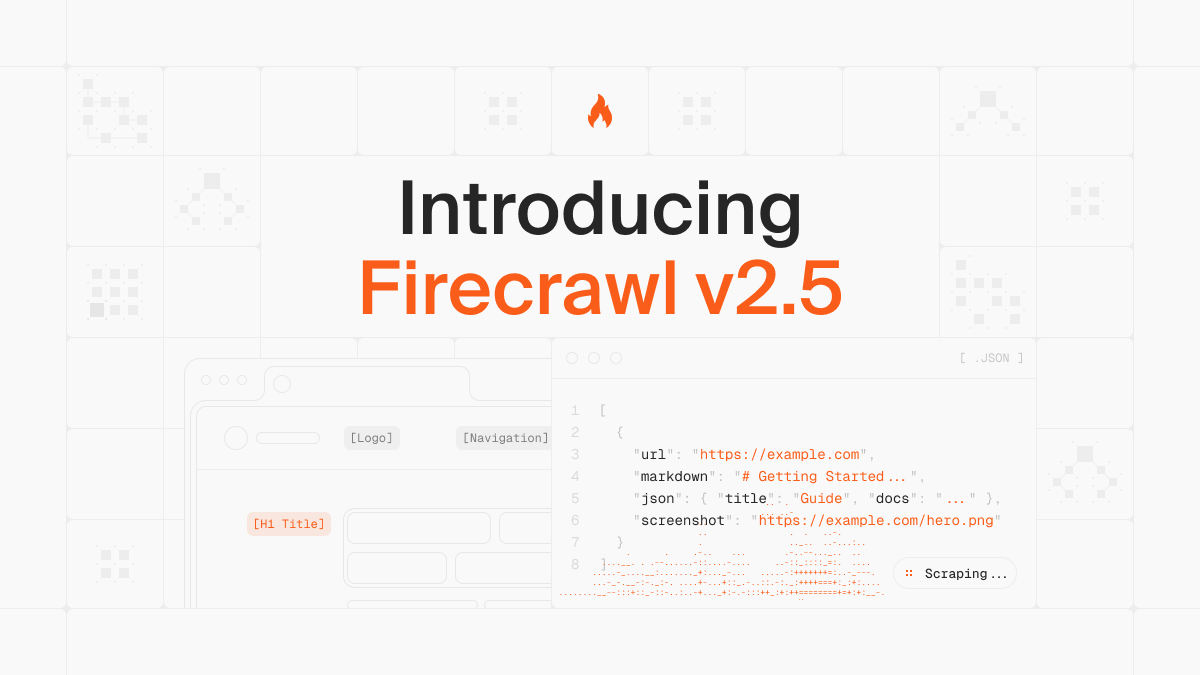
Converts Pages, Tables, and PDFs to Multiple Formats: Firecrawl processes diverse content types—from standard web pages to intricate tables, spreadsheets, and PDF documents—and converts them into clean markdown, JSON, HTML, and plain text formats. The platform also supports Excel (.xlsx) and CSV file extraction, ensuring standardization across all output types for seamless integration into data pipelines.
96% Web Coverage: The combination of semantic indexing and custom browser technology enables Firecrawl to access 96% of publicly available web content, including JavaScript-heavy sites and protected pages, without requiring proxy management.
Designed for Agent and LLM Use: Every aspect of Firecrawl, from data quality to output formats, is optimized for use with AI agents and Large Language Models. The platform provides the precise, structured data these systems need for effective operation and informed decision-making.
Interactive Scraping Capabilities: Firecrawl supports advanced browser interactions including clicking, scrolling, typing, waiting for elements, and taking screenshots. This enables automation of complex user workflows before data extraction.
How It Works
Getting started with Firecrawl v2.5 is straightforward for developers. Users interact with the API through dedicated endpoints: /scrape, /search, /crawl, /extract, and /map. By sending requests to these endpoints, developers can programmatically extract, semantically search, and map data from a wide array of complex web content or documents. The /scrape endpoint handles single-page content extraction with JavaScript rendering and format conversion, the /search endpoint performs web searches with optional content retrieval, the /crawl endpoint discovers and extracts data from entire websites, the /extract endpoint structures unstructured content based on natural language prompts or JSON schemas, and the /map endpoint identifies all available URLs on a domain for strategic crawling. The API handles the rendering, understanding, and structuring of data, delivering it back in clean, agent-ready formats.
Use Cases
Firecrawl v2.5’s capabilities make it an essential tool for advanced data-driven projects.
- Building AI Agents Requiring Web Data: Ideal for developers creating intelligent agents that need to browse the web, gather information, and make decisions based on real-time or historical web content. The platform’s agent-ready output formats integrate seamlessly with AI frameworks and large language models.
Large-Scale Data Scraping and Research: Perfect for researchers and businesses needing to collect vast amounts of high-quality, structured data from the internet for competitive intelligence, market research, lead generation, or academic analysis.
Automated Data Aggregation Pipelines: Streamlines the collection and consolidation of data from multiple web sources into unified databases or systems, ensuring consistency, cleanliness, and reliability for ongoing operations.
Content Monitoring and Change Detection: Track website changes and updates in real-time to trigger alerts or automated workflows based on predefined conditions.
Pros & Cons
Understanding the strengths and limitations of any tool is key to successful implementation. Here’s a breakdown for Firecrawl v2.5.
Advantages
- High Data Quality: Thanks to its Semantic Index and custom browser architecture, Firecrawl delivers exceptionally high-quality, contextually rich data with minimal post-processing required.
Comprehensive Coverage: It can effectively process and extract data from challenging content types, including dynamic JavaScript applications, complex tables, protected pages, PDFs, and spreadsheets.
Agent-Ready Output: Specifically designed to provide data in formats and structures optimized for AI agents and LLMs, reducing integration time and preprocessing overhead.
Speed and Reliability: Sub-second response times for simple pages through intelligent caching, combined with 96% web coverage and no proxy complexity.
Flexible Extraction Options: Supports both natural language prompts and JSON schema-based extraction, allowing developers to request data intuitively without complex selectors.
Disadvantages
- Requires Technical Setup and API Integration Knowledge: While accessible, Firecrawl is an API-first platform requiring programming skills and familiarity with API integration. Integration with existing systems requires development effort.
Credit-Based Pricing Model: Developers need to monitor credit consumption, as different operations consume different amounts of credits. Large-scale projects require careful budget planning.
How Does It Compare?
When evaluating web data extraction platforms in 2025, Firecrawl competes alongside diverse solutions including Apify, Oxylabs, Bright Data, Scrapfly, and ScrapingBee. While these competitors offer robust scraping services, Firecrawl distinguishes itself through several unique advantages. Firecrawl prioritizes AI-native data extraction with optimized output formats specifically designed for large language models and AI agents, whereas most competitors focus on general-purpose web scraping. The platform’s Semantic Index provides both fresh data and indexed snapshots, offering flexibility that most competitors lack. Firecrawl’s custom browser infrastructure delivers sub-second response times without proxy management, contrasting with competitors requiring extensive proxy network configuration. For teams building AI-centric applications requiring clean, structured, semantically-aware web data, Firecrawl offers specialized capabilities that general-purpose web scraping platforms do not provide. However, enterprise teams requiring massive-scale operations with dedicated support should evaluate whether Oxylabs or Bright Data’s extensive infrastructure better suits their needs. For maximum development flexibility, Apify’s framework-based approach allows deeper customization. Firecrawl excels as a specialized solution for modern AI development, particularly in the niche of LLM-powered applications and intelligent agent infrastructure.
Pricing and Accessibility
Firecrawl offers a flexible pricing model with a free tier providing initial credits for new users, followed by subscription plans starting at entry-level pricing suitable for individuals and startups. Enterprise plans provide custom configurations and dedicated support. The platform’s model makes it accessible for small projects while scaling to enterprise requirements as needs grow.
Final Thoughts
Firecrawl v2.5 emerges as a specialized and powerful platform for anyone building AI agents, LLMs, or data pipelines that demand high-quality, semantically rich web data. Its custom infrastructure, semantic indexing, and AI-native optimization position it as a frontrunner for modern AI-driven applications. The platform’s ability to navigate complex web structures and transform diverse content into clean, usable formats specifically for AI consumption provides distinct advantages over general-purpose web scraping solutions. While technical expertise is required for implementation, the unparalleled data quality and seamless AI integration make it a valuable asset for advanced development teams.