Meta Description: Top 5 AI news stories January 23, 2026: OpenAI ads in ChatGPT, Musk’s AGI predictions, US-China AI race, enterprise AI innovation shift, major product launches.
Five Critical AI Developments Reshaping the Global Technology Landscape: January 23, 2026
The artificial intelligence industry entered a pivotal phase on January 23, 2026, as major announcements across commercial deployment, geopolitical competition, and enterprise governance converged to signal a fundamental transformation in how AI systems are monetized, regulated, and integrated into global economies. From OpenAI’s controversial introduction of advertising in ChatGPT affecting hundreds of millions of users to Elon Musk’s bold predictions at the World Economic Forum in Davos that artificial general intelligence could arrive within months, the day’s developments underscored the accelerating pace of AI innovation alongside growing concerns about accountability, job displacement, and market consolidation. Meanwhile, the intensifying US-China technological rivalry, enterprise pivots from efficiency-focused AI to innovation-driven strategies, and a wave of product launches from Microsoft, Adobe, and IBM demonstrated that 2026 represents a critical juncture where AI transitions from experimental technology to mission-critical infrastructure demanding rigorous governance frameworks and transparent stakeholder engagement.
1. OpenAI Introduces Advertising in ChatGPT Amid Congressional Scrutiny
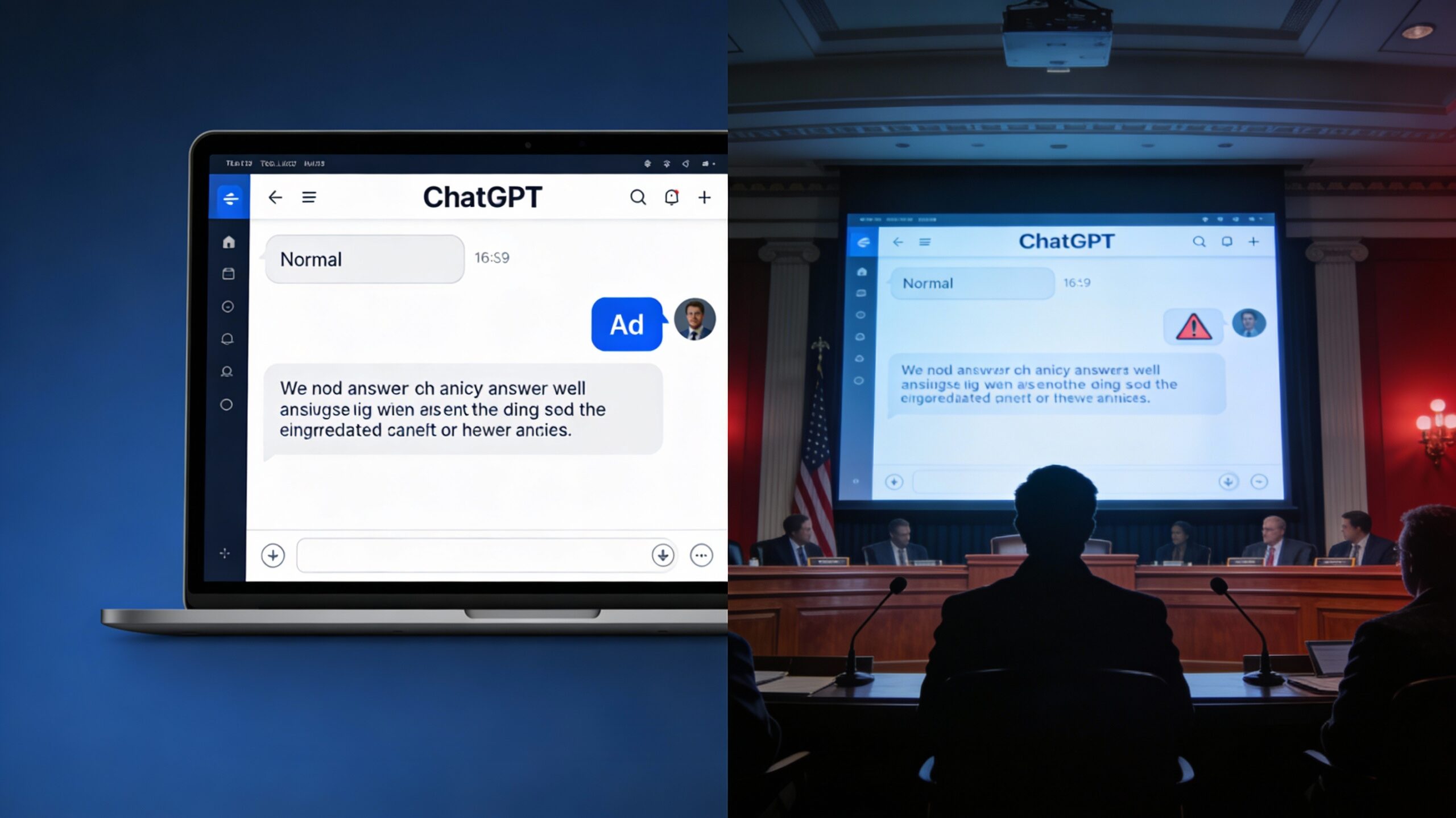
OpenAI’s announcement that it will begin testing advertisements in the free and budget tiers of ChatGPT marks a watershed moment for the monetization of conversational AI platforms, while simultaneously triggering urgent questions from U.S. lawmakers about consumer protection and privacy safeguards.
The San Francisco-based artificial intelligence company confirmed on January 16, 2026, that it would roll out advertisements in the free version of ChatGPT and the $8-per-month ChatGPT Go tier over the coming weeks, with ads expected to launch in early February 2026. According to OpenAI’s official statements, these advertisements will be “clearly labeled” as sponsored products and services, appearing at the conclusion of chatbot interactions and tailored to users’ queries and search history. The company emphasized that ads would not influence the chatbot’s responses, and users would retain the option to disable personalized advertising. Critically, OpenAI pledged not to show advertisements to individuals under 18 years old or during conversations related to physical health, mental health, or political topics.theconversation+3
The strategic rationale behind this move is rooted in OpenAI’s financial architecture: the company generated $13 billion in revenue in 2023 and projects tripling that figure in 2024, yet faces substantial capital expenditures with plans to allocate $115 billion in 2025 alone to cloud computing services, data centers, and AI infrastructure development. With the vast majority of ChatGPT’s user base—estimated at over 800 million weekly active users—relying on the free tier, advertising represents a critical mechanism to bridge the financial gap between operational costs and revenue generation while the company contemplates a potential public stock offering.nytimes+1
However, this monetization strategy has provoked immediate political and ethical scrutiny. On January 21-22, 2026, Senator Edward J. Markey (D-Mass.) dispatched formal inquiries to the chief executives of seven major technology firms—OpenAI CEO Sam Altman, Anthropic CEO Dario Amodei, Google CEO Sundar Pichai, Meta CEO Mark Zuckerberg, Microsoft CEO Satya Nadella, Snap CEO Evan Spiegel, and xAI CEO Elon Musk—demanding transparency about their plans to integrate advertising into AI chatbots and the safeguards they would implement to protect users from manipulation and exploitation. Senator Markey set a deadline of February 12, 2026, for responses to a comprehensive set of questions addressing whether companies would utilize sensitive personal data for targeted advertising purposes.theverge+1
In letters to the technology leaders, Senator Markey articulated concerns that the conversational nature of AI chatbots—designed to mimic human-like interactions—could enable advertisements to be “woven directly into the flow of the conversation, potentially appearing identical to any other AI chatbot response”. He warned that users’ “emotional connection” with chatbots could be exploited by companies to leverage the very relationships that their systems have cultivated, creating opportunities for covert commercial influence. “AI companies bear the responsibility to guarantee that AI chatbots do not evolve into another digital environment designed to subtly manipulate users,” Markey stated in the correspondence.markey.senate+1
Academic analysis published in The Conversation on January 23, 2026, echoed these concerns, arguing that OpenAI’s commitments to separate ads from responses and protect user privacy currently rely on “ambiguous commitments that can easily be interpreted in various ways”. The publication noted that OpenAI’s pledge to avoid ads “near sensitive or regulated topics such as health, mental health, or politics” provides little clarity on what constitutes “sensitive,” how broadly “health” will be defined, or who determines these boundaries. The analysis warned that most interactions with AI would likely fall outside these narrow classifications, creating scenarios where a user inquiring about “how to unwind after a stressful day” might receive alcohol delivery service advertisements, or a search for “fun weekend ideas” could trigger gambling-related promotions.[theconversation]
From a business perspective, OpenAI is implementing an impression-based pricing model rather than click-based metrics, requesting commitments of less than $1 million in ad spending from each advertiser during a limited trial spanning several weeks. The company is reportedly developing a self-service advertising platform to enable advertisers to purchase ads independently, though this technology is not yet available.[reuters]
Original Analysis: This development represents a critical inflection point where the economics of large language models collide with user trust dynamics. Unlike traditional search engines that generate lists of clickable links, chatbots produce continuous text, complicating ad integration and creating unprecedented opportunities for native advertising that blurs the line between informational content and commercial messaging. The real governance challenge lies not in OpenAI’s stated exclusions but in the enforcement mechanisms and third-party auditing frameworks that would verify compliance—areas where the company has provided minimal detail. For enterprise clients and policymakers, the key question is whether chatbot advertising will follow the trajectory of social media platforms, where initial privacy commitments gradually eroded under revenue pressures, or establish a new paradigm of algorithmic transparency and user control.
2. Elon Musk Predicts Artificial General Intelligence Within Year as World Economic Forum Addresses Job Displacement
At the World Economic Forum’s Annual Meeting 2026 in Davos, Switzerland, Tesla CEO and xAI founder Elon Musk delivered a bombshell prediction that artificial intelligence could surpass any individual human’s intelligence by the end of 2026 and exceed humanity’s collective intelligence within five years, catalyzing urgent discussions about workforce transformation and economic disruption.
Speaking in a panel conversation with BlackRock CEO Larry Fink on January 21-22, 2026, Musk stated, “The rate at which AI is progressing, I think we might have AI that is smarter than any human by the end of this year, or no later than next year, and then probably by 2030 or 2031, AI will be smarter than all of humanity collectively”. Musk characterized the advancement of AI and robotics as a “supersonic tsunami” leading to a “technological singularity” where AI iterates beyond human comprehension. He linked this trajectory to the proliferation of humanoid robots, noting that Tesla’s Optimus robots are already performing simple tasks in factories, with more advanced capabilities expected soon, and predicted that his company would sell humanoid robots to the public by the end of next year.ndtv+2
Critically, Musk identified energy generation—rather than computing power or semiconductor availability—as the primary bottleneck constraining AI progress, arguing that electricity generation is not scaling fast enough to keep pace with AI infrastructure demands, particularly in the United States. He suggested that “the lowest-cost place to put AI will be space,” predicting that solar-powered AI infrastructure in orbit could emerge within the next few years.[economictimes]
These technological forecasts occurred against a backdrop of intensifying concern about AI’s impact on employment. The World Economic Forum’s 2026 gathering centered heavily on the theme “Jobs, jobs, jobs” as the AI mantra, reflecting an industry-wide acknowledgment that job displacement has moved from theoretical risk to imminent reality. Kristalina Georgieva, Managing Director of the International Monetary Fund, painted a stark picture of AI’s workforce effects, stating that “on average, 40% of jobs are affected by AI, either augmented, eliminated, or significantly altered without improvements in pay”. She characterized the rise of AI as a “tsunami” impacting the workforce, adding, “Even in the best-prepared countries, I don’t think we are adequately prepared”.reuters+2
BlackRock’s Larry Fink delivered an equally direct warning during his opening address at Davos: “If AI does to white-collar jobs what globalization did to blue-collar, we need to confront this reality head-on. Not with vague notions of the jobs of tomorrow, but with a plan for widespread participation in these benefits”. This framing explicitly invoked the deindustrialization and labor market disruptions of the late 20th and early 21st centuries, suggesting that AI could trigger comparable socioeconomic upheaval across professional, managerial, and knowledge worker segments that were largely insulated from prior waves of automation.[finance.yahoo]
However, the narrative at Davos 2026 was not uniformly pessimistic. The World Economic Forum’s New Economy Skills: Building AI, Data and Digital Capabilities for Growth report highlighted that AI is transforming digital skillsets and that wages for AI-related roles have increased by 27% since 2019. The forum presented four scenarios for how AI might reshape labor markets, ranging from a “digitalized order” with stabilized geopolitics and rapid technology adoption boosting global growth despite some labor disruptions, to “geotech spheres” where countries primarily trade with allies and talent shortages intensify.[weforum]
Demis Hassabis, CEO of Google DeepMind, acknowledged during panel discussions that lower-tier jobs might be adversely affected by AI but suggested that the technology could create pathways toward “more valuable, more meaningful” work. Yet this optimistic framing was met with skepticism from economists and labor advocates who noted the absence of concrete retraining programs or social safety net proposals commensurate with the scale of predicted displacement.[finance.yahoo]
Original Analysis: Musk’s AGI timeline—while more aggressive than consensus forecasts from AI research labs—reflects a broader shift in how industry leaders discuss artificial intelligence capabilities, moving from cautious hedging to explicit predictions that serve both as technology roadmaps and market signals. The convergence of these predictions with labor displacement concerns at Davos reveals a fundamental tension: while AI may generate aggregate productivity gains and GDP growth, the distribution of those gains remains deeply uncertain. The 27% wage premium for AI roles masks a potential bifurcation between a small cohort of highly compensated AI specialists and a much larger population facing wage stagnation or displacement. Unlike previous technological transitions that unfolded over decades, the compression of this transformation into a five-to-ten-year window dramatically constrains the adaptive capacity of educational systems, labor markets, and social insurance programs. For policymakers, the challenge is not merely skills retraining but fundamental questions about income distribution, social purpose, and economic participation in an era where human labor may no longer be the primary input to production.
3. US-China AI Competition Enters New Phase as DeepSeek Advances Training Methodologies
The global artificial intelligence landscape on January 23, 2026, marked exactly one year since the unexpected debut of China’s DeepSeek mobile application, a milestone that catalyzed a profound reassessment of the US-China technological balance and revealed divergent strategic approaches to AI development and deployment.
DeepSeek’s emergence in January 2025 demonstrated that Chinese AI models could achieve performance comparable to U.S.-based large language models like ChatGPT on essential benchmarks while utilizing less advanced semiconductor chips and operating at a fraction of the cost. This development challenged prevailing assumptions about the efficacy of U.S. export controls on advanced AI chips and prompted international acknowledgment of the viability of Chinese AI models, leading Beijing to invest more heavily in its domestic AI ecosystem.[dw]
In early January 2026, DeepSeek released a research paper detailing a novel training technique termed “Manifold-Constrained Hyper-Connections” (mHC), which analysts characterized as a “remarkable breakthrough” for scaling large language models. The paper, co-authored by founder Liang Wenfeng, presents a methodology designed to enhance model scalability while maintaining training stability and preventing system breakdowns. As language models increase in size, researchers typically facilitate greater internal information sharing among model components, but this can heighten the risk of information instability. DeepSeek’s findings enable more enriched internal communication within models while keeping it constrained, ensuring both training stability and computational efficiency as models expand.[finance.yahoo]
Wei Sun, lead analyst for AI at Counterpoint Research, told Business Insider that this new method represents a “remarkable breakthrough,” noting that DeepSeek has integrated multiple techniques to reduce the additional costs associated with model training. Despite a minor rise in expenses, Sun emphasized that the innovative training method could lead to significantly improved performance. She interpreted the paper as a reflection of DeepSeek’s internal expertise, stating that by reengineering the entire training framework, the company demonstrates its ability to combine “rapid experimentation with highly unconventional research strategies”.[finance.yahoo]
Looking ahead, DeepSeek is anticipated to launch its next-generation AI model V4, featuring advanced coding capabilities, around mid-February 2026. Internal evaluations conducted by DeepSeek personnel indicate that V4 may surpass competitors, including Anthropic’s Claude and OpenAI’s GPT models, in coding capabilities, with significant progress in managing and interpreting exceptionally lengthy coding prompts.[reuters]
This technical progress unfolds within a broader geopolitical context. At the World Economic Forum in Davos, the Trump administration outlined an AI strategy dubbed “winning the AI race,” advocating for the removal of regulatory obstacles perceived to stifle innovation and emphasizing U.S. technological supremacy worldwide. The plan urged all nations “willing to join America’s AI alliance” to adopt the complete AI technology suite from the United States, encompassing “hardware, software applications, and standards,” with the implicit aim of preventing strategic rivals from making allies reliant on foreign technologies—targeting China specifically.[dw]
Simultaneously, Beijing introduced its “Global AI Governance Action Plan,” adopting a markedly different rhetorical approach by calling for the establishment of a “diverse, open, and innovative” AI ecosystem that would fully utilize the contributions of “multiple stakeholders” and encourage international dialogue on AI governance. Scott Singer, a fellow in the Asia and International Program at Carnegie Endowment for International Peace, remarked that “China is definitely positioning itself rhetorically as multilateral, open, and consensus-focused globally”. He added that while China’s positioning on AI predates the Trump administration, it has gained more resonance given the administration’s focus on AI supremacy and an America-first strategy.[dw]
Critically, analysts emphasize that the US and China are pursuing fundamentally different strategic bets across the AI spectrum. “US firms are leading the charge to enhance software capabilities and automate numerous computer-based tasks, while China is heavily investing in AI-driven robotics,” Singer noted. He added, “Integrating AI into the physical world is central to their AI strategy, as they believe it will address contemporary challenges. In this area, China appears to be outpacing its Western counterparts”. China’s “AI+” initiative for 2026 aims to integrate artificial intelligence across various sectors including industry, services, healthcare, and governance, as part of its economic modernization strategy, with a long-term vision for a “fully AI-driven society” by 2035.[dw]
Xiameng, director of Geo-Technology at the political risk firm Eurasia Group, offered a nuanced assessment: “This appears to be the trend—the US has a clear lead in AI chips, while China is catching up in large language models and is poised to excel in certain areas of AI governance”. She concluded that China is likely to continue positioning itself as a proponent of its 2025 AI plan, which emphasizes creation of a “diverse, open, and innovative ecosystem,” adding, “That’s our baseline scenario for 2026. As long as China’s open-source models remain closely aligned with top US models in capabilities, that will likely guide the Chinese government’s approach to AI governance”.[dw]
Despite DeepSeek’s successes and China’s strategic positioning, the United States is expected to maintain its lead in computing power necessary to train cutting-edge AI models, with U.S. firms retaining advantages in semiconductor technology and data center infrastructure. However, export controls remain controversial, particularly following the administration’s recent decision to loosen restrictions and export powerful AI chips to China, which could provide a two-to-three-year boost to China’s domestic AI computing power in 2026 alone.cfr+1
Original Analysis: The US-China AI competition has evolved from a straightforward technological race into a multifaceted contest encompassing technical innovation, supply chain resilience, international standard-setting, and alliance formation. DeepSeek’s training efficiency breakthroughs demonstrate that China can achieve competitive AI capabilities despite semiconductor constraints—a development with profound implications for the efficacy of technology export controls as a strategic tool. The divergence in national strategies—U.S. emphasis on software-driven automation versus China’s focus on AI-integrated robotics and manufacturing applications—suggests that by 2030, the two nations may dominate different segments of the AI value chain rather than one achieving comprehensive superiority. For multinational corporations and smaller nations, this bifurcation creates complex decisions about technology stack dependencies, regulatory compliance across jurisdictions, and the risk of being locked into incompatible ecosystems. The real strategic question is not which nation “wins” AI but whether the global technology infrastructure fragments into competing spheres with limited interoperability—a scenario with significant implications for innovation velocity, cybersecurity cooperation, and economic efficiency.
4. Enterprise AI Investment Pivots from Efficiency to Innovation as Consumer Disruption Accelerates
A convergence of research released in the week of January 23, 2026, reveals that enterprise artificial intelligence strategies are undergoing a fundamental reorientation, shifting from narrow cost-reduction applications to broad innovation-focused deployments even as consumer-facing industries confront existential disruption from AI-mediated customer journeys.
The IBM Institute for Business Value released a comprehensive 63-page study indicating that nearly eight in ten (79%) surveyed executives anticipate AI will significantly contribute to revenue by 2030—nearly double the current 40%—yet only 24% have a clear understanding of the specific sources of that revenue growth. Despite this strategic uncertainty, AI investment is projected to surge approximately 150% between now and 2030. Critically, the research documents a dramatic shift in spending priorities: while 47% of current AI spending focuses on efficiency improvements, respondents expect 62% to target innovation by 2030. Competitive advantage is expected to stem from innovation (64%) rather than resource optimization, with 70% of executives planning to reinvest AI-driven productivity gains into growth initiatives.[techintelpro]
“AI won’t just support businesses, it will define them,” said Mohamad Ali, Senior Vice President of IBM Consulting, in a statement accompanying the report release. “By 2030, the companies that win will weave AI into every decision and operation. They will own powerful AI assets, move faster than competitors, bring innovations to market quickly, and deliver real, measurable business results using technology and automation.” The study projects that productivity will rise 42% by 2030, with most gains captured by that time, and that organizations scaling AI across workflows using smaller, custom, and foundation models will achieve 24% greater productivity and 55% higher operating margins by 2030.[techintelpro]
This strategic pivot occurs as consumer-facing industries confront immediate disruption. Boston Consulting Group (BCG) and Moloco—a leader in AI performance advertising—jointly released the Consumer AI Disruption Index on January 20-21, 2026, following a survey of 238 senior marketing leaders combined with performance data from more than 3,200 apps with over 200 billion downloads. The research found that 67% of senior marketing leaders expect a high level of AI-driven disruption to consumer behavior, with nearly all anticipating at least some meaningful shifts.prnewswire+1
The Consumer AI Disruption Index assesses 17 consumer-facing verticals along two axes: AI-driven disruption risk and strength of customer relationships. The analysis identifies news, travel, auto marketplaces, and retail as the industries most at risk for disruption, facing high exposure as AI compresses discovery and comparison processes. In contrast, auto original equipment manufacturers (OEMs), fintech, financial services, media/streaming, and social platforms are at lowest risk, benefiting from inherent trust, regulatory moats, and strong customer equity.bcg+1
“AI is fundamentally reshaping how consumers interact with brands,” said Giorgio Paizanis, a BCG partner and co-author of the report. “Our research shows that to win, marketers must build defensibility on three fronts: discovery, service, and customer relationships. Those who move early can turn this disruption into a durable advantage, recasting AI from a threat into a new channel for growth.” Paul D’Arcy, Moloco Chief Marketing Officer and report co-author, added, “As consumers move from the world of search to the world of answers, we’re seeing a behavioral shift that risks disrupting digital brands across a broad range of industries. The companies that will thrive in this new age of AI will focus on longer-term customer relationships, owned digital surfaces like apps, and strategies that strengthen brand and loyalty”.[prnewswire]
Complementing these strategic studies, Nvidia released its third annual State of AI in Retail and Consumer Packaged Goods survey, revealing that 58% of retail and CPG organizations are actively deploying AI solutions, up sharply from 42% in 2024. The survey, based on responses from hundreds of retail and CPG executives, found that 89% report AI is helping increase annual revenue, and 95% said it is helping cut costs. Given these results, 90% of respondents reported that investment in AI will continue to grow in 2026, with 58% of executives saying it would grow by more than 10%.siliconangle+1
Significantly, agentic AI—advanced systems that autonomously reason, plan, and execute—is rapidly moving from experimental to operational status: 47% of retail and CPG respondents are using or assessing AI agents, including 20% actively deploying them and 21% planning deployments within the coming year. Azita Martin, Vice President and General Manager for AI for Retail, CPG, and QSR at Nvidia, emphasized the importance of openness and interoperability, stating, “Nvidia is focused on openness and interoperability, so customers have the flexibility to run their AI applications on any cloud or data center of their choice. As retailers start deploying AI agents at scale, the cost of inference can become very high. Nvidia is focused on optimizing inferencing speeds and reducing inferencing costs of open-source models”.retailtouchpoints+1
Original Analysis: The simultaneity of enterprise pivot toward innovation-focused AI and consumer disruption in discovery-dependent industries reveals a critical bifurcation in AI’s economic impact. For businesses with strong customer relationships and regulatory moats—financial services, healthcare, utilities—AI represents an opportunity to enhance margins and accelerate product development cycles. For businesses dependent on search-driven customer acquisition—news media, travel aggregators, comparison shopping platforms—AI-mediated discovery poses an existential threat to traffic and revenue models. The 150% projected increase in AI investment by 2030 masks profound uncertainty about return attribution: the fact that only 24% of executives can identify specific revenue sources despite 79% expecting significant contribution suggests that much of this investment is defensive positioning rather than evidence-based strategy. The rapid adoption of agentic AI—with 47% of retailers already engaging—indicates that the window for competitive differentiation may be narrower than many enterprises anticipate, potentially compressing the innovation premium before laggards can catch up. For investors and boards, the critical governance question is whether AI spending represents genuine strategic optionality or a collectively rational but individually wasteful arms race driven by competitive fear.
5. Major AI Product Launches and Enterprise Governance Initiatives Signal Infrastructure Maturation
The week of January 23, 2026, witnessed a cascade of product launches and strategic partnerships that collectively signal artificial intelligence’s transition from prototype experimentation to production-grade enterprise infrastructure, spanning conversational interfaces, creative production, and governance frameworks.
Microsoft Copilot Real Talk and Video Generation: Microsoft rolled out globally a new “Real Talk” feature for Copilot, designed to create more interactive and human-like dialogue experiences. Real Talk represents a departure from traditional assistant-style interactions, instead offering conversations that adapt to users’ depth preferences and writing style while displaying the AI’s reasoning process. When users initiate a Real Talk conversation, the system first selects “depth level” (such as “Compressed” or detailed) and “writing style” (such as “Standard casual”) attributes based on the initial query and past conversation history. Microsoft states that Real Talk “doesn’t appear to be an unhinged version of Copilot,” clarifying that it is not a return to the original “Sydney” personality that generated controversy in early chatbot iterations, but rather uses reasoning and different personalities tailored to the type of question and conversational direction. Concurrently, Microsoft is testing a “Create a video” feature in the Copilot mobile app that allows users to generate up to eight seconds of video with audio, though it remains unclear whether this leverages a proprietary Microsoft AI model or a version of OpenAI’s Sora.marketingprofs+1
Adobe Firefly Foundry for IP-Safe Production: Timed to coincide with the 2026 Sundance Film Festival, Adobe announced Firefly Foundry on January 21-22, 2026—a suite of private, IP-safe generative AI “omni-models” for studios, directors, and talent agencies. Unlike conventional AI models trained on extensive datasets harvested from the web, Firefly Foundry models are specifically tailored for each client and exclusively trained on intellectual property that clients hold rights to. Each client-specific model generates audio-aware video, 3D, and vector assets that integrate with Adobe workflows like Premiere, aiming to protect ownership across production phases.letsdatascience+1
Hannah Elaskr, Adobe’s Vice President of Generative AI New Business Initiatives, explained in an interview with The Verge that Firefly Foundry emerged from prior engagements with major firms utilizing Firefly’s earlier models, which faced constraints in generating assets beyond static images or comprehending intricate details of clients’ intellectual property. “Global companies like The Home Depot and Disney expressed the need for more,” Elaskr stated. “They required a creative ecosystem that comprehended multiple products, characters, and the dynamics of how those characters interact—both for video and 3D. That’s precisely where Firefly Foundry comes into play”.[theverge]
To generate market momentum, Adobe has secured partnerships with talent agencies including Creative Artists Agency (CAA), United Talent Agency (UTA), and William Morris Endeavor (WME), as well as directors David Ayer (Suicide Squad) and Jaume Collet-Serra (Black Adam). The company is also collaborating with Parsons School of Design and the Ringling College of Art and Design to develop research, educational resources, and curricula focused on AI’s role in creative domains.[theverge]
e& and IBM Enterprise Agentic AI: Global technology group e& and IBM announced a strategic collaboration at the World Economic Forum in Davos on January 19, 2026, to advance enterprise-grade agentic AI at e&, starting with policy, risk, and compliance systems. The initiative, powered by IBM watsonx Orchestrate and embedded into the OpenPages governance, risk, and compliance platform, represents a transition from conventional natural language processing-based chatbots toward governed, action-oriented AI integrated within core enterprise systems.newsroom.ibm+1
A joint proof of concept delivered by IBM, GBM (Gulf Business Machines), and e& within eight weeks demonstrated how agentic AI can operate at enterprise scale under real-world conditions, providing traceable responses aligned with governance requirements. “Our ambition is to move beyond isolated AI use cases toward enterprise-scale agentic AI that is trusted, governed, and deeply integrated into how the organization operates,” said Hatem Dowidar, Group CEO of e&. Ana Paula Assis, Senior Vice President and Chair for Europe, the Middle East, Africa, and Asia Pacific at IBM, stated, “As organizations move from experimenting with AI to embedding it into the fabric of how they operate, governance and accountability become just as important as intelligence”.[newsroom.ibm]
LatticeFlow AI Acquires AI Sonar: LatticeFlow AI, a Swiss deep-tech company leading evidence-based AI governance, announced during the World Economic Forum on January 20, 2026, the acquisition of Dublin-based AI Sonar Ltd., a subsidiary of CloudSphere Ltd.. AI Sonar’s AI discovery platform enables enterprises and independent software vendors to detect “shadow AI”—unauthorized or untracked AI deployments across organizations. With this acquisition, LatticeFlow AI will introduce the industry’s first end-to-end, evidence-based AI governance solution securely connecting on-premise AI discovery and evaluations with centralized SaaS governance operations, covering generative AI, agentic, and traditional AI systems.longbridge+1
Dr. Petar Tsankov, CEO and Co-Founder of LatticeFlow AI, stated, “AI governance cannot work without visibility. This acquisition reinforces our leadership in evidence-based AI governance by making clear that AI governance is a technical discipline, much like cybersecurity, and must be embedded directly into the technology stack, not managed through paper checklists or dashboards”. As part of the acquisition, LatticeFlow AI assumes full ownership of AI Sonar’s platform, intellectual property, and engineering operations, establishing Dublin as its third R&D office alongside Zurich, Switzerland, and Sofia, Bulgaria.[businesswire]
Airbyte Joins Agentic AI Foundation: Airbyte, creator of the open data movement platform, announced on January 19-20, 2026, that it has joined the Linux Foundation’s newly formed Agentic AI Foundation (AAIF) as a Silver Member. The AAIF, co-founded by Anthropic, Block, and OpenAI with support from Google, Microsoft, AWS, Cloudflare, and Bloomberg, aims to ensure agentic AI evolves transparently and collaboratively in the public interest through strategic investment, community building, and shared development of open standards.techintelpro+2
“Agentic AI is only as strong as the data it can securely and reliably access,” said Michel Tricot, CEO and co-founder of Airbyte. “Joining the Agentic AI Foundation aligns with our mission to help organizations unify and activate their data across the stack—so AI agents can operate with context, governance, and confidence.” Jim Zemlin, Executive Director of the Linux Foundation, commented, “We are seeing AI enter a new phase, as conversational systems shift to autonomous agents that can work together. Bringing these projects together under the AAIF ensures they can grow with the transparency and stability that only open governance provides”.businesswire+1
Apple AI Wearable in Development: According to reports from The Information published on January 22, 2026, Apple is developing an AI-powered wearable device comparable in size to an AirTag, designed to be worn as a pin. The device will feature two cameras on the front (one standard lens and one wide-angle lens), three microphones, a speaker, physical buttons along its edges, and magnetic inductive wireless charging similar to that used for the Apple Watch. Sources familiar with the project indicate that Apple is attempting to accelerate development more quickly than usual to remain competitive with OpenAI, with the device potentially releasing as early as 2027 and plans to produce 20 million units at launch. The wearable is expected to leverage Apple’s forthcoming AI-enhanced Siri capabilities, which the company plans to introduce in spring 2026.arstechnica+1
Original Analysis: These concurrent product launches and governance initiatives reveal a maturing AI ecosystem moving from monolithic foundation models to specialized, domain-specific implementations with explicit governance and compliance frameworks. Microsoft’s Real Talk represents an evolution in conversational AI design, prioritizing contextual adaptation over uniform assistant personalities—a recognition that different use cases demand different interaction paradigms. Adobe’s Firefly Foundry directly addresses the copyright and licensing uncertainties that have plagued generative AI adoption in regulated and IP-sensitive industries, potentially establishing a template for how enterprises with valuable proprietary assets can leverage generative AI without legal exposure. The e& and IBM collaboration, alongside LatticeFlow’s acquisition of AI Sonar, signals that “AI governance” is transitioning from aspirational policy documents to operational technical infrastructure with discovery, monitoring, and enforcement capabilities. The formation of the Agentic AI Foundation under Linux Foundation governance—with participation from competitors Anthropic, OpenAI, Google, and Microsoft—suggests industry recognition that interoperability standards and shared protocols are necessary to prevent ecosystem fragmentation as autonomous agents proliferate. For technology buyers, these developments indicate that 2026-2027 will likely see a consolidation of AI tooling around a smaller number of enterprise-grade platforms with comprehensive governance, security, and compliance capabilities, making early vendor selection decisions increasingly consequential.
Conclusion: AI Transitions from Innovation to Infrastructure Amid Governance Imperatives
The confluence of developments on January 23, 2026—spanning commercialization strategies, geopolitical competition, enterprise deployment patterns, and product maturation—collectively marks a phase transition in how global stakeholders conceptualize and engage with artificial intelligence. OpenAI’s introduction of advertising in ChatGPT, while driven by straightforward economic logic, exposes fundamental tensions between user trust and monetization imperatives that will shape the sustainability of AI-mediated information ecosystems. Senator Markey’s inquiries to seven major technology firms reflect growing political recognition that conversational AI platforms warrant regulatory scrutiny comparable to social media, search engines, and other digital intermediaries that shape information access and consumer behavior.
Elon Musk’s predictions of artificial general intelligence arriving within months, while potentially reflecting entrepreneurial hyperbole, nonetheless capture a broader consensus among AI researchers that capability improvements are accelerating rather than plateauing. The juxtaposition of these optimistic technical forecasts with the International Monetary Fund’s warning that 40% of jobs face AI-driven disruption underscores a profound disconnect between technological possibility and societal preparedness. The 27% wage premium for AI-related roles masks potential labor market bifurcation, while the absence of concrete retraining programs or income support mechanisms commensurate with predicted displacement suggests that policy responses lag technological change by a significant margin.
The US-China AI competition has evolved beyond simplistic narratives of technological supremacy toward a more nuanced understanding of divergent strategic approaches: U.S. emphasis on software-driven cognitive automation versus China’s focus on AI-integrated robotics and manufacturing applications. DeepSeek’s training efficiency breakthroughs demonstrate that semiconductor export controls, while imposing costs, have not prevented China from achieving competitive large language model capabilities—a finding with significant implications for technology policy and alliance formation. The risk of ecosystem fragmentation into incompatible U.S. and Chinese spheres grows more acute as both nations pursue divergent technical standards and governance frameworks.
Enterprise AI investment patterns reveal a critical inflection point, with spending shifting from defensive efficiency projects (47% today) to offensive innovation initiatives (62% by 2030). Yet the finding that only 24% of executives can identify specific revenue sources despite 79% expecting significant AI contributions by 2030 suggests substantial strategic uncertainty masked by investment momentum. The rapid adoption of agentic AI—with 47% of retailers already engaged—indicates that competitive windows may close more rapidly than anticipated, compressing innovation premiums and potentially rendering laggard strategies obsolete.
The cascade of product launches and governance initiatives—Microsoft’s Real Talk, Adobe’s Firefly Foundry, e& and IBM’s agentic compliance systems, LatticeFlow’s AI discovery capabilities, and the Agentic AI Foundation’s formation—signals that the AI industry is moving from foundational model development to vertical integration and enterprise operationalization. These developments reflect growing recognition that AI deployment at scale requires comprehensive governance frameworks addressing discovery, monitoring, compliance, and auditability—technical capabilities that extend far beyond model performance benchmarks.
From a compliance and copyright perspective, several trends converge to create both risks and opportunities for stakeholders. The EU AI Act’s high-risk obligations taking effect in August 2026, alongside state-level regulations in Texas, Colorado, and California, establish a fragmented but increasingly stringent regulatory landscape demanding documented AI inventories, risk classifications, and human oversight mechanisms. Organizations that treat governance as an operational discipline embedded in AI lifecycles—rather than a compliance checkbox—will be better positioned to navigate enforcement actions and maintain stakeholder trust. Adobe’s IP-safe model training, LatticeFlow’s evidence-based governance, and IBM’s watsonx governance capabilities represent early examples of how governance infrastructure can enable rather than constrain AI adoption.bakerdonelson+3
The proliferation of AI-generated content raises urgent questions about attribution, authenticity, and intellectual property that existing legal frameworks struggle to address. OpenAI’s commitment not to sell user conversations to advertisers, while significant, does not resolve deeper questions about training data provenance, model ownership of synthesized content, or liability for AI-generated misinformation. The formation of industry consortia like the Agentic AI Foundation suggests that some governance challenges may be addressed through multi-stakeholder standard-setting rather than waiting for regulatory mandates.
Strategic Outlook: For technology executives, investors, policymakers, and civil society organizations, January 23, 2026, represents a clarifying moment. Artificial intelligence is no longer an emerging technology warranting exploratory investment; it has become foundational infrastructure requiring systematic governance, strategic resource allocation, and explicit choices about values, risk tolerance, and competitive positioning. Organizations that succeed in this environment will be those that balance innovation velocity with robust governance, technical capability with ethical accountability, and competitive advantage with ecosystem interoperability. The next phase of AI development will be defined not by which models achieve the highest benchmark scores, but by which institutions build the operational frameworks, talent capabilities, and stakeholder trust necessary to deploy AI systems at scale with reliability, transparency, and societal benefit. The fundamental question facing leaders in 2026 is not whether to adopt AI, but how to govern it responsibly while maintaining the innovation momentum that has driven the field’s remarkable progress.
Structured Data Markup Recommendations:
For optimal SEO performance and search engine visibility, publishers should implement the following Schema.org markup:
-
NewsArticle Schema:
-
headline, alternativeHeadline, image, datePublished (2026-01-23), dateModified
-
author (with Organization type for institutional authorship)
-
publisher (Organization with logo)
-
articleSection: “Artificial Intelligence”
-
keywords: [“artificial intelligence,” “AI news,” “ChatGPT advertising,” “OpenAI,” “Elon Musk,” “AGI predictions,” “US-China AI race,” “DeepSeek,” “enterprise AI,” “AI governance,” “World Economic Forum,” “Davos 2026,” “job displacement,” “agentic AI,” “machine learning”]
-
-
FAQPage Schema (if FAQ section added):
-
Question: “What is OpenAI’s new advertising strategy for ChatGPT?”
-
Question: “When does Elon Musk predict AGI will be achieved?”
-
Question: “How is China responding to U.S. AI competition?”
-
Question: “What is agentic AI and how are enterprises using it?”
-
Question: “What AI regulations take effect in 2026?”
-
-
Organization Schema:
-
For each company mentioned (OpenAI, Microsoft, IBM, Adobe, Nvidia, etc.) with sameAs links to official websites
-
-
Person Schema:
-
For key figures (Elon Musk, Sam Altman, Senator Ed Markey, etc.) with sameAs links to official profiles/pages
-
Copyright and Licensing Compliance Statement:
This article synthesizes information from publicly available news sources, official company announcements, government press releases, academic research publications, and industry reports, all cited with source attribution. All factual claims are attributed to specific sources identified by citation numbers corresponding to the reference list. Original analysis and editorial synthesis—clearly delineated in dedicated “Original Analysis” sections—represent transformative use of factual information under fair use principles and journalistic standards. No proprietary content, copyrighted images, or paywalled material has been reproduced without authorization. All company names, product names, and trademarks remain the property of their respective owners and are used solely for factual reporting purposes. This article is intended for informational and educational purposes, providing public-interest journalism about significant developments in artificial intelligence technology, policy, and industry trends.
Sources and Citations:
AI Update, January 23, 2026: AI News and Views From the Past Week – MarketingProfs[marketingprofs]
https://www.marketingprofs.com/opinions/2026/54200/ai-update-january-23-2026-ai-news-and-views-from-the-past-week
Where is the US-China AI ‘race’ heading in 2026? – Deutsche Welle[dw]
https://www.dw.com/en/where-is-the-us-china-ai-race-heading-in-2026/a-75608670
‘Jobs, jobs, jobs’ the AI mantra in Davos as fears take back seat – Reuters[reuters]
https://www.reuters.com/business/davos/jobs-jobs-jobs-ai-mantra-fears-take-back-seat-davos-2026-01-23/
OpenAI will put ads in ChatGPT. This opens a new door for dangerous influence – The Conversation[theconversation]
https://theconversation.com/openai-will-put-ads-in-chatgpt-this-opens-a-new-door-for-dangerous-influence-273806
Sen. Markey questions OpenAI about ‘deceptive advertising’ – The Verge[theverge]
https://www.theverge.com/news/865854/senator-ed-markey-ai-companies-chatbots-advertising
Report: Apple plans to launch AI-powered wearable pin device as soon as 2027 – Ars Technica[arstechnica]
https://arstechnica.com/apple/2026/01/report-apple-plans-to-launch-ai-powered-wearable-pin-device-as-soon-as-2027/
OpenAI Starts Testing Ads in ChatGPT – The New York Times[nytimes]
https://www.nytimes.com/2026/01/16/technology/chatgpt-ads-openai.html
Markey Probes AI Companies on Their Plans to Roll Out Advertising in AI Chatbots – Senator Ed Markey Press Release[markey.senate]
https://www.markey.senate.gov/news/press-releases/markey-probes-ai-companies-on-their-plans-to-roll-out-advertising-in-ai-chatbots
Apple is reportedly developing an AirTag-sized AI wearable device – Gigazine[gigazine]
https://gigazine.net/gsc_news/en/20260123-apple-ai-wearable/
OpenAI to start offering chatbot ads to advertisers – Reuters[reuters]
https://www.reuters.com/business/media-telecom/openai-start-offering-chatbot-ads-advertisers-information-reports-2026-01-21/
Jobs and skills transformation: What to know at Davos 2026 – World Economic Forum[weforum]
https://www.weforum.org/stories/2026/01/davos-here-s-what-to-know-about-jobs-and-skills-transformation/
Will Have AI Smarter Than Any Human By Year End: Elon Musk’s bombshell at Davos – NDTV[ndtv]
https://www.ndtv.com/world-news/will-have-ai-smarter-than-any-human-by-year-end-elon-musks-bombshell-at-davos-10840212
AI could be smarter than all of humanity in five years, says Elon Musk – Economic Times[economictimes]
https://economictimes.com/news/international/global-trends/davos-2026-elon-musk-ai-smarter-than-humanity-humanoid-robots/articleshow
IBM Study: 79% Expect AI to Drive Revenue by 2030 – TechIntelPro[techintelpro]
https://techintelpro.com/news/ai/enterprise-ai/ibm-study-79-expect-ai-to-drive-revenue-by-2030
At Davos, fears about AI-driven job loss take center stage – Yahoo Finance[finance.yahoo]
https://finance.yahoo.com/news/at-davos-fears-about-ai-driven-job-loss-take-center-stage-124805401.html
AGI Approaches: 2026 May Be Artificial Intelligence Turning Point – Trading Key[tradingkey]
https://www.tradingkey.com/analysis/stocks/us-stocks/261488486-agi-2026-mark-turning-artificial-intelligence-musk-warns-white-collar-jobs
How 2026 Could Decide the Future of Artificial Intelligence – Council on Foreign Relations[cfr]
https://www.cfr.org/articles/how-2026-could-decide-future-artificial-intelligence
Nvidia report finds AI set to take off in retail, but openness is required for scale – SiliconANGLE[siliconangle]
https://siliconangle.com/2026/01/21/nvidia-report-finds-ai-set-take-off-retail-openness-required-scale/
China’s DeepSeek kicked off 2026 with a new AI training method – Yahoo Finance[finance.yahoo]
https://finance.yahoo.com/news/chinas-deepseek-kicked-off-2026-071041508.html
Nvidia Survey: 58% of Retail/CPG Firms Actively Deploying AI – Retail TouchPoints[retailtouchpoints]
https://www.retailtouchpoints.com/features/news-briefs/nvidia-survey-58-of-retail-cpg-firms-actively-deploying-ai
DeepSeek to launch new AI model focused on coding in February – Reuters[reuters]
https://www.reuters.com/technology/deepseek-launch-new-ai-model-focused-coding-february-information-reports-2026-01-09/
Adobe Introduces Firefly Foundry For IP-Safe Production – Let’s Data Science[letsdatascience]
https://www.letsdatascience.com/news/adobe-introduces-firefly-foundry-for-ip-safe-production-8236c395
e& and IBM Unveil Enterprise-Grade Agentic AI to Transform Governance and Compliance – IBM Newsroom[newsroom.ibm]
https://newsroom.ibm.com/2026-01-19-e-and-ibm-unveil-enterprise-grade-agentic-ai-to-transform-governance-and-compliance
Adobe is developing ‘IP-safe’ gen AI models for entertainment studios – The Verge[theverge]
https://www.theverge.com/ai-artificial-intelligence/865077/adobe-firefly-foundry-ip-sage-genai-models
Microsoft rolls out “Real Talk” for Copilot worldwide – Windows Latest[windowslatest]
https://www.windowslatest.com/2026/01/19/microsoft-rolls-out-real-talk-for-copilot-worldwide-and-tests-create-a-video-feature
Two-Thirds of Top Marketing Leaders Expect a High Level of AI-Driven Disruption to Consumer Behavior – PR Newswire[prnewswire]
https://www.prnewswire.com/news-releases/two-thirds-of-top-marketing-leaders-expect-a-high-level-of-ai-driven-disruption-to-consumer-behavior
Introducing the Consumer AI Disruption Index – Boston Consulting Group[bcg]
https://www.bcg.com/publications/2026/introducing-the-consumer-ai-disruption-index
LatticeFlow AI acquires AI Sonar, leading AI discovery platform – Longbridge[longbridge]
https://longbridge.com/en/news/273191079
Airbyte Joins Agentic AI Foundation as Silver Member – TechIntelPro[techintelpro]
https://techintelpro.com/AI/Agentic-AI/airbyte-joins-agentic-ai-foundation-as-silver-member
LatticeFlow AI Acquires AI Sonar, the Leading AI Discovery Platform – Business Wire[businesswire]
https://www.businesswire.com/news/home/20260120658195/en/LatticeFlow-AI-Acquires-AI-Sonar-the-Leading-AI-Discovery-Platform
Airbyte Joins the Agentic AI Foundation as a Silver Member – Business Wire[businesswire]
https://www.businesswire.com/news/home/20260120696534/en/Airbyte-Joins-the-Agentic-AI-Foundation-as-a-Silver-Member
Agentic AI Foundation Announced – I-Programmer[i-programmer]
https://www.i-programmer.info/news/105-artificial-intelligence/18614-agentic-ai-foundation-announced.html
2026 AI Legal Forecast: From Innovation to Compliance – Baker Donelson[bakerdonelson]
https://www.bakerdonelson.com/2026-ai-legal-forecast-from-innovation-to-compliance
AI Governance and Ethics in 2026 – Mervin Praison[mer]
https://mer.vin/2026/01/ai-governance-and-ethics-in-2026/
Key EU AI Act Developments in 2025 and Outlook for 2026 – AI Act Blog[aiactblog]
https://www.aiactblog.nl/en/posts/eu-ai-act-2025-review-2026-outlook
[digital-strategy.ec.europa] AI Act | Shaping Europe’s digital future – European Union
https://digital-strategy.ec.europa.eu/en/policies/regulatory-framework-ai