Overview
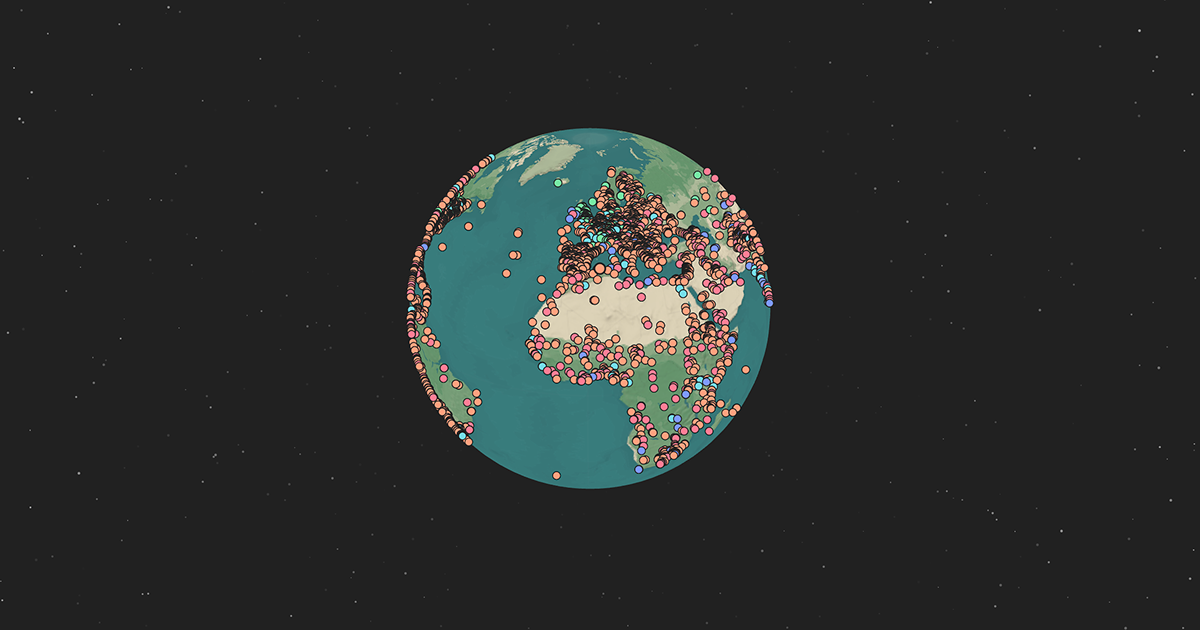
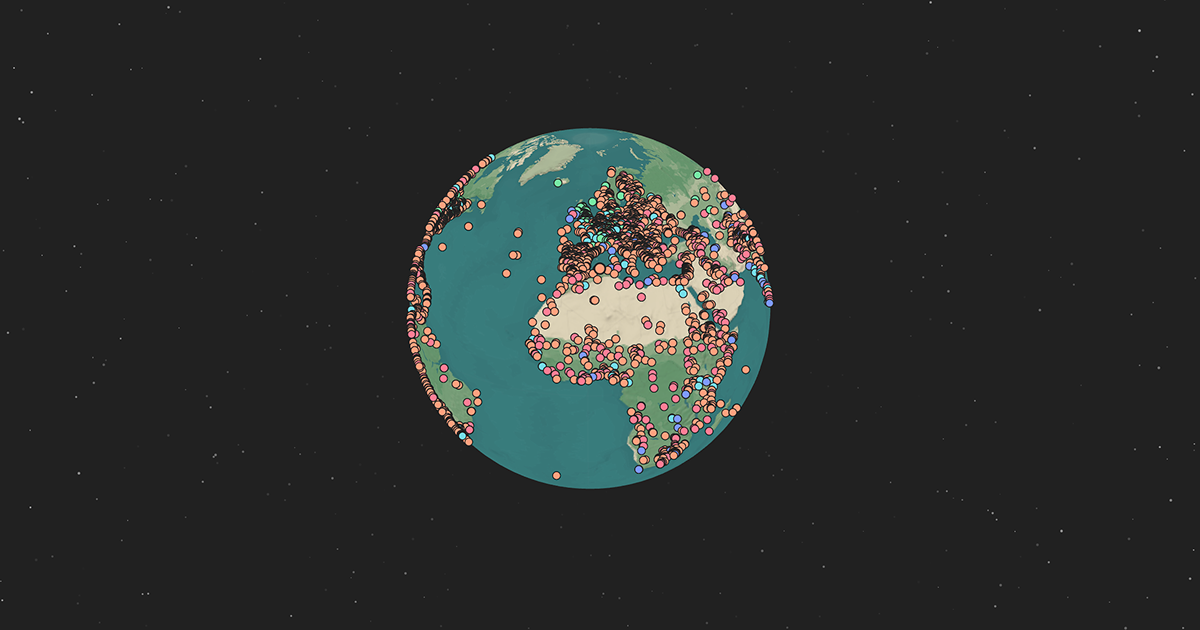
Globe of History is an interactive 3D mapping platform that visualizes historical events across both geographic space and time. Launched in November 2024, the platform transforms historical learning from static timelines into dynamic spatial exploration. By rendering battles, philosophical movements, inventions, assassinations, and natural disasters as location-tagged markers on a 3D globe, the tool enables users to discover patterns and connections across approximately 6,000 years of recorded human history. The platform addresses the challenge of understanding simultaneous historical developments across different regions, offering an immersive alternative to traditional linear timelines and flat historical atlases.
Built using Mapbox GL JS and React, Globe of History employs a custom AI data pipeline to aggregate, synthesize, and verify historical information from public sources including Wikipedia and Wikidata. This approach enables rapid expansion of the historical dataset while maintaining factual grounding through automated verification processes.
Key Features
Globe of History provides several distinctive capabilities for historical exploration:
Interactive 3D Globe Interface: The platform renders Earth as a fully rotatable 3D sphere with historical events displayed as geographic markers. Users can zoom into specific regions, pan across continents, and view events from any angle. The interface provides both political boundary overlays and relief maps showing topographical features, enabling geographic context for historical developments.
Draggable Timeline Navigation: A temporal slider positioned at the bottom of the interface allows continuous navigation through centuries. Users can drag the timeline to any point between 4000 BCE and 2025 CE, with the globe updating dynamically to display relevant events. This time-travel mechanism makes it intuitive to observe how centers of power, conflict zones, and innovation hubs shifted across millennia.
Category and Era Filtering: Advanced filtering enables focused exploration by historical theme and period. Category filters include Battles and Wars, Philosophers and Thinkers, Inventions and Discoveries, Assassinations, and Natural Disasters. Era filters allow users to isolate specific time periods such as Ancient, Medieval, or Modern, helping identify patterns within concentrated timeframes.
AI-Powered Data Pipeline: A three-stage AI data factory drives content creation and quality assurance. First, automated scripts harvest structured metadata from Wikipedia and Wikidata, extracting dates, locations, and basic event information. Second, large language models generate concise narrative descriptions for each event, providing historical context in accessible language. Third, an automated verification system cross-references generated narratives against source documents to reduce factual inaccuracies, supplemented by manual spot-checking for quality control.
Comprehensive Historical Dataset: The platform currently maps over 5,000 data points spanning from 4000 BCE to 2025 CE, covering military conflicts, intellectual history, technological milestones, political assassinations, and natural catastrophes. The dataset prioritizes events with established geographic coordinates and verified dates from public historical records.
Source Transparency: Each event marker links to source metadata, allowing users to trace information back to Wikipedia articles and Wikidata entities. This transparency enables users to assess reliability and conduct deeper research through original sources.
How It Works
Globe of History operates through an integrated system combining data processing, visualization, and user interaction:
The platform begins with its AI data factory, which systematically collects historical information from public knowledge bases. Automated scripts query Wikipedia and Wikidata for events with temporal markers and geographic coordinates. This harvested metadata includes event names, dates, locations, categories, and reference links.
Once raw data is collected, the AI pipeline processes each event through a large language model that generates short narrative summaries. These AI-generated descriptions aim to provide context and significance for each event in 2-3 sentences, making complex historical moments accessible to general audiences.
Before events appear on the platform, an automated verification stage cross-checks generated narratives against source documents to identify potential hallucinations or inaccuracies. Manual reviewers conduct spot-checks on a sample of entries to maintain quality standards. This hybrid approach balances scalability with accuracy.
The verified dataset feeds into the visualization layer built with Mapbox GL JS and React. When users access the platform, they see a 3D globe rendered with WebGL technology, displaying event markers as interactive pins. Each pin is geotagged to its precise location and timestamped to its occurrence date.
Users navigate history by dragging the timeline slider, which filters visible events based on the selected time period. Rotating or zooming the globe allows spatial exploration, while clicking individual markers reveals event details including narrative descriptions and source links. Category filters refine results to specific themes, enabling comparative analysis such as tracking philosophical centers across centuries or visualizing the geographic spread of technological innovations.
The desktop-optimized interface ensures smooth rendering of thousands of data points simultaneously, though mobile support is planned for future development.
Use Cases
Globe of History serves diverse educational, research, and engagement applications:
Historical Education: Students can visualize temporal and spatial relationships between events that traditional textbooks present separately. Seeing the Roman Empire’s expansion alongside contemporaneous Chinese dynasties or understanding how Renaissance thinking spread from Italian city-states to Northern Europe becomes intuitive through spatial-temporal visualization.
Academic Research: Historians and researchers use the platform to identify correlations between events across different regions and time periods. The tool facilitates hypothesis generation by revealing patterns such as migration routes following climate events, the geographic clustering of philosophical schools, or the spatial distribution of military conflicts during specific eras.
Geographic History Contextualization: Travelers and cultural enthusiasts explore the historical significance of locations they plan to visit or regions they study. The platform provides quick visual summaries of a location’s historical importance across different periods.
Curriculum Development: Educators incorporate the platform into lesson planning for world history courses, using it to create visual demonstrations of historical narratives. The timeline playback feature enables instructors to show how political boundaries, cultural centers, and power dynamics evolved over centuries.
Museum and Exhibition Support: Cultural institutions utilize the platform as an interactive component for exhibitions, providing visitors with spatial context for artifacts and historical narratives. The visual interface engages audiences who may find traditional text-heavy displays less accessible.
Comparative Chronology: Users investigating questions like “What was happening in other parts of the world during the American Revolution?” can set the timeline to specific dates and survey global events simultaneously occurring, revealing interconnections and contrasts between civilizations.
Pros and Cons
Advantages
Globe of History offers compelling benefits for historical visualization:
The spatial-temporal approach provides unique insights that linear timelines cannot deliver. Seeing the geographic clustering of events, understanding distance relationships between contemporaneous developments, and tracking movement patterns across regions transforms abstract historical knowledge into tangible visual understanding.
The AI data factory enables rapid dataset expansion that would be impractical with purely manual curation. Processing thousands of events from public knowledge bases accelerates content development while maintaining source attribution through Wikipedia and Wikidata links.
The filtering system supports both broad exploration and focused analysis. Users can survey entire millennia to identify macro-patterns or narrow their view to specific categories and time periods for detailed study of particular themes.
The platform is free to use at launch, lowering barriers for educators, students, and independent learners. This accessibility democratizes sophisticated historical visualization tools previously available only through expensive software or institutional subscriptions.
Transparent sourcing builds trust and supports further research. Unlike black-box AI systems, Globe of History links every event to its source metadata, enabling users to verify information and explore topics in greater depth.
Disadvantages
Globe of History faces several notable limitations:
The desktop-only interface restricts access for mobile and tablet users, who represent a significant portion of educational technology consumers. This limitation may affect classroom integration in schools with tablet-based learning programs or students relying on mobile devices for study.
Dataset coverage reflects biases inherent in historical records and source materials. Regions with rich written traditions and digitized archives appear denser on the map than areas with oral histories or less-documented pasts. This imbalance may reinforce Eurocentric narratives if users don’t recognize that map density represents recorded history rather than historical importance.
AI-generated narratives risk oversimplification of complex events. Condensing multifaceted historical moments into 2-3 sentence descriptions inevitably omits nuance, potentially creating misleading impressions for users without existing historical knowledge.
The platform functions best as a supplementary tool rather than a comprehensive historical reference. While it excels at providing visual entry points and geographic context, serious research requires consulting primary sources and scholarly analysis beyond what Globe of History provides.
The verification process, while transparent about using automated checks and manual spot-checking, cannot guarantee complete accuracy across thousands of entries. Users conducting formal research should treat the platform as a discovery tool rather than an authoritative source.
The dataset remains a work in progress with ongoing refinement. Early adopters may encounter gaps in coverage, regional imbalances, or occasional inaccuracies that will improve over time but currently affect comprehensiveness.
How Does It Compare?
Globe of History enters an established market of digital historical visualization tools, each serving overlapping but distinct purposes. The competitive landscape includes interactive atlases, timeline platforms, and mapping services:
Interactive Historical Atlases
GeaCron: A mature web-based historical atlas providing interactive maps with timeline controls spanning from 3000 BCE to present. GeaCron specializes in geopolitical boundary changes, showing territorial evolution of empires, kingdoms, and nations year by year. Users can visualize political entities, battles, expeditions, and comparative histories across regions. The platform offers both free web access and iOS app. Compared to Globe of History, GeaCron provides more detailed geopolitical mapping with precise border changes, while Globe of History emphasizes thematic event categorization and AI-curated narratives.
Chronas: An ambitious history map application featuring over 50 million data points with Wikipedia integration. Built as a collaborative platform where registered users can contribute and curate content, Chronas covers 1 CE to 2000 CE with features including population data, cultural and religious information, migration patterns, and centers of power. The platform uses Wikipedia as its knowledge base, automatically linking map regions to relevant articles. Globe of History differentiates through its 3D visualization and broader temporal range extending to 4000 BCE, while Chronas offers deeper data density for the Common Era with community contribution features.
Historica.org: An AI-powered historical mapping platform focusing on territorial boundaries and landscape reconstruction. Historica uses AI to generate historical maps based on place data and clustering algorithms that infer borders from mentions of places associated with specific states in given years. The platform emphasizes cartographic accuracy and verification against historical sources. Unlike Globe of History’s event-centric approach, Historica prioritizes territorial mapping and political geography with AI-generated boundary visualizations.
Running Reality (World History Model): A timeline-based historical visualization allowing exploration of human civilization from 3000 BCE to present. The platform focuses on territorial changes and political boundaries across time. Globe of History distinguishes itself through category-based event filtering and thematic organization beyond purely geopolitical mapping.
Timeline and Mapping Platforms
TimeMapper: An open-source platform combining geographic locations with temporal data streams to create timeline visualizations. Users can import spreadsheet data containing dates, locations, and descriptions to generate interactive timemaps. TimeMapper excels in customizable project creation where educators and researchers build specific historical narratives from their own data. Globe of History offers a pre-built, comprehensive dataset covering world history, while TimeMapper provides flexible tools for creating specialized timemaps from user-supplied information.
OldMapsOnline: A mobile and web application providing access to over 500,000 high-resolution scanned historical maps. The platform enables users to overlay historical maps on modern geography, explore political boundaries across time periods through an interactive timeline, and view historical context including battles and notable figures. OldMapsOnline emphasizes authentic historical cartography and map comparison, while Globe of History focuses on event visualization with modern 3D rendering.
Harvard MAPS (Mapping Past Societies): An academic geodatabase with geospatial and analytical capabilities covering diverse historical topics including economic development, pandemics, climate change, religious movements, and migration. Built for scholarly research, MAPS provides sophisticated GIS functionality for analyzing complex datasets. Globe of History targets broader audiences with intuitive 3D visualization, while Harvard MAPS serves researchers needing advanced spatial analysis tools.
Traditional Historical Resources
World History Encyclopedia: A comprehensive online encyclopedia providing fact-checked articles, images, videos, maps, and timelines. Operating as a non-profit, the platform offers educational materials including interactive lessons and primary source analyses. World History Encyclopedia emphasizes narrative depth and scholarly rigor with editorial oversight, while Globe of History prioritizes visual exploration and spatial-temporal discovery.
Wikipedia and Wikidata: The foundational sources that Globe of History draws upon. These platforms provide exhaustive textual information with extensive sourcing and community editing. Globe of History transforms this textual data into visual, interactive experiences but trades encyclopedic depth for geographic intuition and temporal navigation.
Key Differentiators
Globe of History distinguishes itself through several unique combinations:
The 3D globe visualization creates intuitive spatial understanding that 2D maps cannot replicate, particularly for understanding distance relationships, maritime connections, and global patterns. Most competitors use flat maps or political boundary overlays.
The AI data factory enables rapid scaling of content with automated narrative generation and verification, balancing speed with quality control through hybrid AI-human review processes. This approach differs from purely manual curation or fully community-driven platforms.
The category-based filtering system allows thematic exploration across the full temporal range, making it easy to track specific types of events such as philosophical movements or technological innovations across millennia. Most competitors focus primarily on geopolitical boundaries and territorial changes.
The approximately 6,000-year temporal span from 4000 BCE to 2025 CE provides comprehensive coverage exceeding many competitors that focus on more limited date ranges or specific eras.
The free, accessible desktop interface with no registration required lowers barriers to entry compared to subscription services or platforms requiring account creation.
However, Globe of History trades customizability for convenience—users work with the pre-built dataset rather than creating custom visualizations. Platforms like TimeMapper offer greater flexibility for specialized projects but require more setup effort.
Pricing and Availability
Globe of History launched as a free platform in November 2024, requiring no subscription or account registration. Users access the full feature set through web browsers on desktop computers at globeofhistory.com. The team has indicated plans to expand accessibility with mobile device support in future updates, though no timeline has been publicly specified. The free access model makes the platform accessible to individual learners, educators, and researchers without budget constraints, though the sustainability model beyond initial launch has not been publicly disclosed.
Final Thoughts
Globe of History represents an innovative approach to historical education and exploration by transforming abstract timelines into spatial narratives. The platform successfully addresses a genuine gap in historical learning tools—helping users understand not just when events occurred, but where they happened and how they relate geographically to simultaneous developments elsewhere. The AI-powered data pipeline demonstrates practical application of automation in educational content creation, balancing scalability with verification safeguards.
The tool is particularly valuable for visual learners, students seeking geographic context for historical events, and educators looking for engaging demonstration tools. The ability to watch history unfold across a rotatable globe while dragging through centuries creates memorable learning experiences that static textbooks cannot replicate.
However, users should approach the platform with appropriate expectations. Globe of History excels as a discovery and visualization tool but cannot replace comprehensive historical education. The AI-generated narratives provide helpful summaries but inevitably omit complexity and nuance. Regional coverage biases reflect the underlying data sources, meaning the platform visualizes recorded history rather than providing equal representation of all civilizations.
The desktop-only limitation currently restricts educational applications in mobile-first contexts, though planned expansion may address this constraint. As the dataset continues to mature through ongoing refinement and community feedback, coverage gaps and occasional inaccuracies should diminish.
For educators teaching world history, students visualizing chronological relationships, or history enthusiasts exploring connections between events, Globe of History offers a compelling free resource worth integrating into learning workflows. It works best when paired with traditional educational materials—using the platform to generate questions and spark curiosity, then consulting scholarly sources for authoritative information. The combination of intuitive spatial-temporal navigation, thematic filtering, and transparent sourcing makes Globe of History a valuable addition to the digital history toolkit, particularly for audiences who benefit from visual, interactive learning experiences.