
Table of Contents
Overview
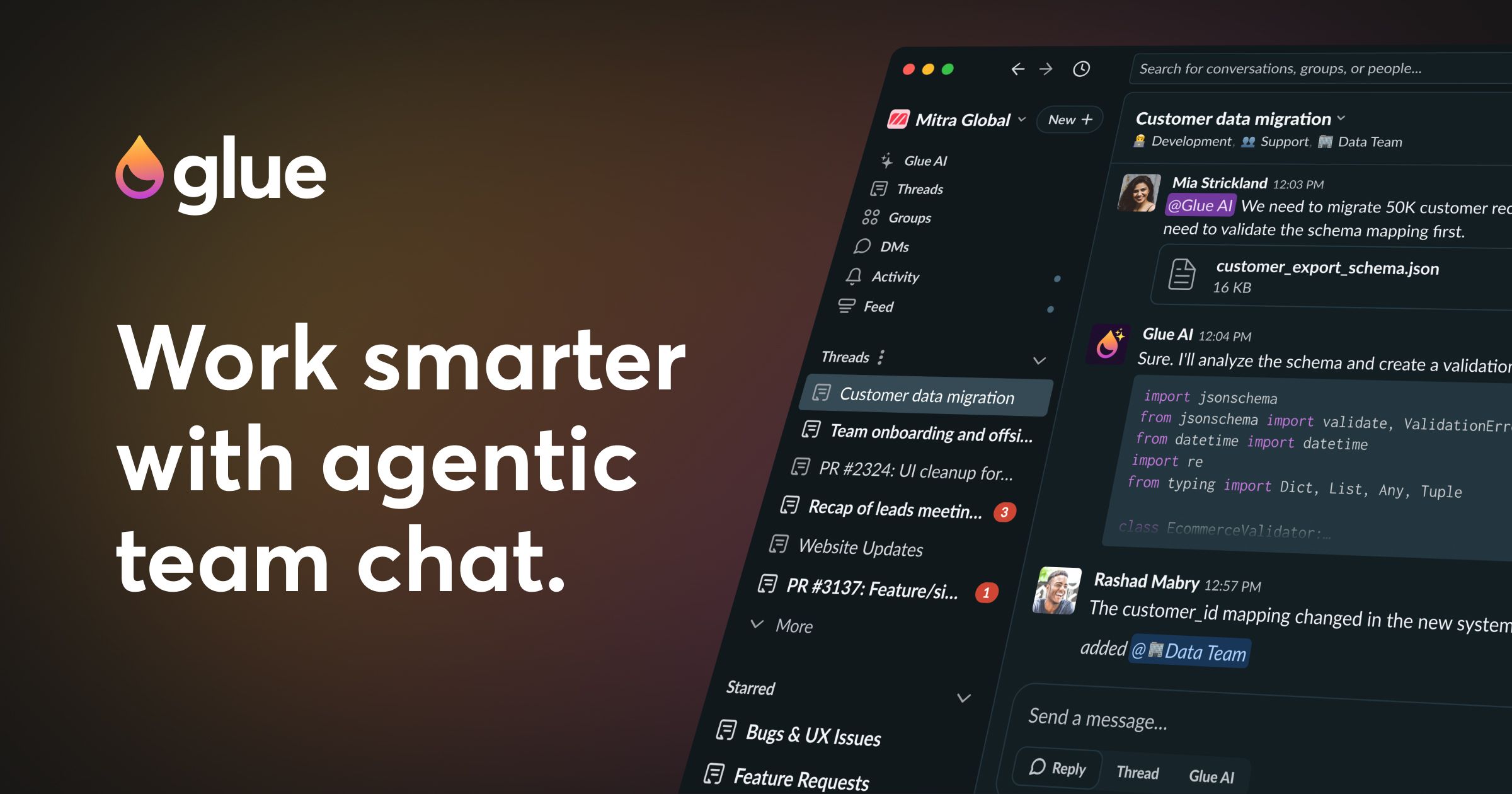
In the rapidly evolving landscape of team collaboration, Glue emerges as a groundbreaking platform, redefining how humans, their tools, and AI interact. As the first platform for agentic team chat, Glue is designed to cut through the noise and transform conversations into tangible outcomes. By seamlessly integrating native AI, goal-oriented threads, and MCP-powered workflows, Glue empowers teams to collaborate side by side with intelligent agents, ensuring every discussion drives progress and delivers measurable results.
Key Features
Glue is packed with innovative features designed to streamline communication and boost productivity. Here’s a closer look at what makes it stand out:
- Native AI integration in team chats: AI agents are not just add-ons; they are integral participants in your team conversations, offering real-time assistance and insights with access to multiple AI providers including GPT-5, Claude, and Gemini.
- Goal-oriented threading for tasks: Conversations are structured around specific objectives, ensuring discussions remain focused and directly contribute to task completion while reducing channel noise and distractions.
- MCP-powered automated workflows: Leverage Model Context Protocol to connect with over 35 one-click install apps and thousands more through custom MCP servers, enabling sophisticated automated workflows based on chat interactions.
- Human-AI-tool collaboration: Glue fosters an environment where human intelligence, AI capabilities, and various tools work in concert through the largest in-app MCP directory, creating a truly synergistic workspace.
- Multiplayer agentic AI: Teams can collaborate with AI agents simultaneously in the same thread, with context-aware responses that understand your specific work patterns and team dynamics.
- Outcome tracking from conversations: Every interaction and decision is logged and linked to specific outcomes, providing clear visibility into progress and accountability with open data principles ensuring portability.
How It Works
Understanding the mechanics behind Glue reveals its power as an AI-native collaboration platform. Teams initiate collaboration by joining dedicated chat rooms or threads, where AI agents participate alongside human users as core teammates rather than simple plugins. Conversations are intuitively structured around predefined goals, which in turn trigger automated workflows designed to streamline operations across connected tools and applications. The integrated AI continuously analyzes inputs from the chat, offering intelligent suggestions for actions, seamlessly integrating necessary tools through MCP, and generating desired outcomes. Crucially, all interactions, decisions, and outcomes are meticulously logged with open data architecture, providing a comprehensive audit trail for review and future reference while ensuring data remains under user control.
Use Cases
Glue’s versatile design makes it suitable for a wide array of applications, enhancing productivity across different team functions:
- Collaborative project management in remote teams: Facilitate seamless communication and task progression for geographically dispersed teams, with AI agents helping coordinate work across time zones and maintaining project momentum.
- Automating routine tasks in development and operations: Leverage AI to handle code reviews, deployment coordination, and issue tracking through integrated tools like Linear, Notion, and GitHub, freeing up human agents for strategic work.
- Integrating AI into daily workflows for productivity: Embed AI assistance directly into everyday tasks, from drafting documentation to analyzing project metrics, with context-aware suggestions based on team history and preferences.
- Enhancing cross-functional team coordination: Utilize AI’s analytical capabilities to provide data-driven insights for complex projects involving multiple departments, ensuring alignment and informed decision-making.
Pros \& Cons
Every innovative tool comes with its unique set of advantages and challenges. Here’s a balanced view of Glue:
Advantages
- True agentic AI integration: AI agents are deeply embedded as core teammates with sophisticated MCP-powered tool access, not just superficial add-ons or simple chatbots.
- Comprehensive workflow automation: MCP integration with thousands of apps enables complex, multi-step automation that spans across your entire tool ecosystem.
- Open data architecture: Built with data portability and user control at its core, ensuring teams maintain ownership and flexibility without vendor lock-in.
- Context-aware intelligence: AI understands team dynamics, project history, and tool relationships to provide genuinely useful assistance rather than generic responses.
Disadvantages
- Early-stage product complexity: As a cutting-edge platform, teams may need time to fully understand and leverage the sophisticated MCP and agentic AI capabilities.
- Dependency on integration ecosystem: The platform’s power relies heavily on the breadth and quality of MCP server implementations and tool integrations.
- Learning curve for AI-native workflows: Teams accustomed to traditional chat tools may require adjustment time to fully embrace agentic collaboration patterns.
How Does It Compare?
When evaluating Glue against its contemporaries, its unique value proposition as the first truly agentic team chat platform becomes clear. While Microsoft Teams has significantly evolved with Copilot integration, featuring AI Facilitator agents, thread summarization, and real-time prompts throughout 2025, Glue distinguishes itself by making AI a core participant rather than an assistant. Teams Copilot excels at meeting facilitation and productivity enhancement, but operates within Microsoft’s ecosystem with AI as a supporting feature.
Slack has transformed substantially since launching its comprehensive AI toolkit in 2025, offering channel recaps, AI-powered search, and Agentforce integration for enterprise workflows at \$10 per user monthly. However, Slack AI primarily focuses on summarizing and searching existing conversations, while Glue’s agentic approach enables AI to actively participate in and drive conversations forward with actionable outcomes.
Notion AI has expanded dramatically in 2025, adding Jira connectivity, calendar integration, and sophisticated workflow automation for collaborative document creation. While Notion excels at structured knowledge management and content collaboration, Glue’s strength lies in real-time, conversation-driven teamwork where AI agents can immediately act across connected tools through MCP.
The fundamental differentiator is Glue’s MCP-native architecture, which enables seamless tool connectivity and true agentic behavior. Rather than requiring teams to adapt their workflows to fit within existing platform constraints, Glue’s open, extensible approach allows AI agents to work naturally with any tool or system, making it uniquely positioned for teams that need flexible, intelligent automation at the center of their collaboration.
Final Thoughts
Glue represents a significant evolution in team collaboration, pioneering the concept of agentic chat where AI serves as an active participant rather than a passive assistant. Its MCP-powered architecture and commitment to open data principles position it as a transformative solution for teams looking to harness artificial intelligence as a genuine teammate. While the platform requires teams to embrace new collaboration paradigms and may present initial complexity, its innovative approach to human-AI-tool integration offers unprecedented potential for streamlined, outcome-driven teamwork. For organizations ready to move beyond traditional chat tools and embrace AI as a core collaborator, Glue provides a compelling glimpse into the future of intelligent workplace communication.