Table of Contents
Overview
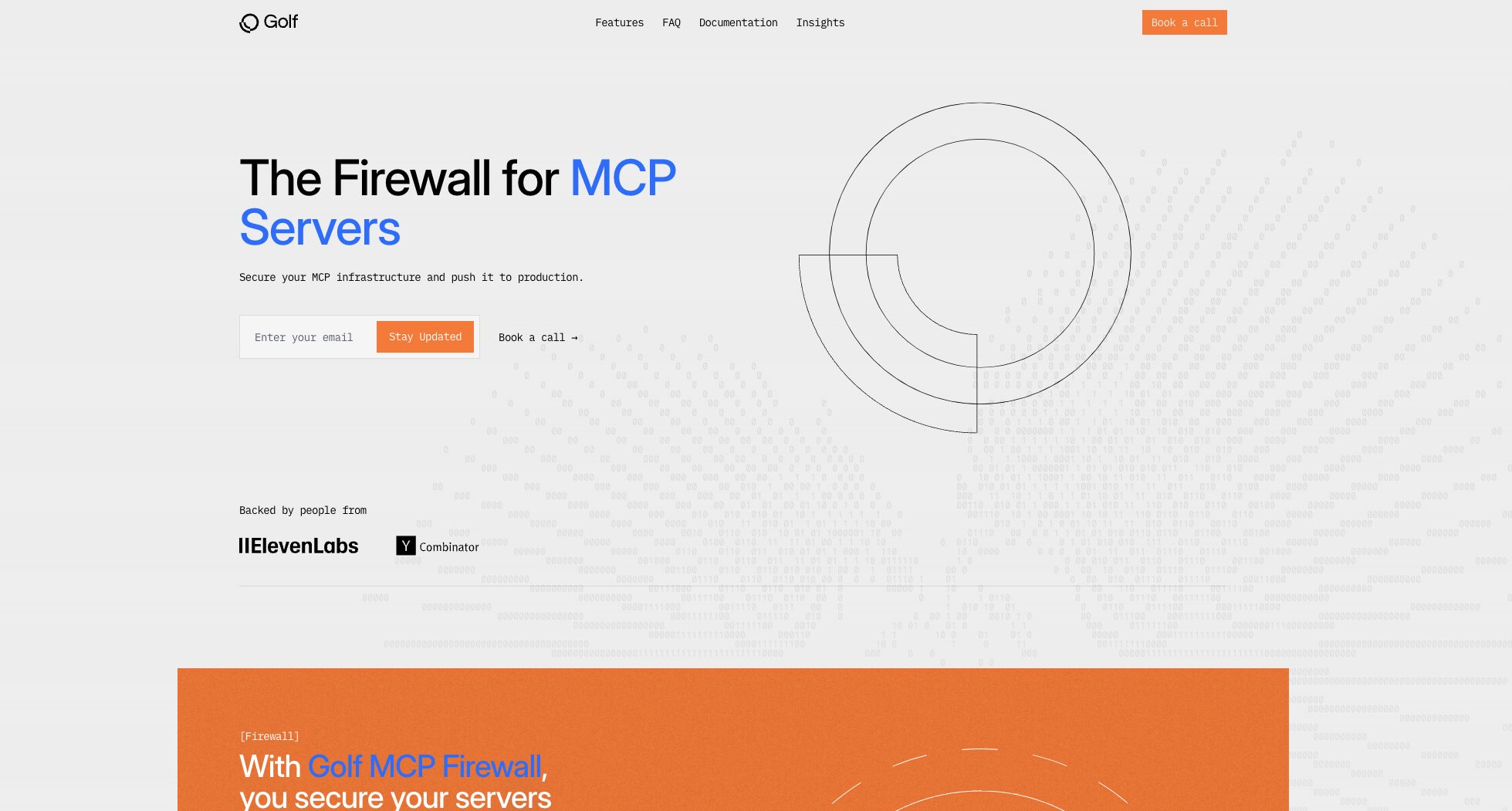
As AI agents increasingly power enterprise operations, the security architecture underlying these systems has become critical. Model Context Protocol (MCP) servers—which enable AI agents to safely interact with external data sources and tools—create new security challenges that traditional infrastructure tools fail to address. Prompt injection attacks, PII leaks, and credential exposure represent unique risks within the MCP ecosystem, particularly when agents retrieve data from multiple sources and execute tool calls. Golf Firewall addresses this gap by providing protocol-aware security specifically designed for MCP server deployments. By positioning itself between MCP servers and external agents, Golf proactively identifies and blocks malicious patterns, sensitive data exposure, and token abuse before they compromise agent integrity or expose organizational data.
Key Features
Golf Firewall delivers MCP-specific security capabilities designed to protect the agent-to-tool interaction layer:
- MCP prompt injection detection: Analyzes MCP server requests and tool responses in real-time, identifying both direct and indirect prompt injections where malicious instructions are embedded in external data or tool call responses.
- Credential and token protection: Detects credential leaks, API key exposure, and token hijacking attempts in MCP traffic; prevents authentication tokens from being exfiltrated through tool calls or response data.
- Sensitive data blocking: Automatically identifies and filters personally identifiable information (PII) before it reaches external agents, ensuring compliance with data protection regulations while maintaining operational functionality.
- Protocol-aware security: Understands MCP’s specific threat vectors—tool spoofing, resource indicator validation, command injection in tool parameters—that generic firewalls cannot detect.
- Pre-agent request validation: Analyzes and validates incoming requests at the MCP server level, checking token legitimacy, resource permissions, and suspicious request patterns before tool execution.
- Audit trails and compliance logging: Records complete data flow tracing and security event logging for forensic analysis, regulatory compliance, and incident response.
- CORS and security headers management: Automatically configures Cross-Origin Resource Sharing (CORS) policies and security headers across MCP server infrastructure from a centralized control plane.
How It Works
Golf Firewall operates by acting as the master MCP server in your infrastructure, intercepting all traffic between your MCP server deployments and external agents. The architecture positions Golf strategically in your network, where it processes every request and response flowing through your MCP endpoints. As requests arrive from agents seeking to access tools or retrieve data, Golf performs multi-stage analysis: it validates MCP tokens using strict spec compliance, verifies resource indicators against authorization policies, and analyzes request parameters for injection patterns or suspicious command structures. Simultaneously, when your MCP server prepares responses—including tool outputs and data retrieval results—Golf scans this content for embedded malicious instructions, credential patterns (API keys, passwords, tokens), and sensitive personal information. If Golf detects a threat, it immediately blocks the response from leaving your infrastructure, preventing the compromised data from ever reaching the external agent. This occurs entirely within your infrastructure, ensuring no sensitive data transits to third-party systems. The unified control plane consolidates security policies across all MCP server instances, eliminating the inconsistency that emerges when each server implements independent security controls.
Use Cases
Golf Firewall protects multiple critical scenarios where MCP servers interact with AI agents:
- Enterprise agent deployments: Secure internal AI agents that access sensitive business data through MCP servers—financial records, customer information, proprietary systems—preventing data exfiltration or agent manipulation.
- Multi-MCP server environments: Enforce consistent security policies across distributed MCP server deployments, eliminating security gaps that attackers could exploit across multiple endpoints.
- Customer-facing AI agents: Protect customer-facing agents that interact with internal MCP servers, ensuring that malicious end-user inputs cannot trick agents into exposing internal systems or credentials.
- Tool integration security: Secure MCP servers that integrate with external tools and services, detecting when tool responses contain injected instructions or stolen credentials and preventing these attacks from reaching agents.
- Compliance-critical deployments: Maintain audit trails and policy enforcement for regulated industries (healthcare, finance, legal) where MCP server access logs and data protection are regulatory requirements.
- Supply chain AI automation: Secure agents that automate workflows across multiple organizations and systems, ensuring that compromised external data sources cannot manipulate internal agents.
Pros \& Cons
Advantages
- MCP protocol expertise: Unlike generic security tools, Golf understands MCP’s specific attack surface—tool specifications, resource indicators, token mechanics—enabling precise threat detection.
- Infrastructure-resident security: Operates within your network; sensitive data never leaves your infrastructure, ensuring compliance and eliminating external service dependencies.
- Unified policy enforcement: Centralized control plane eliminates the fragmentation and inconsistency that emerges when each MCP server independently implements security controls.
- Pre-compromise blocking: Stops threats before they reach agents, rather than relying on post-incident detection or damage control.
- Real-time protection: Continuous monitoring and immediate blocking enable rapid response to emerging threats without human intervention delays.
- Compliance support: Built-in audit trails, data classification, and policy enforcement support regulatory compliance (GDPR, CCPA, HIPAA, SOC 2).
Disadvantages
- MCP-specific focus: Designed exclusively for MCP security; organizations without MCP deployments need different security solutions.
- Infrastructure integration required: Requires deployment within your network architecture; not a simple SaaS add-on for less technically mature organizations.
- Emerging platform maturity: As a recently launched solution, long-term stability, feature roadmap execution, and ecosystem integration remain to be validated.
- Potential false positive tuning: Content classification and pattern detection may require initial tuning to balance security with operational efficiency in specific environments.
- MCP ecosystem still evolving: As MCP standards and adoption patterns continue developing, security requirements and threat vectors may change, requiring platform evolution.
How Does It Compare?
The broader AI security ecosystem includes multiple categories of solutions, each addressing different threat models:
Traditional API Gateways (Kong, MuleSoft, AWS API Gateway, NGINX, Apache APISIX) provide foundational security through authentication, authorization, rate limiting, and request validation. These tools excel at managing who can access what and protecting against traditional API abuse. However, they lack LLM-specific threat intelligence and don’t understand MCP protocol specifics. They cannot detect prompt injections because they treat all traffic equally, without semantic understanding of AI agent-tool interactions. For MCP deployments, API gateways provide baseline infrastructure security but miss agent-specific threats entirely.
General AI Security Platforms (Lakera Guard, Prompt Security, HiddenLayer, Arthur.ai) focus on LLM-level threat detection—monitoring model inputs and outputs for jailbreak attempts, harmful content, and prompt manipulation. These solutions provide valuable protection for models themselves, detecting when user queries contain injection attempts or when model outputs generate inappropriate content. However, they operate at the LLM layer, not the infrastructure layer. They don’t understand MCP server interactions, tool calls, or the specific vectors through which agents interact with external systems. For organizations using standard LLM APIs (like OpenAI or Claude), these solutions provide essential security; for MCP deployments, they leave server-layer threats unaddressed.
Content Moderation APIs (OpenAI Moderation API, Hive, Perspective API, Sightengine, CleanSpeak) classify text and media content as safe or harmful based on predefined categories. These tools excel at identifying toxic language, adult content, or policy violations. However, their focus is content classification, not security threat detection. They cannot identify sophisticated prompt injections disguised in legitimate text, detect token leaks in structured data, or understand MCP-specific attack vectors. OpenAI’s Moderation API includes both pre-processing (analyzing user input before sending to models) and post-processing capabilities, but remains designed for general content moderation rather than infrastructure security.
MCP-Specific Security Platforms now emerging include:
- Pillar Security provides automated discovery, inventory, and runtime protection for MCP servers, with adaptive guardrails and anomaly detection for MCP interactions.
- MCP Guardian (EQTY Lab) offers proxy-based security with message logging, automated scans, and real-time approval workflows for MCP traffic.
- Invariant’s MCP-Scan provides static analysis and runtime protection against tool poisoning, rug pulls, and prompt injection in MCP contexts.
- ScanMCP.com offers cloud-based scanning and real-time monitoring for MCP workflows, detecting context drift, protocol misconfigurations, and malicious activity.
- Teleport introduces zero-trust architecture to MCP with strict access control and comprehensive audit trails for LLM interactions.
Golf Firewall’s distinctive positioning combines several unique advantages: it provides the deepest MCP protocol awareness among security solutions, operates infrastructure-resident (eliminating third-party data transmission), and blocks threats before they reach agents rather than relying on post-incident detection. Unlike API gateways that treat MCP traffic as generic API calls, Golf understands prompt injection patterns specific to agent-tool interactions, token mechanics within MCP contexts, and the specific vulnerabilities created when agents retrieve and process external data. Unlike general AI security platforms focused on LLM input/output, Golf secures the MCP server layer itself—where tools execute and data flows between agents and external systems. For enterprises deploying MCP servers with customer-facing or sensitive-data-accessing agents, Golf provides specialized protection that generic security tools cannot offer. However, organizations needing cross-platform security, general AI threat detection, or traditional API gateway capabilities may find broader platforms more suitable.
Final Thoughts
Golf Firewall addresses a genuine security gap in the rapidly expanding MCP and AI agent ecosystem. As enterprises increasingly deploy AI agents that interact with external systems through MCP servers, the security layer at this interface becomes critical. Traditional security tools were not designed with prompt injection, agent manipulation, or MCP-specific threat vectors in mind. Golf’s protocol-aware design, infrastructure-resident architecture, and pre-compromise blocking approach represent a necessary evolution in AI security infrastructure. While Golf’s specialization means it serves a specific use case—organizations deploying MCP servers—for that use case, it provides capabilities that no existing security platform adequately addresses. As MCP adoption accelerates and AI agents become embedded in enterprise operations, specialized security solutions like Golf Firewall will likely become standard infrastructure requirements rather than optional security enhancements. For enterprises deploying MCP servers or planning AI agent infrastructure, Golf warrants careful evaluation as part of comprehensive security architecture.