Table of Contents
Good Assistant
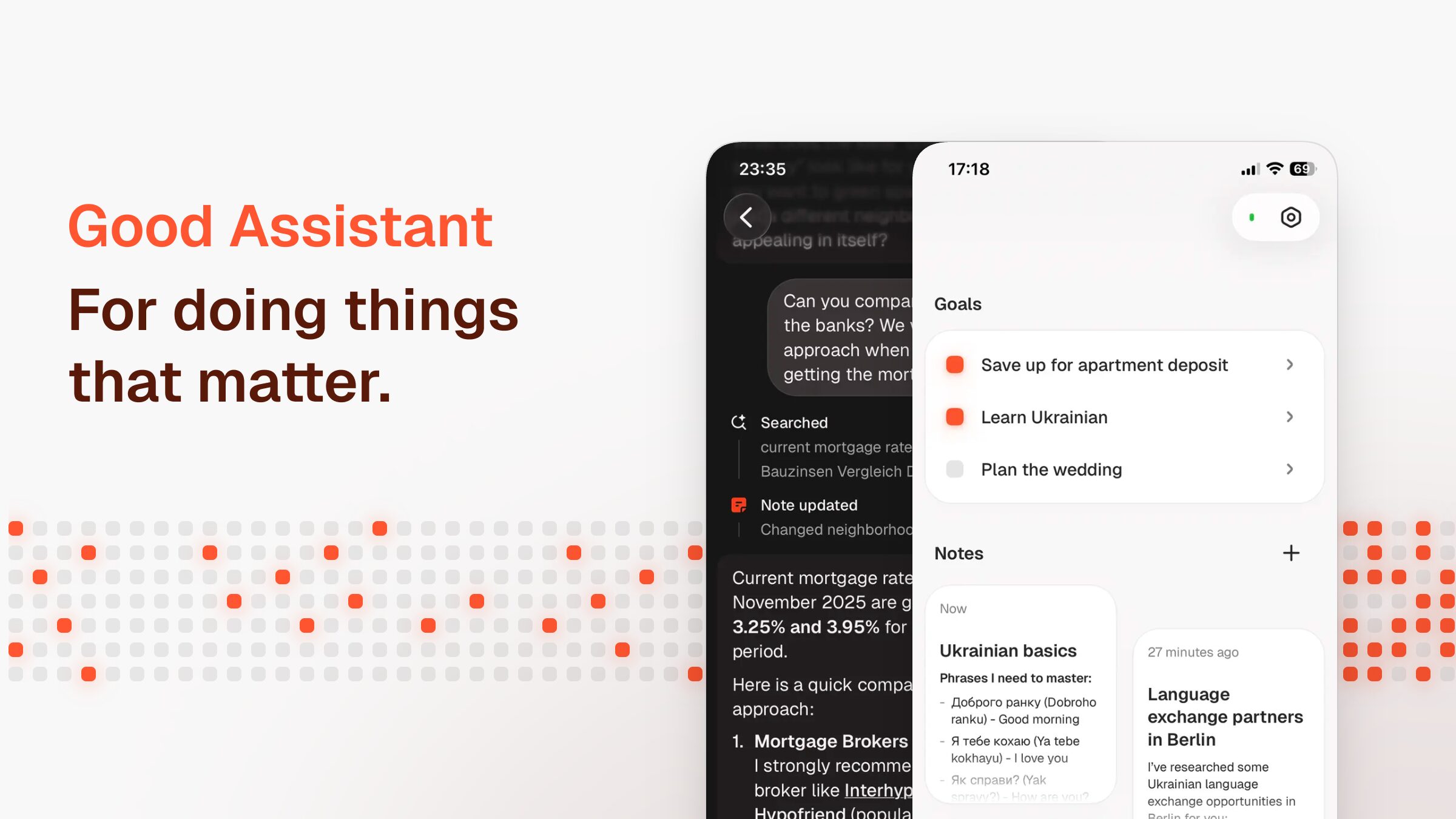
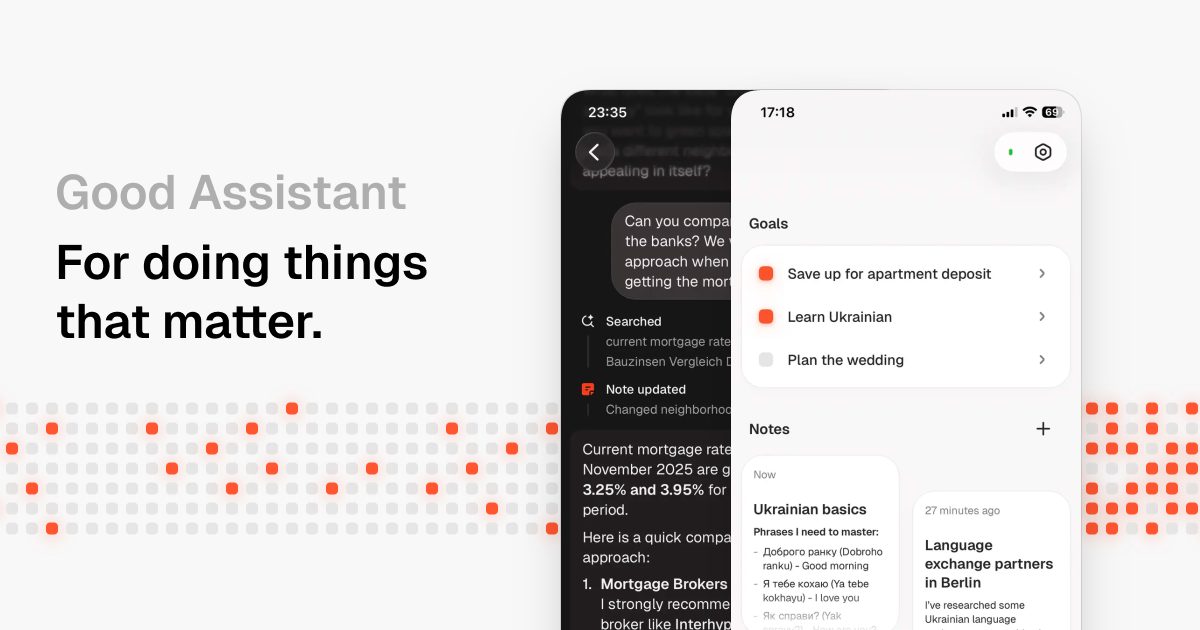
Good Assistant is an AI-powered personal productivity tool designed to bridge the gap between simple task management and long-term goal achievement. Unlike standard chatbots that reset context, it emphasizes persistent memory and proactive engagement to help users break down ambitions into actionable daily steps.
Core Features
- Goal-Oriented Memory System: Retains user context across all sessions, remembering personal preferences, long-term objectives, and past conversations to provide consistent guidance.
- Visual Progress Tracking: automatically generates visual timelines and milestone trackers for defined goals, making abstract ambitions concrete.
- Proactive Engagement: Instead of waiting for prompts, the assistant initiates check-ins, offers suggestions, and sends reminders based on your established plans.
- Integrated Workspace: Combines a note-taking interface with AI chat, allowing the assistant to read, edit, and organize your notes directly.
- Task Decomposition: AI breaks down complex, high-level goals (e.g., “Launch a business”) into small, manageable daily tasks.
How It Works
Users begin by defining a high-level goal. The AI analyzes this objective and the user’s existing notes/calendar to build a personalized execution plan. It then operates as an active partner—monitoring progress, sending reminders for upcoming deadlines, and conducting web research to solve specific blockers as they arise. All interactions are stored in a persistent memory layer, allowing the assistant to “grow” with the user over time.
Use Cases
- Long-term Goal Achievement: Structured support for multi-month projects like learning a new language, financial planning, or fitness transformations.
- Daily Task Management: Turning overwhelming to-do lists into prioritized, bite-sized actions.
- Research & Thought Partner: acting as a sounding board that remembers previous brainstorming sessions to refine ideas further.
- Personal Development: Tracking habits and offering “coaching” style feedback based on past performance.
Pros & Cons
- Pros: Stronger focus on execution rather than just conversation; solves the “amnesia” problem of standard LLMs with persistent context; integrates planning visuals directly into the chat interface; proactive nature reduces the mental load of remembering to check in.
- Cons: Pricing transparency is low (often requires sign-up to view details); platform availability is currently more limited than major competitors (web-centric); effectiveness relies heavily on the user committing to it as their primary organizational tool; specific data privacy details regarding the long-term storage of personal notes should be reviewed by privacy-conscious users.
Pricing
- Pricing is not publicly listed on the main landing page without account creation. It typically follows a freemium model common to similar tools, but users should check the app directly for the latest tiers.
How Does It Compare?
The market for “AI with Memory” has exploded in 2026. Good Assistant competes by focusing specifically on goals, whereas others focus on general conversation or knowledge management.
- ChatGPT (OpenAI)
The generalist leader. While it now has a “Memory” feature to recall facts (e.g., “you like python”), it lacks the structured goal visualization and timeline management of Good Assistant. ChatGPT is a better tool for answering questions, but Good Assistant is a better manager for tracking a project over months. - Claude (Anthropic)
Claude’s “Projects” feature allows for deep context within a specific workspace, but it is passive—it waits for you to ask it questions. Good Assistant differentiates itself with proactivity, nudging you to complete tasks without you needing to log in and prompt it first. Dume.ai
A direct competitor in the “unified memory” space. Dume connects to your Slack, Email, and Calendar to build context automatically. Good Assistant is less about integrating with external apps and more about building a dedicated, focused environment for your personal goals, making it less noisy but also less automated than Dume.Notion AI
The king of integrated notes. If you already live in Notion, its AI features are superior for organizing existing text. However, Notion AI is not a “coach”—it won’t text you on Tuesday to ask if you finished your run. Good Assistant fills this gap by acting as an accountability partner, not just a text editor.Lindy
Lindy focuses heavily on being an “employee” that can execute tasks (like sending emails or booking meetings). Good Assistant is positioned more as a “Coach” or “Planner” that helps you execute tasks, rather than doing them for you.
Final Thoughts
Good Assistant addresses a specific frustration with modern AI: high intelligence but low continuity. By shifting the focus from “chatting” to “planning,” it offers a compelling alternative for users who need an accountability partner rather than just a search engine. It is best suited for individuals who struggle with follow-through on long-term goals and need an AI that actively nags them (helpfully) rather than passively waiting for input.