Table of Contents
Overview
Guess Whale is a gamified reverse-prompt engineering mobile puzzle game launched December 2025 transforming AI image generation understanding into competitive word puzzle gameplay. Rather than users generating images from prompts (traditional prompt engineering), Guess Whale inverts the model—players receive AI-generated images and deduce original prompts through semantic similarity scoring. Available exclusively on iOS through Apple App Store and compatible with Mac/Vision Pro (requires iOS/macOS 16.0+), Guess Whale by Whale Laboratories represents philosophical shift toward “inverse prompting” as mental exercise building intuition for diffusion model semantics. The December 2025 launch with free unlimited gameplay (cross-platform free access) and optional cosmetic microtransactions validates market interest in AI literacy gamification.
Designed for puzzle enthusiasts, AI curious individuals, and prompt engineers seeking intuitive understanding of semantic similarity, Guess Whale combines Wordle’s daily social format with reverse-prompt deduction mechanics creating unique position in growing AI-gamification space. The emphasis on semantic scoring (rewarding conceptually close attempts versus exact text matching) and collaborative daily challenges enables accessibility for casual players while maintaining depth for advanced users understanding diffusion model semantics.
Key Features
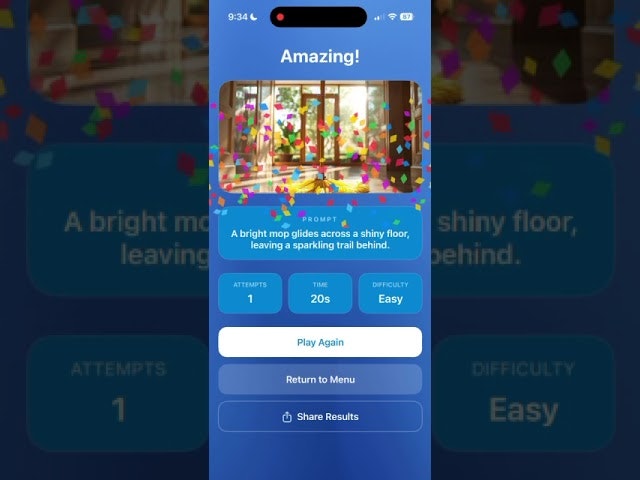
Reverse-Prompt Guessing Gameplay: Players receive AI-generated images and type prompts they believe created it. System scores guesses based on semantic similarity to original prompt—not exact text matching. Conceptually close attempts earn partial credit rewarding intuitive understanding.
Semantic Similarity Scoring: System uses embeddings and semantic understanding scoring prompts on meaning not keywords. Guess “happy dog running” scores well against “joyful puppy sprinting” despite word differences—teaches semantic thinking versus pattern matching.
Daily Hand-Curated Challenges: Every day same image released globally in Wordle-style format. Complete daily challenge in single attempt for maximum stars (leaderboard competitive mode). Optional unlimited practice rounds with same image until solved.
Difficulty Progression: Three difficulty levels (Easy, Medium, Hard) providing accessibility across skill levels. Difficulty determines image complexity and prompt subtlety teaching progressive semantic understanding.
Star Earning and Collectible System: Solve daily challenge in under 10 attempts earning stars. Stars unlock collectible whale icons, cosmetic customizations, and character variants—progression without pay-to-win gameplay.
Leaderboard Competition: Daily challenges enable social competition through leaderboards. See how you rank against global players—similar to Wordle’s viral social sharing mechanics.
Multi-Round Unlimited Play: Beyond daily challenge, unlimited practice rounds against randomized images. Same scoring system enabling learning across infinite variations building semantic intuition.
Whale Character Collection: Grow collection of whale characters with distinct personalities, visual styles, and cosmetic variations. Leaderboard and cosmetic motivation without gameplay advantage gatekeeping.
Educational Feedback System: Scoring shows how close guess was semantically, enabling players learning why close-but-not-exact prompts score well. Builds intuitive understanding of semantic relationships diffusion models recognize.
Social Sharing Integration: Share daily puzzle results on social platforms (similar to Wordle) without spoiling answer. Encourages viral organic growth and community engagement.
How It Works
Download Guess Whale from iOS App Store (free). Open app and access daily challenge. View AI-generated image and guess the prompt you believe created it. Type natural language prompt attempt. System scores your guess based on semantic similarity (not keyword matching) to original prompt. View score and feedback. Retry with refined guesses building understanding. Complete when satisfied or try unlimited practice rounds against new randomized images. Earn stars for efficient solutions. Spend stars unlocking whale character cosmetics and customizations. Track performance on daily leaderboard comparing global ranking.
Use Cases
Learning Prompt Engineering: Users building prompt engineering intuition through gamified reverse-engineering. Understand how semantic relationships work in diffusion models through repeated exposure and feedback.
Daily Brain Training: Casual puzzle players enjoy daily cognitive challenge combining vocabulary, lateral thinking, and visual analysis. 5-10 minute daily sessions provide entertainment and mental stimulation.
Competitive Social Gaming: Leaderboard competition enables social engagement and bragging rights. Sharing daily puzzle results creates viral viral opportunity similar to Wordle’s explosive adoption.
AI Literacy and Understanding: Users curious about how AI image generation works leverage gamification developing intuitive understanding. Demystifies “black box” AI through interactive exploration.
Prompt Engineering Community Building: Brings together prompt engineers, AI enthusiasts, and curious players enabling shared learning culture around semantic understanding and image generation.
Pros \& Cons
Advantages
Fun Gamified Learning: Puzzle gameplay makes AI concepts accessible and entertaining versus abstract education. Rewards exploration and experimentation building intrinsic motivation.
Free to Play with Optional Cosmetics: Generous free tier enables broad adoption without pay-to-win mechanics. Cosmetic-only monetization respects player accessibility while enabling monetization.
Unique Reverse-Engineering Mechanic: Flipping traditional prompt engineering into puzzle creates novel experience unavailable elsewhere. Genuinely original game concept not incremental clone.
Daily Social Format: Wordle-inspired daily challenges with global leaderboards create viral social engagement. Competing and sharing creates community around AI understanding.
Semantic Scoring Beyond Keywords: Rewarding conceptually close attempts teaches sophisticated understanding of semantic relationships versus pattern matching. Builds genuine intuition.
Cross-Platform Accessibility: iOS, Mac, and Vision Pro support reaches broad Apple ecosystem enabling seamless play across devices.
Disadvantages
iOS-Only Limitation: Exclusive iOS/macOS availability excludes Android, Windows, and web players—significant market limitation reducing addressable audience dramatically.
Niche Appeal Ceiling: Puzzle gamers and AI enthusiasts represent niche market. Limited mainstream appeal compared to casual games (Candy Crush, Wordle) restricting growth potential.
Limited Practical Utility: Gameplay teaches semantic understanding but doesn’t translate directly to prompt engineering skill. Learning value incremental versus dedicated prompt engineering courses.
Content Curation Dependency: Game quality depends on daily image curation. Poor image selection, repetition, or creative exhaustion could degrade experience. Sustainable curation challenging long-term.
December 2025 Early-Stage: Launch timing means unproven market fit, unknown retention rates, limited customer references, and potential abandonment risk for small team.
Semantic Scoring Accuracy Questions: Scoring relies on embedding models (likely OpenAI/similar)—accuracy varies. Edge cases, cultural differences, and non-obvious semantic relationships occasionally score incorrectly frustrating players.
Limited Social Features: No player-to-player messaging, communities, or collaborative modes limiting social depth. Pure leaderboard competition versus community building.
How Does It Compare?
Guess Whale vs Pictionary vs AI
Pictionary vs AI is board game where players draw and AI guesses, enabling prediction of AI accuracy—a competitive multiplayer game requiring physical setup and board game materials.
Direction:
- Guess Whale: Reverse (image to prompt guessing)
- Pictionary vs AI: Forward (drawing to AI recognition)
Gameplay Loop:
- Guess Whale: Solo/competitive prompt guessing with leaderboards
- Pictionary vs AI: Multiplayer drawing game with prediction element
Skill Tested:
- Guess Whale: Semantic understanding and prompt intuition
- Pictionary vs AI: Drawing ability and predicting AI recognition
Setup Requirements:
- Guess Whale: Mobile phone only
- Pictionary vs AI: Board, physical components, QR code scanning
Social Model:
- Guess Whale: Async daily leaderboard competition
- Pictionary vs AI: Synchronous multiplayer game
Cost:
- Guess Whale: Free (cosmetics optional)
- Pictionary vs AI: \$30-50 board game
Platform:
- Guess Whale: iOS/Mac
- Pictionary vs AI: Physical board game + mobile app
When to Choose Guess Whale: For solo/async AI understanding puzzle gaming.
When to Choose Pictionary vs AI: For social multiplayer game nights.
Guess Whale vs Midjourney Describe Feature
Midjourney Describe is tool enabling users uploading images receiving four AI-generated prompt suggestions based on that image enabling prompt exploration and variation generation.
Direction:
- Guess Whale: Reverse (guess prompt from image)
- Midjourney Describe: Assist (receive suggestions for images)
Purpose:
- Guess Whale: Learn and test semantic understanding through puzzle gameplay
- Midjourney Describe: Practical tool for prompt exploration and image generation
Interaction:
- Guess Whale: Guessing game with scoring and feedback
- Midjourney Describe: Utility tool providing prompt suggestions
Learning Outcome:
- Guess Whale: Intuitive semantic understanding through gameplay
- Midjourney Describe: Practical prompt engineering technique learning
Primary User:
- Guess Whale: Puzzle gamers and AI curious players
- Midjourney Describe: Image creators and prompt engineers
When to Choose Guess Whale: For learning game and casual understanding building.
When to Choose Midjourney Describe: For practical image generation and prompt exploration.
Guess Whale vs Wordle
Wordle is daily word puzzle where players guess five-letter words in six attempts with color-coded letter feedback (green correct position, yellow wrong position, gray not in word).
Puzzle Type:
- Guess Whale: Image-to-prompt with semantic scoring
- Wordle: Word-to-word with letter position feedback
Difficulty:
- Guess Whale: Variable based on image and semantic closeness
- Wordle: Consistent five-letter word format
Learning Curve:
- Guess Whale: Requires AI/semantic understanding
- Wordle: Requires vocabulary and pattern matching
Skill Barrier:
- Guess Whale: Higher (requires semantic thinking)
- Wordle: Lower (language familiarity sufficient)
Topic:
- Guess Whale: AI image generation semantics
- Wordle: English vocabulary
Social Sharing:
- Guess Whale: Daily leaderboard with image spoiler-free results
- Wordle: Daily word with emoji results (spoiler-free)
Accessibility:
- Guess Whale: iOS/Mac only
- Wordle: Web and all platforms
When to Choose Guess Whale: For AI learning combined with daily puzzle.
When to Choose Wordle: For accessible vocabulary puzzle gaming.
Final Thoughts
Guess Whale represents thoughtful response to growing AI literacy need—making abstract AI concepts tangible through interactive gamification. Rather than forcing technical understanding, Guess Whale builds intuition through repeated exposure and feedback creating organic learning aligned with how humans actually internalize new concepts.
The December 2025 launch with Wordle-inspired daily format and leaderboard competition positions for potential viral adoption particularly within AI enthusiast communities. The reverse-prompt mechanics genuinely original creating unique position unavailable in existing puzzle game ecosystem. The free-to-play model with cosmetic monetization balances accessibility with sustainable business model.
However, December 2025 launch creates adoption risk. iOS-only limitation drastically restricts addressable market versus web-based approach. Niche appeal ceiling—puzzle gamers and AI curious represent bounded audience versus mainstream gaming. Content curation dependency—sustainable daily image generation and curation challenging long-term. Semantic scoring accuracy unproven at scale—embedding model inconsistencies occasionally frustrate players.
For puzzle enthusiasts, prompt engineers, and AI curious individuals seeking intuitive understanding of how diffusion models understand semantic relationships, Guess Whale provides compelling entertainment and education combination. The daily social format enables community building around AI literacy—rare positioning combining learning with entertainment.
The positioning distinctly addresses the “AI comprehension gap”—most users interacting with generative AI lack understanding of how prompts influence outputs. Guess Whale makes semantic understanding enjoyable, social, and habit-forming transforming abstract AI concepts into tangible puzzle gameplay building genuine intuition about how AI systems understand language and images.