Heuris
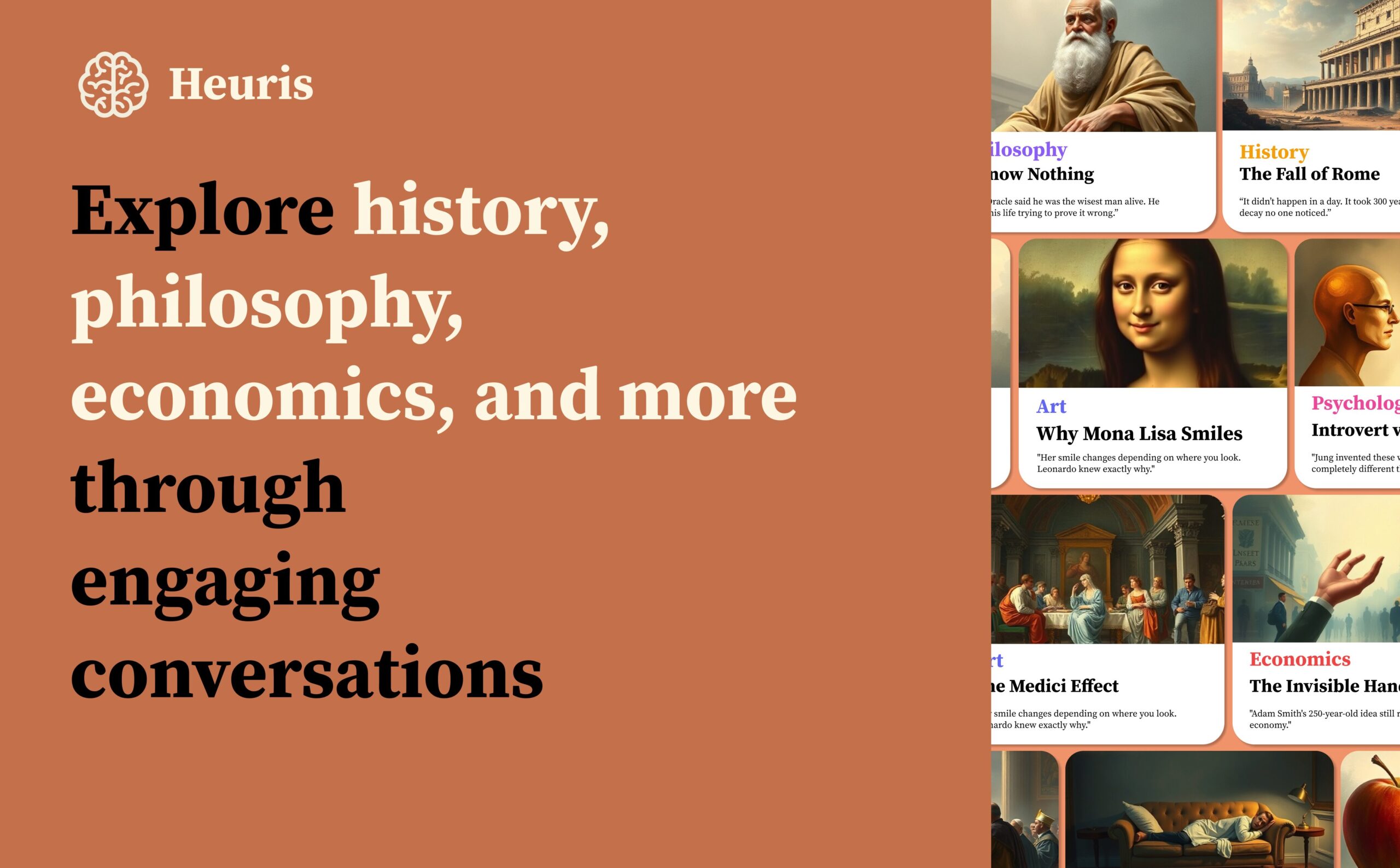
Heuris is an AI-powered learning companion for iOS that transforms the “Wikipedia rabbit hole” into a structured, adaptive dialogue. Unlike generic chatbots, Heuris is specifically engineered for humanities and social sciences—covering Philosophy, History, Art History, Economics, and Psychology. It tracks user curiosity over time to curate a personalized daily feed of 5-minute learning sessions, designed to build deep conceptual understanding rather than just surfacing trivia.
Core Features
- Adaptive Daily Feed: Curates a fresh set of three topics every morning based on your previous interactions, ensuring the content evolves with your interests.
- Conversational Learning: Presents information through an interactive chat interface where users can ask “why?” or “how?” at any point, rather than passively reading static articles.
- Threaded Exploration: Allows users to tap on any concept within a session to spin off a new “thread,” enabling deep dives without losing the context of the original lesson.
- 5-Minute Micro-Learning: Sessions are designed to be completed in short bursts, making it easy to fit complex topics (like “Existentialism” or “The Gold Standard”) into a daily commute.
- Session Memory: The AI remembers past conversations and references them in future sessions (e.g., connecting a new lesson on Plato back to a previous discussion on Socrates).
- Depth-First Focus: Prioritizes “why things happen” and causal relationships over simple dates and names, distinguishing it from standard trivia apps.
How It Works
Upon downloading the iOS app, users select their initial areas of interest. Heuris generates a “Daily Pick” of topics—for example, “The Stoic View on Anger.” The user enters a chat interface where the AI explains the concept. If the user is intrigued by a specific term mentioned (e.g., “Logos”), they can tap it to open a side-thread for a quick explanation before returning to the main flow. The app tracks which topics the user engages with most deeply to refine the next day’s recommendations.
Use Cases
- Alternative to Doomscrolling: Replacing social media breaks with short, stimulating dives into Art History or Economics.
- Structured “Rabbit Holes”: For users who love Wikipedia but get lost; Heuris keeps the exploration guided and coherent.
- Foundational Knowledge Building: Systematically filling gaps in one’s understanding of world history or philosophical schools of thought.
- Intellectual Curiosity: Serving as a “digital tutor” for lifelong learners who want to discuss complex ideas without enrolling in a formal course.
Pros & Cons
- Pros: Personalized Curriculum that adapts to what you actually find interesting; High-Quality UX designed specifically for reading and chat interaction on mobile; Prevents “Chatbot Amnesia” by linking concepts across sessions; Focused Domain ensures higher quality explanations for humanities than generic bots.
- Cons: iOS Exclusive at launch (no Android or Web version); Niche Scope (does not cover coding, math, or hard sciences); Subscription Model required for unlimited exploration; Requires Active Participation (you get more out of it if you ask questions, which takes more mental effort than passive reading).
Pricing
- Free Tier: Includes a limited selection of daily topics (e.g., 3 daily picks).
- Intellectio Premium: ~$12.99/month (or equivalent local pricing). Unlocks unlimited topic exploration, advanced personalization, and extended session history.
How Does It Compare?
Heuris occupies a unique middle ground between “Book Summary Apps” and “Open-Ended Chatbots.”
- Blinkist / Headway
These apps provide static summaries of non-fiction books. They are one-way (read/listen only). Heuris is interactive—you can argue with it, ask for clarification, or steer the topic in a new direction. Blinkist is better for “finishing a book,” Heuris is better for “exploring an idea.” - Wikipedia
Wikipedia is exhaustive but dry and unguided. You have to know what to search for. Heuris pushes content to you based on your interests, acting as a curator rather than just an encyclopedia. -
ChatGPT / Claude
You can use ChatGPT to learn philosophy, but you have to prompt it yourself (“Explain Stoicism”). You also have to manage the chat history. Heuris wraps this experience in a Learning Management System (LMS) layer—it manages the curriculum, remembers what you already learned, and prompts you with the next logical topic, removing the burden of “what should I ask next?” -
Brilliant.org
Brilliant focuses on STEM (Math, CS, Science) with interactive puzzles. Heuris focuses on the Humanities (History, Philosophy, Art) with interactive dialogue. They are effectively complementary tools for different sides of the brain.
Final Thoughts
Heuris is a “thinking person’s social media.” It targets the specific demographic of users who feel guilty about wasting time on phone screens and want to convert that time into intellectual growth. By constraining the experience to 5-minute chats and focusing strictly on the “Great Conversation” of history and philosophy, it delivers a much more satisfying learning experience than aimlessly prompting a standard AI bot. It is highly recommended for anyone who wants to become more well-read but lacks the time for full books.