
Table of Contents
Overview
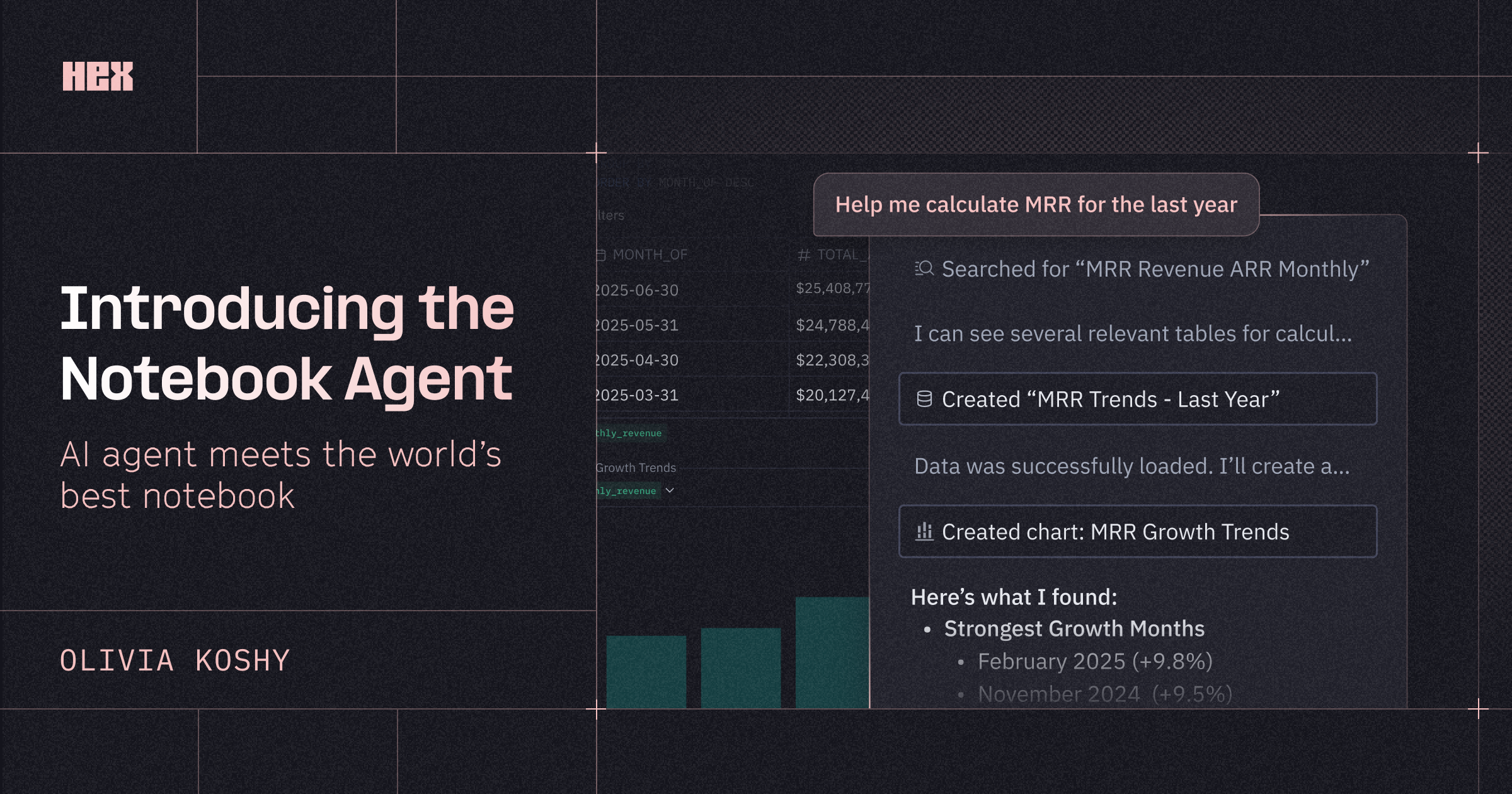
Hex continues to strengthen its position as a leading collaborative data platform with the introduction of the Notebook Agent, an AI-powered assistant that transforms how data teams approach analysis and insight generation. Rather than treating AI as an external tool requiring constant context switching, Hex integrates Claude Sonnet 3.5 directly into its notebook environment where thousands of data professionals already conduct their most critical work. This embedded approach enables data scientists and analysts to seamlessly transition from questioning data to generating comprehensive analyses, effectively bridging the gap between initial curiosity and actionable business intelligence through conversational interaction with their existing datasets and project contexts.
Key Features
The Notebook Agent introduces several sophisticated capabilities designed to accelerate data workflows while maintaining analytical rigor:
- Comprehensive Code Generation: Automatically produces SQL queries, Python scripts, and complex multi-step analyses based on natural language descriptions, eliminating the need for manual coding of routine data operations while supporting advanced analytical requirements.
- Contextual Project Intelligence: Leverages deep understanding of existing project files, warehouse schemas, and previous analyses to provide relevant suggestions and maintain consistency across collaborative data work, ensuring recommendations align with established project patterns and data governance standards.
- Native Visualization Creation: Generates interactive pivot tables, exploratory charts, and dashboard-ready visualizations using Hex’s built-in charting capabilities, enabling immediate visual feedback without requiring external plotting libraries or manual formatting.
- Interactive Analysis Guidance: Provides dynamic suggestions for data exploration pathways, hypothesis testing approaches, and analytical methodologies, helping teams discover insights they might not have considered while maintaining focus on business objectives.
- Integrated Documentation Generation: Automatically creates Markdown summaries, methodology explanations, and finding synthesis, transforming raw analytical outputs into stakeholder-ready narratives that communicate both technical processes and business implications.
- Advanced Diff Review System: Offers cell-level code review interfaces with inline editing capabilities, allowing users to examine, modify, and approve AI-generated suggestions with granular control over implementation decisions.
How It Works
The Notebook Agent operates through a three-phase intelligent workflow designed to maximize both analytical depth and user control. Initially, users interact with the agent through natural language queries within their existing Hex notebooks, where the system accesses project context including code history, data warehouse schemas, and file relationships. During the analysis phase, the agent leverages Claude Sonnet 3.5 to generate appropriate SQL queries, Python code, and visualizations while maintaining awareness of existing project patterns and data governance requirements. Finally, the refinement phase enables iterative improvement through conversational feedback, automated version saving, and collaborative review processes that ensure analytical accuracy and business relevance.
Use Cases
The Notebook Agent enables diverse analytical scenarios that benefit from AI-assisted acceleration:
- Rapid Prototype Development: Transform business questions into initial analytical frameworks within minutes, enabling data teams to quickly evaluate feasibility and scope complex projects before committing extensive resources to full implementations.
- Cross-Functional Data Democratization: Enable business users and domain experts to directly interact with data through natural language interfaces while maintaining data governance and analytical rigor through AI-guided exploration and validation.
- Complex Multi-Step Analysis Construction: Automatically generate sophisticated analytical pipelines that combine multiple data sources, statistical methods, and business logic, reducing the manual effort required for comprehensive data investigations.
- Collaborative Insight Synthesis: Transform individual analytical findings into coherent narratives and presentations that communicate methodologies, limitations, and business implications to diverse stakeholder audiences.
- Iterative Hypothesis Testing: Support rapid experimentation cycles where analysts can quickly test assumptions, modify approaches, and explore alternative methodologies without extensive manual recoding or data preparation overhead.
Pros \& Cons
Advantages
- Eliminates Context Switching: Integrates AI assistance directly into existing analytical workflows, reducing the cognitive overhead associated with moving between different tools and maintaining analytical momentum throughout complex investigations.
- Enterprise-Grade Governance: Operates within Hex’s established security and governance frameworks, ensuring AI-assisted analysis maintains compliance requirements and data protection standards without compromising analytical capabilities.
- Collaborative Optimization: Enhances team productivity through shared AI insights, version control integration, and collaborative review processes that enable multiple team members to contribute expertise while maintaining analytical coherence.
- Transparent Analytical Process: Provides complete visibility into AI-generated code and reasoning, enabling users to understand, validate, and modify analytical approaches while building confidence in AI-assisted findings.
- Extended Beta Capabilities: Includes enhanced AI usage limits during early access period, allowing teams to extensively test capabilities without immediate cost implications or usage restrictions.
Disadvantages
- Subscription Requirement: Available exclusively to Editor+ users on paid plans, potentially limiting accessibility for smaller teams or individual practitioners exploring AI-assisted analysis capabilities.
- Limited Version Control Integration: Supports one-way Git export functionality, requiring manual processes to synchronize external repository changes back into Hex notebooks, potentially complicating collaborative development workflows.
- AI Output Validation Responsibility: Requires users to review and validate AI-generated analyses for accuracy and business appropriateness, particularly important for high-stakes decisions involving financial reporting or strategic planning.
- Platform Dependency: Ties AI-assisted capabilities to Hex’s specific notebook environment, potentially creating vendor lock-in considerations for organizations evaluating long-term analytical infrastructure strategies.
How Does It Compare?
In the rapidly evolving 2025 landscape of AI-powered data analysis platforms, Hex Notebook Agent competes against several sophisticated alternatives. Compared to Databricks Notebooks with AI Assistant, Hex offers superior collaborative features and user interface design, while Databricks provides more extensive machine learning infrastructure and big data processing capabilities for enterprise-scale deployments.
Against Deepnote’s AI Copilot, Hex demonstrates stronger integration with enterprise data warehouses and governance frameworks, while Deepnote excels in academic and research environments with more flexible computational resource management and publishing capabilities.
When evaluated alongside Google Colab’s enhanced AI features, Hex provides superior enterprise security and collaborative workflow management, though Colab maintains advantages in free tier accessibility and integration with Google Cloud services for cost-conscious individual users.
Compared to emerging platforms like Quadratic with integrated AI capabilities, Hex offers more mature notebook functionality and established enterprise adoption, while Quadratic provides innovative spreadsheet-AI hybrid interfaces that may appeal to business users transitioning from traditional analytical tools.
Against specialized AI analysis tools like ThoughtSpot Spotter and Power BI Copilot, Hex delivers greater analytical flexibility and coding capabilities for complex investigations, while these alternatives provide more streamlined experiences for business intelligence and reporting-focused use cases.
The platform’s integration of Claude Sonnet 3.5 with comprehensive project context and governance frameworks positions it particularly well for enterprises requiring both analytical sophistication and operational compliance, distinguishing it from both traditional notebook environments and standalone AI analysis tools.
Final Thoughts
Hex Notebook Agent represents a significant evolution in AI-assisted data analysis, successfully addressing the challenge of integrating advanced AI capabilities into established analytical workflows without disrupting existing team practices or governance requirements. By embedding conversational AI directly into collaborative notebooks with full project context awareness, it transforms the traditionally time-intensive process of moving from business questions to analytical insights.
While subscription requirements and platform dependencies may constrain adoption for some users, the combination of sophisticated AI assistance, enterprise-grade security, and collaborative optimization capabilities positions Hex as a compelling solution for data teams seeking to accelerate analytical productivity without compromising quality or compliance standards.
The platform’s focus on maintaining transparency and user control over AI-generated analysis, combined with robust review and validation mechanisms, addresses critical concerns about AI reliability in business-critical analytical contexts. As organizations increasingly seek to democratize data access while maintaining analytical rigor, Hex Notebook Agent offers a practical pathway for achieving both objectives through intelligently designed human-AI collaboration.
For data teams evaluating AI-enhanced analytical platforms, Hex provides a mature, enterprise-ready solution that balances sophisticated automation with the flexibility and oversight required for high-quality analytical work in complex organizational environments.