Hexis Investment Report
Category: Enterprise AI agent infrastructure / governance
Company Stage: Pre-seed / early commercial
Founder or Founders: Ali Raza, Juan Ignacio Viera Garcia, Razvan-Ion Radulescu
Headquarters: Munich, Germany
Funding: €128,000 EXIST non-dilutive grant reported by the founder; no verified equity financing
Business Model: Open-core software, managed enterprise deployment, and AI-transformation services
Product Hunt Launch Date: August 8, 2026
Report Date: August 11, 2026
| Investment Metric | Assessment |
|---|---|
| Venture Potential | 65/100 |
| Unicorn Path | Conditional |
| Valuation Attractiveness | Not Assessable |
| Evidence Confidence | 54/100 |
| Final Decision | DD |
Executive Summary
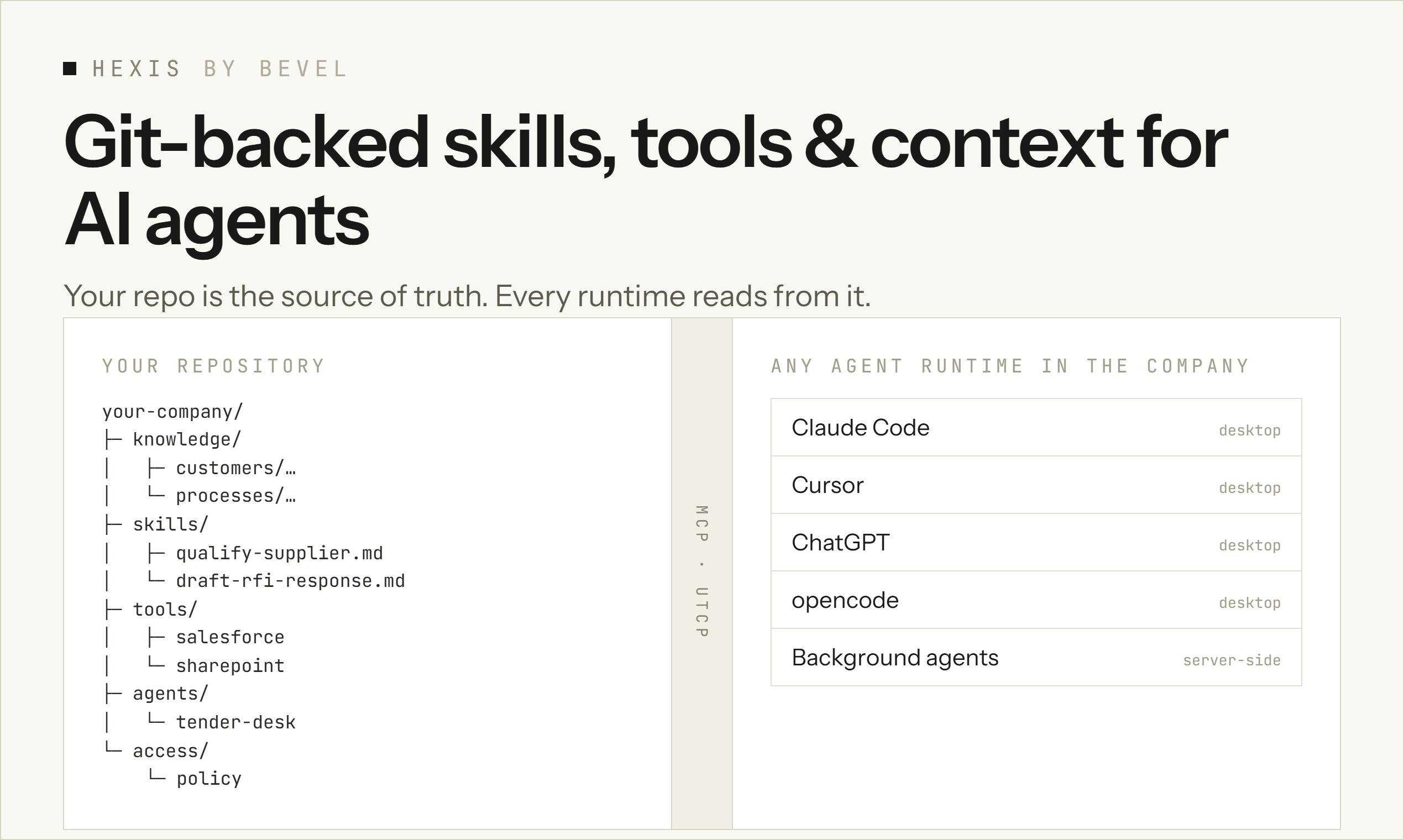
Hexis is the open-source core of Bevel, a vendor-agnostic control plane for managing enterprise AI-agent context, skills, tools, permissions, and identities. These artifacts are stored as Markdown and YAML in a customer-owned Git repository and exposed to agent runtimes through MCP or UTCP. The product targets organizations deploying multiple agents across tools such as Claude, ChatGPT, Cursor, and self-hosted runtimes (Bevel; GitHub).
Product quality: The architecture addresses a genuine emerging problem: agent knowledge and permissions are becoming fragmented across vendor-specific systems. Git-based versioning, approval workflows, role-based access, OAuth, and self-hosting are sensible design choices for regulated enterprises. The Apache-2.0 repository is deployable with Docker and includes a public demo, making the product more verifiable than a typical Product Hunt prototype (Hexis repository).
Company quality: The three founders have complementary operational, product, and technical experience documented by a Technical University of Munich page. They also built or contributed to UTCP, demonstrating credible protocol-level engineering. Bevel reports work with Unite, EGYM, Luminovo, Workpath, and Avi Medical, but contract values, payment status, deployment scope, and retention are not disclosed (TUM; UTCP; Bevel).
Venture-scale potential: The category could support a substantial infrastructure company if heterogeneous enterprise agents become common and Bevel becomes the independent governance layer across them. However, hyperscalers and developer platforms are adding their own agent control planes, while Hexis currently has limited open-source adoption and no verified commercial metrics.
Unicorn potential: A $1 billion outcome is conditional on converting services-led deployments into repeatable, high-margin software revenue and reaching roughly $100 million of ARR. The present evidence does not establish that Bevel has repeatable pricing, scalable distribution, or meaningful switching costs.
The appropriate decision is DD, not Invest. Named customer references, technical execution, and an important market problem justify a founder meeting and data-room request. Unknown revenue, retention, margins, valuation, and financing terms preclude an investment recommendation.
Product Overview
Enterprises adopting multiple AI agents risk duplicating prompts, tools, knowledge, and permissions inside separate vendor platforms. Hexis replaces that fragmented workflow with a customer-owned Git repository containing agent skills, contextual knowledge, tool definitions, access policies, and identities.
Core value comes from version history, change requests, ownership approval, role-based access, an encrypted secrets vault, and portability across agent runtimes. Hexis supports self-hosted Docker deployment, managed hosting, GitHub/GitLab/Bitbucket/Azure DevOps repositories, OIDC single sign-on, MCP with OAuth 2.1, and the company’s UTCP protocol (documentation).
The open-source version is free under Apache 2.0. Managed hosting and enterprise pricing require contacting Bevel; no public price or standard package was found. The principal alternatives are storing instructions directly in agent platforms, maintaining separate Git repositories manually, or building an internal MCP gateway and access layer.
Founder and Team Assessment
Product Hunt identifies Ali Raza, Juan Viera Garcia, and Razvan-Ion Radulescu as makers. TUM describes Raza’s experience across PepsiCo, KSB, Fernride, Alasco, and UVC Partners; Viera Garcia’s MIT research and finance/startup experience; and Radulescu’s technical work connected to TUM and Cambridge (Product Hunt; TUM).
Radulescu is listed as managing director of Bevelites GmbH, registered in Munich as HRB 303590 (legal notice). The founders previously built Bevel around legacy-code understanding before repositioning toward enterprise-agent infrastructure, indicating adaptability but also strategic discontinuity. In a 2025 interview, Raza said the three founders had begun working full-time and received a €128,000 EXIST grant; this is founder-reported rather than independently audited (interview).
The current employee count, hiring plan, founder equity, prior exits, and continuing full-time commitment are not publicly verified. Public GitHub data shows four contributors to Hexis, with most contributions concentrated among two accounts, creating key-person risk (GitHub contributors).
Founder Assessment: Strong technical and product capability, but commercial scaling experience and current team capacity remain insufficiently verified.
Market Opportunity
The initial segment is European and North American enterprises deploying agents across several departments, models, and software vendors—particularly organizations requiring self-hosting, auditability, and access control.
A bottom-up analyst scenario is:
- Approximately 20,868 U.S. firms have at least 500 employees, according to a figure summarized from Census data (U.S. business data).
- The EU had approximately 33.5 million enterprises in 2024, of which roughly 0.2% were large enterprises, implying about 67,000 potential organizations before sector and adoption filters (Eurostat).
- Applying a conservative technology/adoption filter produces an initial target of approximately 30,000–50,000 organizations.
- At an assumed $50,000–$200,000 annual software contract, the theoretical initial market is approximately $1.5–$10 billion annually.
These are analyst assumptions, not company forecasts. Expansion could include agent identity, runtime policy enforcement, observability, compliance reporting, managed connectors, and API usage. Market timing is favorable, but the same timing attracts well-capitalized incumbents.
Traction and Growth Signals
Hexis placed #3 Product of the Day on Product Hunt on August 8, 2026. The broader Bevel page showed 368 followers and no Product Hunt reviews at the report date (award page; forum announcement). This demonstrates launch interest, not product-market fit.
The GitHub repository was created July 30, 2026 and had 39 stars, two forks, two open issues, and recent commits as of August 11. That establishes active development but limited independent adoption (GitHub API).
Bevel’s website names Unite, EGYM, Luminovo, Workpath, and Avi Medical and publishes positive testimonials describing deployed agents and AI-transformation work. These are meaningful company-reported references, but it is unknown whether all are paying recurring-software customers or primarily consulting engagements (Bevel).
Revenue, ARR, customer count, usage, retention, growth, pipeline conversion, and deployment expansion are not publicly disclosed.
Traction Assessment: Technically credible and supported by named references, but commercially unverified.
Competitive Position
Direct and adjacent competitors include Microsoft Foundry Agent Service, AWS Bedrock AgentCore, Google’s Gemini Enterprise Agent Platform, GitHub’s enterprise agent control plane, CrewAI, LangSmith, and independent MCP gateways. Microsoft, AWS, and Google explicitly offer enterprise agent deployment, scaling, and governance (Microsoft; AWS; Google).
Hexis differentiates through customer-owned Git artifacts, open-source deployment, runtime neutrality, readable Markdown skills, and a protocol-level pedigree through UTCP. It may appeal to enterprises avoiding hyperscaler lock-in.
However, switching costs are currently moderate at best: Markdown, YAML, Git, MCP, and UTCP are intentionally portable. Proprietary data and network effects are not evident. The defensive asset would have to become Bevel’s enterprise workflow integrations, policy model, installed base, and trusted governance position.
If a major platform replicated the feature within six months, customers would remain only if they valued cross-vendor neutrality, self-hosting, superior policy controls, or accumulated Bevel-specific integrations. That answer is credible but not yet proven.
Defensibility Assessment: Medium-Low
Business Model and Economics
Hexis follows an open-core model. Potential revenue sources are managed hosting, enterprise security and support, connector packages, and implementation services. Pricing and average contract value are not disclosed.
The self-hosted architecture should limit model-inference expense because Hexis primarily manages artifacts and permissions rather than necessarily running models. Cloud hosting, support, security audits, connector maintenance, and enterprise onboarding remain variable costs. Current testimonials emphasize co-building agents and ongoing transformation support, suggesting a services component that could reduce gross margin and scalability.
A credible venture model would require standardized deployments, annual software contracts, net expansion as customers add agents and departments, and software gross margins above approximately 70%. None of those economics are publicly verified.
Unicorn Path
Assuming Bevel develops into a high-growth enterprise infrastructure SaaS company, a 10× ARR multiple is a reasonable optimistic benchmark for a scaled business with strong growth, retention, and software margins.
Required ARR = $1 billion ÷ 10 = approximately $100 million.
At an assumed $100,000–$150,000 annual contract, Bevel would need approximately 670–1,000 enterprise customers. At $50,000 ACV, it would need 2,000. Material services revenue would likely receive a lower multiple and therefore increase the required total revenue.
Reaching this scale requires repeatable enterprise sales, standardized connectors, credible security certifications, multi-year contracts, international expansion, high net retention, and differentiation from hyperscaler control planes. The current five named relationships are far from demonstrating that engine.
Unicorn Path: Conditional
Valuation Assessment
No reliable public evidence of an equity round, SAFE cap, post-money valuation, secondary transaction, or current fundraising terms was found. The €128,000 EXIST grant was non-dilutive and does not establish valuation.
Valuation Attractiveness: Not Assessable
Assessment requires current ARR, growth, gross margin, retention, services mix, burn, runway, cap table, round size, valuation or SAFE cap, option pool, ownership targets, and liquidation preferences. Product quality and Product Hunt ranking are insufficient grounds for a valuation range.
Key Risks
- No verified ARR, paying-customer count, retention, or commercial growth.
- Hyperscalers and GitHub can bundle agent governance into existing enterprise relationships.
- Customer work may be services-heavy rather than scalable recurring software.
- Cross-vendor portability also reduces product switching costs.
- The strategic pivot from legacy-code tooling may indicate continuing market-search risk.
- Enterprise security, secrets management, and permissions create substantial liability and audit requirements.
- Small apparent engineering team and founder concentration.
- MCP or agent-vendor changes could weaken integrations.
- Open-source adoption remains modest at 39 GitHub stars shortly after launch.
- Current valuation and financing structure are unknown.
Final Assessment
Venture Potential: 65/100
| Category | Score |
|---|---|
| Market Size and Expansion Potential | 16/20 |
| Traction and Growth Evidence | 8/20 |
| Founder and Team | 12/15 |
| Product Strength | 8/10 |
| Distribution Potential | 9/15 |
| Business Model and Economics | 6/10 |
| Defensibility | 6/10 |
| Total | 65/100 |
The strongest elements are technical execution, an increasingly important enterprise problem, named customer references, and open-source distribution. The weakest are unverified commercial traction, services risk, and intense platform competition.
Evidence Confidence: 54/100
Verified information includes the legal entity, founders, open-source code, product functionality, launch date, GitHub activity, and public technical documentation. Customer relationships, UTCP adoption, and grant funding are company- or founder-reported. Revenue, retention, margins, customer economics, team size, burn, valuation, and financing terms remain unavailable.
Final Decision: DD
Hexis is sufficiently differentiated and technically credible to justify formal diligence. It is not ready for an Invest decision because valuation, commercial traction, retention, unit economics, cap table, and financing terms are unknown.
Upgrade Conditions
- Verify at least $1 million ARR with predominantly software revenue.
- Demonstrate 90%+ gross retention and meaningful account expansion.
- Show software gross margin above 70% after support costs.
- Convert at least ten named enterprises into recurring contracts.
- Establish repeatable acquisition beyond founder-led consulting.
- Complete SOC 2 or equivalent security readiness.
- Demonstrate a durable policy, integration, or distribution advantage.
Downgrade Conditions
- Named deployments prove to be unpaid pilots or consulting-only projects.
- Customers standardize on bundled hyperscaler control planes.
- Weak expansion or high churn after initial implementation.
- Services remain necessary for every deployment.
- Repository and product activity decline after launch.
- Material security, secrets-management, or privacy failures emerge.
Questions for Further Diligence
- What are current ARR, MRR, monthly growth, and the recurring-versus-services revenue split?
- How many named organizations are paying, in production, in pilot, or inactive?
- What are median ACV, sales-cycle length, implementation cost, and contract duration?
- What are 30-, 90-, and 180-day usage retention and gross/net revenue retention?
- How many active agents, employees, skills, and tool calls does each deployment manage?
- Which acquisition channels have generated qualified pipeline beyond founder relationships?
- What are gross margin and monthly hosting, support, and connector costs per customer?
- What security audits, penetration tests, certifications, and incident-response controls exist?
- Which capabilities are proprietary to the paid platform versus Apache-licensed Hexis?
- Why did Bevel move from legacy-code modernization to agent infrastructure, and what customer evidence drove the decision?
- What are current burn, runway, team responsibilities, and each founder’s full-time commitment?
- What are the cap table, current round size, valuation or SAFE cap, option pool, and proposed investor terms?