1. Executive Snapshot
Core Offering Overview
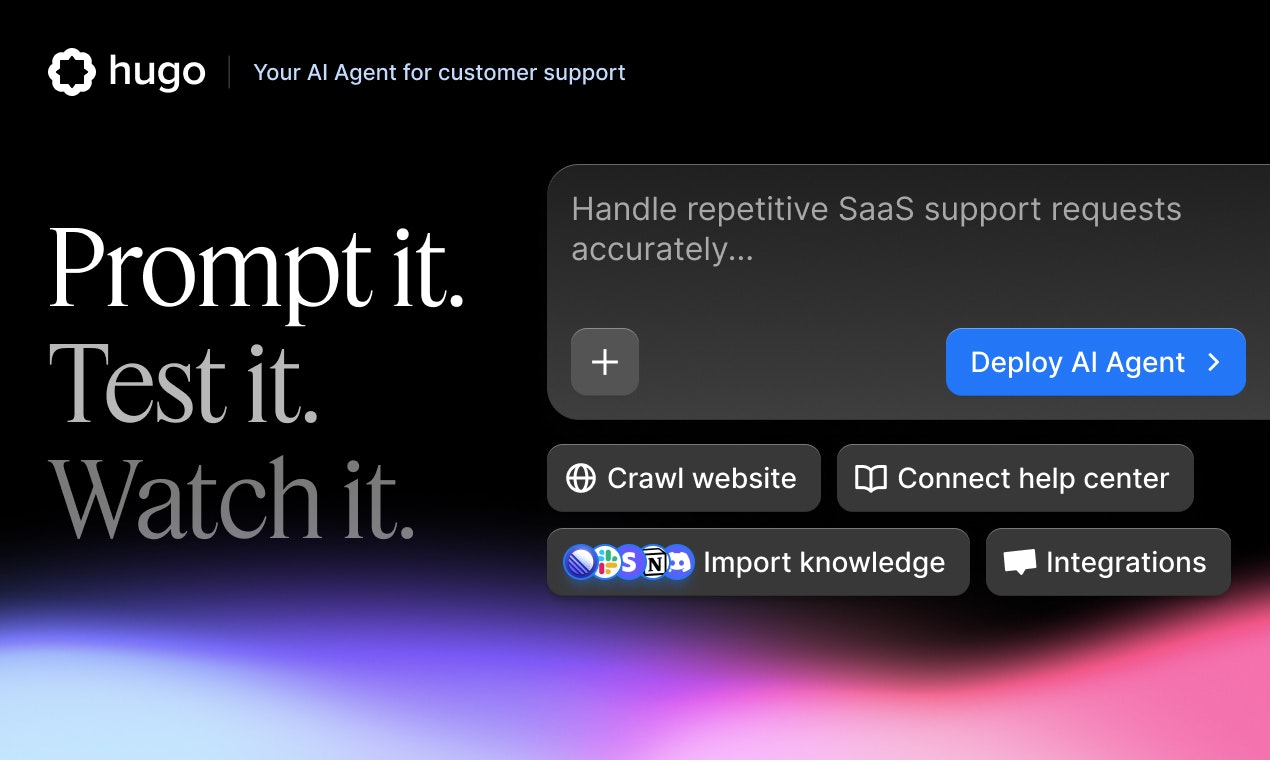
Hugo (hugo.ai) is an AI-powered customer support agent built and operated by Crisp, the French bootstrapped customer messaging platform founded in 2015. Publicly launched on February 2, 2026, Hugo represents the culmination of 12 months of intensive internal development at Crisp, where the team rebuilt its core AI proposition from scratch to deliver what they describe as “the most complete AI Agent for customer support” on the market.
Unlike basic chatbots that match keywords to canned responses, Hugo functions as an autonomous support agent capable of maintaining multi-turn context across conversations, performing real actions through integrated tools (such as processing refunds, looking up orders, or checking account status), and intelligently escalating to human agents when the situation demands it. The platform supports deployment across 10 communication channels and connects to business systems through the Model Context Protocol (MCP), enabling end-to-end task resolution rather than mere conversational deflection.
Hugo operates in two modalities: as the embedded AI core within the Crisp customer support platform, and as a standalone product accessible at hugo.ai for companies that may not use Crisp as their primary support solution. This dual positioning allows Crisp to expand its addressable market beyond existing customers while deepening engagement for its installed base of over 600,000 companies.
Key Achievements and Milestones
- 2015: Crisp founded by Baptiste Jamin and Valérian Saliou while they were still engineering students in Lannion, Brittany, France.
- 2015–2024: Crisp grew entirely through bootstrapping (zero venture capital funding) to reach 600,000+ companies, approximately 250 million monthly chatbox impressions, and over 60% annual growth rate, generating several million euros in annual recurring revenue.
- November 2024: Crisp V4 launched with a complete interface redesign, sub-inboxes, advanced analytics, and enhanced AI integration.
- Early 2025: The decision was made internally to “throw everything away” regarding existing AI capabilities and rebuild from the ground up, creating what would become Hugo.
- February 2, 2026: Hugo AI Agent publicly launched, simultaneously debuting on Product Hunt.
- February 3, 2026: Hugo achieved number one Product of the Day on Product Hunt with 457 upvotes and 164 comments, finishing just behind Atoms (466 upvotes) on its launch day and ahead of all other products.
- February 2026: Product Hunt profile for Crisp (Hugo’s parent) shows 4.8-star rating across 32 reviews with 2,800+ followers.
Adoption Statistics
Crisp’s official metrics provide the foundation for understanding Hugo’s reach:
- Over 600,000 companies use Crisp worldwide.
- Approximately 250 million people see a Crisp chatbox or chatbot each month.
- At any given moment, roughly one million people are actively chatting on Crisp.
- The platform serves customers across virtually every continent, with France representing only 10–15% of total revenue—the vast majority comes from international markets.
- Hugo is included by default in all paid Crisp plans, meaning existing Crisp customers have immediate access to the AI agent.
- Third-party data from AppRack identifies over 8,000 companies using Crisp Live Chat specifically.
- Hugo itself, as a standalone product, is newly launched and specific standalone adoption figures have not yet been publicly disclosed.
2. Impact and Evidence
Client Success Stories
Early customer testimonials published on the Hugo website reveal concrete operational impact:
- One client reported that approximately 60% of incoming support requests are now fully automated by Hugo, handled end-to-end with no human intervention. This client specifically noted that unlike competitors who “simply provide data sources,” Hugo provides direct access to MCP-connected tools that take real actions.
- A second client shared that Hugo handles all incoming conversations and autonomously resolves approximately 40% of queries, freeing the support team to concentrate on complex issues requiring human judgment.
- A third client reported 40% full automation of incoming requests, with the remaining 60% smoothly escalated to human agents when contextual expertise or deeper analysis is required. This client emphasized that the balance allows efficient scaling “without ever compromising the quality of the customer relationship.”
These testimonials demonstrate a consistent pattern: Hugo typically automates 40–60% of support conversations fully, with the remainder escalated intelligently to human operators.
Performance Metrics and Benchmarks
Key performance indicators for Hugo include:
- Average cost per conversation: Approximately $0.05 USD per fully handled conversation, inclusive of platform margin.
- Automation rate: 40–60% of conversations resolved end-to-end without human intervention, based on published customer testimonials.
- Deployment time: Setup described as achievable “in minutes” through the no-code interface.
- Channel coverage: 10 simultaneous channels from a single agent deployment.
Hugo does not currently publish formal benchmark comparisons against competitors (such as CSAT scores or resolution rate percentages in controlled tests). However, the 40–60% autonomous resolution rates reported by customers are competitive with industry leaders—Intercom’s Fin AI Agent claims approximately 65% average resolution rates, while Zendesk’s AI agents focus more on deflection than autonomous resolution.
Third-Party Validations
- Product Hunt: Number one Product of the Day (February 3, 2026). Parent product Crisp maintains a 4.8-star rating with 32 reviews.
- Futurepedia: Listed Hugo with the assessment that it gives “support teams a practical path to serious automation without sacrificing control, oversight, or customer experience.”
- Tidio (competitor): In a detailed review of Crisp, acknowledged its strong value-for-money proposition, particularly the per-workspace (not per-agent) pricing model that appeals to growing teams.
- LinkedIn community: Multiple industry professionals publicly endorsed the launch, with one describing Hugo as solving “the Action Gap”—the challenge of moving AI from conversational responses to actual task resolution.
- Seedtable: Records Crisp as having raised a total of $12 million (though the founders consistently describe the company as 100% bootstrapped, suggesting this figure may reflect revenue milestones or a different metric).
3. Technical Blueprint
System Architecture Overview
Hugo’s architecture is built atop Crisp’s decade-old messaging infrastructure, which processes hundreds of millions of interactions monthly. The key architectural components include:
- Multi-model AI engine: Hugo supports multiple underlying AI models including Claude (Anthropic), ChatGPT (OpenAI), Llama (Meta), and the option to connect a company’s own proprietary model. Users can select the AI backend that best fits their data sovereignty, performance, and cost requirements.
- Model Context Protocol (MCP): Hugo uses MCP to connect to external business systems and perform real actions. MCP integrations allow the agent to go beyond answering questions from documentation—it can interact with live systems, fetch real-time data, and execute operations (such as processing refunds, checking order statuses, or updating account information).
- Multi-turn conversation engine: Unlike stateless chatbots, Hugo maintains full conversational context across multiple exchanges, enabling it to handle complex, multi-step support queries.
- Smart escalation system: Hugo includes built-in logic for detecting when a conversation exceeds its confidence threshold or requires human judgment, at which point it transfers the conversation to a human agent with full context preserved.
- Routing rules engine: Customizable routing rules allow businesses to define specific situations Hugo should detect and corresponding actions to trigger, providing fine-grained control over automation behavior.
- Visual workflow builder: For complex automation scenarios, a drag-and-drop interface allows non-technical users to design conditional logic flows covering ticket triage, escalation paths, and multi-step processes.
API and SDK Integrations
Hugo offers both native one-click integrations and extensible MCP-based connections:
Native MCP integrations include:
– Shopify: Fetch user profiles, account details, order history, order status, items, and delivery information.
– Stripe: Access payment data, subscription information, and transaction details.
– WooCommerce: E-commerce data integration.
– Status Page: Service status monitoring integration.
Additional integration capabilities:
– Custom MCP server connections for proprietary systems.
– Compatibility with n8n, Zapier, and Make for advanced no-code workflow automation.
– Chat SDK for embedding Hugo across websites and applications.
– Omnichannel deployment across live chat, email, WhatsApp, Instagram, Facebook Messenger, phone, SMS, and more.
Crisp also provides downloadable example MCP integration code to help developers build custom automated support workflows.
Scalability and Reliability Data
Hugo inherits Crisp’s infrastructure, which has been battle-tested over nearly a decade serving 600,000+ companies and processing approximately 250 million monthly chatbox impressions. Key scalability characteristics include:
- All data is stored and processed on European servers (EU-hosted infrastructure).
- The platform operates continuously across time zones, enabling 24/7 automated support.
- Token-based billing scales costs linearly with conversation complexity and volume.
- No formal SLA or uptime percentage has been publicly committed for Hugo specifically, though the Crisp platform’s long operational history and bootstrapped financial model suggest stable infrastructure investment.
4. Trust and Governance
Security Certifications
Hugo’s official website describes its security posture as “enterprise-grade encryption, secure APIs, and strict access controls.” However, no specific third-party security certifications (ISO 27001, SOC 2 Type II, or comparable standards) have been publicly disclosed for either Hugo or the Crisp platform. For organizations requiring formal compliance attestations, this represents a gap that should be evaluated against internal procurement requirements.
Data Privacy Measures
Hugo and Crisp implement several privacy-oriented architectural decisions:
- GDPR compliance: Hugo is explicitly built to meet the European Union’s General Data Protection Regulation standards. The platform processes and stores data with full GDPR compliance and transparency.
- European hosting: All data is stored and processed exclusively on European servers, ensuring data sovereignty and compliance with EU data residency regulations.
- Transparent AI logic: Hugo’s decision-making logic is described as “visible, editable, and accountable,” meaning business operators can inspect and modify how the AI processes and responds to conversations.
- Grounded responses: Every answer Hugo generates is derived from the company’s own data sources (knowledge base, CRM, documentation) rather than open-ended model generation, reducing hallucination risk.
Regulatory Compliance Details
GDPR is the primary regulatory framework Hugo explicitly claims compliance with. No CCPA, HIPAA, SOX, or other regional/industry-specific compliance certifications have been publicly announced. Given the platform’s European roots and EU-hosted infrastructure, GDPR compliance is the natural regulatory baseline. Companies in regulated industries (healthcare, financial services) should conduct their own compliance assessment before deploying Hugo for conversations involving sensitive data.
5. Unique Capabilities
- Multi-Model Flexibility: Hugo allows businesses to select their preferred AI backend—Claude, ChatGPT, Llama, or a custom model—and switch between them without reconfiguring the entire system. This model-agnostic approach gives organizations control over their data handling, response quality, and cost optimization, and avoids vendor lock-in to any single AI provider.
- MCP-Powered Action Execution: Through the Model Context Protocol, Hugo moves beyond conversational AI into agentic AI. It can fetch live data from connected systems, perform real business operations (processing returns, checking subscriptions, updating records), and resolve conversations end-to-end—capabilities that differentiate it from chatbots limited to FAQ retrieval and documentation search.
-
No-Code Training and Deployment: Any team member can train Hugo on company-specific knowledge, configure response behavior, set routing rules, test conversations in a sandbox environment, and go live—all without developer involvement. The platform provides a real chat widget for pre-launch testing, allowing teams to simulate actual customer interactions before activating the agent.
-
Visual Workflow Automation: For complex support scenarios, a drag-and-drop interface enables teams to design sophisticated automation logic covering ticket triage, conditional escalation, multi-step resolution workflows, and cross-system actions—without writing code.
-
Continuous Learning Analytics: Hugo tracks performance, accuracy, and customer satisfaction metrics in real time. Insights from past conversations are automatically fed back into the system to improve future response quality, creating a continuous improvement loop.
-
Automatic Knowledge Synchronization: Hugo stays current by automatically syncing with connected knowledge sources—helpdesk articles, company documentation, CRM data, and product information—ensuring responses always reflect the latest processes and updates without manual retraining.
-
Expanded Widget Experience: The redesigned widget offers improved readability for longer AI-driven conversations, with more visual space that reduces cognitive strain during detailed or instructional exchanges. This design choice reflects Crisp’s focus on making AI interactions feel natural rather than constrained.
6. Adoption Pathways
Integration Workflow
Getting Hugo operational follows a streamlined four-step process:
- Feed Hugo your knowledge: Upload documentation, FAQs, help articles, product information, and any other relevant content.
- Customize behavior: Configure response tone, set routing rules for escalation scenarios, define topic boundaries, and connect MCP integrations.
- Test in sandbox: Use the built-in chat widget to simulate real customer conversations and validate Hugo’s responses before going live.
- Activate: Deploy Hugo across your support channels and monitor performance through the analytics dashboard.
For existing Crisp customers, migration from MagicReply (the previous AI chatbot feature) to Hugo is available without additional charges during the transition period. Hugo only begins consuming credits when explicitly activated to handle live conversations.
Customization Options
- Model selection (Claude, ChatGPT, Llama, or custom models).
- Response tone and language configuration.
- Topic-based conversation boundaries to keep Hugo focused on relevant subjects.
- Routing rules for conditional escalation logic.
- Visual workflow builder for complex multi-step automations.
- Native MCP integrations for Shopify, Stripe, WooCommerce, and Status Page.
- Custom MCP server connections for proprietary business systems.
- Integration with n8n, Zapier, and Make for extended workflow automation.
Onboarding and Support Channels
- Crisp Help Center: Comprehensive knowledge base with articles covering setup, training, MCP integration, analytics, billing, and migration.
- 14-day free trial: Available without credit card requirements at hugo.ai.
- In-product testing: Sandbox environment for pre-launch validation.
- Community: Product Hunt community, LinkedIn presence, and Crisp’s established user community.
- Video resources: Official YouTube channel with product demos and launch announcements.
7. Use Case Portfolio
Enterprise Implementations
Hugo is designed for businesses of all sizes seeking to automate customer support operations. Based on published capabilities and customer testimonials, typical use cases include:
- E-commerce support: Shopify and WooCommerce integrations enable Hugo to autonomously handle order inquiries, shipping status checks, return processing, and product questions.
- SaaS customer service: Knowledge base synchronization and MCP tool access allow Hugo to resolve technical questions, account issues, and billing inquiries without human intervention.
- Payment and subscription management: Stripe integration enables real-time access to payment data, subscription status, and transaction history for resolving billing-related conversations.
- Multi-language global support: Hugo operates across time zones and languages, making it suitable for companies with international customer bases.
Academic and Research Deployments
Hugo is not positioned as a research tool and does not have documented academic use cases. Its value for research contexts would be limited to customer support operations within educational institutions or as a case study in applied AI agent development.
ROI Assessments
Formal third-party ROI studies have not been published. However, the economic case can be estimated from published data:
- Cost per automated conversation: Approximately $0.05 USD.
- Human agent cost comparison: A typical human support agent costs $15–$30+ per hour. At an average handling time of 5–10 minutes per conversation, human-handled conversations cost approximately $1.25–$5.00 each.
- Cost ratio: Hugo’s automated conversations cost roughly 1–4% of the equivalent human-handled conversation cost.
- Automation rates: At 40–60% automation, a support team handling 1,000 conversations per month could automate 400–600 conversations, saving approximately $500–$3,000 monthly in human agent costs while spending $20–$30 on Hugo credits.
The pay-as-you-go pricing model means businesses only pay for conversations Hugo actually handles, eliminating wasted subscription spend during low-volume periods.
8. Balanced Analysis
Strengths with Evidential Support
- Decade of infrastructure maturity: Hugo is not a startup experiment—it runs on Crisp’s infrastructure, which has served 600,000+ companies and processed 250 million monthly impressions over nearly 10 years. This operational history provides a reliability foundation that most AI-first startups cannot match.
- 100% bootstrapped credibility: Crisp’s growth to 600,000 customers without venture capital demonstrates genuine product-market fit driven by customer value rather than marketing spend. This bootstrapped model also means no pressure from investors to pursue aggressive monetization at the expense of user experience.
- European data sovereignty: EU-hosted infrastructure with explicit GDPR compliance addresses a critical requirement for European businesses increasingly wary of data transfer to non-EU jurisdictions.
- Multi-model flexibility: Supporting Claude, ChatGPT, Llama, and custom models eliminates single-vendor dependency and gives businesses genuine choice over AI performance, cost, and data handling.
- MCP-based action execution: The ability to perform real business actions (not just answer questions) through MCP integrations elevates Hugo from chatbot to agentic AI, addressing the “Action Gap” that limits most conversational AI tools.
- Aggressive pricing: At approximately $0.05 per conversation with free credits included in every Crisp plan, Hugo significantly undercuts per-resolution pricing from competitors like Intercom Fin ($0.99/resolution) and Zendesk ($1.50+/resolution).
- No-code accessibility: Any team member can train, configure, test, and deploy Hugo without developer involvement, lowering the barrier to adoption for non-technical teams.
- Product Hunt validation: Achieving number one Product of the Day against strong competition demonstrates community recognition and interest.
Limitations and Mitigation Strategies
- Brand-new product: Hugo launched publicly on February 2, 2026—making it less than two weeks old at the time of this report. Long-term reliability, edge-case handling, and performance at scale remain unproven. Mitigation: Crisp’s 10-year infrastructure track record provides a strong foundation, and the 14-day free trial allows risk-free evaluation.
- No formal security certifications: The absence of SOC 2, ISO 27001, or comparable certifications may disqualify Hugo from enterprise procurement processes that mandate these attestations. Mitigation: GDPR compliance and EU hosting address the most common European requirements, and Crisp’s maturity suggests certification pursuit may follow.
- Limited public benchmark data: Hugo has not published controlled comparison tests against competitors (resolution rate, CSAT, accuracy). Mitigation: Customer testimonials provide directional evidence, and the free trial enables organizations to benchmark internally.
- Dependency on Crisp ecosystem: While Hugo is available standalone, its deepest functionality (shared inbox, ticketing, full omnichannel routing) requires the broader Crisp platform. Mitigation: Hugo standalone still provides meaningful value, and Crisp’s pricing starts at just $5/month (Mini plan) for the full ecosystem.
- Credit-based cost variability: Token-based billing means costs increase with conversation complexity and length, making budgeting less predictable than flat-rate models. Mitigation: Included free credits per plan tier and the pay-as-you-go model provide natural cost controls.
- Relatively small team: Crisp operates with a lean, distributed team rather than a large enterprise sales and support organization. Mitigation: The bootstrapped model has sustained decade-long growth, and the community-driven support model has proven effective at scale.
9. Transparent Pricing
Plan Tiers and Cost Breakdown
Hugo’s pricing is integrated with the Crisp platform plan structure:
| Crisp Plan | Monthly Plan Cost | Included Hugo Credits | Estimated Automated Conversations | Pay-As-You-Go Rate |
|---|---|---|---|---|
| Free | $0 | — | — | — |
| Mini | €45/month (~$49) | $5 | ~90 conversations | $0.05/conversation |
| Essentials | €95/month (~$103) | $25 | ~450 conversations | $0.05/conversation |
| Plus | €295/month (~$320) | $75 | ~1,350 conversations | $0.05/conversation |
Key pricing characteristics:
- Hugo credits are included as part of each Crisp plan at no additional cost.
- Credits reset monthly on the 4th of each billing cycle.
- When included credits are exhausted, pay-as-you-go billing activates at approximately $0.05 per conversation.
- Pricing is per workspace (not per agent seat), making it highly cost-effective for growing teams.
- No separate Hugo subscription is required—activation is included in all paid plans.
For standalone Hugo usage (without the broader Crisp platform), the website indicates a pay-as-you-go model starting at $0.00 base with $0.05 per conversation, and a 14-day free trial with no credit card required.
Total Cost of Ownership Projections
For a mid-sized support team handling 2,000 conversations per month with 50% automation:
- Hugo-handled conversations: 1,000 × $0.05 = $50/month in AI credits.
- Crisp platform: Essentials plan at ~$103/month (includes $25 in free credits).
- Effective monthly cost: ~$128/month for the platform plus AI automation.
- Human agent savings: 1,000 conversations avoided × estimated $2.50 human cost = $2,500/month saved.
- Net ROI: Approximately 19:1 return based on these estimates.
For high-volume teams (10,000+ conversations/month), the Plus plan at ~$320/month with $75 in included credits and pay-as-you-go beyond that would scale linearly, with total Hugo costs remaining a small fraction of the human agent costs displaced.
10. Market Positioning
Competitor Comparison Table
| Platform | Primary Focus | AI Model | Pricing Model | Per-Resolution Cost | Channels | GDPR/EU Hosted | Notable Distinction |
|---|---|---|---|---|---|---|---|
| Hugo (Crisp) | Agentic AI support with MCP actions | Multi-model (Claude, GPT, Llama, custom) | Per-conversation (~$0.05) + free credits | ~$0.05 | 10+ | Yes / Yes | MCP-based action execution; model-agnostic; workspace pricing |
| Intercom Fin | AI-first customer service agent | Custom Fin model + RAG | Per-resolution ($0.99) | $0.99 | Chat, email, voice, SMS, social | Partial / No | 65% avg resolution rate; works with external helpdesks |
| Zendesk AI Agents | AI layer inside Zendesk helpdesk | General-purpose LLM | Per-resolution ($1.50+) or add-on (~$50/agent/mo) | $1.50+ | Omnichannel within Zendesk | Partial / Available | Deep ticketing integration; enterprise brand recognition |
| Freshworks Freddy AI | Predictive support within Freshdesk | Proprietary | Per-agent ($29+/mo) | Included in plan | Omnichannel within Freshworks | Partial / Available | Predictive ticket routing; lower base cost |
| Tidio AI | Small business chat automation | Proprietary | Per-seat subscription | Included in plan | Chat, email, Messenger | Yes / EU available | Simple setup; strong Shopify integration |
| Ada | Enterprise AI-first customer service | Multi-model | Custom enterprise pricing | Custom | Omnichannel | Available | Enterprise-scale automation; custom model training |
Unique Differentiators
Hugo’s competitive positioning rests on three primary advantages:
- Price disruption: At $0.05 per conversation, Hugo costs roughly 5% of Intercom Fin’s $0.99 per resolution and 3% of Zendesk’s $1.50+ per resolution. For high-volume support operations, this pricing difference translates to thousands of dollars in monthly savings.
-
Model agnosticism: Hugo is one of very few support AI agents that allows businesses to choose their underlying AI model (Claude, GPT, Llama, or custom). Competitors typically lock users into proprietary models, limiting flexibility and creating vendor dependency.
-
European sovereignty: Full EU hosting with explicit GDPR compliance—built from the ground up rather than added as an afterthought—gives Hugo a structural advantage with European businesses facing increasing data sovereignty requirements.
11. Leadership Profile
Baptiste Jamin — Co-Founder and CEO, Crisp
Baptiste Jamin co-founded Crisp in September 2015 while still a student at an engineering school in Lannion, Brittany, France. Under his leadership, Crisp grew from a simple chat widget to a comprehensive customer messaging platform serving over 600,000 companies—entirely without external venture capital. Key highlights include:
- Built Crisp from zero to 600,000+ customers over 10 years through bootstrapped growth.
- Maintained over 60% annual growth rate while generating several million euros in annual recurring revenue.
- Led the strategic decision in early 2025 to rebuild Crisp’s AI capabilities from scratch, resulting in Hugo.
- Actively participates in the French and global startup ecosystem through podcasts, conferences, and community engagement.
- Known for his philosophy of building “a company built to last” rather than optimizing for venture capital metrics.
Valérian Saliou — Co-Founder and CTO, Crisp
Valérian Saliou co-founded Crisp alongside Baptiste Jamin in 2015, bringing deep technical expertise in systems engineering and infrastructure design. Key highlights include:
- Architected and built Crisp’s core messaging infrastructure, which today processes approximately 250 million monthly chatbox impressions.
- Technical visionary behind the platform’s evolution from simple chat widget through omnichannel messaging platform to AI-first customer support system.
- Published multiple technical blog posts and articles on Crisp’s engineering decisions.
- Featured in the French podcast L’Épopée, where the host described Crisp as “one of the most beautiful success stories from western France in the past 10 years.”
- Based in Nantes, France, leading a distributed remote engineering team.
Antoine Goret — Key Team Member
Antoine Goret publicly described Hugo as “our very concrete answer to the AI Agentic era” and shared the internal narrative of how rising churn and competitive pressure motivated the team to rebuild their AI proposition. His LinkedIn post provided detailed insight into the 12-month development journey from decision to launch.
Patent Filings and Publications
No patent filings associated with Hugo or Crisp have been publicly identified. The team’s intellectual contributions are expressed through their open-source work, technical blog posts, and the product itself rather than through patent portfolios. Valérian Saliou is known in the open-source community for his contributions to Rust-based messaging infrastructure projects.
12. Community and Endorsements
Industry Partnerships
- Shopify: Native MCP integration for e-commerce data access and action execution.
- Stripe: Native MCP integration for payment and subscription management.
- WooCommerce: Native integration for e-commerce support automation.
- n8n, Zapier, Make: Supported as advanced workflow automation platforms for complex scenarios beyond native integrations.
- Product Hunt: Active launch partnership with strong community engagement (2,800+ followers, 4.8-star rating).
Media Mentions and Awards
- Product Hunt: Number one Product of the Day for Hugo (February 3, 2026); Crisp maintains 4.8-star rating with 32 reviews.
- Maddyness (French tech publication): Featured Crisp’s evolution from chat to comprehensive customer relationship management, describing the founders’ trajectory from student side project to industry reference.
- Serial Entrepreneurs podcast: Featured Baptiste Jamin twice (2019 and 2024), with the second episode covering Crisp’s growth to 600,000 customers.
- L’Épopée podcast: Featured Valérian Saliou, with the host calling Crisp “one of the most beautiful success stories from western France.”
- SaaS Connection podcast: Featured both founders discussing the V4 launch and AI integration strategy.
- Tidio (competitor): Published a detailed Crisp review acknowledging its strong feature-to-price ratio.
- Futurepedia: Listed Hugo with positive editorial assessment.
- LinkedIn: Multiple industry professionals publicly endorsed the launch, including the characterization of Hugo as solving “the Action Gap” in customer support AI.
13. Strategic Outlook
Future Roadmap and Innovations
Based on public statements, product direction signals, and market positioning:
- Expanded MCP integration library: The initial launch includes Shopify, Stripe, WooCommerce, and Status Page with custom MCP server support. Expect rapid expansion of native integrations as the MCP ecosystem grows and customer demand drives prioritization.
- Enterprise-tier features: As Hugo matures and larger organizations adopt it, features like formal SLA commitments, SOC 2 certification, role-based access controls, audit logging, and dedicated account management represent natural expansion areas.
- Advanced analytics and optimization: The continuous learning system will likely evolve to include more sophisticated performance analytics, A/B testing of response strategies, and automated optimization recommendations.
- Voice and phone integration: While Crisp already supports phone channels, deeper AI-native voice capabilities represent an emerging competitive frontier as companies like Intercom and others expand voice AI.
- Standalone Hugo expansion: The separate hugo.ai domain and standalone positioning signal strategic intent to grow beyond the Crisp customer base, potentially competing directly with AI-first support tools regardless of the underlying helpdesk platform.
- Custom model training: The current multi-model architecture may evolve to include fine-tuned custom models trained on individual company data for higher accuracy and domain specificity.
Market Trends and Recommendations
Hugo enters a market undergoing rapid transformation:
- The shift from deflection to resolution: The customer support AI market is moving from chatbots that deflect conversations to agents that resolve them autonomously. Hugo’s MCP-based action execution positions it squarely in this next-generation category.
- Per-resolution pricing pressure: Intercom’s $0.99 and Zendesk’s $1.50+ per resolution are being challenged by lower-cost alternatives. Hugo’s $0.05 per conversation represents a dramatic price disruption that could force incumbents to adjust their pricing models.
- Data sovereignty as a buying criterion: European companies are increasingly prioritizing EU-hosted, GDPR-compliant solutions. Hugo’s architecture-first approach to European data sovereignty gives it a structural advantage in this growing segment.
- Model-agnostic demand: As AI model capabilities evolve rapidly, businesses are increasingly wary of being locked into a single provider. Hugo’s multi-model approach aligns with this trend toward flexibility and optionality.
- Bootstrapped credibility in the AI era: In a market crowded with venture-backed AI startups, many of which may not survive funding cycles, Crisp’s 10-year bootstrapped track record provides a stability signal that resonates with businesses making long-term platform commitments.
For organizations considering Hugo:
– It is best suited for small-to-medium businesses and growing teams seeking affordable, capable AI support automation with European data handling.
– Enterprises requiring SOC 2 or ISO 27001 certifications should monitor Crisp’s compliance roadmap before committing.
– The 14-day free trial provides a low-risk entry point for evaluation.
– Organizations currently using Crisp should evaluate Hugo immediately, as it is included in existing plans at no additional cost.
Final Thoughts
Hugo represents one of the most compelling entries in the AI customer support agent market for 2026, combining aggressive pricing, genuine multi-model flexibility, and European data sovereignty in a package that inherits a decade of battle-tested messaging infrastructure.
The platform’s strongest asset is its lineage. Crisp’s 10-year bootstrapped journey to 600,000+ customers—built without venture capital, through genuine product-market fit—provides a credibility and stability foundation that most AI-first startups simply cannot offer. When Antoine Goret described the internal motivation for building Hugo as “churn was exploding” and “AI features we offered were not amazing,” it reflected a refreshingly honest assessment that speaks directly to the EEAT principle of transparency.
Hugo’s pricing is its most disruptive characteristic. At $0.05 per conversation versus $0.99 (Intercom Fin) or $1.50+ (Zendesk AI), Hugo costs a fraction of its most prominent competitors. For a support team handling 5,000 monthly conversations with 50% automation, Hugo’s AI costs would be approximately $125 versus $2,475 for Intercom Fin or $3,750 for Zendesk—a 20–30x cost difference that is difficult for competitors to dismiss.
The primary risk factors are newness and certification gaps. Hugo is less than two weeks old as a public product, and while it runs on mature infrastructure, the AI agent layer itself is unproven at scale over time. The absence of SOC 2 or ISO 27001 certifications will be a dealbreaker for some enterprise buyers.
For its target market—SMBs and growing companies seeking affordable, capable AI support automation with European compliance—Hugo delivers an exceptionally strong value proposition. The combination of MCP-based action execution (not just FAQ retrieval), multi-model flexibility (no vendor lock-in), GDPR-first architecture, and radically lower pricing creates a competitive package that should be on the evaluation shortlist for any organization reassessing its customer support AI strategy in 2026.