Table of Contents
Overview
Traditional learning materials present information in static, linear formats that fail to accommodate diverse thinking styles or reveal the interconnected nature of complex subjects. Dense textbooks, endless walls of text, and rigid hierarchical structures create cognitive barriers that hinder comprehension and retention. Infira emerges as a multidimensional learning engine designed to fundamentally transform how we understand, retain, and explore information through dynamic, synchronized visualizations.
Rather than presenting data as isolated facts, Infira crafts living conceptual landscapes where ideas breathe, connections pulse, and relationships become visible. This approach recognizes that human understanding operates through multiple cognitive channels simultaneously, and that complex topics reveal themselves more naturally through spatial, temporal, and relational representations than through linear text alone. The platform empowers deeper comprehension and longer-lasting memory by enabling learners to interact with material through whichever perspective resonates most strongly at any given moment.
Key Features
Infira delivers an integrated suite of innovative features designed to create intuitive and effective learning journeys through multidimensional representation:
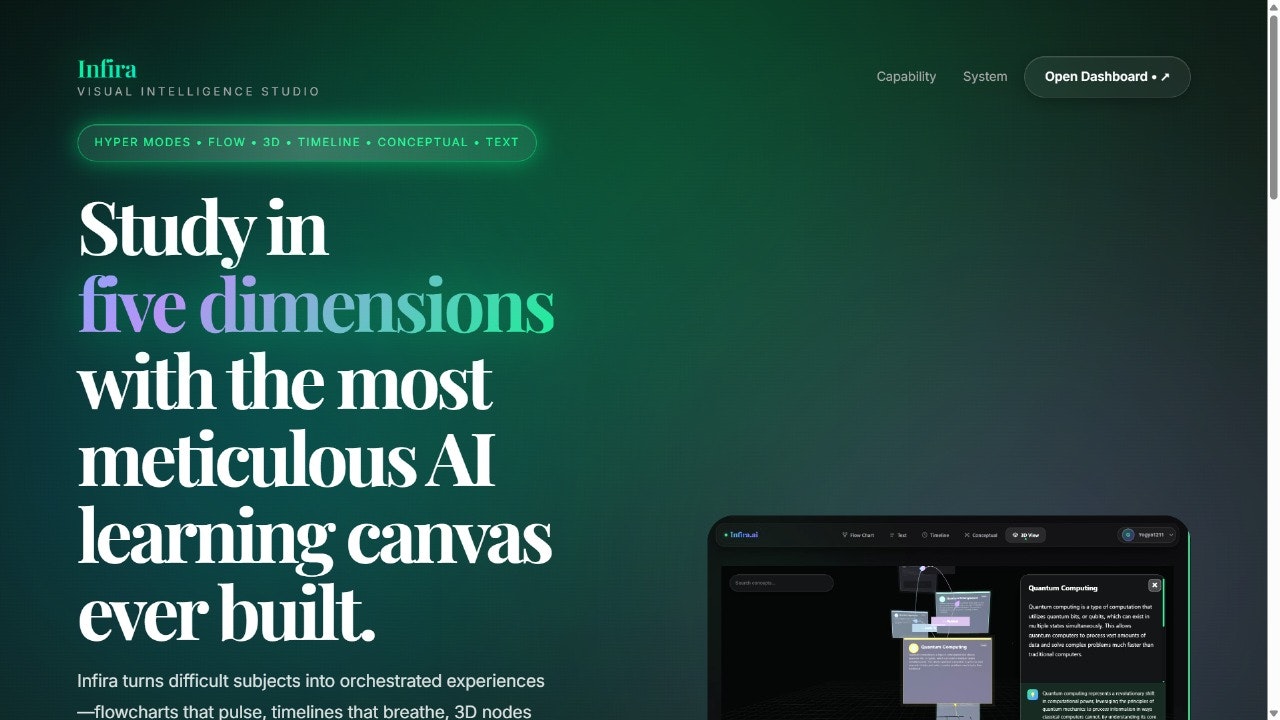
Five Synchronized Visualization Modes: Seamlessly navigate between Flow charts illustrating processes and decision points, Text providing detailed explanations and context, 3D Concept Maps revealing spatial relationships between ideas, Timelines showing chronological progression and historical context, and Conceptual views organizing abstract relationships. All five modes remain perfectly synchronized in real-time. As you edit or explore content in one view, the others update instantly and automatically, offering multifaceted perspectives on the same material without requiring manual synchronization or duplicate entry.
Live Focus with Intelligent Autoscroll: Maintain attention precisely where comprehension occurs through an intelligent navigation system that automatically scrolls and highlights relevant sections as you move through visualized concepts. The system employs contextual awareness, sensing when you are actively reading and pausing the automatic glide to respect your pace. This mindful autoscroll ensures you never lose your place when switching between visualization modes or exploring connected concepts, eliminating the frustration of manual repositioning and allowing focus to remain on understanding rather than navigation.
AAA Accessibility Standards: Built with inclusivity at the foundational level, Infira implements comprehensive accessibility features including keyboard-first navigation enabling full functionality without mouse interaction, screen reader compatibility with properly structured semantic HTML and ARIA labels, AAA contrast ratios ensuring readability for users with vision impairments, skip links for rapid navigation to main content areas, live regions announcing dynamic content changes to assistive technologies, and reduced-motion perfection respecting user preferences to disable animations that might cause discomfort. These implementations make complex multidimensional learning genuinely available to all users regardless of ability.
Calm Interface Design: Experience a learning environment intentionally architected to promote focus and reduce cognitive load through generous whitespace preventing visual clutter, steady rhythm in layout and spacing creating predictability, typography tuned specifically for deep focus and extended reading sessions, minimal distractions eliminating unnecessary interface elements, and tactile motion employing easing curves inspired by natural physical interactions. The interface aesthetic prioritizes clarity and concentration over decoration, recognizing that effective learning tools should recede into the background while content commands attention.
Three-Dimensional Interactive Exploration: Navigate concept galaxies through fully interactive 3D environments powered by Three.js technology. Drag nodes to explore from different angles, zoom to focus on specific concept clusters or view the entire knowledge structure, and rotate to reveal hidden relationships and connections. The 3D rendering maintains perfect legibility at all zoom levels through auto-layered nodes that prevent overlap, cinematic connectors that elegantly illustrate relationships, and accessible annotations ensuring information remains comprehensible regardless of spatial orientation.
Timeline Visualization with Narrative Context: Understand historical progression and causal relationships through timelines that pulse with life, spanning from origin points through current developments to future trajectories. Each milestone becomes a curated micro-story with relevant context, key events, and significance clearly communicated. This temporal perspective proves invaluable for historical subjects, technological evolution, project planning, and any domain where chronological understanding enhances comprehension.
Instant Perspective Switching: Transition between different representation modes instantly without losing context or nuance. A concept explored as a flowchart can immediately shift to timeline view to understand its historical development, then to 3D space to grasp its relationship with other ideas. This fluid movement between perspectives accommodates different learning needs at different moments, whether you need procedural understanding, historical context, spatial relationships, or detailed textual explanation.
How It Works
Infira’s transformative capabilities emerge from its sophisticated Inference Engine that processes topics through multiple representational lenses simultaneously. The workflow balances simplicity in interaction with complexity in underlying architecture.
Users begin by inputting a topic of interest through a straightforward text interface. The Inference Engine then analyzes this topic and intelligently generates multiple synchronized visual representations. This generation process leverages natural language understanding to extract key concepts, identifies hierarchical relationships and dependencies, determines chronological sequences when relevant, maps conceptual connections and influences, and produces appropriate visualizations for each mode.
Whether you prefer chronological timelines showing historical progression, branching flowcharts illustrating decision points and processes, interconnected 3D node maps revealing spatial relationships, conceptual diagrams organizing abstract connections, or detailed text providing comprehensive explanations, Infira provides these perspectives simultaneously and maintains perfect synchronization across all views.
The true power emerges through interactive exploration. Editing or expanding a concept in one view instantly updates all other synchronized views through real-time propagation. Add a node in the 3D map, and the corresponding timeline, flowchart, and text immediately reflect this addition with appropriate context. Reorder events in the timeline, and the flowchart logic, 3D spatial arrangement, and narrative text all adjust accordingly. This multidimensional consistency enables holistic exploration where you can think through problems from whichever angle provides clearest insight at any moment, confident that your work remains integrated across all perspectives.
The synchronized architecture ensures that learners never face the common frustration of maintaining multiple disconnected representations of the same material. Changes propagate instantly, relationships remain explicit, and the cognitive load of managing multiple views disappears, allowing full attention to focus on understanding the subject matter itself.
Use Cases
Infira’s versatile architecture opens possibilities across diverse learning and research scenarios where multidimensional understanding provides advantages over linear presentation:
Deep Study of Complex Historical Events and Systems: Unravel intricate historical developments by simultaneously viewing chronological timelines showing when events occurred, flowcharts illustrating causal chains and decision points, 3D concept maps revealing interconnections between political, economic, and social factors, and detailed text providing context and analysis. Understanding complex periods like the Industrial Revolution, World War II, or the Scientific Revolution becomes dramatically clearer when you can seamlessly shift between temporal, causal, and relational perspectives.
Visualizing Research Connections and Literature Reviews: Map relationships between research papers, theoretical frameworks, methodologies, and findings through interconnected concept networks. Track how ideas evolved chronologically, understand which theories influenced later developments, identify gaps in existing literature, and discover unexpected connections between seemingly unrelated work. The multidimensional approach proves particularly valuable for dissertation research, systematic reviews, and synthesis of large bodies of academic literature.
Creating Accessible Educational Materials: Develop engaging and universally accessible learning content that caters to diverse learning styles, abilities, and cognitive preferences. Visual learners benefit from flowcharts and 3D maps, sequential learners prefer timelines and process flows, detail-oriented learners appreciate comprehensive text, and students requiring accessibility accommodations receive keyboard navigation, screen reader compatibility, and high-contrast interfaces. A single Infira-based learning module serves all these needs simultaneously without requiring parallel development of multiple resources.
Strategic Business Planning and System Design: Map business strategies, organizational structures, product development roadmaps, and technology architectures through synchronized views showing hierarchical relationships, chronological milestones, process flows, and conceptual frameworks. Founders and teams can explore strategic options from multiple angles, communicate complex plans clearly to stakeholders, and identify dependencies and risks that might remain hidden in traditional planning documents.
Understanding Scientific Concepts and Technical Systems: Break down complex scientific theories, engineering systems, or technical architectures by viewing component relationships spatially, understanding historical development through timelines, following process flows through diagrams, and reading detailed explanations in text. Subjects like cellular biology, computer networking, quantum mechanics, or software architecture reveal themselves more completely when approached through multiple representational modes.
Pros and Cons
Advantages
Unique Synchronized 3D and Timeline Visualization: The ability to see and interact with three-dimensional concept maps and living timelines that remain perfectly synchronized with flowcharts, conceptual diagrams, and text offers a genuinely novel approach to grasping complex relationships. This multidimensional synchronization goes beyond traditional single-perspective tools, enabling users to explore how spatial, temporal, and logical relationships intersect. The interactive 3D environments powered by Three.js provide cinema-quality visual experiences while maintaining complete accessibility, a combination rarely achieved in educational technology.
Uncompromising Accessibility Focus: Infira’s commitment to AAA accessibility standards ensures that powerful multidimensional learning tools reach wider audiences including users with vision impairments, motor disabilities, cognitive differences, and those requiring assistive technologies. The keyboard-first design, comprehensive screen reader support, high-contrast interfaces, and reduced-motion options demonstrate that accessibility can coexist with sophisticated visual capabilities rather than compromising between the two. This inclusivity represents a significant competitive advantage and ethical strength.
Cognitive Load Reduction Through Calm Design: The intentionally minimalist interface with generous whitespace, steady visual rhythm, and focus-optimized typography creates an environment conducive to deep concentration and extended learning sessions. By eliminating visual noise and distraction, Infira allows cognitive resources to focus entirely on understanding subject matter rather than navigating complex interfaces. This design philosophy proves particularly valuable for challenging subjects requiring sustained mental effort.
Instant Context Preservation During Perspective Switching: The ability to fluidly move between different visualization modes without losing context or manually maintaining synchronization eliminates a major friction point in multidimensional learning. Traditional approaches require either working with multiple disconnected documents or laboriously updating parallel representations. Infira’s automatic synchronization respects the reality that different moments in the learning process benefit from different perspectives, while ensuring that switching views never creates confusion or duplication of effort.
Disadvantages
Early Development Stage with Demo Platform Hosting: Infira currently operates on Railway.app infrastructure accessible primarily through demo URLs, indicating an early-stage product that has not yet launched production-level infrastructure. This early status suggests potential limitations including possible performance constraints under heavy load, risk of service interruptions during platform development, limited user base providing feedback and identifying edge cases, and uncertain long-term availability or pricing models. Organizations considering Infira for critical educational workflows should carefully evaluate stability requirements and maintain contingency plans.
Limited Learning Management System Integration: As an emerging platform, Infira may not yet offer deep integrations with established Learning Management Systems such as Canvas, Blackboard, Moodle, Google Classroom, or enterprise platforms like SAP SuccessFactors and Cornerstone OnDemand. This integration gap creates challenges for institutional adoption including difficulty embedding Infira content within existing course structures, lack of automatic grade synchronization, absence of single sign-on authentication, and limited learning analytics integration with institutional dashboards. Educational institutions heavily invested in LMS ecosystems may find adoption friction despite Infira’s pedagogical advantages.
Potential Complexity Overwhelming for Simple Topics: The multidimensional approach with five synchronized visualization modes may introduce unnecessary complexity for straightforward subjects that genuinely benefit from linear presentation. Simple procedural instructions, basic definitions, or elementary concepts might be more efficiently communicated through traditional text or single diagrams rather than full 3D concept galaxies and synchronized timelines. Users should thoughtfully assess whether specific learning objectives genuinely benefit from multidimensional representation or whether simpler tools suffice.
Learning Curve for Maximizing Platform Capabilities: While Infira’s interface emphasizes usability, fully leveraging the synchronized multidimensional system requires understanding how different visualization modes complement each other, when to switch between perspectives for optimal comprehension, how to structure input topics for effective multi-view generation, and techniques for navigating complex 3D concept spaces. Initial users may experience cognitive overhead as they internalize the platform’s interaction model before productivity benefits fully materialize.
Unclear Pricing and Sustainability Model: Public information does not clearly specify pricing structure, business model, or long-term sustainability plans for the platform. Potential users face uncertainty regarding whether Infira will adopt freemium, subscription, institutional licensing, or other monetization approaches, what features might be restricted in different pricing tiers, and whether the platform will remain operational and supported over multi-year timeframes relevant for educational content development. This uncertainty may discourage investment of significant time in creating Infira-based learning materials.
How Does It Compare?
The knowledge management and visual learning landscape in late 2025 encompasses diverse tools serving overlapping but distinct needs. Understanding Infira’s position requires examining multiple categories of platforms, each with particular strengths and philosophical approaches.
Visual Knowledge Management Platforms
Heptabase
Heptabase positions itself as an intelligent, visual knowledge base built specifically for students, researchers, and lifelong learners requiring deep engagement with complex material. The platform emphasizes spatial thinking through visual canvases where users create cards containing notes, link them bidirectionally, and arrange them spatially to reflect conceptual relationships.
Core capabilities include block-based editing with rich text and multimedia support, bidirectional linking creating web-like knowledge structures, Readwise integration for importing highlights and annotations, comprehensive PDF annotation tools, daily journals for temporal organization, and web clipper for capturing online content. Recent 2025 updates introduced AI-powered features including knowledge base-wide chat enabling questions across all stored content, AI-generated card suggestions for discovering connections, and premium plans unlocking advanced capabilities.
Heptabase excels in helping users build connected knowledge networks over time, supporting research workflows where understanding emerges from exploring relationships between sources, and facilitating collaborative work on shared knowledge projects. The platform demonstrates particular strength for academic research, literature reviews, and projects requiring synthesis of large information volumes.
Compared to Infira, Heptabase focuses on long-term knowledge accumulation and relationship discovery through user-directed spatial arrangement, whereas Infira emphasizes AI-generated multi-perspective visualization of individual topics. Heptabase requires manual card creation and linking, building knowledge networks incrementally, while Infira automatically generates synchronized representations from topic input. Users choosing between them should consider whether their workflow prioritizes gradual knowledge base construction with deep customization favoring Heptabase or rapid multi-perspective understanding of specific topics favoring Infira.
Scrintal
Scrintal bridges visual note-taking and structured knowledge management through a card-based interface combined with infinite canvas organization. The platform describes itself as transforming creative ideas into structured knowledge for solving real-world problems.
Key features include visual note cards functioning like digital sticky notes with full rich text editing, spatial organization on infinite canvases enabling clustering, trees, and mind maps reflecting natural thought connections, flexible viewing options with compact, snippet, and full views for different working modes, floating tab functionality allowing multimedia files to open in movable windows anywhere on the canvas, enabling simultaneous video watching and note-taking, bidirectional linking for building knowledge networks, board-based organization for managing different projects and topics, and task management with checkboxes for action items.
Scrintal targets creatives, students, freelancers, and anyone seeking to connect ideas visually without steep learning curves. The platform emphasizes immediacy and simplicity, enabling users to start capturing ideas productively within minutes rather than requiring extensive setup.
Compared to Infira, Scrintal provides more granular control over individual note creation and spatial arrangement, whereas Infira automates generation of multiple synchronized visualization modes from topic input. Scrintal focuses on user-driven spatial organization and card connections, while Infira emphasizes AI-generated multidimensional representations. Users valuing manual control and gradual knowledge construction prefer Scrintal, while those seeking rapid multidimensional perspective generation favor Infira.
Heptabase vs. Scrintal Positioning
Both Heptabase and Scrintal operate in the visual knowledge management space but with different emphases. Heptabase targets deeper research workflows with stronger AI integration and knowledge base-wide intelligence, while Scrintal prioritizes accessibility and creative workflow support with lighter cognitive overhead. Infira differentiates from both by focusing on topic-specific multidimensional visualization rather than gradual knowledge base accumulation.
Collaborative Whiteboard Platforms
Miro
Miro stands as the dominant collaborative online whiteboard platform in 2025, enabling distributed teams to visualize ideas and collaborate seamlessly regardless of geographic location. The platform has evolved from simple digital canvas to comprehensive collaboration workspace.
Core capabilities include infinite canvas providing unlimited space for expansive project mapping, real-time collaboration allowing simultaneous editing by multiple users with visible cursors and instant updates, extensive template library containing hundreds of pre-built frameworks for brainstorming, project planning, workshops, retrospectives, and specialized methodologies, integration with essential productivity tools including Slack, Jira, Trello, Google Drive, Microsoft Teams, and numerous others, presentation mode for structured walkthroughs during meetings, timer and voting features for facilitated workshops, AI-powered features for idea generation, clustering insights, and summarizing takeaways, and robust mobile applications enabling participation from any device.
Miro excels in team brainstorming sessions, agile ceremonies and retrospectives, workshop facilitation, design thinking exercises, and strategic planning. The platform’s strength lies in synchronous collaboration where teams work together in real-time or asynchronous workflows where contributors add content across time zones.
Compared to Infira, Miro provides a broad collaboration canvas for team-driven ideation and planning, whereas Infira generates structured multidimensional learning representations from topic input. Miro requires manual content creation by collaborators, while Infira automates visualization generation. Miro serves collaborative workflow needs, while Infira targets individual or small group learning and research. Organizations requiring team whiteboarding capabilities benefit more from Miro, while those seeking AI-generated multidimensional educational content favor Infira.
Note-Taking and Personal Knowledge Management Platforms
Obsidian
Obsidian operates as a powerful knowledge management system built on local Markdown files, emphasizing user ownership of data and extensibility through community plugins. The platform pioneered many features now common in modern PKM tools.
Core capabilities include local-first architecture storing all content as plain text Markdown files on user devices, graph view visualizing bidirectional links between notes as interactive network diagrams, extensive plugin ecosystem with hundreds of community-developed extensions, canvas feature for spatial note arrangement, dataview plugin enabling database-like queries across notes, and complete offline functionality without cloud dependencies.
Obsidian excels for users valuing data ownership, preferring local storage over cloud services, requiring extensive customization through plugins, and building long-term personal knowledge bases. The platform serves developers, researchers, writers, and knowledge workers comfortable with technical setup.
Compared to Infira, Obsidian provides comprehensive personal knowledge management with user-driven organization and customization, whereas Infira focuses on AI-generated multidimensional visualization of specific topics. Obsidian requires manual note creation and linking, while Infira automates synchronized multi-perspective generation. Users building extensive personal knowledge bases over years prefer Obsidian, while those seeking rapid multidimensional topic understanding favor Infira.
Notion
Notion combines note-taking, database management, project tracking, and wiki capabilities into a unified workspace. The platform has become ubiquitous across startups, creative teams, and individual productivity enthusiasts.
Core capabilities include flexible database views supporting tables, kanban boards, calendars, galleries, and lists, rich block-based editing with embed support for multimedia and third-party services, wiki and documentation features for team knowledge bases, project management capabilities with task tracking, collaboration features including real-time editing, comments, and permissions, and AI integration for content generation and summarization.
Notion excels as all-in-one workspace for teams requiring documentation, project management, and knowledge management in a single platform. The flexibility accommodates diverse use cases from personal task tracking to enterprise wikis.
Compared to Infira, Notion provides comprehensive workspace functionality with strong database and collaboration features, whereas Infira specializes in multidimensional learning visualization. Notion requires manual content structuring, while Infira generates synchronized perspectives automatically. Teams needing integrated workspace capabilities prefer Notion, while learners seeking AI-driven multidimensional representation favor Infira.
Roam Research
Roam Research pioneered bidirectional linking and networked thought concepts that influenced an entire generation of knowledge management tools. The platform emphasizes daily note-taking with automatic backlinking creating knowledge graphs.
Core capabilities include outliner-based editing with infinite nesting, bidirectional linking automatically creating connections between notes, daily notes encouraging temporal organization, graph database storing notes as interconnected nodes, and block-level references enabling granular knowledge connections.
Roam excels for users embracing daily note-taking workflows, preferring networked thought over hierarchical organization, and valuing automatic relationship discovery through backlinks. The platform serves writers, researchers, and knowledge workers building extensive interconnected knowledge bases.
Compared to Infira, Roam provides long-term knowledge accumulation through daily notes and bidirectional linking, whereas Infira generates multidimensional topic visualizations on demand. Roam requires gradual knowledge base building, while Infira produces instant multi-perspective representations. Users committed to daily note-taking practice prefer Roam, while those seeking rapid topic exploration favor Infira.
Logseq
Logseq operates as an open-source alternative to Roam Research, combining privacy-focused local-first architecture with bidirectional linking and knowledge graph capabilities. The platform emphasizes user ownership and extensibility.
Core capabilities include local-first storage with Markdown and Org-mode support, bidirectional linking and knowledge graphs, outliner-based editing with task management, plugin system for customization, and optional Git synchronization for version control.
Logseq appeals to users valuing open-source software, requiring privacy through local storage, preferring technical customization capabilities, and building personal knowledge bases without subscription costs.
Compared to Infira, Logseq provides comprehensive personal knowledge management with local control, whereas Infira focuses on AI-generated multidimensional visualization. Logseq requires manual note creation and linking, while Infira automates synchronized perspective generation. Users prioritizing privacy and ownership prefer Logseq, while those seeking AI-driven multidimensional learning favor Infira.
Tana
Tana emerged as a next-generation outliner combining structured data capabilities with fluid note-taking through innovative supertag and live query systems. The platform emphasizes powerful data modeling without database complexity.
Core capabilities include supertags creating structured schemas within freeform notes, live queries dynamically filtering and displaying content, AI assistant for content generation and processing, calendar integration with natural language date parsing, and collaboration features for team knowledge management.
Tana targets power users seeking advanced data modeling capabilities, teams requiring structured yet flexible knowledge management, and users valuing cutting-edge features and rapid development velocity.
Compared to Infira, Tana provides structured knowledge management with powerful querying capabilities, whereas Infira specializes in multidimensional topic visualization. Tana requires manual knowledge structuring, while Infira automates multi-perspective generation. Users needing sophisticated data modeling prefer Tana, while those seeking AI-driven multidimensional learning favor Infira.
RemNote
RemNote uniquely integrates spaced repetition learning directly into note-taking, automatically generating flashcards from notes for active recall practice. The platform targets students and lifelong learners committed to long-term retention.
Core capabilities include integrated spaced repetition with automatic flashcard generation, bidirectional linking for knowledge network building, outliner-based editing, PDF annotation, and knowledge base organization features.
RemNote excels for students preparing for exams, professionals learning new domains requiring long-term retention, and anyone valuing scientifically-proven spaced repetition methods integrated with knowledge management.
Compared to Infira, RemNote focuses on long-term retention through spaced repetition, whereas Infira emphasizes multidimensional understanding through synchronized visualization. RemNote requires manual note creation and flashcard management, while Infira automates perspective generation. Users prioritizing active recall and retention prefer RemNote, while those seeking multidimensional comprehension favor Infira.
Infira’s Competitive Position
Infira occupies a specialized niche within the broader knowledge management and educational technology landscape. The platform’s unique positioning emerges from several strategic differentiators that set it apart from both visual knowledge management tools and collaborative whiteboard platforms.
Against Visual Knowledge Management Tools: Compared to Heptabase, Scrintal, Obsidian, Notion, Roam Research, Logseq, Tana, and RemNote, Infira differentiates through emphasis on AI-generated multidimensional visualization rather than manual knowledge base construction. These competitors require users to create, link, and organize content over time, building knowledge networks incrementally. Infira instead generates synchronized flowcharts, timelines, 3D concept maps, conceptual diagrams, and text automatically from topic input, prioritizing rapid multidimensional understanding over long-term knowledge accumulation.
This distinction matters for specific use cases. Users who benefit most from Heptabase, Obsidian, or similar platforms invest time gradually building comprehensive knowledge bases that compound value over months and years. Infira serves users needing to rapidly understand complex topics from multiple perspectives without long-term knowledge base commitment. The tools complement rather than compete directly, as some users might maintain ongoing knowledge bases in traditional PKM tools while using Infira for intensive topic-specific deep dives.
Against Collaborative Whiteboard Platforms: Compared to Miro, Infira focuses on structured learning visualization rather than freeform team collaboration. Miro provides blank canvas where teams manually create content through brainstorming, planning, and workshop activities. Infira automatically generates structured multidimensional representations designed specifically for learning and comprehension rather than collaborative ideation.
This positioning means Miro excels for team workshops, design thinking sessions, and collaborative planning where human creativity drives content creation. Infira serves individual learners, researchers, and small groups seeking AI-assisted multidimensional exploration of complex subjects. Organizations might use both tools for different purposes: Miro for team collaboration and Infira for educational content development or research visualization.
Unique Value Proposition: Infira’s distinctive strength lies in synchronized multidimensional representation with strong accessibility focus. No competitor combines AI-generated flowcharts, timelines, 3D concept maps, conceptual diagrams, and text that remain perfectly synchronized during editing while maintaining AAA accessibility standards. This combination addresses specific scenarios where multidimensional understanding accelerates comprehension more effectively than traditional approaches.
The platform particularly suits situations including learning complex historical periods where temporal, causal, and relational perspectives all contribute to understanding, synthesizing research literature where relationships between papers, theories, and methodologies need visualization, creating accessible educational materials serving diverse learning styles and abilities, understanding technical systems where component relationships, processes, and chronological evolution all matter, and strategic planning where organizational, temporal, and conceptual perspectives must align.
Limitations and Trade-offs: Infira’s specialized focus creates trade-offs. The platform does not provide comprehensive personal knowledge management for ongoing note accumulation, extensive plugin ecosystems for customization, robust database capabilities for structured data, collaborative whiteboarding for team ideation, or long-term knowledge base building with incremental growth.
Users requiring these capabilities should consider alternative tools better suited to those specific needs. The optimal choice depends on whether the core requirement centers on rapid multidimensional topic exploration favoring Infira, long-term personal knowledge accumulation favoring traditional PKM tools, or team collaboration favoring whiteboard platforms.
Final Thoughts
Infira represents a focused innovation in how we engage with complex information through its unique approach to synchronized multidimensional visualization. By transforming abstract concepts into dynamic, interactive experiences spanning flowcharts, timelines, 3D concept maps, conceptual diagrams, and text, the platform empowers users to learn faster, remember more effectively, and think more critically through whichever perspective resonates most strongly at any given moment.
The platform’s genuine innovation lies not in individual visualization modes, which exist separately in various tools, but in the seamless synchronization enabling fluid exploration across perspectives without losing context or manually maintaining consistency. This architectural choice respects the reality that different moments in the learning process benefit from different representational modes: temporal sequences reveal historical development, spatial maps show interconnections, flowcharts clarify processes, and detailed text provides comprehensive explanations.
Infira’s unwavering commitment to AAA accessibility standards demonstrates that sophisticated multidimensional visualization can coexist with comprehensive accessibility rather than compromising between the two. The keyboard-first navigation, screen reader compatibility, high-contrast interfaces, and reduced-motion support ensure that powerful learning tools reach all users regardless of ability. This inclusive design represents both ethical strength and competitive advantage in educational technology.
However, prospective users should carefully consider Infira’s current development stage and specific fit for their needs. The early-stage status with Railway.app hosting suggests potential stability considerations for mission-critical educational workflows. The lack of established LMS integrations creates friction for institutional adoption within existing educational infrastructure. The specialized focus on multidimensional topic visualization means Infira does not replace comprehensive personal knowledge management systems for long-term note accumulation or collaborative whiteboard platforms for team ideation.
Organizations and individuals evaluating Infira should assess several factors: whether their learning objectives genuinely benefit from multidimensional representation beyond simpler linear approaches, if the early-stage risk profile aligns with their stability requirements, whether LMS integration limitations create adoption barriers, and if the platform’s strengths align with specific use cases like complex subject learning, research synthesis, or accessible educational content creation.
For learners, researchers, and educators confronting genuinely complex subjects where multidimensional understanding accelerates comprehension, Infira delivers meaningful value. The platform proves particularly effective for historical analysis requiring temporal and causal perspectives, research synthesis needing relationship visualization, educational content development serving diverse learning styles, technical system understanding combining component, process, and temporal views, and strategic planning aligning multiple organizational perspectives.
As Infira matures beyond its current early stage, success will depend on demonstrating production-level reliability, expanding LMS integration capabilities, clarifying pricing and sustainability models, growing user community providing feedback and use cases, and continuing innovation in synchronized multidimensional representation while maintaining accessibility focus.
While still in its early stages, Infira’s innovative approach and genuine commitment to accessibility make it a tool worth watching for anyone seeking to deepen understanding of complex subjects through multidimensional exploration. The platform represents a significant step forward in applying AI to educational visualization, offering a glimpse into futures where learning tools automatically generate diverse perspectives that complement human cognitive strengths rather than forcing adaptation to rigid linear formats.