Table of Contents
Overview
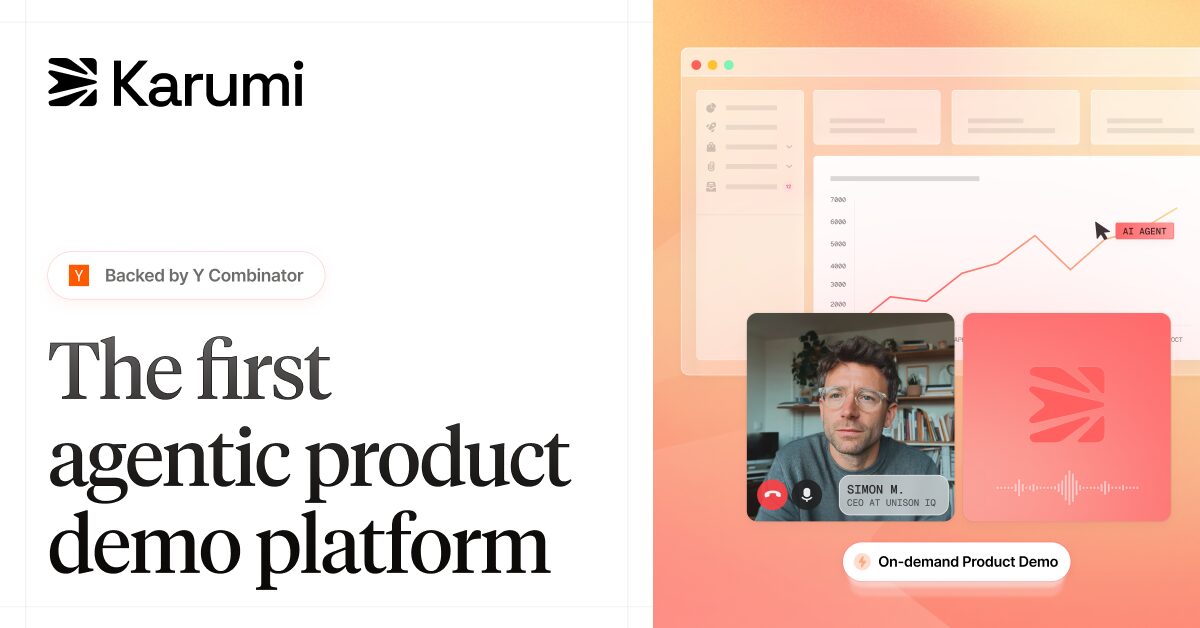
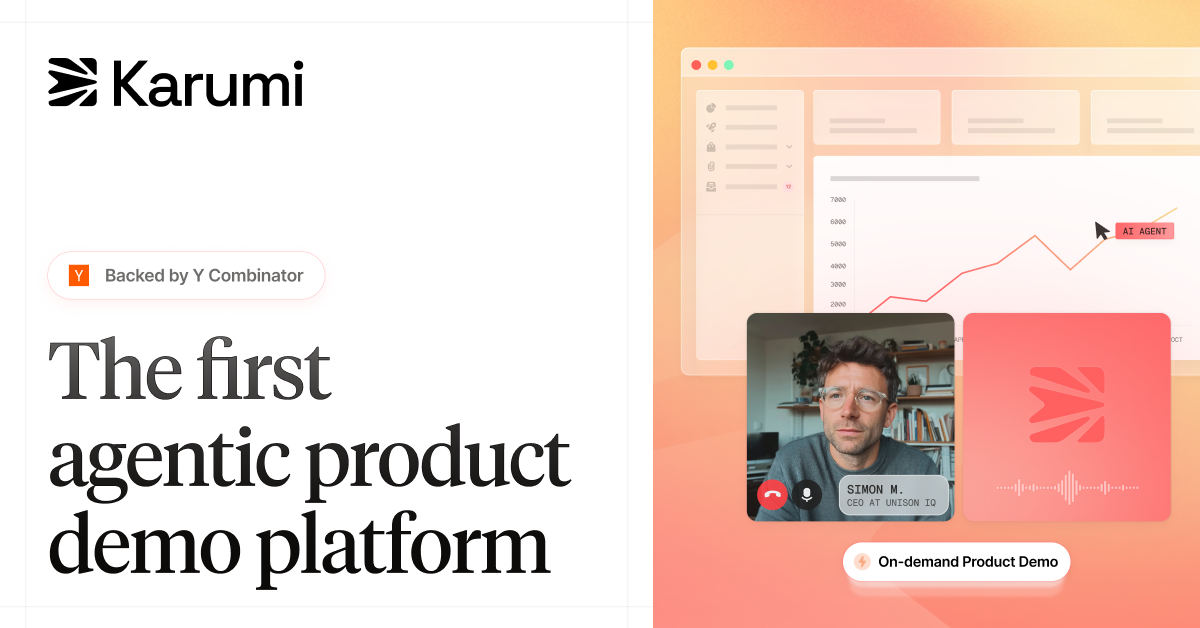
Sales teams face a fundamental bottleneck: demo requests grow faster than human capacity to deliver them. High-intent prospects wait days for scheduled calls while reps get overwhelmed with back-to-back demonstrations, leaving little time for strategic deal-closing. This capacity constraint means less than nine percent of inbound leads ever reach actual sales conversations. Karumi addresses this scalability challenge through a fundamentally different approach: an AI agent that joins live video calls to deliver personalized product demonstrations in real-time, available 24/7 in any language. Rather than pre-recorded videos or static clickable tours, Karumi provides live interaction where the AI can answer questions, navigate through the actual product, adapt presentations based on visitor interests, and engage prospects at their peak moment of intent. Backed by Y Combinator’s Fall 2025 batch, Karumi positions itself as the interface between people and software, starting with demo automation but envisioning broader applications.
Key Features
Live AI Agent Video Participation: A dedicated AI agent joins scheduled or on-demand video meetings directly, appearing as a participant that can speak, listen, and interact. The agent handles the complete demonstration, freeing human team members while maintaining consistent, professional presentation quality across every session.
Real-Time Product Navigation: Unlike screen-recorded demos, the Karumi agent actively clicks through your actual application, navigating interfaces, filling forms, and demonstrating workflows in real-time. This live manipulation creates authentic product experiences rather than passive video watching.
Multilingual Capability: The AI delivers fluent product walkthroughs in any language without requiring separate demo versions or human translators. This breaks down geographical barriers and enables immediate global market expansion without hiring international sales teams.
Adaptive Personalization: Rather than following rigid scripts, the agent listens to visitor questions and interests during the call, then adapts the demonstration flow accordingly. It can skip irrelevant features, dive deeper into specific areas, and adjust pacing based on engagement signals.
24/7 Instant Availability: The AI agent never sleeps, takes breaks, or experiences scheduling conflicts. Prospects can request and receive immediate personalized demos regardless of time zone, enabling capture of high-intent traffic that would otherwise bounce due to wait times.
Product Knowledge Integration: The agent is trained on your product documentation, feature sets, messaging guidelines, and sales scripts, combining the technical depth of your best engineer with the persuasive abilities of your top sales representative.
Discovery and Qualification: Beyond demonstration, Karumi can conduct discovery conversations, ask qualifying questions, understand prospect use cases, and gather information that helps sales teams prioritize follow-up effectively.
Interactive Q\&A: Prospects can interrupt with questions mid-demo, and the AI responds conversationally in real-time rather than requiring callback or email follow-up. This interactive dialogue creates engagement levels impossible with pre-recorded content.
CRM Integration and Analytics: Automatically log demo sessions, capture engagement data, track which features generated interest, identify drop-off points, and sync information to your CRM for sales team follow-up with complete context.
How It Works
Karumi operates through a streamlined integration designed to fit existing sales workflows. Begin by training the AI agent on your product using documentation, demo scripts, feature descriptions, positioning materials, and any content that defines how your product should be presented. The platform learns your product’s capabilities, value propositions, and target use cases. Once trained, embed Karumi’s meeting scheduler or instant demo trigger on your website, allowing visitors to request demonstrations immediately when interest peaks. When a prospect initiates a demo request, they join a video call where the Karumi AI agent greets them, introduces itself, and begins the discovery process by asking about their role, challenges, and specific interests. Based on these responses, the agent tailors the demonstration, navigating through your actual product interface while explaining features, highlighting relevant use cases, and answering questions conversationally. The AI adapts in real-time if the prospect asks to see something specific or expresses confusion, adjusting the presentation flow rather than rigidly following predetermined paths. Throughout the session, Karumi captures engagement signals: which features generated questions, where attention focused, what concerns arose, and which benefits resonated. After the call concludes, all this intelligence automatically syncs to your CRM, providing sales teams with rich context for follow-up conversations. The entire process happens instantly without human coordination, enabling your business to deliver hundreds or thousands of personalized demos that would be impossible to handle manually.
Use Cases
Karumi serves diverse scenarios where demo delivery creates bottlenecks or missed opportunities:
Scaling SaaS Product Demonstrations: Handle explosive growth in demo requests without proportionally scaling sales headcount. SaaS companies experiencing rapid inbound traffic can instantly engage every prospect with personalized attention, preventing high-intent leads from abandoning due to scheduling delays or capacity constraints.
Global Market Expansion: Enter new geographical markets without hiring local sales teams by delivering fluent product demonstrations in native languages. The AI removes language barriers that traditionally require expensive international expansion or limit addressable markets.
After-Hours Lead Capture: Convert traffic arriving outside business hours, during weekends, or from distant time zones. Rather than forcing these prospects to fill forms and wait days, immediate interactive demos capture interest when intent is highest.
Product Launch Surges: Handle traffic spikes during product launches, marketing campaigns, or conference attendance without temporary sales team expansion. Karumi scales infinitely to meet demand surges that would otherwise overwhelm human capacity.
Qualifying Inbound Volume: Pre-qualify large volumes of inbound interest by having the AI conduct initial discovery and demonstration, identifying serious prospects with genuine use cases versus tire-kickers. Sales teams then focus exclusively on qualified, engaged leads rather than spending time on unproductive early-stage conversations.
Multi-Product Portfolio Demonstrations: For companies with multiple products or complex solution portfolios, the AI can intelligently navigate to relevant offerings based on prospect needs, demonstrating appropriate products without requiring specialized sales reps for each solution.
Automated Customer Onboarding: Guide new customers through product setup and feature introduction with personalized walkthroughs that adapt to their specific implementation, reducing time-to-value and support burden on customer success teams.
Partner Enablement: Equip channel partners and resellers with on-demand demo capability without extensive training. Partners can offer prospects immediate demonstrations even if they lack deep product expertise themselves.
Pros \& Cons
Advantages
Unlimited Scalability: The AI can conduct simultaneous demos with hundreds or thousands of prospects without degradation in quality or personalization, solving the fundamental constraint of human calendar capacity that limits traditional sales approaches.
Immediate Engagement: Prospects receive instant gratification rather than scheduling friction. Research shows 66% of buyers expect responses within 10 minutes and converting leads contacted within 30 seconds increases 90%, making Karumi’s instant availability a significant conversion advantage.
Consistent Quality: Every demo delivers the same level of professionalism, product knowledge, and messaging accuracy regardless of time, sales rep experience level, or prospect volume. This eliminates the variability inherent in human demonstrations.
True Multilingual Support: Real-time fluency in any language without multiple demo versions, translator hiring, or market-specific sales team expansion removes traditional barriers to international growth.
Live Interaction Superiority: Interactive Q\&A and adaptive flow create engagement levels impossible with pre-recorded videos, while still maintaining the scalability that human-delivered demos cannot achieve.
Sales Team Efficiency: By handling initial demonstrations and qualification, Karumi frees senior sales talent to focus exclusively on high-value activities like closing qualified deals, strategic relationship building, and complex enterprise negotiations rather than repetitive product overviews.
Rich Qualification Data: Automatically capture prospect interests, pain points, budget signals, and engagement patterns during demos, providing sales teams with intelligence that improves follow-up effectiveness and prioritization.
Disadvantages
Early-Stage Product Maturity: As a Y Combinator Fall 2025 company, Karumi is newly launched with limited production deployment history. Early adopters accept beta-period risk including potential bugs, feature gaps, or unexpected behavior as the product evolves.
Complex Product Limitations: While effective for straightforward SaaS demonstrations, highly technical enterprise solutions requiring deep domain expertise, relationship-building conversations, or consultative selling may exceed current AI capabilities. The platform works best for relatively structured product demonstrations rather than open-ended discovery.
Trust and Acceptance Barriers: Many organizations remain skeptical about AI agents representing their brand in customer-facing sales conversations. Overcoming risk aversion requires proof of reliable performance, which early-stage companies struggle to provide at scale.
Video Platform Dependencies: Functionality relies on integration with video conferencing platforms. Changes in APIs, access policies, or pricing from platforms like Zoom, Google Meet, or Microsoft Teams could impact Karumi’s capabilities or economics.
AI Accuracy Risk: If the agent provides incorrect product information, misunderstands prospect questions, or creates negative experiences, the damage to brand reputation and pipeline quality could be severe. Sales conversations have zero tolerance for factual errors that might be acceptable in other AI applications.
Limited to Live Demo Use Cases: The platform specifically addresses real-time video demonstration scenarios. Teams needing embedded website tours, asynchronous leave-behind demos, or non-video formats must supplement Karumi with other tools rather than replacing their entire demo stack.
How Does It Compare?
Karumi enters a competitive demo automation landscape with tools addressing different aspects of the demonstration workflow:
Interactive Demo Platforms (Screenshot/Capture-Based)
Navattic: No-code platform enabling teams to clone their application interface, edit captures with personalized prompts, and create self-guided clickable demos that can be embedded on websites or shared via links. Navattic excels at marketing-focused top-of-funnel website embeds with fast implementation, unlimited user seats, and extensive integrations including Segment, Marketo, and Google Analytics. Pricing starts at free tier up to \$1,200/month for Growth plan. Navattic provides self-service exploration but lacks the live interaction, conversational Q\&A, and adaptive personalization that define Karumi’s approach.
Walnut: HTML-based demo platform focused on sales team needs, using browser extensions to capture software screens and build interactive presentations with templates, customization options, and personalization variables. Walnut offers semi-sandbox environments, ChatGPT integration for dummy data population, team collaboration features, and direct prospect feedback mechanisms. Pricing ranges from \$9,200 to \$20,000+ annually. While Walnut enables sophisticated pre-built demo customization, it creates static experiences that prospects navigate independently rather than Karumi’s live AI-guided conversations.
Storylane: Interactive demo software offering guided tours and sandbox solutions with AI-generated interactive features, intent data analysis for lead qualification, and custom demo flow building. Available from free Basic plan to \$1,200/month Premium tier. Storylane provides hands-on product exploration but lacks real-time human-like guidance and conversation.
Demostack: Advanced platform that clones entire product front-end and back-end code to create pixel-perfect functional duplicates, enabling instant personalization, consistent storytelling at scale, AI-powered data customization, and actionable engagement insights with CRM integration. Demostack serves teams wanting total control and flexible demos without engineering support, but focuses on leave-behind sandbox environments rather than live conversational demonstrations.
Live Demo Enhancement Tools
Saleo: Unique approach using real-time overlays to inject customized data into live product environments during human-led demonstrations. Saleo enables sales reps to showcase realistic workflows with clean demo data while presenting their actual software. This solves demo data quality issues but still requires human presenters and doesn’t provide automation or scalability benefits. Karumi replaces the human presenter entirely while maintaining live interaction.
TestBox: Data-first sandbox platform using AI to generate complex, realistic PII-free data ingested directly into actual product instances. TestBox creates fully functional proof-of-concept environments where prospects interact hands-on with real software populated with believable data. Starting at \$44,750/year, TestBox enables deep product exploration but focuses on self-service trials rather than guided AI-led presentations.
Video Demo Automation
Consensus: Combines video demos with product tour elements to create interactive automated demonstrations that guide buyers through personalized journeys based on role, industry, and needs. Consensus captures buyer intent data and facilitates smooth pipeline transitions but relies on pre-recorded video content rather than live AI interaction.
Arcade: Platform for creating polished, guided product demos quickly through screen recording and interactive layering. Arcade emphasizes speed and visual appeal for marketing content but produces fixed demonstrations without adaptive conversation.
Automated Demo Presentation Platforms
Demoboost: Product demo software enabling screen capture with editing for different buyer segments, building demo libraries, and accessing engagement metrics including watch rates and NPS. Demoboost offers live demo support with speaker notes and analytics, plus unique channel partner external libraries. Pricing custom. While Demoboost supports live presentations, it assists human presenters rather than replacing them with AI agents.
Omedym: Converts existing demo content into interactive experiences and digital sales rooms that create content hubs. Uses natural language processing for searchable demo libraries. Pricing from \$120 to \$600/month. Omedym organizes and enhances existing content but doesn’t generate real-time personalized presentations.
Emerging AI Demo Agents
The competitive landscape currently lacks direct alternatives providing AI agents that join live video calls for real-time product demonstrations. Traditional demo platforms focus on pre-built clickable experiences, sandbox environments, or tools that enhance human-led presentations. Karumi’s approach of deploying conversational AI agents as autonomous demo presenters represents a distinct category attempting to replace human capacity rather than simply creating self-service alternatives.
Key Differentiators
What distinguishes Karumi from existing solutions is the combination of live video participation, real-time conversational interaction, and adaptive personalization delivered by an AI agent rather than pre-recorded content or human presenters. Traditional interactive demo platforms create sophisticated self-guided experiences but lack the dialogue, questioning, and adaptive storytelling of human conversations. Live demo tools enhance human presenters but don’t solve the scalability bottleneck. Karumi attempts to capture the engagement benefits of human-led live demos while achieving the scalability of automated tools. This positions it uniquely for scenarios where immediate personalized interaction drives conversion but human capacity creates unacceptable delays or coverage gaps. The approach represents a genuinely different paradigm, though success depends on AI quality meeting the exacting standards of B2B sales conversations.
Platform Availability and Pricing
Karumi launched on Product Hunt on November 19, 2025, garnering attention for its ambitious approach to demo automation. The platform is backed by Y Combinator as part of their Fall 2025 batch, providing validation and support for the founding team’s vision of AI agents as the interface between people and software.
According to Y Combinator’s company profile, one early test demonstrated the platform’s scalability potential when the AI agent delivered over 1,700 product demonstrations within a 24-hour period, showcasing the unlimited capacity advantage that defines Karumi’s value proposition.
The platform operates as a web-based service integrating with standard video conferencing platforms and CRM systems. Specific pricing tiers, feature allocations, and implementation requirements are determined through consultation with the Karumi team rather than publicly listed standardized plans, reflecting the early-stage custom deployment approach common for enterprise-focused products.
Interested companies can request access through the Karumi website to explore how AI-powered demo agents might fit their specific sales workflows, product complexity, and volume requirements.
Final Thoughts
Karumi addresses a genuine pain point that intensifies as SaaS companies scale: the unbridgeable gap between growing demo demand and finite human capacity. The platform’s ambition to deploy AI agents as autonomous demo presenters represents a bold bet on AI capabilities reaching the threshold necessary for authentic B2B sales conversations. If execution matches vision, the implications are profound for how companies approach product demonstrations.
The core value proposition resonates immediately for businesses experiencing demo bottlenecks. Offering instant, personalized, multilingual demonstrations 24/7 without scaling headcount solves real problems around lead response times, global expansion barriers, and sales team efficiency. The reported case of delivering over 1,700 demos in 24 hours illustrates scalability impossible through traditional approaches.
However, success hinges entirely on AI quality meeting the exacting standards of sales contexts. Prospects evaluating software make decisions worth thousands or millions of dollars based partly on demo experiences. Any perception of robotic interaction, factual inaccuracy, or inability to handle nuanced questions could damage brand perception and pipeline quality. The zero-tolerance nature of sales conversations creates higher bars than many AI applications.
The platform’s suitability varies dramatically by use case. Straightforward SaaS products with clear value propositions, structured feature sets, and relatively simple demos appear well-suited for AI presentation. Complex enterprise solutions requiring deep technical expertise, consultative discovery, relationship building, or customized demonstrations may exceed current AI capabilities, though this boundary will shift as technology improves.
For companies considering Karumi, the decision framework should prioritize:
Volume and capacity constraints: If demo requests regularly exceed human capacity, forcing prospects to wait days for calls, Karumi’s instant availability provides clear value. If current volume fits comfortably within sales team schedules, the urgency diminishes.
Product complexity: Simpler products with predictable demo flows, common questions, and straightforward positioning work better than highly technical, deeply customized, or relationship-intensive sales requiring human judgment and expertise.
Risk tolerance: Early-stage technology requires accepting beta-period limitations, potential glitches, and ongoing product evolution. Risk-averse enterprises may prefer waiting for expanded production validation while startups and innovative companies gain first-mover advantages.
Global ambitions: Companies targeting international markets find multilingual capability particularly valuable, potentially unlocking geographical expansion that would otherwise require expensive local team building.
The broader vision of AI agents as the interface between people and software positions Karumi beyond just demo automation toward fundamental transformation in how humans interact with digital products. Demos serve as the entry point for this vision, but success could extend into onboarding, support, training, and eventually direct product interaction. Whether this ambitious future materializes depends on near-term proof that AI agents can reliably handle the nuanced, high-stakes conversations that define B2B sales.
For forward-thinking companies willing to embrace emerging technology and experiment with novel approaches, Karumi offers compelling potential to solve real constraints. Traditional alternatives remain safer choices for risk-averse organizations or use cases requiring deep human expertise, but the platform’s unique approach merits evaluation for teams where demo capacity limits growth.