Overview
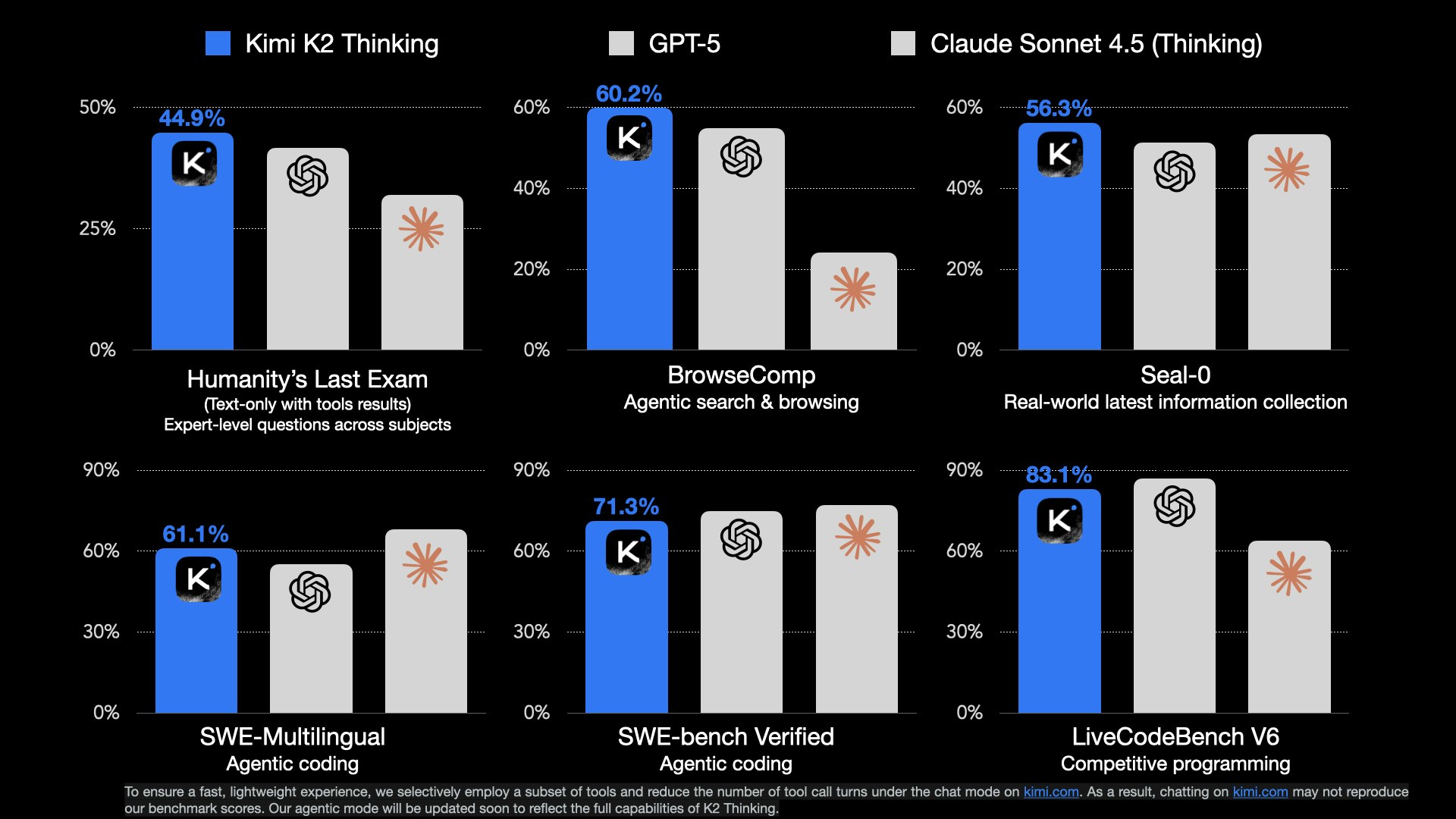
Kimi K2 Thinking is a large language model developed by Moonshot AI that emphasizes extended reasoning and agentic tool use. Released in November 2025, the model achieves strong performance on reasoning benchmarks—44.9% on HLE and 60.2% on BrowseComp—through extended chain-of-thought processing. The model’s distinctive capability is executing up to 200-300 sequential tool calls autonomously, enabling complex multi-step workflows without constant human intervention. With a 256K token context window, Kimi K2 Thinking positions itself for tasks requiring deep reasoning, code generation, and autonomous problem-solving where context length and sustained tool use are critical factors.
Key Features
Kimi K2 Thinking delivers focused capabilities for reasoning-intensive and tool-rich tasks:
- Extended reasoning with thinking tokens: Uses internal reasoning processes (thinking tokens) to work through complex problems before generating responses, improving accuracy on reasoning benchmarks.
- High benchmark performance: Achieves competitive scores on reasoning benchmarks (44.9% HLE, 60.2% BrowseComp), demonstrating strong logical reasoning and task completion capabilities.
-
Autonomous sequential tool calling: Executes up to 200-300 tool calls in sequence without human intervention, enabling complex workflows and multi-step problem decomposition.
-
Large context window: 256K token context enables processing of extensive documents, codebases, and datasets while maintaining coherent reasoning across long sequences.
-
Open-source foundation: Released under Modified MIT license on Hugging Face, providing transparency and enabling community customization and fine-tuning.
How It Works
Kimi K2 Thinking operates through extended reasoning processes followed by action. The model allocates internal computational resources (thinking tokens) to work through problems step-by-step, then generates external responses and tool calls based on this reasoning. When operating as an autonomous agent, the model plans a sequence of tool calls, executes them, observes results, and continues reasoning based on outcomes—repeating this cycle across dozens or hundreds of steps to solve complex problems.
The 256K context window enables the model to maintain awareness of problem context, previous tool outputs, and overall strategy throughout extended tool-calling sequences. This architecture supports both standard language model use cases and agentic workflows where sustained autonomous operation is required.
Use Cases
Kimi K2 Thinking addresses specific scenarios where reasoning depth and extended tool use are valuable:
- Complex research and coding tasks: Multi-step code generation, debugging across extensive codebases, or research requiring sustained logical reasoning and tool use across many steps.
-
Autonomous problem decomposition: Problems requiring breaking into multiple sub-tasks, using different tools sequentially, and synthesizing results—such as data pipeline construction or complex system design.
-
Extended context processing: Tasks requiring analyzing or reasoning about massive documents, API documentation, or codebases where context length creates value.
-
Agent research and development: Serves as a foundation model for teams exploring extended reasoning and autonomous agent capabilities with research-grade benchmarks.
Pros & Cons
Advantages
Kimi K2 Thinking offers meaningful benefits for reasoning-intensive applications:
- Strong reasoning performance: Achieves competitive benchmark scores through extended thinking, improving accuracy on complex logical tasks.
-
Extensive autonomous operation: Executing 200-300 sequential tool calls enables sophisticated workflows without human intervention between steps.
-
Large context window: 256K tokens enables processing of extensive information while maintaining coherent reasoning across long sequences.
-
Open-source transparency: Modified MIT license enables community inspection, fine-tuning, and customization for specific domains.
Disadvantages
While strong for specific use cases, Kimi K2 Thinking has meaningful limitations:
- Extended inference latency: Reasoning token computation adds latency compared to standard models, making real-time applications less suitable.
-
Requires agentic framework integration: Executing sustained tool-calling sequences requires integration with agent orchestration frameworks or custom agent implementations.
-
Benchmark-specific optimization: Performance strength lies in specific reasoning benchmarks. General-purpose tasks may show less dramatic improvements over standard models.
-
Operational complexity: Effectively using extended reasoning and autonomous tool calling requires technical infrastructure and domain expertise.
How Does It Compare?
The reasoning-focused model landscape includes tools serving different purposes and optimization targets.
AutoGen by Microsoft provides a multi-agent orchestration framework enabling multiple AI agents to collaborate on problems through conversation and tool use. Unlike Kimi K2 Thinking which is a single reasoning model, AutoGen is a framework for coordinating multiple agents (potentially using different models). AutoGen emphasizes agent collaboration patterns and conversation-based coordination, while Kimi K2 Thinking emphasizes a single model’s extended reasoning and autonomous action. Organizations might use AutoGen as the orchestration layer with Kimi K2 Thinking as one of the models within the framework.
AutoGPT represents an earlier-generation autonomous agent approach, now less actively developed. AutoGPT focused on autonomous goal-seeking without explicit multi-agent coordination. Compared to AutoGPT, Kimi K2 Thinking provides stronger benchmarks, more sophisticated reasoning through thinking tokens, and better sustained tool use. However, AutoGPT served more as a proof-of-concept for autonomous agents rather than production-grade infrastructure.
AgentVerse offers a framework for building and managing multi-agent systems with emphasis on agent specialization and coordination. Like AutoGen, AgentVerse operates at the orchestration framework level rather than the model level. Both AutoGen and AgentVerse work with any models (including Kimi K2 Thinking) to provide coordination, scheduling, and communication infrastructure.
Other reasoning models like OpenAI’s o1, Anthropic’s Claude 3.5 Sonnet Thinking, and Grok-4’s reasoning capabilities operate similarly to Kimi K2 Thinking—using extended thinking or reasoning tokens to improve performance on complex tasks. These represent direct model-level competitors with different performance profiles and availability models. OpenAI’s o1 and Claude’s Thinking variants offer comparable reasoning approaches but through different API providers.
Kimi K2 Thinking’s distinctive positioning centers on open-source availability with strong benchmark performance, high-volume autonomous tool calling, and extended context processing. Where AutoGen and AgentVerse provide orchestration frameworks for multi-agent coordination, Kimi K2 provides the underlying reasoning model capability. For teams prioritizing open-source transparency and extended reasoning capabilities, Kimi K2 represents a significant offering in the reasoning model landscape.
Final Thoughts
Kimi K2 Thinking represents Moonshot AI’s contribution to the emerging reasoning model category, emphasizing extended thinking, strong benchmark performance, and autonomous tool use. The model’s 256K context and ability to execute 200-300 sequential tool calls enable sophisticated autonomous workflows suitable for complex reasoning, code generation, and multi-step problem solving.
The model works best for research teams, developers building sophisticated autonomous systems, and organizations requiring open-source transparency in their reasoning infrastructure. Teams prioritizing closed-source API access might prefer OpenAI or Anthropic models, while teams needing multi-agent orchestration should evaluate frameworks like AutoGen or AgentVerse to coordinate multiple agents (potentially including Kimi K2 Thinking).
For organizations seeking open-source reasoning capabilities with strong benchmark performance and extensive autonomous tool calling, Kimi K2 Thinking merits serious evaluation as a foundation model for reasoning-intensive applications and agent research.