Table of Contents
Overview
Kodezi Chronos-1 is a purpose-built debugging language model that performs autonomous bug localization, root cause analysis, and test-validated code repair at repository scale. Announced on December 3, 2025 (launched on Product Hunt December 4, 2025 with specific vote count not publicly available at time of research), Chronos-1 addresses a fundamental limitation in current AI coding assistants: while models like GPT-4, Claude, and GitHub Copilot excel at code generation and completion, they struggle with complex debugging tasks requiring deep codebase understanding, multi-file reasoning, and iterative fix-test-refine cycles—achieving only 13-14% success rates on real-world multi-file debugging benchmarks compared to Chronos-1’s 67.3%.
Developed by Kodezi (YC W23, backed by established venture firms) and validated through peer-reviewed research published at arXiv (paper 2507.12482), Chronos-1 represents a paradigm shift from code completion models toward debugging-native architectures. Unlike traditional LLMs trained on next-token prediction, Chronos-1 learns from 15 million debugging sessions including GitHub issues, validated resolution paths, 8 million stack traces, 3 million CI/CD failure logs, and specialized datasets (Defects4J, SWE-bench, BugsInPy). This debugging-specific training enables the model to trace logic paths, identify failure causes, and generate validated patches through autonomous fix-test-refine loops—reducing debugging time by 40% and iterations by 65% compared to manual approaches.
The system achieves state-of-the-art 80.33% resolution rate on SWE-bench Lite (241 of 300 issues resolved), outperforming the next-best system by 20 percentage points and reaching repository-specific highs of 96.1% on Sympy and 90.4% on Django. Unlike generic LLMs with 10-100x larger context windows, Chronos-1’s output-optimized design and Adaptive Graph-Guided Retrieval (AGR) enable navigating codebases up to 10 million lines with 92% precision and 85% recall—demonstrating that for debugging, output quality and structured reasoning matter more than raw input capacity.
Key Features
Kodezi Chronos-1 is packed with specialized capabilities engineered specifically for autonomous debugging:
- Autonomous Bug Localization Through Multi-Hop Graph Traversal: Chronos-1 implements Adaptive Graph-Guided Retrieval (AGR) that constructs dynamic dependency graphs representing code relationships (function calls, imports, co-change patterns, test coverage) and intelligently navigates these graphs through k-hop traversal. When investigating bugs, the system follows execution paths across files, traces data flow through function boundaries, identifies temporal edges showing code evolution, and surfaces co-change signals revealing historically related failures. This graph-based approach enables pinpointing root causes in million-line codebases where bugs span multiple files, modules, or even repositories—achieving 92% precision and 85% recall on retrieval tasks versus sequence-based approaches missing distant dependencies.
- Validated Repair Generation with Autonomous Fix-Test-Refine Loops: Unlike one-shot patch generators, Chronos-1 implements iterative debugging cycles: proposing candidate fixes, executing test suites in secure sandboxes, analyzing failure patterns, refining patches based on test results, and continuing until validation succeeds. The system averages 7.8 iterations to successful fix (versus 4.8 for competitors), completing autonomous debugging in 2.2 cycles compared to 4.8 for alternative approaches. Each iteration incorporates learnings from previous failures, avoiding redundant attempts and converging toward correct solutions through hypothesis refinement. This autonomous loop achieves 67.3% fully autonomous success rate without human intervention—4-5x improvement over GPT-4.1 (13.8%) and Claude 4.1 Opus (14.2%) on identical multi-file debugging scenarios.
- Persistent Debug Memory Engine Trained on 15M+ Sessions: Chronos-1 maintains long-term knowledge through Persistent Debug Memory (PDM) storing patterns from 15 million debugging sessions including recurring bug signatures, anti-pattern templates, test failure correlations, configuration pitfalls, and validated fix shapes. When encountering new bugs, the system retrieves relevant historical patterns enabling faster root cause identification and solution synthesis. The memory engine learns repository-specific conventions, team coding preferences, module-level vulnerability profiles, and historical fix effectiveness metrics—essentially accumulating institutional debugging knowledge that improves over time. This memory-driven approach outperforms stateless models requiring complete problem rediscovery for each debugging session.
- Logic Path Tracing with Causal Reasoning: The model performs structured reasoning tracing execution flows through call stacks, identifying where variables change unexpectedly, following data transformations across function boundaries, and constructing causal chains linking symptoms to root causes. This trace analysis distinguishes retryable transient errors from permanent logic flaws, identifies cascading failure patterns, and reconstructs bug introduction timelines through temporal code analysis. The causal reasoning capability proves essential for complex debugging scenarios where symptoms manifest far from actual root causes—enabling Chronos-1 to resolve multi-file bugs requiring cross-repository understanding that sequence-based models cannot address.
- Adaptive Retrieval Scaling Across Entire Repositories: AGR dynamically determines optimal retrieval depth based on query complexity scores, code artifact density in dependency neighborhoods, and historical debugging patterns for similar issues. Simple bugs trigger shallow retrieval gathering local context; complex multi-file issues expand retrieval recursively following typed graph edges (implementation links, dependency chains, dataflow connections) until confidence thresholds are met or diminishing returns detected. This adaptive strategy enables repository-scale comprehension supporting codebases up to 10 million lines while maintaining computational efficiency—solving the context window limitation plaguing fixed-window LLMs that cannot simultaneously reason over entire large codebases.
- Output-Optimized Architecture for Complex Patch Generation: Chronos-1 is optimized for ~3K output tokens (fixes, tests, documentation) achieving 47.2% output entropy density versus 12.8% for code completion models. The architecture generates cohesive debugging artifacts as structured units rather than token-by-token autocompletion: complete bug explanations detailing root causes and investigation paths, validated code patches with proper error handling, regression test generation preventing future occurrences, and documentation updates reflecting code changes. This output-centric design enables superior debugging success despite competitors having 10-100x larger context windows—validating that structured output generation matters more than maximum input capacity for repair tasks.
- Multi-Source Input Layer Processing Heterogeneous Debugging Signals: Unlike code models primarily processing source files, Chronos-1 natively understands diverse debugging artifacts: source code with AST-aware structural analysis, CI/CD logs capturing build failures and pipeline errors, error traces showing stack dumps and exception propagation, configuration files revealing environment mismatches, historical pull requests documenting past fixes, and issue reports containing user-reported symptoms. This multi-modal understanding enables synthesizing evidence across information sources that humans consult during debugging—replicating expert troubleshooting methodologies requiring correlation across disparate data.
- Repository-Specific Pattern Learning and Template Generation: Chronos-1 learns codebase-specific conventions including commit message formats, test file organization, documentation styles, naming conventions, and module architecture patterns. When generating fixes, the model produces patches matching repository idioms rather than generic solutions requiring manual adaptation. The template-aware generation reduces output token waste while maintaining consistency with existing codebase standards—enabling generated fixes to pass code review without extensive revision. This contextual adaptation proves especially valuable in large enterprise codebases with established engineering practices.
- Confidence-Guided Output with Fallback Strategies: The model generates detailed explanations and alternative approaches only when confidence scores fall below thresholds, optimizing output token efficiency. High-confidence fixes provide terse patches with minimal commentary; low-confidence scenarios trigger comprehensive analysis including multiple solution candidates, risk assessments for each approach, rollback procedures, and escalation recommendations. This adaptive verbosity balances thoroughness against efficiency based on problem difficulty—ensuring developers receive appropriate context depth without overwhelming high-certainty situations with redundant information.
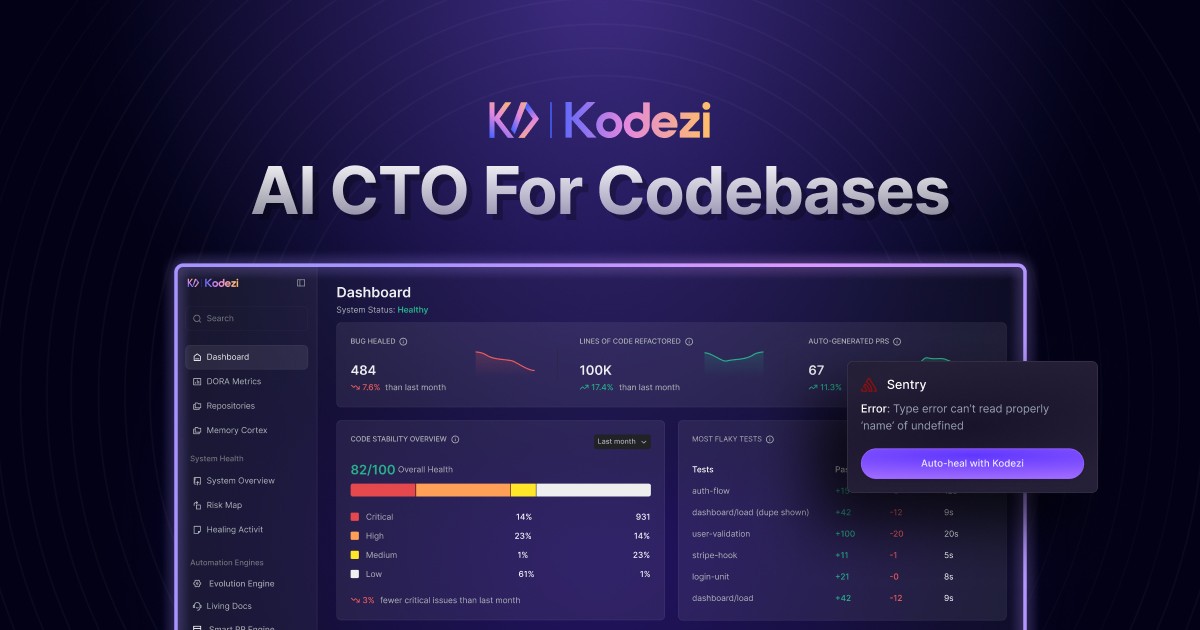
- Native Integration with IDEs, CI/CD, and Observability Tools: Chronos-1 embeds directly into development workflows through IDE plugins, CI/CD pipeline integration, observability platform connections, and version control hooks. The system operates as an “AI CTO” layer autonomously catching issues, proposing structured fixes, learning from execution outcomes, and maintaining codebase health without manual prompting. This event-driven architecture enables proactive debugging where Chronos-1 monitors code changes, detects potential issues before production deployment, and automatically generates preventative patches—shifting from reactive firefighting to continuous code health maintenance.
How It Works
Kodezi Chronos-1 operates through a sophisticated seven-layer architecture purpose-built for autonomous debugging:
Layer 1: Multi-Source Input Processing
Chronos-1 ingests heterogeneous debugging signals including source code (analyzed via AST parsing preserving structural relationships), CI/CD logs (capturing build failures, test results, deployment errors), error traces (stack dumps showing exception propagation), stack traces with validated resolution paths, configuration files (environment variables, deployment manifests), historical pull requests (past fixes and code evolution), and issue reports (user-described symptoms and reproduction steps). Unlike code models limited to source file processing, this multi-modal input layer mirrors information sources expert debuggers consult—enabling comprehensive problem understanding from diverse evidence.
Layer 2: Adaptive Graph-Guided Retrieval (AGR)
The retrieval engine constructs dynamic dependency graphs representing code relationships: AST-aware embeddings preserving structural syntax, dependency graph indexing for cross-file impact analysis, call hierarchy mapping showing execution flow understanding, temporal indexing tracking code evolution and bug history, and semantic similarity vectors capturing functional equivalence. When debugging begins, AGR performs intelligent k-hop neighbor expansion adaptively increasing search radius based on bug complexity scores, following typed edges (implementation, dependency, dataflow) to relevant nodes, and employing confidence-based termination when retrieval quality plateaus. This graph-based approach locates contextually relevant code even when separated by thousands of lines or multiple modules—solving the non-local reasoning challenge plaguing sequence-based models.
Layer 3: Debug-Tuned LLM Core
The foundational transformer undergoes specialized training on bug-fix pairs rather than code completion datasets, regression histories showing how bugs recur, CI/CD failure logs with resolution outcomes, stack traces correlating symptoms to causes, race conditions and concurrency bugs, and long-tail debugging edge cases. This debug-specific pretraining teaches the model to recognize failure patterns, distinguish symptoms from root causes, and understand common anti-patterns causing bugs. The training corpus emphasizes real-world debugging workflows including iterative refinement attempts, failed fix patterns, and successful resolution strategies—enabling the model to navigate debugging’s inherently exploratory nature.
Layer 4: Persistent Debug Memory (PDM)
The memory layer stores long-term patterns including repository-specific bug signatures, anti-pattern templates (common mistake categories), test failure correlations (which tests fail together), configuration pitfalls (environment-specific issues), fix shape templates (structural patterns in successful patches), team coding conventions and preferences, module-level vulnerability profiles, and historical fix effectiveness metrics. When encountering new bugs, PDM retrieval surfaces relevant historical knowledge accelerating root cause identification. The memory continuously updates as Chronos-1 resolves issues, accumulating institutional debugging expertise that improves performance over time—functioning as an organizational knowledge base for software maintenance.
Layer 5: Orchestration Controller Implementing Autonomous Loops
The orchestration layer manages iterative debugging workflows: hypothesis generation from error signals proposing probable causes, fix proposal synthesizing candidate patches, test execution running validation suites in secure sandboxes, result interpretation analyzing test outputs and failure patterns, iterative refinement updating patches based on test feedback, rollback mechanisms reverting failed attempts, and confidence scoring quantifying solution reliability. This autonomous loop continues until reaching validated solutions or exhausting iteration budgets—mimicking expert debugger behavior of iterative hypothesis testing rather than attempting single-shot fixes. The controller averages 7.8 iterations to successful fix while maintaining 67.3% fully autonomous success rate.
Layer 6: Execution Sandbox with Multi-Dimensional Validation
Proposed fixes undergo rigorous validation in isolated execution environments: unit test execution verifying functional correctness, integration test suites confirming cross-module compatibility, performance profiling detecting efficiency regressions, security scanning identifying vulnerability introduction, linting and style compliance ensuring code quality standards, and regression test generation preventing future recurrence. The sandbox provides instant feedback enabling Chronos-1 to detect flawed fixes immediately and iterate toward validated solutions—preventing blind code shipping characteristic of non-validated patch generators. Test results feed back into the orchestration loop guiding subsequent refinement attempts.
Layer 7: Output Generation and Documentation
Validated patches undergo final processing generating production-ready artifacts: code diffs with proper formatting and style compliance, commit messages following repository conventions, test cases documenting expected behavior, documentation updates reflecting code changes, and rollback procedures for safety. The output layer implements template-aware generation matching repository-specific patterns, confidence-guided verbosity providing appropriate detail levels, and structured formatting enabling direct integration into version control workflows. Generated artifacts require minimal manual modification due to repository-specific pattern learning during training.
Use Cases
Given its specialized debugging capabilities, Kodezi Chronos-1 addresses various scenarios where software maintenance creates development bottlenecks:
Automated Pull Request Fixes Accelerating Code Review:
- Continuous integration failures automatically investigated and resolved without human intervention, generating validated patches addressing test failures
- Security vulnerability patches produced autonomously when static analysis tools flag issues, with fixes validated against security scanning requirements
- Style guide violations corrected automatically maintaining code quality standards without manual developer time
- Documentation drift detected and fixed ensuring comments accurately reflect code behavior after modifications
CI/CD Pipeline Error Resolution Preventing Deployment Blocks:
- Build failures diagnosed and repaired autonomously identifying missing dependencies, configuration errors, or compilation issues
- Test suite failures investigated through execution trace analysis pinpointing exactly which code changes introduced regressions
- Deployment script errors resolved through configuration analysis and environment mismatch detection
- Pipeline bottlenecks eliminated by automatically fixing blocking issues rather than escalating to human operators
Legacy Code Maintenance Reducing Technical Debt:
- Deprecated API migrations automated by identifying usage patterns and generating updated implementations matching current standards
- Security vulnerability remediation in unmaintained codebases where original developers departed and institutional knowledge disappeared
- Code modernization converting legacy patterns to contemporary best practices while preserving functional behavior
- Documentation generation for undocumented legacy systems through code analysis and behavior inference
Reducing Mean Time to Resolution (MTTR) for Production Incidents:
- Critical bug investigations accelerated through automated root cause analysis correlating symptoms across logs, metrics, and code
- Emergency patches generated and validated within minutes rather than hours required for manual debugging during outages
- Rollback recommendations produced when fixes prove infeasible, enabling faster incident mitigation through alternative approaches
- Post-incident regression test generation preventing similar failures through expanded test coverage
Scaling Development Team Capacity Without Proportional Hiring:
- Junior developer augmentation where Chronos-1 handles routine debugging enabling juniors to focus on feature development
- Code review automation reducing senior developer burden by catching bugs before human review
- Self-service bug fixing for product teams enabling non-engineers to resolve simple issues without engineering escalation
- 24/7 debugging coverage providing continuous code health monitoring without requiring on-call engineer rotations
Pros \& Cons
Every powerful tool comes with its unique set of advantages and potential limitations:
Advantages
- 4-6x Higher Fix Rate Than Generic LLMs on Real Debugging Tasks: Chronos-1 achieves 67.3% autonomous fix success versus 13-14% for GPT-4 and Claude on identical multi-file debugging scenarios, demonstrating specialized architecture advantages over general-purpose models. This performance gap validates debugging-specific training and graph-based retrieval versus one-size-fits-all approaches attempting all coding tasks with single models.
- Integrates Seamlessly Into IDE and CLI Workflows: Native tooling support through VSCode extensions, command-line interfaces, CI/CD pipeline hooks, and version control integrations enables developers to leverage Chronos-1 without workflow disruption. The event-driven architecture operates autonomously catching issues proactively rather than requiring manual invocation—functioning as persistent debugging assistant embedded in development environments.
- Reduces Debugging Time by 40% and Iterations by 65%: Documented performance improvements translate directly into developer productivity gains, enabling teams to ship features faster by eliminating debugging bottlenecks. The 40% time reduction and 65% iteration decrease compound across hundreds of debugging sessions annually per developer, yielding substantial organizational efficiency improvements justifying adoption investment.
- State-of-the-Art 80.33% Resolution on SWE-bench Lite: Industry-standard benchmark performance establishes Chronos-1 as top-tier debugging solution, outperforming next-best system by 20 percentage points and achieving repository-specific highs of 96.1% (Sympy) and 90.4% (Django). This validation through rigorous academic evaluation reduces adoption risk compared to unverified commercial claims.
- Persistent Memory Engine Improves Over Time: Unlike stateless models requiring complete problem rediscovery for each session, Chronos-1’s debug memory accumulates institutional knowledge including repository-specific bug patterns, team coding conventions, and historical fix effectiveness. This continuous learning ensures ROI increases with usage as the system adapts to organizational contexts.
- Peer-Reviewed Research Validation: Academic publication at arXiv (paper 2507.12482) with rigorous evaluation methodology, statistical significance testing (Cohen’s d = 3.87 effect size), and reproducible benchmarks provides scientific credibility beyond marketing claims. The research transparency enables technical evaluation before adoption commitment.
Disadvantages
- Niche Focus on Debugging Means Additional Tools Required for Generation: Chronos-1 specializes exclusively in bug fixing, localization, and repair without providing code completion, feature implementation, or general programming assistance offered by Copilot or Claude. Organizations require supplementary tools for non-debugging coding tasks, potentially increasing tooling complexity and subscription costs compared to all-in-one alternatives.
- Per-Fix Pricing or Specialized Costs May Exceed Generic Token Budgets: While specific pricing details remain undisclosed pending Q1 2026 public availability, debugging-specific models may employ per-fix pricing versus generic per-token costs. Organizations with high debugging volumes could face higher expenses than generic LLM usage, requiring ROI justification through productivity gains versus direct cost comparisons.
- Limited to Python and Java in Current Research Evaluation: Published research primarily evaluates Python and Java codebases through Defects4J and SWE-bench datasets. Language support for JavaScript, Go, Rust, C++, or other ecosystems remains unclear pending production release. Multi-language organizations may experience uneven value realization across technology stacks.
- Requires Q1 2026 Wait for Public Availability: Despite December 2025 announcement, Chronos-1 reaches general availability through Kodezi OS only in Q1 2026 with API access following. Early adopters face months-long waiting period before production deployment, limiting immediate productivity gains and creating uncertainty around exact capabilities versus announced features.
- Effectiveness Dependent on Test Suite Quality: Autonomous fix-test-refine loops require comprehensive test coverage providing accurate validation signals. Codebases with poor test coverage, flaky tests, or missing assertions reduce Chronos-1’s ability to validate fixes autonomously—potentially degrading performance or requiring manual verification undermining automation benefits.
- Early-Stage Product Without Extensive Production Track Record: As newly announced technology lacking widespread production deployment, Chronos-1 presents adoption risk through potential undiscovered limitations, evolving APIs requiring migration effort, or performance gaps between research benchmarks and real-world usage. Risk-averse organizations may prefer waiting for broader adoption and customer success stories before committing critical debugging workflows.
How Does It Compare?
Kodezi Chronos-1 vs. Sweep.dev
Sweep.dev (YC S23) is an AI junior developer transforming bug reports and feature requests into code changes through GitHub integration.
Core Capability:
- Kodezi Chronos-1: Purpose-built debugging model performing autonomous bug localization, root cause analysis, and validated repair
- Sweep.dev: General-purpose AI developer handling both bug fixes and feature implementation using generic LLMs
Debugging Performance:
- Kodezi Chronos-1: 67.3% autonomous fix success; 4-6x better than generic LLMs on multi-file debugging
- Sweep.dev: Uses generic models (GPT-4, Claude) achieving ~13-14% success on complex debugging per Chronos-1 research
Architecture:
- Kodezi Chronos-1: Specialized debugging architecture with Adaptive Graph-Guided Retrieval, Persistent Debug Memory, fix-test-refine loops
- Sweep.dev: Wrapper around generic LLMs with embedding-based code search and basic iteration
Scope:
- Kodezi Chronos-1: Exclusively debugging and repair; no feature implementation
- Sweep.dev: Broader scope including feature development, refactoring, and general code changes beyond debugging
Integration:
- Kodezi Chronos-1: IDE, CLI, CI/CD, and observability tool integration operating as embedded debugging layer
- Sweep.dev: GitHub-first integration creating pull requests from issue descriptions
Pricing:
- Kodezi Chronos-1: Undisclosed pending Q1 2026 release; Basic free, Pro \$9.99/mo, Team \$59.99/user/mo for Kodezi platform
- Sweep.dev: Freemium model with hosted option; self-hosted available
When to Choose Kodezi Chronos-1: For maximum debugging performance, autonomous root cause analysis, and when specialized debugging architecture justifies higher investment.
When to Choose Sweep.dev: For unified bug fixing and feature development tool, GitHub-centric workflow, and when generic LLM capabilities suffice for debugging needs.
Kodezi Chronos-1 vs. Ellipsis (YC W24)
Ellipsis is an AI developer tool that reviews code and fixes bugs during the pull request review process, reducing time-to-merge by 13%.
Primary Function:
- Kodezi Chronos-1: Autonomous debugging and repair across entire repositories proactively catching issues
- Ellipsis: Code review automation finding bugs during PR review and proposing fixes
Workflow Integration:
- Kodezi Chronos-1: Continuous monitoring embedded in IDE, CI/CD, and development environments catching issues before PRs
- Ellipsis: GitHub PR-centric workflow activating when developers create pull requests
Bug Detection:
- Kodezi Chronos-1: Multi-file bug localization through graph-based retrieval tracing dependencies across repositories
- Ellipsis: Identifies logical bugs, style violations, anti-patterns, security issues, and documentation drift within PRs
Fix Generation:
- Kodezi Chronos-1: Autonomous fix-test-refine loops with validated patch generation through sandbox execution
- Ellipsis: One-click bug fixes proposed as PR comments; developers accept fixes directly in GitHub interface
Scope:
- Kodezi Chronos-1: Deep debugging including root cause analysis, multi-iteration refinement, and complex multi-file scenarios
- Ellipsis: Code review enhancement catching bugs reviewers might miss; shallower analysis versus dedicated debugging
Performance Metrics:
- Kodezi Chronos-1: 67.3% autonomous fix success; 40% debugging time reduction; 65% fewer iterations
- Ellipsis: 13% faster PR merges; 99% reviews within 3 minutes; catches bugs before human review
Pricing:
- Kodezi Chronos-1: Undisclosed; Kodezi platform \$9.99-59.99/user/mo
- Ellipsis: Custom pricing; 7-day free trial available
When to Choose Kodezi Chronos-1: For autonomous debugging requiring deep root cause analysis, multi-file bug resolution, and continuous code health monitoring.
When to Choose Ellipsis: For accelerating PR review process, catching review-stage bugs, and when GitHub-native workflow matches team practices.
Kodezi Chronos-1 vs. GitHub Copilot
GitHub Copilot is Microsoft’s AI pair programming assistant providing code completion, chat-based assistance, and debugging support across IDEs.
Architecture:
- Kodezi Chronos-1: Purpose-built debugging model with specialized training on 15M debugging sessions
- Copilot: General-purpose coding assistant based on GPT-4/Codex trained on code completion tasks
Debugging Approach:
- Kodezi Chronos-1: Autonomous debugging loops with graph-based retrieval, causal reasoning, and validated repair
- Copilot: Chat-based debugging assistance through
/fixcommand and conversational troubleshooting
Autonomy:
- Kodezi Chronos-1: Fully autonomous bug localization and fixing achieving 67.3% success without human intervention
- Copilot: Interactive assistant requiring developer direction; suggests fixes but doesn’t autonomously iterate until validation
Performance:
- Kodezi Chronos-1: 4-6x better than GPT-4 on multi-file debugging tasks per research benchmarks
- Copilot: Uses GPT-4 achieving ~13-14% success on complex debugging (per Chronos-1 comparison data)
Scope:
- Kodezi Chronos-1: Debugging-exclusive specialization
- Copilot: Comprehensive coding assistant including completion, generation, refactoring, documentation, and debugging
Pricing:
- Kodezi Chronos-1: Undisclosed; Kodezi platform \$9.99-59.99/user/mo
- Copilot: Free tier (50 chat messages/month); Individual \$10/mo; Business \$19/user/mo; Enterprise \$39/user/mo
Market Position:
- Kodezi Chronos-1: Specialized debugging tool for teams prioritizing fix quality
- Copilot: Market-leading general coding assistant with 1M+ paying users
When to Choose Kodezi Chronos-1: For maximum debugging performance, autonomous root cause analysis, and when specialized architecture justifies investment.
When to Choose Copilot: For all-in-one coding assistant, code completion, feature development, and when general capabilities across entire development workflow outweigh debugging specialization.
Kodezi Chronos-1 vs. Manual Debugging
Manual debugging involves developers using traditional tools (debuggers, log analysis, stack trace examination) without AI assistance.
Speed:
- Kodezi Chronos-1: 40% faster bug resolution through autonomous localization and validated repair
- Manual: Hours to days depending on bug complexity and developer expertise
Iteration Efficiency:
- Kodezi Chronos-1: 65% fewer debug-fix-test iterations through intelligent hypothesis refinement
- Manual: Trial-and-error approaches with frequent failed fix attempts requiring multiple cycles
Multi-File Debugging:
- Kodezi Chronos-1: 67.3% success on complex multi-file scenarios through graph-based retrieval
- Manual: Challenging for humans to trace dependencies across thousands of files; high cognitive load
Consistency:
- Kodezi Chronos-1: Systematic approach applying best practices and learned patterns consistently
- Manual: Varies dramatically by developer skill, experience, and cognitive state; inconsistent quality
Scalability:
- Kodezi Chronos-1: Handles unlimited concurrent debugging tasks without capacity constraints
- Manual: Linear scaling requiring proportional developer time; organizational bottleneck
Cost:
- Kodezi Chronos-1: Subscription cost plus initial setup investment
- Manual: Developer salary costs (\$100,000-180,000/year) multiplied by time spent debugging (often 30-50% of development time)
When to Choose Kodezi Chronos-1: For nearly all scenarios; 40% time savings and 4-6x success rate improvements justify adoption for most organizations.
When to Choose Manual: Only when AI trust barriers are insurmountable, regulatory constraints prohibit AI code modification, or debugging volume too low to justify subscription costs.
Final Thoughts
Kodezi Chronos-1 represents a watershed moment in software engineering by addressing the long-neglected debugging domain through purpose-built AI architecture. While the industry celebrated code generation breakthroughs (Copilot, Claude Code, ChatGPT coding), the harder problem of understanding broken code, diagnosing root causes, and producing validated fixes remained largely unsolved—generic LLMs achieving only 13-14% success on complex multi-file debugging scenarios that constitute real-world software maintenance. Chronos-1’s 67.3% autonomous success rate (4-6x improvement over GPT-4/Claude) demonstrates that debugging requires fundamentally different architectural approaches than code completion: graph-based retrieval navigating non-local dependencies, persistent memory learning from 15 million past debugging sessions, and autonomous fix-test-refine loops that generic models cannot replicate through simple prompting.
The December 2025 announcement backed by peer-reviewed research (arXiv 2507.12482) with rigorous evaluation methodology, statistical significance testing (Cohen’s d = 3.87 effect size), and state-of-the-art SWE-bench Lite performance (80.33% resolution) provides scientific credibility often absent in AI tooling marketing. The research transparency—including published benchmarks, evaluation frameworks, and architectural details—enables technical due diligence before adoption commitment, reducing risk compared to proprietary black-box alternatives.
What makes Chronos-1 particularly compelling is its recognition that software maintenance consumes 30-50% of development time yet receives fraction of tooling innovation compared to greenfield code generation. By specializing exclusively on debugging rather than attempting all coding tasks with one model, Chronos-1 achieves performance levels impossible for general-purpose assistants—validating the specialist-versus-generalist architecture debate favoring purpose-built solutions for complex domains.
The tool particularly excels for:
- Organizations with large legacy codebases where debugging complexity and institutional knowledge loss create maintenance bottlenecks that junior developers struggle addressing
- High-velocity development teams shipping frequently where 40% debugging time reduction and 65% fewer iterations directly accelerate release cadence
- Engineering leaders measuring productivity seeking quantifiable metrics (MTTR reduction, fix success rates, developer time savings) justifying AI investment through concrete outcomes
- Teams experiencing debugging talent shortages where Chronos-1’s autonomous capabilities augment junior developers and reduce senior developer burden reviewing routine fixes
- Regulated industries requiring validated patches with comprehensive test coverage where autonomous fix-test-refine loops ensure change safety before deployment
For organizations requiring unified coding assistant spanning completion, generation, refactoring, and debugging, GitHub Copilot’s comprehensive capabilities and \$10-39/user/month pricing provide broader value despite weaker debugging performance. For teams prioritizing GitHub-native PR review workflows, Ellipsis’s review-stage bug detection achieves 13% faster merges at potentially lower cost than specialized debugging subscriptions. For general feature development beyond debugging, Sweep.dev’s broader scope covering both bugs and features justifies adoption when debugging alone doesn’t warrant specialized tooling.
But for the specific intersection of “autonomous debugging,” “multi-file root cause analysis,” and “validated repair generation,” Chronos-1 addresses capabilities gaps no alternative replicates. The platform’s primary limitations—debugging-only scope requiring supplementary tools, undisclosed pricing creating budget uncertainty, and Q1 2026 availability delaying immediate deployment—reflect expected tradeoffs of specialized first-mover solutions rather than fundamental flaws. Organizations willing to adopt best-of-breed architecture combining Chronos-1 for debugging with Copilot/Claude for generation likely achieve superior outcomes versus relying on single general-purpose tool attempting everything adequately but nothing exceptionally.
The critical strategic question isn’t whether AI will transform debugging (40% time savings and 4-6x success rates prove transformative potential), but whether organizations will adopt purpose-built specialist models like Chronos-1 or continue relying on general-purpose LLMs achieving fraction of debugging performance despite superior generation capabilities. For teams where debugging represents significant productivity drag, the 67.3% autonomous success rate justifies specialized subscription costs through time savings alone—especially considering developer salaries (\$100,000-180,000/year) where 40% debugging time reduction yields five-figure annual value per engineer.
If your organization struggles with debugging bottlenecks delaying releases, if legacy codebases lack institutional knowledge for effective maintenance, or if quantifiable productivity metrics (MTTR, iteration counts, autonomous resolution rates) matter for demonstrating AI ROI, Chronos-1 provides specialized capabilities worth monitoring through Q1 2026 public release. The peer-reviewed research, state-of-the-art benchmark performance, and Kodezi’s YC backing reduce adoption risk compared to unproven alternatives, while debugging-specific architecture ensures capabilities no general-purpose model currently replicates.