Table of Contents
Komo Playbook
Type: AI Operations Platform (SOP-to-Agent)
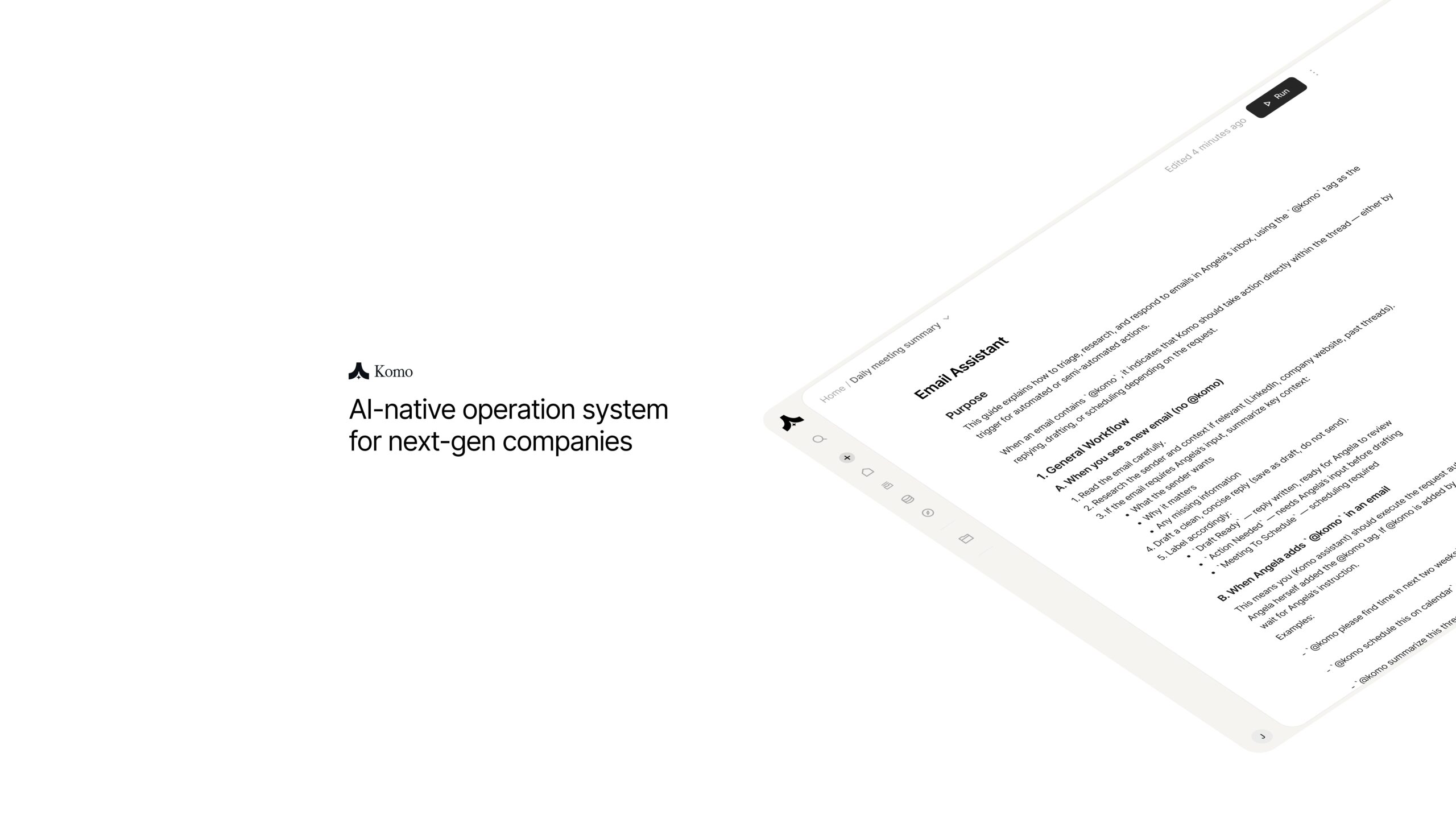
Komo Playbook reimagines business automation by eliminating the need for complex flowcharts or code. It positions itself as the “first AI operations platform” that you can train just like a human employee: by showing it a Standard Operating Procedure (SOP), a screen recording, or simply describing the task in plain English. Once taught, it doesn’t just blindly follow a script; it uses reasoning to handle exceptions and adapts to minor interface changes, executing workflows 24/7 without constant supervision.
Key Features
- “Teach Once” Onboarding: Instantly convert existing PDF/Word SOPs, Loom screen recordings, or text instructions into executable autonomous agents.
- Dynamic Exception Handling: Unlike brittle RPA bots that break when a button moves, Komo uses visual and semantic reasoning to adapt to UI changes and resolve unexpected errors automatically.
- No-Code / No-Canvas: Removes the visual spaghetti of wiring nodes together. You verify the logic in natural language, not through complex “if/then” flowcharts.
- Parallel Scaling: Capable of spinning up thousands of agents simultaneously to handle volume spikes in operations (e.g., processing 5,000 forms overnight).
Use Cases
- Autonomous Admin Ops: Handling invoice processing, data entry, and form filling across legacy systems that lack APIs.
- Customer Support Routing: Reading tickets, checking CRM data, and executing refunds or escalations based on complex policy documents.
- Research & Lead Gen: Navigating multiple websites to gather prospect data and populating spreadsheets with cited sources.
- Internal Process Management: Automating employee onboarding steps across email, Slack, and HR portals.
Pros & Cons
- Pros: Drastically lowers the barrier to entry for complex automation (SOP-based setup); highly resilient compared to traditional scripts; affordable entry price.
- Cons: As a newer platform, it may lack the massive pre-built integration ecosystem of mature giants like Zapier; heavily reliant on the reliability of the underlying AI model for decision-making.
Pricing
$20/month
The “Pro” tier starts at roughly $20/month, offering a significantly lower entry point than enterprise RPA solutions. A 7-day free trial is typically available.
How Does It Compare?
Komo Playbook bridges the gap between rigid enterprise RPA and consumer-grade automation tools. Here is the breakdown:
- vs. UiPath / Traditional RPA: UiPath is powerful but expensive and brittle—if a website button moves 5 pixels, the bot often crashes. Komo uses AI vision to “see” and understand the screen, making it far more resilient to UI changes without needing a developer to fix it.
- vs. Zapier / Make: These tools rely on APIs. If a tool (like a government website or legacy ERP) doesn’t have an API, Zapier can’t help. Komo interacts with the user interface (browser/desktop) directly, allowing it to automate literally anything a human can click on.
- vs. Bardeen: Bardeen is excellent for browser automation but is often triggered manually or via simple triggers. Komo focuses more on end-to-end “operations”, ingesting entire SOP documents to handle long-running, multi-step business logic autonomously.
- vs. AutoGPT / Open Source Agents: While AutoGPT proved the concept, it was often unstable and hard to control. Komo packages that agentic promise into a stable, productized business tool with the reliability controls needed for actual work.
Final Thoughts
Komo Playbook represents the “Holy Grail” of operations: the ability to hand off a document (SOP) to software and have it “just work.” By shifting the paradigm from programming (connecting APIs) to teaching (demonstrating workflows), it unlocks automation for non-technical operations teams who know what needs to be done but don’t know how to code it. It is a potential game-changer for SMBs that cannot afford a dedicated automation engineer.
https://komo.ai/