Table of Contents
Overview
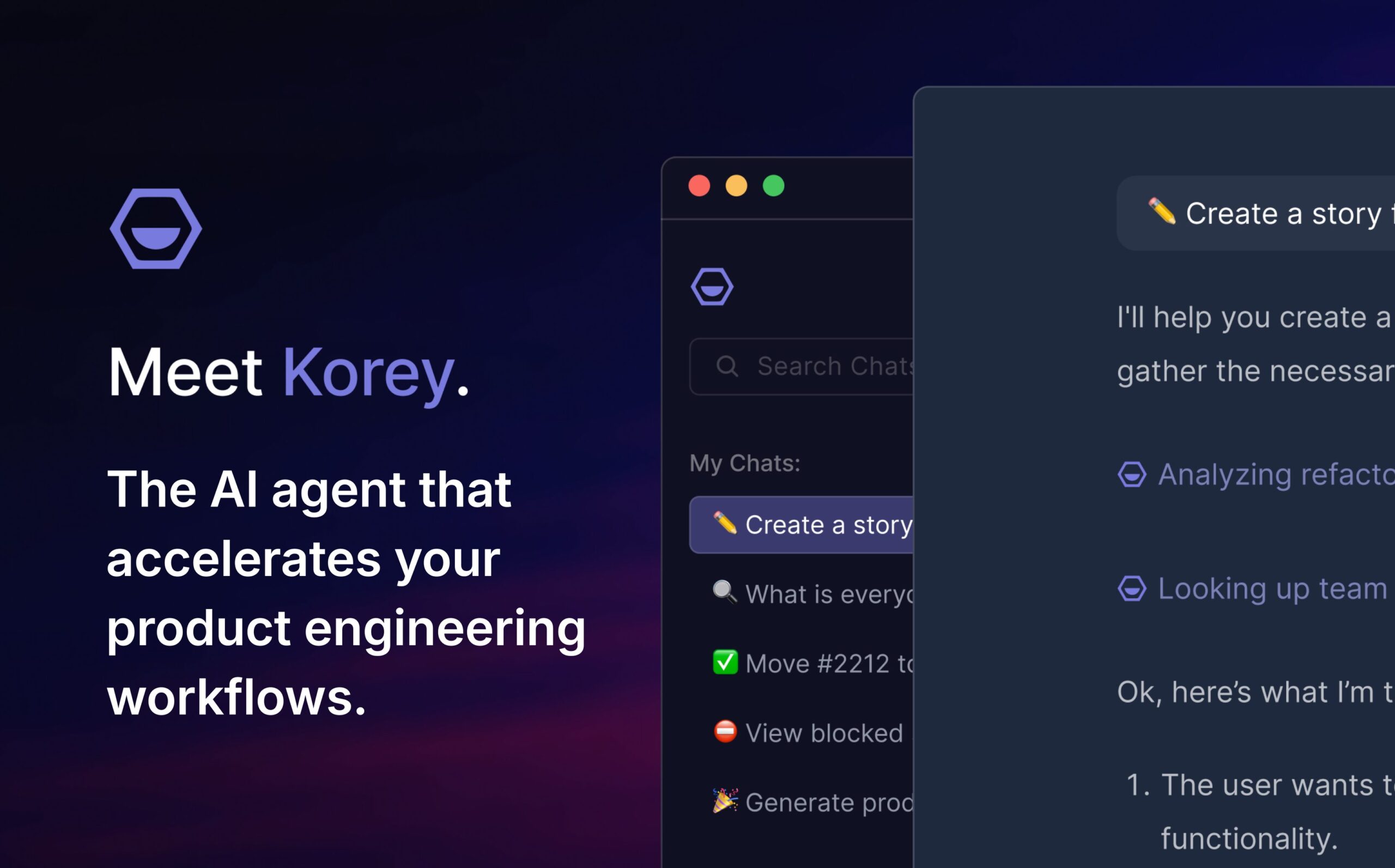
Korey is an AI product engineering agent launched publicly (fully released November 2025, beta December 2024) enabling teams automating idea-to-implementation workflow by generating technical specifications, creating task breakdowns, syncing with issue trackers, and directing coding agents (Cursor, Devin) to implement directly. Built by the team behind Shortcut (project management platform), Korey represents architectural shift from single-function AI tools toward agentic orchestration—integrating specification generation, task coordination, and coding agent handoffs into unified workflow. Rather than requiring product managers manually writing specs, engineers breaking down work into tickets, and developers discovering tasks via push notifications, Korey automates entire PM-to-Dev handoff reducing “overhead” that Korey’s site quantifies as consuming 48% of spec creation time and preventing 40%+ engineering velocity gains.
Available through freemium model with 14-day free trial and paid plans starting \$59/organization (organization-based pricing, not per-seat), Korey specifically targets product and engineering teams using Shortcut, Linear, or GitHub with capacity constraints and spec-writing burden. November 2025 launch with strong Product Hunt reception and LinkedIn coverage validates market demand. The emphasis on direct Cursor agent handoff—enabling PM-written specs flowing directly to coding agents executing without manual engineering context-switching—represents significant architectural innovation distinguishing from generic spec generation tools.
Key Features
Spec Generation from Ideas: Transform rough PM ideas, user requests, or feature descriptions into complete technical specifications with acceptance criteria, implementation guidance, and architectural notes. System learns team’s writing style generating specs matching team conventions.
Automatic Task Breakdown: AI decomposes specifications into granular tasks, identifies dependencies, maps subtasks, and suggests sequencing. Prevents manual ticket creation overhead that drowns PMs in administrative work.
Conversational Spec Refinement: Real-time collaboration where teams discuss ideas with Korey iteratively improving specs before marking ready-for-engineering. Reduces misunderstanding and rework.
Coding Agent Handoff (Direct Integration): Directly assign generated tasks to Cursor Agents (via Claude API integration). Agents autonomously pick up work, implement code, and push pull requests. Engineers review completed work versus implementing from spec.
GitHub and Shortcut Context Integration: System pulls context from GitHub commits, issue history, Shortcut project history enabling informed spec generation understanding previous patterns and architectural decisions.
Release Notes Generation: Automatically summarize shipped work into non-technical language enabling stakeholder communication. Tracks what shipped, why it matters, and impact.
Stand-up Assistant: Summarizes previous day’s commits, current sprint priorities, tomorrow’s deadlines enabling fast stand-ups. Auto-compiled from Shortcut and GitHub context.
Dependency Mapping and Critical Path: Visualizes task dependencies identifying critical paths enabling sprint planning optimization. Prevents bottleneck surprises mid-sprint.
Team Capacity Matching: Analyzes team capacity across human engineers and available coding agents matching tasks to available capacity. Assigns to right person/agent.
Burndown and Progress Tracking: Automatic sprint progress visualization showing completed versus estimated work enabling real-time scope visibility.
Style Learning: Learns individual team’s specification writing conventions generating specs matching team patterns versus generic templates.
Bulk Operations: Deduplicate issues, bulk update priorities, prepare sprints in single commands reducing administrative overhead.
How It Works
Connect Korey to Shortcut workspace or GitHub (authorization as agent inside workspace). Team describes feature in natural language (Slack message, issue comment, meeting notes, rough idea). Korey expands into full technical specification with acceptance criteria, task breakdown, subtasks, and dependencies. System optionally learns team’s writing style from previous specs. Review and refine spec conversationally with Korey. Mark as ready-for-engineering triggering task creation in Shortcut/Linear. Optionally assign Cursor Agent for implementation. Agent autonomously implements, opens PR for review. Engineering reviews completed code. Korey tracks progress generating summaries and release notes.
Use Cases
Accelerating Feature Delivery: Teams with PM-to-Dev handoff bottlenecks use Korey automating spec-to-task-to-code workflow. Sales-driven features shipped faster reducing revenue friction.
Reducing “Blank Page” Syndrome: Coding agents often struggle with ambiguous requirements. Pre-spec generation from Korey provides clear context enabling agents generating higher-quality code faster.
Automating PM-to-Dev Handoff: Eliminates manual spec writing, ticket creation, and context transfer. Engineers receiving structured specs with dependencies versus vague Slack messages.
Keeping Specs and Code in Sync: Specs often diverge from implementations. Korey-generated tasks flow to Cursor Agents generating code directly from specifications maintaining alignment.
Sprint Planning Automation: Automatically break down quarter/sprint goals into executable tasks removing sprint planning meetings and manual ticket creation.
Unblocking Product Teams: Product-driven organizations where PMs outnumber engineers experience severe bottlenecks. Korey amplifies engineering capacity by automating non-engineering work.
Pros \& Cons
Advantages
Bridges “Chatting with AI” and “Shipping Code”: Unlike ChatGPT enabling conversation or Cursor enabling code generation, Korey orchestrates complete workflow from idea through implementation. Integration with coding agents closes entire loop.
Integrates Widely with Existing Tools: Works with Shortcut, Linear, GitHub, Cursor providing flexibility for different team setups. Respects existing workflows rather than requiring tool changes.
Learns Team Conventions: Adapts to individual team’s writing style, task naming conventions, and architectural patterns. Specs match team standards versus generic templates.
Reduces Measurable Overhead: Quantifies time savings (48% spec creation reduction, 40% velocity increase, 1.2+ hours daily saved) with real customer data validating effectiveness.
Agent-to-Agent Handoff: Direct Cursor integration enables automated agent-to-agent handoffs without human context-switching. Revolutionary for high-throughput feature delivery.
Free Trial Access: 14-day free trial with limited interactions enables teams evaluating without commitment.
Disadvantages
Adds Abstraction Layer: Rather than reducing abstraction, Korey adds AI orchestration layer between PMs and engineers. Introduces dependency on Korey’s quality for specification generation.
Requires Trust in Auto-Generated Specs: Teams must trust AI-generated specifications sufficiently assigning to coding agents. Inadequate specs cause incorrect implementations. Requires verification.
Early-Stage Stability: November 2025 public release means unproven reliability at enterprise scale, unknown edge case handling, limited long-term customer references. Survival uncertainty for startup dependency.
Shortcut Dependency: Platform built by Shortcut team creating implicit vendor lock-in. Should Shortcut face issues, Korey’s value diminishes. Smaller teams may prefer tool-agnostic solution.
Agent Integration Immaturity: Cursor agent handoff new (November 2025 feature). Unknown reliability of autonomous agent implementation without engineering review. Potential for low-quality code requiring rework.
Learning Curve for Teams: Effective usage requires understanding how to structure ideas for Korey’s spec generation. Teams defaulting to raw chat inputs get poor results.
How Does It Compare?
Korey vs Linear AI
Linear is project management platform offering AI-powered issue creation, triage intelligence (duplicate detection), and agent deployment for code generation and other tasks.
Primary Focus:
- Korey: Spec generation and engineering coordination
- Linear: Project management with embedded AI features
Spec Generation:
- Korey: Dedicated spec generation with style learning
- Linear: Basic AI issue creation
Agent Orchestration:
- Korey: Direct integration with Cursor agents
- Linear: Generic agent support framework
Release Notes:
- Korey: Automatic non-technical summaries
- Linear: Manual or basic generation
Context Integration:
- Korey: Shortcut and GitHub context
- Linear: Native within Linear ecosystem
Coding Agent Handoff:
- Korey: Direct Cursor integration
- Linear: Requires separate agent setup
When to Choose Korey: For dedicated spec generation and Cursor agent coordination.
When to Choose Linear: For comprehensive project management with embedded AI features.
Korey vs Ellipsis AI
Ellipsis is AI code review and bug fix platform automating pull request review with async code generation from GitHub comments.
Scope:
- Korey: Spec generation through PR creation coordination
- Ellipsis: Code review and async code generation
Generation Model:
- Korey: Spec-first driving task creation
- Ellipsis: Task/comment-based code generation
Integration:
- Korey: Shortcut, Linear, GitHub
- Ellipsis: GitHub-only
Workflow:
- Korey: PM-to-Dev orchestration
- Ellipsis: Developer code review and generation
Agent Handoff:
- Korey: Cursor integration for autonomous implementation
- Ellipsis: Code generation from GitHub comments
When to Choose Korey: For PM-to-Dev workflow automation including spec generation.
When to Choose Ellipsis: For code review automation and async dev-focused generation.
Korey vs Lovable
Lovable is full-stack web app builder generating complete applications from natural language with GitHub export and live preview.
Scope:
- Korey: Specification and task orchestration
- Lovable: Full-stack application generation
Use Case:
- Korey: Existing product teams adding features
- Lovable: Building new applications from scratch
PM Involvement:
- Korey: PM-centric spec generation and coordination
- Lovable: Founder/developer-centric app building
Integration:
- Korey: Works within existing workflows
- Lovable: Complete application generation
Development Model:
- Korey: Task-based spec workflow
- Lovable: Application-centric generation
When to Choose Korey: For existing product teams managing feature delivery.
When to Choose Lovable: For building complete applications from scratch.
Korey vs Sweep AI
Sweep is AI-powered assistant transforming feature requests and bugs into pull requests automatically fixing issues and implementing features via GitHub.
Scope:
- Korey: Specification and task orchestration
- Sweep: Direct code generation from issues
Workflow:
- Korey: Spec-first, task-driven orchestration
- Sweep: Issue-to-PR direct generation
Spec Quality:
- Korey: Dedicated spec generation focus
- Sweep: Works from existing issue descriptions
Integration:
- Korey: Shortcut, Linear, GitHub
- Sweep: GitHub-only
Task Management:
- Korey: Comprehensive task breakdown and coordination
- Sweep: Issue-focused only
Agent Orchestration:
- Korey: Cursor integration and coordination
- Sweep: Autonomous from issues
When to Choose Korey: For comprehensive PM-to-Dev orchestration with spec quality focus.
When to Choose Sweep: For direct issue-to-PR code generation.
Final Thoughts
Korey by Shortcut represents thoughtful response to persistent product engineering bottleneck: PM-to-Dev handoff consuming disproportionate overhead preventing shipping velocity. Rather than optimizing individual steps (better spec tools, better tasking, better code generation), Korey orchestrates entire workflow integrating specification generation, task coordination, and coding agent handoff.
The November 2025 release with direct Cursor agent integration represents significant architectural innovation—the idea that coding agents should receive specs and implement autonomously without human engineering context-switching. The quantified time savings (48% spec creation reduction, 40% velocity increase) and agent-to-agent handoff vision validate market need.
However, November 2025 launch creates stability concerns. Adding abstraction layer between PMs and engineers introduces dependency on Korey’s specification quality. Teams must trust auto-generated specs directing autonomous agent implementation. Shortcut dependency creates implicit vendor lock-in. The assumption that Cursor agents autonomously generate sufficient-quality code without engineering review remains unproven at scale.
For product-driven engineering organizations with PM-to-Dev bottlenecks, Cursor agent availability, and tolerance for AI-generated specification accuracy, Korey provides compelling infrastructure automating 40%+ of non-shipping overhead. The combination of style-learning spec generation, automatic task breakdown, and Cursor agent integration creates orchestration unavailable from point tools.
The positioning distinctly addresses the “founder engineering bottleneck”—product-driven founders outpacing engineering capacity causing features languishing in specs. Korey transforms this constraint by automating spec writing and task creation, converting human engineering (limited resource) into orchestration of AI agents (abundant resource). The vision of teams shipping primarily via autonomous agent implementation directly from PM-written specs fundamentally reshapes how teams with capacity constraints approach product velocity.