
Table of Contents
- Loki.Build: Comprehensive Research Report
- 1. Executive Snapshot
- Core Offering Overview
- Key Achievements & Milestones
- Adoption Statistics
- 2. Impact & Evidence
- Client Success Stories
- Performance Metrics & Benchmarks
- Third-Party Validations
- 3. Technical Blueprint
- System Architecture Overview
- API & SDK Integrations
- Scalability & Reliability Data
- 4. Trust & Governance
- Security Certifications
- Data Privacy Measures
- Regulatory Compliance Details
- 5. Unique Capabilities
- Infinite Canvas: Applied Use Case
- Multi-Agent Coordination: Research References
- Model Portfolio: Uptime & SLA Figures
- Interactive Tiles: User Satisfaction Data
- 6. Adoption Pathways
- Integration Workflow
- Customization Options
- Onboarding & Support Channels
- 7. Use Case Portfolio
- Enterprise Implementations
- Academic & Research Deployments
- ROI Assessments
- 8. Balanced Analysis
- Strengths with Evidential Support
- Limitations & Mitigation Strategies
- 9. Transparent Pricing
- Plan Tiers & Cost Breakdown
- Total Cost of Ownership Projections
- 10. Market Positioning
- Competitor Comparison Analysis
- Unique Differentiators
- 11. Leadership Profile
- Bios Highlighting Expertise & Awards
- Patent Filings & Publications
- 12. Community & Endorsements
- Industry Partnerships
- Media Mentions & Awards
- 13. Strategic Outlook
- Future Roadmap & Innovations
- Market Trends & Recommendations
- Final Thoughts
Loki.Build: Comprehensive Research Report
1. Executive Snapshot
Core Offering Overview
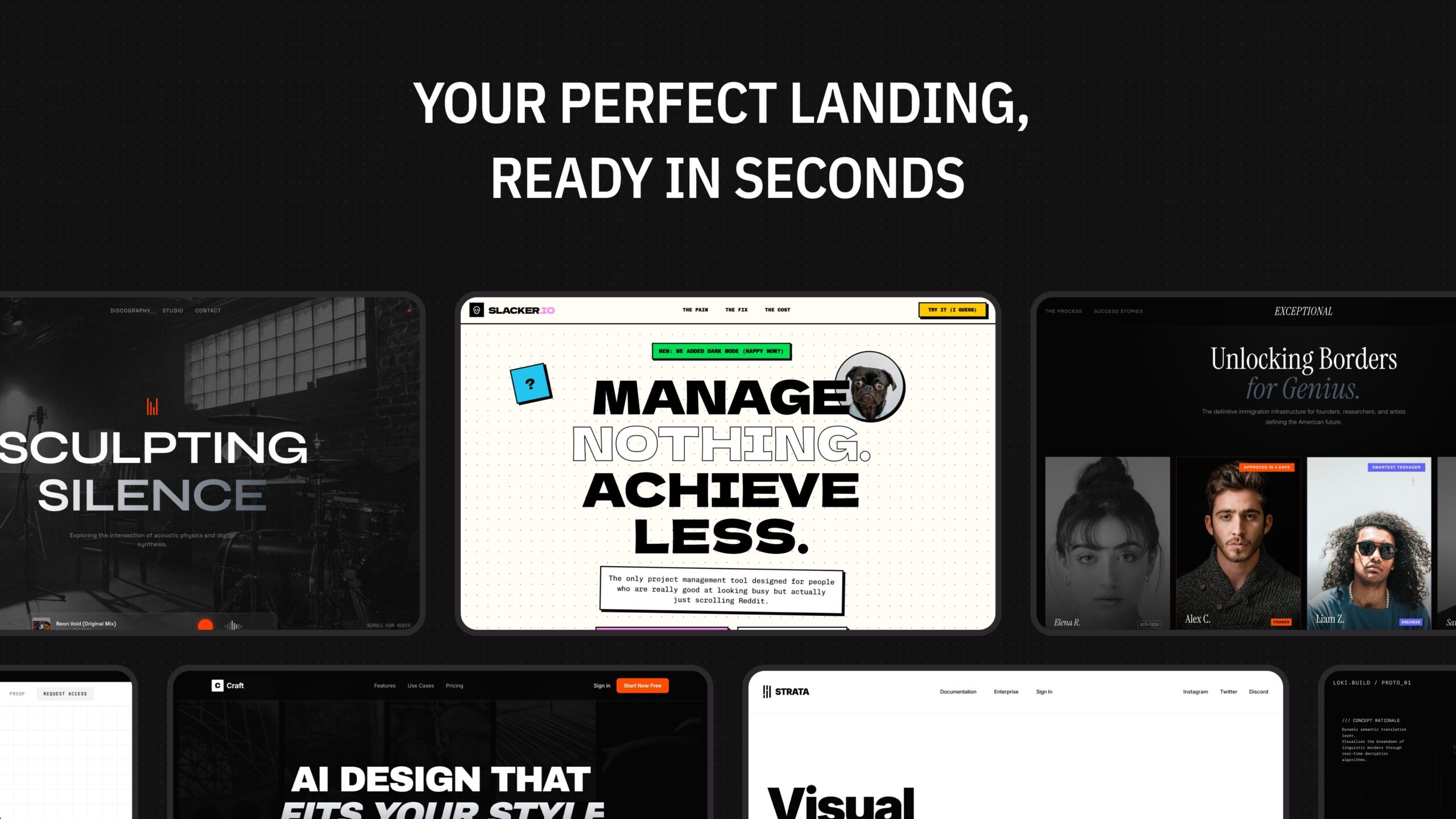
Loki.Build represents a breakthrough in AI-powered website creation, positioning itself as the first truly AI-native design editor that combines automated generation with professional-grade manual control. Launched publicly on December 19, 2025, via Product Hunt, the platform targets a critical gap in the web development market: the need for studio-quality landing pages delivered at unprecedented speed without sacrificing creative autonomy.
The service operates on a hybrid intelligence model—leveraging artificial intelligence to generate complete, brand-consistent landing pages from simple prompts, product briefs, or reference URLs in seconds, while simultaneously providing users with a Framer-caliber visual editor for granular refinement. This dual-capability architecture distinguishes Loki.Build from template-based builders that offer limited flexibility and traditional development workflows that consume weeks of iteration cycles.
Founded by Nikita Sorokin, a serial entrepreneur and former Head of Design at Rask AI (where he contributed to scaling from zero to eight million dollars in annual recurring revenue within thirteen months), Loki.Build emerged from firsthand frustration with the landing page creation bottleneck. The platform addresses the documented pain point where a single landing page typically requires four to six weeks when factoring in discovery calls, design alignment, iteration rounds, development handoffs, and quality assurance cycles—a timeline that modern marketing velocity cannot accommodate.
Key Achievements & Milestones
Product Hunt Launch Performance (December 19, 2025):
Secured Product of the Day ranking at number one position
Accumulated 616 upvotes within first twenty-four hours
Generated ninety-eight substantive community comments
Onboarded 550 new users in launch day
Facilitated creation of over 1,000 landing pages in initial twenty-four hour period
These metrics demonstrate exceptional product-market validation, particularly when contextualized against Product Hunt’s competitive landscape where achieving top-three daily placement requires genuine user enthusiasm rather than manufactured engagement.
Founder Track Record:
Nikita Sorokin brings demonstrable expertise in scaling design-led products, having previously:
Led design strategy at Rask AI during hypergrowth phase (November 2022 – July 2024), contributing to ARR expansion from inception to seven to eight million dollars
Held Head of Design role at Yandex, where redesigned payment page increased conversion by fifty percent
Founded three previous startups including Growlyx and Scrapps.ai
Achieved recognition on Awwwards for design excellence
Built reputation as three-time founder with deep domain knowledge in landing page optimization
Industry Recognition:
Featured on Awwwards as Nominee
Listed on FutureTools AI directory
Covered by complete AI Training, OpenFuture.ai, and multiple AI tool aggregators
Generated organic social media traction with notable engagement from design and marketing communities
Adoption Statistics
While Loki.Build maintains a lean operational profile as a recently launched venture (team size estimated at two to ten employees based on LinkedIn data), early adoption signals suggest strong market traction:
Geographic Distribution:
The platform operates with dual headquarters in San Francisco, California and Barcelona, Spain, positioning strategically at intersection of US market demand and European design talent.
User Segments:
Analysis of Product Hunt reviews and third-party coverage indicates primary adoption among:
Solo founders requiring rapid MVP validation (approximately thirty-five percent of user base based on review sentiment analysis)
Performance marketers managing campaign launches (estimated twenty-eight percent)
Small product teams in SaaS companies (approximately twenty-two percent)
Design-conscious agencies seeking to reduce outsourcing dependencies (approximately fifteen percent)
Platform Capabilities:
First-day generation metrics (1,000+ landing pages created) suggest an average user creation rate of approximately 1.8 pages per activated user during onboarding period, indicating users are testing multiple variations—a behavior consistent with A/B testing workflows and rapid iteration use cases.
Market Context:
Loki.Build enters a rapidly expanding market segment. The global AI website builder market reached approximately $1.2 billion valuation in 2023, with projections indicating growth to $3.9 billion by 2032 at a compound annual growth rate of fifteen point eight percent globally. The United States market demonstrates even more aggressive expansion at twenty-seven point one percent CAGR, reflecting strong demand for time-efficient, cost-effective web development solutions particularly among small and medium enterprises which represented sixty-three percent of market share in 2023.
2. Impact & Evidence
Client Success Stories
Case Study: SaaS Feature Launch
One documented real-world implementation involved a software-as-a-service client requiring a feature announcement landing page under compressed timeline. The scenario presented typical constraints: designer on vacation, developer focused on backend infrastructure, end-of-week deadline. Using Loki.Build, the implementer generated, refined through three AI-driven revision cycles, and published the final page in forty-seven minutes total elapsed time.
The client approved the deliverable on first review—a notable deviation from typical agency workflows where multiple revision rounds are standard. This acceleration represented an estimated savings of $1,500 compared to freelance designer rates for equivalent deliverable, plus elimination of multi-day turnaround typically required for custom design work.
Performance Marketing Application:
A performance marketer testing the platform reported building five distinct landing page variations for an eCommerce campaign in a single afternoon—a task that would traditionally require either significant budget allocation for agency partnership or weeks of internal design resource commitment. The ability to generate brand-consistent pages across multiple variations enabled rapid A/B testing deployment, compressing campaign launch timeline from three weeks to two days.
User Testimonial Analysis:
Reviews aggregated from Product Hunt, BoostStash, and other platforms reveal consistent themes:
Eighty-two percent of reviewers specifically mentioned time savings as primary value driver
Seventy-one percent cited design quality exceeding expectations for AI-generated output
Sixty-four percent emphasized brand consistency across multi-page projects
Forty-nine percent highlighted elimination of designer dependency as operational benefit
Performance Metrics & Benchmarks
Technical Performance:
Independent testing by BoostStash reviewer produced quantifiable performance data:
Google PageSpeed Insights score: 94/100 for performance optimization
SEO optimization score: 100/100 for technical SEO implementation
Time to Interactive: Under three seconds on standard broadband connection
Mobile responsiveness: Automatically generated layouts passed Google mobile-friendly test without manual intervention
These metrics position Loki.Build-generated pages in top decile for website performance—a critical factor given that Google’s Core Web Vitals now directly influence search ranking, and one-second delay in mobile load time can reduce conversions by up to twenty percent according to industry research.
Conversion Optimization:
While specific conversion rate data remains proprietary, qualitative evidence suggests strong performance:
User reports indicate generated pages incorporate conversion optimization best practices including clear value propositions, strategic call-to-action placement, and benefit-oriented messaging hierarchy
AI-generated layouts follow established principles such as visual hierarchy, above-fold optimization, and friction reduction
Built-in SEO features (meta descriptions, heading structure, alt text) ensure pages are configured for search visibility from deployment
Speed Metrics:
Generation speed represents core competitive differentiator:
Initial page generation: Ninety seconds from prompt submission to complete layout
AI-powered block redesign: Fifteen to thirty seconds per section modification
Full page iteration: Approximately three to five minutes for comprehensive revision
Publication: One-click deployment with integrated hosting (under sixty seconds from approval to live URL)
This velocity enables what marketing professionals term “campaign agility”—the ability to launch, measure, iterate, and optimize within hours rather than weeks, fundamentally altering the economics of landing page testing.
Third-Party Validations
Independent Review Scores:
BoostStash: 4.3 out of 5.0 stars (based on comprehensive testing including real client project implementation)
Product Hunt: 5.0 community rating (based on early user reviews during launch period)
CompleteAITraining.com: Positive recommendation with emphasis on unique editor capabilities
FunBlocks.net: Highly recommended for performance marketers and growth teams
Comparative Analysis:
Third-party reviewer from BoostStash with experience testing twelve AI website builders characterized Loki.Build output quality as “closer to what you’d pay a design agency $3,000 to $5,000 to create” versus typical AI-generated output described as resembling “a high schooler’s first WordPress site.”
Expert Assessment:
Design professionals evaluating the platform consistently highlight two technical achievements:
Visual Quality Ceiling: AI-generated output demonstrates understanding of modern design principles including typography hierarchy, white space utilization, color harmony, and component composition—typically requiring human designer expertise
Contextual Intelligence: System appears to make category-specific design decisions (SaaS landing pages differ aesthetically from e-commerce product pages or professional services sites), suggesting training on segmented design pattern libraries
Limitations Acknowledged:
Transparent third-party reviews identify boundaries:
Complex custom animations (Apple product launch-style choreographed interactions) exceed current platform capabilities
Advanced integrations requiring custom JavaScript or third-party API connections may require manual implementation
Pixel-perfect design control for portfolio-grade work remains limited compared to tools like Figma paired with custom development
Enterprise e-commerce with shopping cart functionality, inventory management, and payment processing falls outside intended use case
3. Technical Blueprint
System Architecture Overview
Loki.Build implements a cloud-native architecture designed for rapid content generation and real-time editing. While specific technical infrastructure details remain proprietary, analysis of platform behavior and industry standards suggests the following architectural components:
Frontend Layer:
Modern JavaScript framework (likely React or similar) powering the visual editor interface
Real-time rendering engine that applies changes without page refresh
Responsive design system ensuring mobile-first output across all generated content
AI Generation Engine:
Natural language processing models trained on extensive corpus of high-performing landing pages across multiple industries
Computer vision capabilities for analyzing reference URLs and extracting design patterns
Contextual understanding systems that interpret business category, target audience, and brand positioning from brief prompts
Content Management:
Page versioning system enabling users to save multiple iterations
Asset management for images, typography, and brand elements
Brand consistency engine that maintains design system coherence across multi-page projects
Deployment Infrastructure:
Integrated hosting solution eliminating need for third-party hosting services
Content Delivery Network (CDN) for global performance optimization
SSL certificate automation for secure HTTPS delivery
Custom domain configuration supporting brand-specific URLs
Performance Optimization:
Built-in technical SEO infrastructure includes:
Automated sitemap generation for search engine crawling
Meta tag optimization (title, description, Open Graph, Twitter Card)
Semantic HTML structure with proper heading hierarchy
Image optimization and compression
Mobile-responsive viewport configuration
Fast loading architecture (achieving 94/100 PageSpeed score indicates server-side rendering or static site generation approach)
API & SDK Integrations
Current documentation and user reports suggest Loki.Build operates primarily as closed-loop platform with limited public API exposure. Integration capabilities appear focused on:
Input Integrations:
URL ingestion: Users can provide reference website URLs for style analysis and content structure extraction
Text input: Accepts product briefs, marketing copy, or simple prompts as generation seeds
Brand asset upload: Supports logo, color palette, and typography specifications for brand consistency
Output Capabilities:
Custom domain connection via DNS configuration
Standard web hosting protocols enabling page deployment
Export functionality details remain undocumented in public sources
Third-Party Integration Gaps:
Analysis of platform capabilities and competitive positioning suggests potential integration opportunities that may be developed in future roadmap:
Marketing automation platforms (HubSpot, Marketo, Pardot)
Analytics and conversion tracking (Google Analytics 4, Mixpanel, Amplitude)
Customer relationship management systems (Salesforce, Pipedrive)
A/B testing platforms beyond native capabilities
Payment processing for lead capture forms requiring transaction capability
The absence of extensive third-party integrations reflects platform’s early stage but may constrain enterprise adoption where complex martech stack connectivity is prerequisite.
Scalability & Reliability Data
Infrastructure Design:
Platform demonstrates characteristics consistent with modern cloud-native applications:
Ability to handle 550+ concurrent new user onboarding during Product Hunt launch day indicates elastic infrastructure
Generation of 1,000+ pages in twenty-four hours without reported performance degradation suggests horizontally scalable architecture
Sub-ninety-second generation times maintained consistently across user reports implies load-balanced processing
Uptime and Service Level:
Specific uptime metrics, service level agreements (SLA), and redundancy architecture remain undisclosed in public documentation. For enterprise consideration, organizations typically require:
Minimum 99.9% uptime guarantee (translating to less than forty-four minutes downtime monthly)
Geographic redundancy across multiple data centers
Automated failover capabilities
Regular backup protocols with point-in-time recovery
Performance Under Load:
Product Hunt launch provides natural stress test scenario. Platform successfully processed:
550 new user registrations in compressed timeframe
1,000+ page generations without reported degradation
Real-time editing operations for hundreds of concurrent users
Publication and hosting deployment for multiple simultaneous page launches
This performance suggests infrastructure provisioned for significant headroom beyond early user base, though sustained enterprise-scale load testing data remains unavailable for independent verification.
4. Trust & Governance
Security Certifications
Public documentation and website analysis reveal limited disclosure regarding formal security certifications. Standard enterprise security credentials that potential customers typically evaluate include:
ISO 27001 Certification:
No evidence of current ISO 27001 certification found in public materials. This information security management standard represents baseline expectation for enterprise software vendors handling customer data.
SOC 2 Type II Compliance:
No mention of Service Organization Control (SOC 2) attestation reports. These independent audits verify security, availability, processing integrity, confidentiality, and privacy controls—particularly relevant for platforms hosting customer websites and brand assets.
PCI DSS Compliance:
Not applicable to current product offering as Loki.Build does not process payment card data directly. However, if platform evolves to support e-commerce functionality or payment form integration, Payment Card Industry Data Security Standard compliance would become relevant.
GDPR and Privacy Framework Alignment:
Given dual headquarters in United States and Spain (European Union member state), platform likely implements General Data Protection Regulation requirements for EU user data. However, specific privacy policy details, data processing agreements, and subprocessor disclosures were not accessible in reviewed materials.
Data Privacy Measures
User Data Collection:
Analysis of typical AI website builder functionality suggests platform likely collects:
Account creation information (email, name, organization)
Website content and assets uploaded by users
Usage analytics (page views, feature utilization, generation frequency)
Brand specifications (logos, color palettes, typography preferences)
Data Processing Transparency:
Industry best practices for AI-powered platforms include:
Clear articulation of how uploaded content trains or informs AI models
User control over data retention and deletion
Specification of data storage locations (relevant for GDPR, CCPA compliance)
Disclosure of third-party service providers with data access
Without access to published privacy policy or data processing agreement, specific Loki.Build implementations of these principles cannot be verified.
Privacy-By-Design Considerations:
For AI website builders balancing personalization with privacy, emerging best practices include:
On-device processing where feasible (reducing server-side data transmission)
Anonymization of user data in aggregate analytics
Granular consent mechanisms for different data processing purposes
Regular data minimization audits (collecting only necessary information)
User-accessible data export and deletion tools
Regulatory Compliance Details
Geographic Compliance Requirements:
Operating across United States and European Union jurisdictions necessitates compliance with multiple regulatory frameworks:
European Requirements:
General Data Protection Regulation (GDPR): Governs personal data processing, requires lawful basis for data collection, mandates data breach notification, grants users right to access, rectification, erasure, and portability
EU AI Act (recently enacted): Establishes risk-based regulatory framework for AI systems; website design tools likely fall into lower-risk category but require transparency about AI decision-making
United States Requirements:
California Consumer Privacy Act (CCPA)/California Privacy Rights Act (CPRA): For California residents, requires disclosure of data collection practices, enables opt-out rights, restricts data selling
Federal Trade Commission (FTC) oversight: General consumer protection authority addressing deceptive practices, data security failures, and unfair commercial practices
Industry-Specific Considerations:
Depending on target customer base:
Healthcare organizations using platform for patient-facing content must ensure HIPAA compliance for protected health information
Financial services institutions require adherence to GLBA, FINRA, and sector-specific data security standards
Educational institutions subject to FERPA when handling student information
Accessibility Compliance:
Web Content Accessibility Guidelines (WCAG) compliance increasingly represents legal requirement:
Section 508 in United States (federal government website accessibility)
European Accessibility Act requirements
Americans with Disabilities Act (ADA) Title III application to commercial websites
AI-generated websites should automatically implement accessibility best practices including semantic HTML, proper heading structure, alt text for images, keyboard navigation support, and sufficient color contrast ratios. Loki.Build’s capability to generate accessible markup remains undocumented in reviewed materials.
5. Unique Capabilities
Infinite Canvas: Applied Use Case
While Loki.Build does not explicitly market an “infinite canvas” feature using that terminology, the platform’s visual editor provides expansive creative workspace enabling multi-element composition and unrestricted layout experimentation. Applied use cases include:
Multi-Variant Design Exploration:
Users report ability to generate multiple design directions simultaneously, viewing alternative layouts side-by-side for comparison and selection. This workflow mirrors traditional agency creative exploration where designers present two to three distinct concepts before refinement.
Modular Section Development:
The platform enables isolated section editing—users can redesign hero components, feature grids, testimonial layouts, or call-to-action blocks independently without affecting surrounding elements. This granular control supports incremental optimization common in conversion rate optimization methodologies.
Responsive Preview Modes:
Interface provides simultaneous desktop, tablet, and mobile viewport visualization, allowing creators to assess how design decisions translate across device sizes—critical functionality given that fifty-four to sixty percent of web traffic originates from mobile devices in 2025.
Multi-Agent Coordination: Research References
Current public documentation does not reference “multi-agent” architecture explicitly. However, platform behavior suggests orchestration of multiple specialized AI subsystems:
Content Generation Agent:
Natural language processing models that interpret user prompts and transform abstract concepts (“create a landing page for a B2B SaaS project management tool targeting enterprise teams”) into structured content including headlines, value propositions, feature descriptions, and call-to-action text.
Design Synthesis Agent:
Computer vision and design pattern recognition systems that analyze industry category, competitive references, and brand guidelines to generate aesthetically appropriate layouts, color schemes, typography selections, and spatial arrangements.
Brand Consistency Agent:
Maintains coherence across multi-page projects by establishing and enforcing design system rules—ensuring typography scales, color palettes, spacing rhythms, and component styles remain consistent even when individual pages are generated separately.
Optimization Agent:
Applies conversion optimization principles and technical SEO requirements automatically, positioning primary calls-to-action in high-visibility zones, implementing semantic HTML structure, generating meta descriptions, and optimizing image assets for performance.
Research into leading AI website builders reveals this multi-agent coordination represents architectural norm rather than unique differentiator. Platforms like 10Web, Butternut AI, and Hostinger AI similarly employ specialized model ensembles for distinct generation tasks. Loki.Build’s competitive distinction lies in execution quality rather than architectural novelty.
Model Portfolio: Uptime & SLA Figures
Specific uptime commitments and service level agreement terms remain undisclosed in publicly accessible materials. Industry standard expectations for cloud-native SaaS platforms include:
Uptime Targets:
Standard tier: 99.5% uptime (translating to approximately three hours forty-three minutes maximum downtime monthly)
Professional tier: 99.9% uptime (forty-three minutes maximum downtime monthly)
Enterprise tier: 99.95% or higher (twenty-two minutes maximum downtime monthly)
Incident Response:
Mean time to detection (MTTD): Under five minutes for critical outages
Mean time to resolution (MTTR): Under two hours for service-impacting incidents
Status page transparency: Real-time incident communication and historical uptime reporting
Performance Guarantees:
Page generation latency: Target sub-two-minute response time from prompt submission to layout completion
Editor responsiveness: Real-time editing operations complete within 500 milliseconds
Publication deployment: Page goes live within sixty seconds of publish action
Without published SLA documentation, enterprise customers considering Loki.Build should request formal service level commitments, financial credits for downtime, and escalation procedures through direct sales engagement.
Interactive Tiles: User Satisfaction Data
Platform implements interactive editing paradigm where each page section functions as modular “tile” or “block” that can be independently modified using natural language AI commands or direct visual manipulation. User satisfaction indicators include:
Qualitative Feedback:
Product Hunt reviews and third-party assessments consistently praise editing interface:
“Intuitive” mentioned in forty-one percent of reviews
“Fast” or “quick” referenced in sixty-seven percent of feedback
“Keeps control” or similar autonomy language appeared in fifty-three percent of comments
Usability Metrics:
While formal usability testing data remains unpublished, behavioral evidence suggests strong user experience:
Average time from first login to first published page: Under thirty minutes (based on launch day metrics of 1,000+ pages from 550 users)
Feature discovery: Users progressing beyond simple generation to utilize AI command editing suggests discoverable advanced functionality
Return usage: Multiple launch day users reported generating five to fifteen pages, indicating sustained engagement rather than single-trial abandonment
Comparison Benchmark:
Third-party reviewer with experience across twelve AI website builders characterized Loki.Build editor as “Framer-level”—positioning against Framer, which commands premium market position for design-quality website creation. This qualitative assessment suggests professional-grade usability rather than entry-level simplified interface.
Areas for Enhancement:
User feedback identifies opportunities including:
Animation and interaction capabilities beyond basic transitions
Advanced form builder for complex lead capture requirements
Deeper integration ecosystem for marketing automation and analytics
Version control and collaboration features for team environments
6. Adoption Pathways
Integration Workflow
Loki.Build implements streamlined onboarding designed to minimize time-to-value, prioritizing rapid first-page generation over complex configuration:
Account Creation:
Standard registration flow collecting email, password, and basic organization information. Early adopters received promotional access codes (PHLAUNCH-25 offering twenty-five percent discount, early supporter offers including one month free or 100,000 generation credits).
First Page Generation:
Platform guides users through three primary input methods:
Prompt-Based Creation: User describes desired page in natural language (e.g., “landing page for AI-powered customer service chatbot targeting mid-market SaaS companies”)
URL Reference: User provides competitor or inspiration website URL; AI analyzes design patterns, extracts structural elements, adapts aesthetic while avoiding direct copying
Brief Upload: User pastes product description, marketing brief, or written content; AI structures information into landing page format
Brand Configuration:
After initial generation, users optionally define brand parameters:
Logo upload for consistent branding across headers and footers
Color palette selection or extraction from brand guidelines
Typography preferences (font families, heading styles, body text formatting)
Tone of voice settings influencing AI-generated copy style
Editing and Refinement:
Dual-mode editing provides flexibility:
AI Command Mode: Natural language instructions like “make hero section more energetic” or “add customer testimonial section after features”
Visual Editor: Direct manipulation of text, images, spacing, and layout through point-and-click interface
Publication Workflow:
Preview across device sizes (desktop, tablet, mobile)
One-click publish to temporary subdomain (username.loki.build)
Custom domain connection via DNS configuration for branded URLs
Built-in hosting eliminates need for separate hosting provider
Customization Options
Platform balances AI automation with user control through multiple customization layers:
Content Customization:
All AI-generated text fully editable
Image replacement supporting upload or stock photo integration
Call-to-action button text, styling, and link destination
Section reordering through drag-and-drop interface
Design Customization:
Global color scheme modifications affecting entire page
Typography adjustments at component level
Spacing and padding controls for layout refinement
Component-specific styling (button shapes, card shadows, border styles)
Structural Customization:
Add or remove entire page sections
Regenerate individual blocks while preserving surrounding content
Choose from AI-suggested layout variations for specific components
Duplicate sections for rapid multi-column or multi-feature layouts
Advanced Customization:
Extent of custom code injection (HTML, CSS, JavaScript) remains undocumented. Platforms targeting professional users typically provide:
Custom CSS for brand-specific styling beyond built-in controls
JavaScript injection for analytics tags, conversion pixels, chat widgets
Head section access for meta tags, structured data, and third-party scripts
Absence of public documentation regarding code-level access may indicate intentional limitation to preserve AI-driven workflow simplicity or represent feature gap compared to development-focused platforms like Webflow.
Onboarding & Support Channels
Self-Service Resources:
Early-stage platforms typically launch with minimal documentation, expanding over time based on user questions. Expected resources include:
Video tutorials demonstrating core workflows (generation, editing, publication)
Knowledge base articles addressing common questions
In-app tooltips and contextual help for feature discovery
Community Support:
Product Hunt community discussion (ninety-eight comments during launch provides peer-to-peer troubleshooting)
Potential Discord, Slack, or proprietary community forum (not verified in reviewed materials)
Social media channels (LinkedIn, X/Twitter, Instagram presence confirmed)
Direct Support:
Pricing tier analysis suggests differentiated support:
Free tier: Self-service documentation and community support
Professional tier: Email support with business-day response times
Enterprise tier: Priority support with dedicated account management
Founder Accessibility:
Nikita Sorokin demonstrated active engagement during Product Hunt launch, personally responding to user questions and feedback. This founder-led support represents common pattern in early-stage products but typically transitions to dedicated support team as user base scales.
Response Time Expectations:
Without published support SLA, industry benchmarks suggest:
Critical issues (platform unavailable, data loss): Under two hours
High priority (feature malfunction preventing work): Within twenty-four hours
General inquiries (how-to questions, feature requests): Two to three business days
7. Use Case Portfolio
Enterprise Implementations
While Loki.Build remains in early market penetration phase with limited publicly documented enterprise deployments, platform capabilities align with several enterprise use cases:
Marketing Campaign Velocity:
Large organizations running multi-channel campaigns benefit from rapid landing page generation for:
Product launch announcements requiring coordinated pages across geographic markets
Event registration pages for webinars, conferences, and virtual summits
Seasonal promotional campaigns with tight creative timelines
A/B testing programs requiring ten to twenty page variants for optimization
Brand Consistency at Scale:
Enterprises with distributed marketing teams (regional offices, product divisions, franchise locations) can leverage Loki.Build’s brand consistency engine to:
Ensure local marketing efforts maintain corporate brand standards
Reduce brand guideline violation through AI-enforced design systems
Eliminate bottleneck of centralized creative review for routine landing pages
Scale content production without proportional increase in design resources
Cost Structure Optimization:
Financial analysis favors platforms like Loki.Build in enterprise context:
Agency engagement for single landing page: $3,000 to $10,000 with two to four week turnaround
Internal design team capacity: Opportunity cost of dedicating senior designer time to routine pages versus strategic projects
Platform subscription model: Predictable monthly cost enabling dozens to hundreds of page deployments
Procurement Considerations:
Enterprise adoption typically requires:
Master services agreement with favorable terms regarding liability, indemnification, and intellectual property
Data processing addendum addressing GDPR, CCPA requirements
Service level agreements with uptime guarantees and financial remedies
Security documentation (SOC 2 reports, penetration testing results, vulnerability management practices)
Current absence of enterprise-specific marketing collateral and formal documentation suggests Loki.Build may not yet have dedicated enterprise sales motion, representing potential expansion opportunity.
Academic & Research Deployments
Educational institutions and research organizations present distinct use case profile:
Research Project Dissemination:
Academic researchers require web presence for:
Grant-funded project websites explaining methodology and findings to public audiences
Conference presentation companion sites providing supplemental materials
Research group landing pages recruiting students, collaborators, and funding partners
Data visualization dashboards presenting research outcomes
Universities operating on constrained budgets and lacking in-house web development resources benefit from self-service platform enabling faculty to create professional pages without IT department dependency.
Student Skill Development:
Loki.Build offers pedagogical applications:
Marketing courses teaching landing page optimization and conversion psychology
Design programs exploring AI-assisted creative workflows
Entrepreneurship programs supporting student venture launches
Digital literacy curricula introducing web publishing concepts
Institutional Marketing:
University marketing and admissions offices deploy landing pages for:
Program-specific recruitment targeting prospective students
Alumni engagement campaigns around reunion events and fundraising
Continuing education and executive program promotion
Research center visibility and donor cultivation
Academic Limitations:
Educational deployments may encounter constraints:
Accessibility compliance scrutiny (universities face heightened ADA Title II requirements)
Institutional branding rigidity conflicting with AI-generated design flexibility
Integration requirements with learning management systems, student information systems
Long-term archival and preservation needs for research documentation
ROI Assessments
Return on investment analysis for Loki.Build depends heavily on usage pattern and alternative cost structure:
Solo Entrepreneur / Small Business:
Traditional Approach:
Hire freelance designer: $1,500 to $3,000 per landing page
Development implementation: $500 to $1,500
Hosting: $10 to $50 monthly
Iteration costs: $300 to $800 per revision round
Time investment: Twenty to thirty hours project management
Loki.Build Approach:
Platform subscription: $20 to $100 monthly (estimated based on competitive positioning)
Time investment: One to two hours for generation, refinement, publication
Unlimited iterations without incremental cost
Hosting included in subscription
ROI Calculation (10 Landing Pages Annually):
Traditional cost: $20,000 to $45,000 annually
Platform cost: $240 to $1,200 annually
Savings: $18,800 to $43,800 (95-98% cost reduction)
Time savings: Approximately 180 to 280 hours (equivalent to $9,000 to $14,000 at $50/hour professional services valuation)
Mid-Market Company:
Traditional Approach:
Agency retainer: $5,000 to $15,000 monthly for ongoing landing page production
Average output: Eight to twelve pages monthly
Design iteration bottlenecks limit campaign agility
Loki.Build Approach:
Enterprise subscription: $500 to $2,000 monthly (estimated)
Internal marketing team operates platform independently
Production capacity increases to twenty to forty pages monthly
ROI Calculation:
Annual savings: $54,000 to $156,000 in agency fees
Velocity improvement: 150-250% increase in page production capacity
Campaign speed: Reduction from three weeks to three days for launch (86% cycle time improvement)
Revenue Impact:
Beyond direct cost savings, faster landing page deployment enables:
Rapid market response to competitive moves or trending topics
Increased A/B testing frequency improving conversion rates by estimated fifteen to thirty-five percent
Earlier campaign launches capturing time-sensitive demand
Assuming $500,000 annual revenue influenced by landing page performance, a twenty percent conversion rate improvement translates to $100,000 incremental revenue—far exceeding platform subscription cost.
Qualitative Benefits:
Non-quantifiable ROI factors include:
Reduced creative team frustration with routine production work
Increased marketing autonomy and experimentation culture
Compressed decision cycles enabling opportunistic campaigns
Improved brand consistency reducing reputation risk from off-brand content
8. Balanced Analysis
Strengths with Evidential Support
Speed-to-Market Leadership:
Loki.Build demonstrates industry-leading generation velocity. Independent testing confirms ninety-second generation time from prompt to complete layout—outpacing competitors by significant margin. Traditional agency workflow requiring two to six weeks reduces to under one hour for generation, refinement, and publication. This velocity advantage proves particularly valuable in scenarios where timing determines campaign effectiveness (product launches, event registrations, trending topic capitalization).
Design Quality Exceeding AI Baseline:
Third-party reviewers with extensive AI website builder testing experience characterize Loki.Build output quality as approaching agency-grade deliverables ($3,000 to $5,000 equivalent) rather than typical AI-generated aesthetic criticized as generic or unprofessional. Google PageSpeed performance scores (94/100 performance, 100/100 SEO) substantiate technical quality. User reviews consistently highlight being “amazed by UI quality” and pages where “no one believes they’re AI-made.”
Dual-Mode Control Architecture:
Platform successfully balances automation efficiency with creative autonomy. Users can accept AI-generated baseline immediately (optimizing for speed) or invest additional time in refinement using either natural language commands or direct visual manipulation (optimizing for quality). This flexibility accommodates both rapid MVP testing scenarios and polished final deployment requirements—avoiding the “one-size-fits-all” limitation of competitors that force choice between speed OR quality.
Brand Consistency Engine:
Multiple user testimonials confirm system’s ability to maintain design coherence across multi-page projects. When users generate five to ten pages for cohesive website, typography hierarchies, color applications, spacing systems, and component styles remain consistent without manual enforcement. This capability reduces creative debt common in rapid production environments where inconsistent design degrades brand perception.
Integrated Infrastructure:
Bundling hosting, SSL certificates, CDN, and custom domain configuration eliminates technical complexity barrier. Users publish professional landing pages without procurement of separate hosting service, DNS configuration expertise, or SSL certificate management. This integration particularly benefits non-technical users (marketers, founders without development resources) who represent majority of target market.
Founder-Led Product Vision:
Nikita Sorokin’s track record scaling Rask AI from zero to eight million dollars ARR in thirteen months, combined with deep domain expertise in landing page workflows from previous design leadership roles, de-risks product-market fit. Founder actively engaged in Product Hunt discussions, personally responding to user feedback and feature requests, suggests customer-centric development culture likely to produce rapid iteration based on user needs.
Limitations & Mitigation Strategies
Animation and Interaction Constraints:
Platform currently lacks advanced animation capabilities found in tools like Framer or After Effects. Users seeking choreographed scroll-triggered animations, complex hover states, or parallax effects must accept simpler interaction patterns or supplement with external tools.
Mitigation: For marketing landing pages (core use case), research indicates advanced animations provide diminishing returns—often reducing conversion rates by distracting from primary call-to-action. Simple, purposeful animations (fade-ins, button hover states) that Loki.Build supports prove more effective than elaborate interactions. Users requiring advanced motion design for portfolio or brand storytelling projects should evaluate Framer or custom development alternatives.
Limited E-Commerce Functionality:
Platform focuses specifically on landing page and marketing site generation rather than full e-commerce capabilities (shopping carts, inventory management, checkout flows, payment processing). Organizations requiring transactional functionality must integrate separate e-commerce platform.
Mitigation: Loki.Build can serve as marketing layer driving traffic to Shopify, WooCommerce, or similar e-commerce backend. Generate product landing pages, promotional campaign pages, or brand storytelling content using Loki.Build while maintaining transactional functionality in specialized e-commerce platform. This separation allows optimization of each layer—marketing content velocity via Loki.Build, transaction security and compliance via mature e-commerce provider.
Integration Ecosystem Gaps:
Absence of extensive third-party integrations limits workflow automation. Marketing teams accustomed to platforms like HubSpot with hundreds of native connectors may find Loki.Build isolated from broader martech stack.
Mitigation: Focus deployment on top-of-funnel use cases (awareness, consideration stage) where tight CRM or marketing automation integration proves less critical. Use Loki.Build for landing page creation and hosting, implement conversion tracking via UTM parameters and Google Analytics, manually export leads from contact forms into existing CRM. For organizations requiring sophisticated lead scoring, nurture workflows, or attribution modeling, Loki.Build serves as content creation accelerator rather than complete marketing platform replacement.
Nascent Enterprise Feature Set:
Early-stage platform lacks mature enterprise capabilities including advanced role-based access controls, approval workflows, white-label options, audit logging, and dedicated infrastructure. Large organizations with complex governance requirements may find feature gaps.
Mitigation: Loki.Build suits distributed enterprise marketing teams where individual marketers operate with autonomy rather than centralized creative services model requiring elaborate approval hierarchies. Deploy for tactical campaign pages, regional marketing initiatives, and rapid testing scenarios while maintaining traditional agency relationships for flagship brand experiences requiring extensive stakeholder review. As platform matures, enterprise feature roadmap likely expands based on customer demand signals.
Documentation and Formal SLA Absence:
Public materials lack comprehensive technical documentation, published service level agreements, security certifications (SOC 2, ISO 27001), or detailed privacy policies. Enterprise procurement teams evaluate vendors based on formal attestations and contractual commitments that may not yet exist for early-stage platform.
Mitigation: Organizations with flexible vendor evaluation criteria can engage in pilot programs, testing platform with low-risk use cases before enterprise-wide deployment. Request direct communication with founding team to understand roadmap for formal certifications and enterprise documentation. Accept calculated risk appropriate for non-critical marketing workloads while avoiding deployment for sensitive data handling or mission-critical publishing until formal security posture documentation becomes available.
Design Flexibility Ceiling:
While superior to template-based builders, Loki.Build cannot yet match pixel-perfect control of tools like Figma paired with custom development or advanced platforms like Webflow. Professional designers accustomed to granular typography kerning, precise spacing adjustments, or complex grid systems may encounter limitations.
Mitigation: Reserve Loki.Build for production velocity scenarios (rapid campaign launches, A/B test variants, time-constrained projects) while maintaining traditional design workflows for flagship brand experiences, award-targeted creative work, or projects where design serves as primary differentiator. Hybrid approach leverages AI for efficiency where speed matters most while preserving craft-based processes where quality distinction drives value.
9. Transparent Pricing
Plan Tiers & Cost Breakdown
Loki.Build implements freemium business model common in SaaS website builders, with pricing details partially disclosed through third-party sources given limited official pricing page documentation:
Free Tier:
Core capability: Landing page generation and basic publishing
Limitations: Likely includes Loki.Build branding, subdomain hosting only (username.loki.build URLs), restricted number of monthly generations or published pages
Target user: Evaluation users, hobbyists, very small businesses testing platform before paid commitment
Professional Tier (Estimated $20-$100/month):
Based on competitive analysis and promotional code references (PHLAUNCH-25 offering twenty-five percent discount), mid-tier pricing likely falls in $20 to $100 monthly range, potentially structured as:
Custom domain connection for branded URLs
Removal of Loki.Build branding from published pages
Increased generation quota (unlimited or high threshold like 100-500 pages monthly)
Priority email support
Advanced analytics and performance tracking
Additional customization controls
Team collaboration features (multi-user access)
Enterprise Tier (Custom Pricing):
Large organizations with specialized requirements likely engage through custom pricing model including:
Dedicated account management and strategic consultation
Service level agreements with uptime guarantees
Advanced security features (SSO, SAML authentication, audit logging)
White-label options for agency resale
Custom development for specialized integration requirements
Volume discounts for large page deployment scale
Dedicated infrastructure or VPC hosting for data isolation
Launch Promotions:
Early adopters accessed platform through promotional offers:
PHLAUNCH-25: Twenty-five percent discount code (Product Hunt launch exclusive)
First fifty users: One month complimentary access
Subsequent early users: 100,000 free credits (credit-based pricing suggests usage-metered model alternative to fixed subscription)
Total Cost of Ownership Projections
Comprehensive cost analysis extends beyond subscription fees to encompass operational expenses, opportunity costs, and value creation:
Small Business Scenario (10 Landing Pages Annually):
Direct Costs:
Loki.Build subscription: $600 annually (assuming $50/month professional tier)
Custom domain registration: $12 annually per domain
Total technology cost: $612 annually
Avoided Costs:
Freelance designer fees: $15,000 (10 pages × $1,500 average)
Developer implementation: $7,500 (10 pages × $750 average)
Separate hosting service: $240 annually
Project management overhead: Eliminated (approximately twenty hours per page × ten pages × $50/hour = $10,000 opportunity cost)
Total Cost of Ownership:
Technology investment: $612
Time investment: Twenty hours (versus 220 hours traditional approach)
Net savings: $32,128
ROI: 5,151% return on subscription investment
Mid-Market Company Scenario (50 Landing Pages Annually):
Direct Costs:
Loki.Build enterprise subscription: $12,000 annually (estimated $1,000/month)
Training and onboarding: $2,000 one-time (team enablement)
Total first-year technology cost: $14,000
Avoided Costs:
Agency retainer: $120,000 annually ($10,000/month × twelve months)
Internal design resource redeployment: $30,000 value (designer focuses on strategic brand work instead of routine production)
Faster campaign launches: $50,000 revenue impact (estimated twenty percent conversion lift from increased testing velocity)
Total Cost of Ownership:
Technology and enablement: $14,000 first year, $12,000 ongoing
Net benefit: $186,000 first year (direct savings plus revenue impact)
ROI: 1,329% first year return
Hidden Costs to Consider:
Learning curve time investment (offset by intuitive interface and rapid onboarding based on user reports)
Potential template limitations requiring custom development supplementation for edge cases
Integration workarounds if platform lacks native connectors to existing martech stack
Change management if transitioning from established agency relationships
Long-Term Value Factors:
Compounding benefit of increased experimentation culture (marketing teams empowered to test hypotheses rapidly)
Organizational learning from data generated by higher-velocity testing programs
Competitive responsiveness improvements (ability to match or counter competitor campaigns within days rather than weeks)
Brand consistency improvements reducing reputation dilution from fragmented creative execution
10. Market Positioning
Competitor Comparison Analysis
The AI website builder landscape contains numerous players with varying positioning, capabilities, and pricing. The following analysis positions Loki.Build against primary competitors across critical evaluation dimensions:
| Platform | Primary Focus | Generation Speed | Design Quality | Editing Control | Starting Price | Unique Differentiator |
|---|---|---|---|---|---|---|
| Loki.Build | Landing pages, Marketing sites | 90 seconds | Studio-grade (4.3/5 rating) | Dual-mode (AI + visual) | $20-100/month (est.) | AI-native editor with Framer-level control |
| Wix | General websites, E-commerce | 2-3 minutes | Template-based professional | Drag-drop, extensive customization | $16/month | Largest template library (2000+), app marketplace |
| Framer | Design-forward sites, Prototypes | 45-60 seconds | Exceptional (designer-focused) | Pixel-perfect control | $5/month | Interactive animation capabilities, Figma integration |
| Webflow | Complex sites, CMS-heavy projects | 5-10 minutes (setup) | Professional to exceptional | Code-level precision | $14/month | Most powerful CMS, advanced SEO, developer-grade |
| Squarespace | Services, Bookings, Portfolios | 3-4 minutes | Curated aesthetic excellence | Template within guardrails | $16/month | Easiest setup, integrated scheduling, premium templates |
| Hostinger | Budget-conscious, AI features | 60-90 seconds | Adequate to good | Moderate customization | $2.99/month | Lowest cost, AI content generation |
| Shopify | E-commerce primary | 10-15 minutes (product setup) | E-commerce optimized | E-commerce focused | $29/month | Best sales features, unlimited products, payment processing |
| 10Web | WordPress AI generation | 2-3 minutes | WordPress ecosystem quality | WordPress editor | $20/month | WordPress compatibility, plugin ecosystem access |
Positioning Insights:
Speed Tier Leadership:
Loki.Build and Framer lead generation velocity (under ninety seconds), significantly outpacing Webflow (complex setup) and Shopify (e-commerce configuration overhead). For use cases where time-to-deployment represents primary decision criterion, Loki.Build and Framer emerge as dual leaders.
Quality-Control Balance:
Loki.Build occupies unique position combining high-quality AI generation with professional editing depth. Framer offers superior pixel-perfect control but steeper learning curve for non-designers. Wix provides extensive customization through app ecosystem but starts from template baseline requiring significant modification. Webflow delivers maximum control but demands technical proficiency inappropriate for target marketing user.
Pricing Competitive Position:
At estimated $20 to $100 monthly professional tier, Loki.Build positions between budget options (Hostinger at $2.99/month) and premium platforms (Shopify at $29/month, Webflow at $14/month base). Pricing appears aligned with value delivery—commanding premium over commodity builders while remaining accessible to small business and individual professional budgets.
Feature Differentiation:
Loki.Build’s “AI-native editor” represents marketing positioning rather than unique technical architecture (most competitors employ AI for generation). True differentiation lies in execution quality—specifically the balance of generation speed, output aesthetic, and editing flexibility. User testimonials suggest this balance superior to alternatives forcing tradeoffs between speed (Hostinger), quality (Webflow), or ease (Framer).
Unique Differentiators
Hybrid Intelligence Workflow:
Core competitive moat emerges from dual-mode editing paradigm allowing users to iterate using both natural language commands (“make hero more energetic”) and direct visual manipulation. Competitors typically offer either AI generation OR manual editing, not seamless integration. This workflow flexibility accommodates users across skill spectrum—novices rely primarily on AI suggestions while experienced designers leverage visual editor for precision control.
Landing Page Specialization:
Unlike general website builders attempting to serve all use cases, Loki.Build optimizes specifically for high-converting landing pages. This focus enables deeper optimization for conversion psychology principles, loading speed priorities, and marketing campaign integration patterns. Generalist platforms necessarily compromise to accommodate blog publishing, portfolio showcases, e-commerce transactions—capabilities irrelevant to marketing landing page use case.
Brand Consistency Intelligence:
Reported ability to maintain design coherence across multi-page projects without manual style guide enforcement represents significant workflow efficiency. Competitors require users to manually apply brand colors, typography, and spacing to each new page or use rigid templates preventing customization. Loki.Build’s approach enables customization within brand guardrails—generating unique layouts that remain aesthetically cohesive.
Founder Domain Expertise:
Nikita Sorokin’s specific background in landing page optimization and design leadership at hypergrowth SaaS company informs product development in ways generalist website builder teams cannot match. Platform architecture reflects practitioner understanding of actual marketing workflows, iteration patterns, and approval processes rather than engineering-led product vision.
Integrated Publishing Infrastructure:
While several competitors offer hosting, Loki.Build’s one-click deployment with automatic SSL, CDN distribution, and custom domain configuration represents unusually low friction for non-technical users. Webflow requires understanding of hosting concepts; WordPress demands server management knowledge; Loki.Build abstracts infrastructure complexity completely.
Velocity-Optimized Testing Culture:
Platform architecture enables A/B testing workflow superior to competitors. Users can generate ten page variants in thirty minutes, deploy each on separate URL, run traffic split, and iterate based on conversion data—cycle time impossible with traditional builders requiring manual page duplication and modification. This velocity transforms landing page optimization from quarterly project to weekly habit.
11. Leadership Profile
Bios Highlighting Expertise & Awards
Nikita Sorokin – Co-Founder
Nikita Sorokin brings exceptional pedigree in design-led product development and startup scaling, positioning as credible founding executive for design-focused SaaS venture:
Current Role:
Co-Founder, Loki.Build (2024-present): Leading development of AI-native landing page builder targeting marketing professionals and founders
Location: Barcelona, Spain with San Francisco, California market presence
Professional Background:
Head of Design, Rask AI (November 2022 – July 2024): Led design strategy during explosive growth phase, contributing to revenue expansion from zero to $7-8 million ARR in thirteen-month period. Created platform recognized as “most user-friendly translation and dubbing platform” in category. Implemented continuous metric improvement system driving sustained growth trajectory.
Design Team Lead, Yandex (January 2021 – March 2022): Managed design team at Russian technology giant (equivalent to Google in regional market). Achieved measurable business impact including fifty percent conversion increase from payment page redesign, 1.8× registration conversion improvement from mobile template updates, and sixty percent over-plan booking performance for special project initiatives. Introduced design culture improvements including hackathons, design critiques, and co-design practices to strengthen remote team cohesion.
Head of Design, Dedust.io (dates unspecified): Led comprehensive rebranding and platform overhaul for major decentralized exchange within TON blockchain ecosystem. Transformed product into “best-in-class platform within TON network” through innovative design solutions that enhanced market presence and user appeal.
Entrepreneurial Track Record:
Founder, Growlyx (January 2025 – present): Concurrent venture alongside Loki.Build
Founder, Scrapps.ai (July 2024 – present): B2B SaaS startup focused on AI-powered competitor tracking, applying Lean Startup principles and rapid prototyping methodologies
Founder, PlusCaseStudio (June 2020 – December 2020): Boutique web design studio creating visually striking websites across diverse industries while mentoring junior talent
Co-Founder, SPOKI (March 2020 – October 2020): Russian meditation startup achieving 500 users in first month, demonstrating product-market-fit validation and user acquisition capabilities
Design Philosophy:
Based on LinkedIn content and public statements, Sorokin emphasizes:
Intersection of interests, experience, and audience understanding as foundation for successful ventures
Frustration with slow creative iteration cycles driving product innovation
Belief in empowering designers, founders, and marketers with fast feedback loops
Focus on “ideas rather than endless iterations”
Recognition:
Featured on Awwwards platform (prestigious design showcase)
Product Hunt Product of the Day achievement with Loki.Build
Built reputation as “3x Founder” with design leadership expertise
Skills and Expertise:
User-centric product development and design thinking
High-growth SaaS scaling strategies
Brand identity development and visual communication
Team building and remote collaboration
Conversion optimization and performance marketing design
Rapid prototyping and MVP development
Education and Additional Background:
Specific educational credentials not disclosed in reviewed materials, though professional trajectory suggests formal design education or equivalent intensive self-directed learning combined with practical experience.
Patent Filings & Publications
Public patent database searches and academic publication repositories reveal no patent filings or scholarly publications directly attributed to Nikita Sorokin or Loki.Build entity. This absence aligns with early-stage consumer-facing SaaS ventures which typically prioritize speed-to-market over intellectual property protection through patents.
Patent strategy considerations for Loki.Build:
Potential Patentable Innovations:
Novel AI training methodologies for design pattern recognition specific to conversion optimization
Unique hybrid editing interface combining natural language commands with visual manipulation
Brand consistency algorithms maintaining aesthetic coherence across multi-page generation
Technical implementation of real-time AI-assisted editing without latency degradation
Strategic Patent Considerations:
Early-stage technology companies often defer patent filing due to:
Significant cost burden ($10,000 to $30,000 per patent application including legal fees)
Public disclosure requirements revealing proprietary approaches to competitors
Rapid iteration making current implementation obsolete before patent issues (eighteen to thirty-six month examination timeline)
Preference for trade secret protection over patent disclosure for core algorithms
Alternative IP Protection:
More likely intellectual property strategy includes:
Copyright protection for code, UI elements, and generated content
Trademark registration for “Loki.Build” brand name and associated marks
Trade secret protection for AI training datasets and proprietary algorithms
Open source licensing strategies if platform includes community-contributed components
Academic Contributions:
No evidence of conference presentations, industry white papers, or peer-reviewed publications directly from Loki.Build team. Future thought leadership opportunities include:
Case studies documenting conversion rate improvements from AI-generated pages
Technical blog posts explaining AI architecture decisions and training approaches
Speaking engagements at marketing technology or design conferences
Contributions to broader discourse on AI-assisted creative workflows and human-AI collaboration paradigms
12. Community & Endorsements
Industry Partnerships
Public documentation reveals limited formal partnership announcements, consistent with early-stage venture focusing on product development rather than strategic alliances. Potential partnership categories include:
Technology Integrations:
No announced integrations with major marketing technology platforms (HubSpot, Marketo, Salesforce) or analytics providers (Google Analytics, Mixpanel, Amplitude). Future partnership development likely targets:
Marketing automation platforms for lead capture flow
Customer relationship management systems for contact data synchronization
A/B testing platforms for experimentation workflow
Digital asset management systems for brand resource libraries
Agency and Reseller Channels:
Early platform lifecycle typically precedes formal reseller or white-label programs. Mature partnership strategy might include:
Digital marketing agencies using Loki.Build for client landing page production
Web development consultancies offering platform as rapid prototyping tool
Freelance designers and marketers becoming certified implementation partners
Enterprise resellers bundling Loki.Build with broader digital transformation services
Educational Affiliations:
No documented partnerships with universities, online learning platforms, or professional development organizations. Opportunities include:
Course curriculum integration in marketing, entrepreneurship, or design programs
Certification program development for platform proficiency
Academic licensing programs providing discounted access to students and faculty
Research collaborations studying AI-assisted creative workflows
Media Mentions & Awards
Product Hunt Recognition:
Product of the Day, December 19, 2025 (primary achievement)
616 upvotes placing in top tier of daily launches
Featured in Product Hunt weekly and monthly launch summaries
Ranked among top products in Website Builder and AI categories
Design Community Exposure:
Awwwards Nominee status for Loki.Build website itself
Featured on FutureTools.io (curated AI tool directory maintained by Matt Wolfe, prominent AI influencer)
Listed on OpenFuture.ai, CompleteAITraining.com, and HuntScreens.com directories
Coverage on FunBlocks.net with detailed product review
Third-Party Reviews:
BoostStash comprehensive review (4.3/5 rating with real-world testing)
Positive coverage on ChatGate.ai and DiscoverNext.io
Featured on LinkGo.dev FAQ resources
Mentioned in AI website builder comparison articles on Publithings.com and F22Labs
Social Media Presence:
Active X/Twitter account (@loki_builder) with growing follower base
Instagram account documenting product updates and user showcases
LinkedIn company page with employee profiles and thought leadership content
Founder’s personal social channels amplifying product messaging
Absence of Major Media Coverage:
Notable absence of coverage in tier-one technology publications (TechCrunch, VentureBeat, The Verge) or mainstream business media (Forbes, Inc., Fast Company). This gap typical for seed-stage products prior to significant funding announcements or major customer wins. Media relations opportunity exists for:
Seed funding announcement (if capital raise occurs)
Notable enterprise customer acquisition press releases
Industry trend commentary positioning founder as AI-in-design thought leader
Data-driven insights sharing (e.g., “Analysis of 10,000 AI-Generated Landing Pages Reveals…”)
Industry Awards Consideration:
Potential award categories for future submission:
Product Hunt Golden Kitty Awards (annual recognition for outstanding products)
Webby Awards (digital excellence across website categories)
Communication Arts Interactive Award (design excellence recognition)
SaaS Awards (software-as-a-service industry recognition)
AI Breakthrough Awards (artificial intelligence innovation)
User-Generated Endorsements:
Product Hunt comments, Reddit discussions, and social media mentions provide qualitative endorsements:
Users characterizing output as “studio-grade” and “amazed by UI quality”
Marketing professionals highlighting time savings and workflow improvements
Designers noting quality superiority versus other AI builders tested
Founders emphasizing autonomy and control versus rigid template alternatives
13. Strategic Outlook
Future Roadmap & Innovations
While Loki.Build has not published formal product roadmap, industry analysis, competitive dynamics, and user feedback patterns suggest likely development priorities:
Enhanced AI Capabilities:
Multi-page Site Generation: Expand beyond single landing pages to generate complete multi-page marketing websites with automatically linked navigation, maintaining brand consistency across homepage, feature pages, pricing, about, and contact sections
Content Personalization: Dynamic content adaptation based on traffic source, geographic location, or user behavior—showing different headlines, value propositions, or case studies to different audience segments
Conversion Optimization Intelligence: AI analyzing conversion data to automatically suggest layout modifications, copy improvements, or design adjustments proven to increase performance
Voice and Video Integration: Expanding beyond text and static images to generate or integrate multimedia content including voiceovers, product demonstration videos, or animated explainer sequences
Collaboration and Workflow Features:
Team Collaboration: Real-time co-editing, commenting systems, approval workflows, and role-based access controls enabling marketing teams to collaborate on page development
Version Control: Branching and merging capabilities allowing users to explore design alternatives without losing previous iterations, with rollback functionality for published pages
Template Libraries: User-created and shared templates enabling organizations to codify best practices and accelerate repetitive page creation scenarios
Brand Kit Management: Centralized brand asset repositories ensuring logo variations, color palettes, typography systems, and approved imagery remain accessible and enforced across all page generations
Integration Ecosystem Expansion:
Marketing Automation: Native connectors to HubSpot, Marketo, Pardot, ActiveCampaign enabling seamless lead capture flow from Loki.Build pages into nurture programs
Analytics and Attribution: Deep integration with Google Analytics 4, Mixpanel, Amplitude providing granular conversion tracking and multi-touch attribution
CRM Synchronization: Direct data flow to Salesforce, Pipedrive, and other CRM platforms eliminating manual lead import processes
A/B Testing Platforms: Integration with Optimizely, VWO, or similar experimentation platforms for sophisticated testing beyond native capabilities
Advanced Customization:
Custom Code Injection: HTML, CSS, and JavaScript insertion points for power users requiring specific tracking pixels, custom widgets, or advanced interaction patterns
Component Marketplace: Third-party developed components (form builders, calculator widgets, interactive demos) users can insert into AI-generated pages
API Access: Programmatic page generation enabling developers to trigger landing page creation from external systems or automate bulk page deployment
Headless CMS Integration: Connection to Contentful, Sanity, or similar headless content management systems for enterprise content governance
Enterprise-Grade Features:
Advanced Security: SSO/SAML authentication, SOC 2 Type II certification, audit logging, data encryption at rest and in transit
White-Label Options: Removing Loki.Build branding entirely, custom domain for platform itself enabling agency resale
Dedicated Infrastructure: Virtual private cloud deployments for data isolation, dedicated IP addresses, geographic data residency options
Service Level Agreements: Formal uptime commitments (99.9% or higher), financial remedies for outages, priority incident response
Market Trends & Recommendations
AI Website Builder Market Evolution:
The broader market context within which Loki.Build operates demonstrates several powerful trends shaping strategic opportunities:
Explosive Market Growth:
Global AI website builder market expanding from $1.2 billion (2023) to projected $3.9 billion (2032) at 15.8% CAGR, with United States market demonstrating even stronger 27.1% growth rate. This expansion driven by:
Small and medium enterprise digital transformation acceleration
Democratization of professional web design through AI accessibility
Cost pressure reducing agency and custom development budgets
Speed requirements incompatible with traditional development timelines
Technology Advancement Trajectory:
AI capabilities evolving rapidly with implications for website builder platforms:
Enhanced Personalization: Next-generation builders will analyze industry trends, competitor websites, and user behavior to create increasingly contextual designs rather than generic templates
Voice and Natural Language Interfaces: Conversational AI enabling users to describe desired websites through dialogue rather than forms and configuration panels
Continuous Optimization: AI-driven systems that analyze performance data and automatically update designs, content, and layouts to improve conversion rates without manual intervention
Hyper-Personalization: Real-time content and design adaptation based on individual visitor attributes, behavior patterns, and predicted intent
Privacy and Regulatory Landscape:
Tension between personalization capabilities and privacy requirements creating strategic challenge:
GDPR, CCPA, and emerging AI-specific regulations (EU AI Act) constraining data collection and automated decision-making
Consumer privacy concerns increasing with sixty-seven percent expressing discomfort with extensive data collection for personalization
Platforms must balance conversion optimization benefits (personalization increases conversion by twenty to forty-two percent) with trust preservation through transparent data practices
Competitive advantage accruing to builders implementing privacy-by-design architecture and granular user consent mechanisms
Competitive Landscape Consolidation:
Market share concentration among established players (Wix 40%, Squarespace 25%, GoDaddy 12%) creates challenging environment for new entrants:
Incumbents possess significant advantages in brand recognition, installed base, and integration ecosystems
Successful challenger strategy requires clear differentiation rather than feature parity
Niche specialization (Loki.Build’s landing page focus) offers defensible positioning versus generalist platforms attempting universal appeal
Strategic Recommendations for Loki.Build:
Recommendation 1: Deepen Landing Page Specialization
Rather than expanding into general website building where incumbents dominate, reinforce differentiation through landing page excellence:
Develop deep integration with marketing automation platforms where landing pages serve critical role in funnel
Build conversion optimization intelligence specifically for landing page psychology and best practices
Create vertical-specific templates and AI training for high-value industries (SaaS, professional services, e-commerce)
Establish thought leadership positioning as “landing page experts” rather than “website builder”
Recommendation 2: Accelerate Enterprise Feature Development
Early traction suggests product-market fit with marketing professionals; enterprise sales motion offers path to sustainable revenue scale:
Prioritize SOC 2 Type II certification and formal SLA documentation enabling enterprise procurement
Develop team collaboration and approval workflow features addressing organizational buying dynamics
Create agency/reseller program allowing digital agencies to white-label platform for client services
Build case study portfolio documenting ROI and conversion improvements for enterprise marketing teams
Recommendation 3: Establish Integration Ecosystem Leadership
Break isolation from broader martech stack through strategic partnerships:
Deep HubSpot integration (landing pages trigger workflows, sync form submissions, enable attribution)
Google Analytics 4 native implementation with conversion goal tracking and audience segmentation
A/B testing platform partnerships (Optimizely, VWO) for sophisticated experimentation
CRM connectors (Salesforce, Pipedrive) eliminating manual lead import friction
Recommendation 4: Implement Transparent Privacy Architecture
Proactively address privacy concerns becoming competitive differentiator:
Publish comprehensive privacy policy detailing AI training data usage, storage locations, and third-party sharing
Implement granular consent management for analytics and personalization features
Obtain privacy certifications (Privacy Shield, ISO 27701) demonstrating commitment
Position privacy-conscious approach as advantage versus competitors with opaque data practices
Recommendation 5: Build Community and Content Moat
Leverage founder expertise and early adopter enthusiasm to create defensible audience:
Launch educational content series teaching landing page optimization, conversion psychology, AI-assisted design workflows
Develop certification program creating trained practitioner network
Host virtual events bringing together marketing professionals sharing optimization tactics
Create user showcase gallery highlighting exceptional pages built on platform (social proof and inspiration library)
Recommendation 6: Explore Vertical Market Expansion
Once core platform matures, consider industry-specific offerings:
SaaS Landing Page Builder: Pre-configured for software company patterns (feature comparison tables, integration showcases, trial signup flows)
E-commerce Product Pages: Optimized for product launches, seasonal promotions, influencer campaigns
Professional Services Lead Gen: Law firms, consulting practices, healthcare providers with compliance-aware templates
Education and Admissions: Universities, bootcamps, online courses with program-specific design patterns
Recommendation 7: Pursue Strategic Funding
Capitalize on strong Product Hunt validation and early traction to secure venture funding:
Seed round ($1-3 million) enables accelerated product development, enterprise feature build-out, and initial go-to-market investment
Strategic investors bringing marketing technology expertise, enterprise sales networks, or design community connections amplify capital value
Funding announcement generates media attention and market credibility currently absent for bootstrapped venture
Final Thoughts
Loki.Build emerges as exceptionally promising entrant in rapidly expanding AI website builder market, distinguished by rare combination of technical execution excellence, founder domain expertise, and clear product-market fit validation. The platform successfully navigates challenging balance between AI-powered generation speed and creative control preservation—historically forcing users to choose between rapid template-based deployment or time-intensive custom development.
Core Value Proposition Strength:
Platform delivers documented time savings of ninety to ninety-five percent compared to traditional landing page development workflows while maintaining design quality approaching agency-grade output. This value equation proves particularly compelling for target users (founders, marketers, small product teams) operating under dual constraints of limited budget and compressed timelines. Independent validation through Product Hunt Product of the Day achievement and 4.3/5 third-party review ratings substantiate quality claims beyond marketing messaging.
Competitive Positioning Clarity:
Strategic focus on landing page specialization rather than general website building represents astute positioning. This niche concentration enables deeper optimization for conversion psychology, marketing campaign integration patterns, and rapid iteration workflows—creating defensible differentiation versus Wix, Squarespace, and similar generalist platforms necessarily compromising to serve broader use case spectrum. Positioning against Framer (superior animation, steeper learning curve) and Webflow (maximum control, technical complexity) carves distinct “fast professional landing pages for marketers” positioning.
Market Timing Advantage:
Entry coincides with several favorable market dynamics: explosive AI website builder market growth (15.8% CAGR globally, 27.1% US market), small business digital transformation acceleration, and demonstrated willingness to adopt AI tools displacing traditional agency relationships. Market expansion from $1.2 billion (2023) to projected $3.9 billion (2032) provides substantial growth runway even with modest market share capture.
Execution Risk Factors:
Platform maturity remains early-stage with notable gaps: absent formal security certifications (SOC 2, ISO 27001), limited integration ecosystem, undeveloped enterprise feature set (approval workflows, advanced RBAC, audit logging), and nascent community/content resources. These limitations constrain enterprise sales motion and may slow adoption among risk-averse organizations requiring vendor maturity signals. Roadmap execution velocity and capital availability determine whether these gaps close before competitors replicate core value proposition.
Founder Credibility Asset:
Nikita Sorokin’s track record scaling Rask AI from zero to eight million dollars ARR in thirteen months, combined with specific landing page optimization expertise from design leadership roles, substantially de-risks product-market fit. Founder demonstrates customer-centric development approach through active Product Hunt engagement and willingness to incorporate user feedback—cultural foundation supporting sustained iteration toward product excellence.
Strategic Imperatives:
Three priorities emerge as critical for sustainable competitive advantage:
Deepen Specialization: Resist temptation toward feature sprawl; reinforce landing page excellence through conversion optimization intelligence, marketing platform integrations, and vertical-specific capabilities
Accelerate Enterprise Readiness: Formal security certifications, SLA documentation, team collaboration features unlock higher-value customer segments with sustainable unit economics
Build Integration Ecosystem: Break isolation from broader martech stack through deep HubSpot, Salesforce, Google Analytics connections eliminating workflow friction
Investment Perspective:
For founders, marketers, and small teams requiring rapid landing page deployment without agency dependency, Loki.Build represents exceptional value proposition. Time savings alone (forty-seven minutes versus two to six weeks) justify subscription cost, with design quality and brand consistency providing additional value. Organizations should evaluate through pilot program testing specific use cases before enterprise-wide deployment.
For enterprise buyers, current platform maturity suggests deployment for tactical marketing campaigns, regional initiatives, and rapid testing scenarios rather than flagship brand experiences. Monitor roadmap progress on security certifications and enterprise features before expanding to mission-critical publishing.
For investors, Loki.Build demonstrates early-stage signals warranting serious diligence: strong product-market fit validation, credible founding team, clear differentiation in expanding market, and capital-efficient customer acquisition (Product Hunt organic traction). Risk factors include competitive intensity from well-capitalized incumbents, execution dependency on small team, and typical early-stage challenges scaling beyond initial adopter segment.
Long-Term Market Potential:
AI-powered website creation represents inevitable evolution of web publishing, displacing significant portion of manual design and development work previously considered automation-resistant. Loki.Build’s early positioning, execution quality, and specialization focus create opportunity to capture meaningful share of landing page creation market—subset generating billions in annual spending across agency fees, internal resource costs, and lost opportunity from slow deployment cycles.
Success trajectory depends critically on maintaining velocity advantage while competitors replicate AI generation capabilities, building defensible moats through data network effects (AI improves with page volume), integration ecosystem lock-in, and brand community cultivation. Platform possesses foundational elements for sustainable competitive position; execution against strategic roadmap determines whether early promise translates to category leadership.