Table of Contents
Overview
Engaging with complex academic research represents a persistent challenge for students, researchers, and knowledge workers. Traditional paper reading involves switching between PDF viewers, external references, and documentation tools—an inefficient workflow that interrupts comprehension. Lumi addresses this through an AI-augmented reading interface developed by Google’s People and AI Research (PAIR) team. By integrating contextual AI capabilities directly into the paper reading experience, Lumi transforms static PDFs into interactive documents that enhance comprehension, accelerate reference navigation, and reduce cognitive load.
Key Features
Lumi delivers a specialized suite of AI-augmented reading capabilities designed specifically for academic paper comprehension:
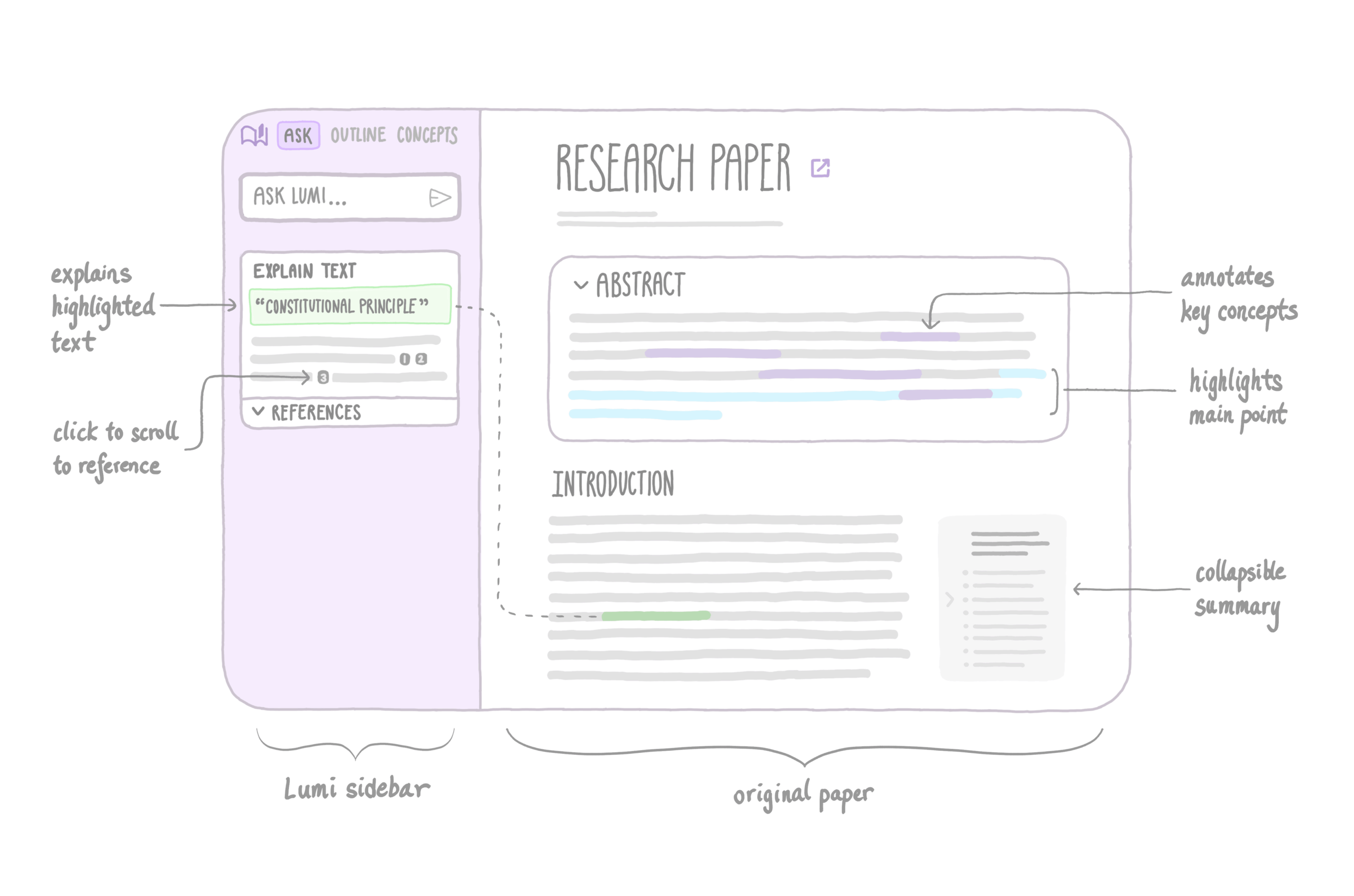
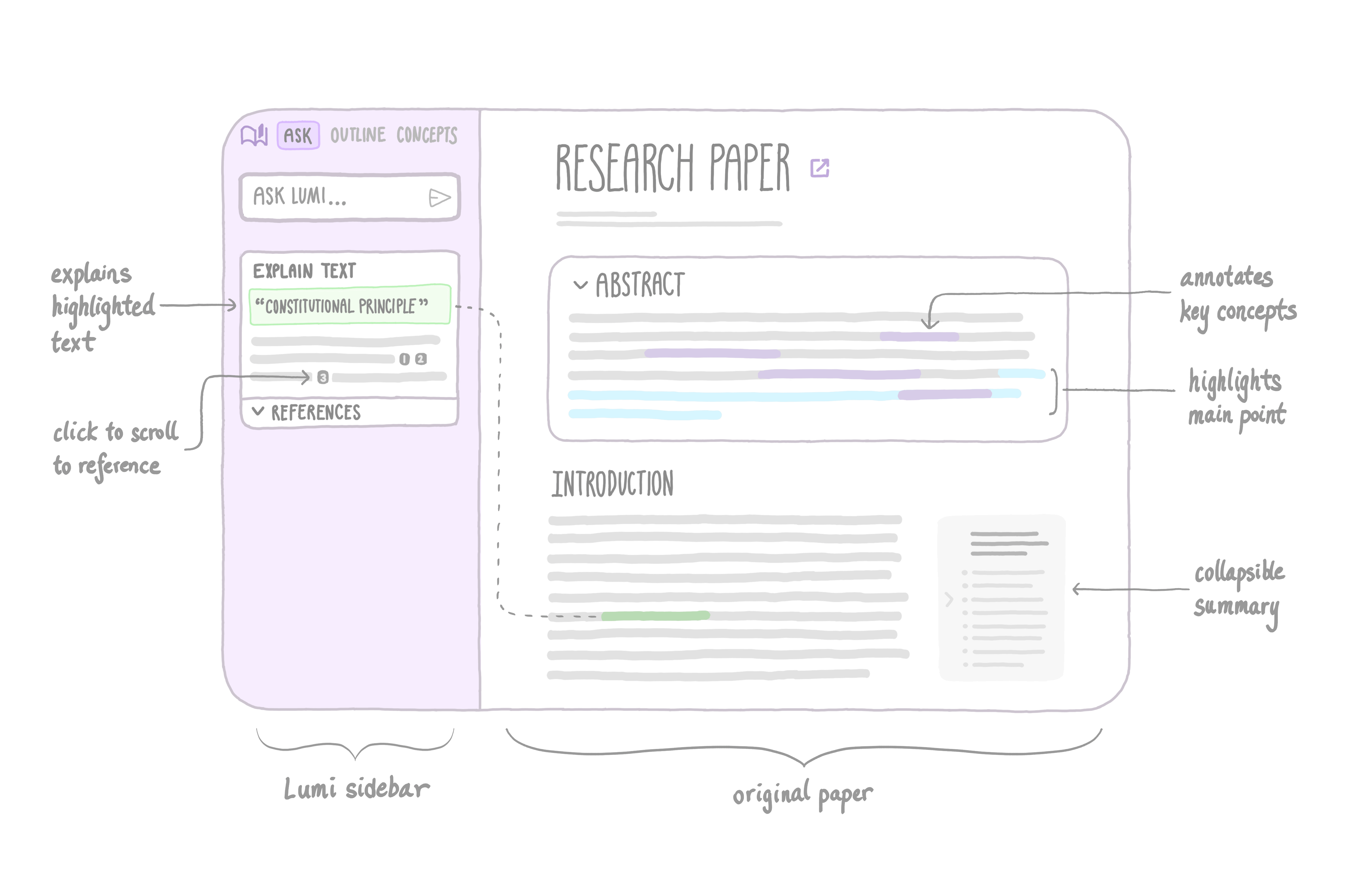
- AI-Augmented Annotations: The system processes paper content and automatically highlights critical concepts, methods, findings, and arguments directly within the source text. Rather than overwhelming summaries, these annotations guide focus toward essential content architecture.
- Intelligent Reference Navigation: All citations and references become dynamically clickable, enabling instant navigation to cited works within the arXiv ecosystem. This transforms static bibliographies into living literature networks without requiring tab switching or external searches.
- Contextual Question-Answering: Readers select any passage, mathematical formula, figure, or equation and pose targeted questions. Lumi returns context-specific answers grounded directly in the paper’s content, with responses appearing inline without document disruption.
- Creative Commons-Licensed arXiv Integration: Optimized exclusively for arXiv papers published under Creative Commons licenses. This specialized scope ensures reliable permission for AI analysis and consistent user experience across supported content.
- Multi-Granular Summaries: Access summaries at multiple levels of abstraction—from high-level overview to section-specific deep dives—enabling both rapid triage and detailed comprehension based on individual needs.
- Transparent AI Layer: All AI-generated insights remain grounded in the original text. The system does not paraphrase or synthesize across papers, maintaining fidelity to author intent and enabling verification of all claims.
How It Works
Lumi operates as an overlay interface that augments traditional PDF reading without replacing the source document. The workflow is intuitive and requires no configuration:
Users access an arXiv paper through Lumi’s web interface (currently supporting Creative Commons-licensed papers). Upon loading, Lumi’s AI layer automatically activates, analyzing paper structure and extracting key concepts. The interface displays the original paper layout with AI annotations overlaid—highlighted passages, concept markers, and reference metadata appear inline with the text.
When readers encounter complex passages, they simply select the problematic text, formula, or figure and pose a natural language question. Lumi processes the query against the paper’s full context and returns a targeted answer, displayed adjacent to the selection. This maintains reading flow while providing on-demand comprehension support.
References throughout the paper become interactive. Hovering or clicking any citation instantly displays the referenced work’s metadata and enables navigation to the source paper (when available within arXiv). This eliminates the traditional citation verification workflow of manually searching references or opening separate tabs.
Use Cases
Lumi’s reading enhancement capabilities serve multiple academic and research scenarios:
- Rapid Literature Review: Reviewers can efficiently process multiple papers by leveraging AI highlights to identify key contributions and methodology variations across works, significantly reducing time spent on irrelevant content.
- Complex Concept Clarification: When encountering unfamiliar mathematical frameworks, domain-specific terminology, or novel methodologies, inline Q\&A provides immediate clarification without breaking reading momentum.
- Method and Finding Verification: Researchers verify specific claims, statistical results, or methodological choices through targeted Q\&A, improving research integrity and supporting evidence-based synthesis.
- Guided Learning for Students: Students approaching unfamiliar fields leverage AI annotations and contextual explanations to build understanding progressively, transforming passive reading into active learning.
- Reference Verification and Exploration: The clickable reference system enables rapid verification of citations and discovery of related literature without manual search processes.
- Teaching Support: Educators use Lumi to prepare lecture materials or guide students through complex papers, with the system providing scaffolded explanations that support pedagogical objectives.
Pros \& Cons
Advantages
- Inline Context Preservation: Q\&A responses remain grounded in specific paper passages, ensuring all AI assistance connects directly to source material rather than external knowledge.
- Friction-Reduced Reading: By embedding AI support directly into the reading interface, the platform eliminates task-switching and context loss inherent in traditional paper reading workflows.
- Reference Navigation Efficiency: Clickable citations transform literature reviews from tedious manual searching into streamlined exploration of connected research.
- Transparent Methodology: All AI-generated insights trace back to specific paper locations, supporting verification and reducing hallucination risks compared to general-purpose AI tools.
- No Configuration Required: The interface activates automatically upon paper loading with no user setup, maximizing accessibility for diverse experience levels.
Disadvantages
- Creative Commons License Limitation: Access restricted to arXiv papers published under Creative Commons licenses, representing approximately 20-30% of total arXiv content depending on license distribution. This significantly narrows available content compared to full arXiv or multi-repository support.
- arXiv-Only Scope: Currently supports exclusively arXiv papers; integration with other repositories (bioRxiv, medRxiv, ACL Anthology, conference proceedings) remains unavailable.
- Experimental Platform Status: As an active research experiment, features may undergo changes, the interface may have stability variations, and long-term platform commitment remains uncertain.
- No Cross-Paper Synthesis: Unlike literature review tools, Lumi cannot synthesize insights across multiple papers, limiting its utility for comprehensive research synthesis tasks.
- Internet Connectivity Dependency: Web-based interface requires continuous connectivity; offline access to annotations is unavailable.
How It Compares
Lumi operates within the academic reading and research support landscape alongside several distinct competitor categories:
Summarization-Focused Platforms (Scholarcy): These tools convert lengthy papers into structured flashcard summaries containing key findings, methods, and limitations. While effective for rapid triage, they transform content rather than enhancing the original reading experience. Scholarcy supports diverse document formats and broad repositories, whereas Lumi maintains source fidelity through in-text annotations.
Literature Mapping Tools (ResearchRabbit): Specialized for citation network visualization and related-work discovery, ResearchRabbit creates visual maps of research landscapes. It excels at literature review planning but provides minimal support for comprehending individual papers. Lumi conversely focuses on deep paper understanding rather than landscape mapping.
Academic Discovery and Search (Semantic Scholar): This platform emphasizes discoverability through semantic search, citations networks, and TLDR summaries alongside a modern PDF reader. Semantic Scholar’s strength lies in finding relevant papers; Lumi assumes discovery is complete and focuses on comprehension of already-selected papers.
Multi-Source AI Research Support (NotebookLM): Google’s NotebookLM analyzes up to 50 sources simultaneously (PDFs, URLs, videos) and generates multi-format outputs including mind maps, timelines, and audio briefings. NotebookLM suits broad literature synthesis but operates through conversational Q\&A rather than in-text augmentation. Lumi, by contrast, specializes in single-paper deep comprehension through embedded AI.
Citation Context Intelligence (Scite): This platform analyzes how papers are cited across the literature, classifying citations as supporting, contrasting, or mentioning. Scite evaluates paper influence and research consensus; Lumi focuses on individual paper comprehension rather than meta-level citation analysis.
General AI Research Support (Claude AI): Large language models support research workflows including topic refinement, citation checking, and draft improvement. However, they process papers through conversational interfaces rather than augmenting the native reading experience, and risk hallucinations on specific claims.
Lumi’s distinctive advantage is specialized focus on transforming single-paper reading through embedded AI: intelligent highlighting reveals argument structure; inline Q\&A provides immediate comprehension support; clickable references enable frictionless literature exploration—all without leaving the original document. This in-text augmentation approach differs fundamentally from separate summarization tools, discovery platforms, or general-purpose synthesis systems. For researchers prioritizing deep individual paper comprehension within the constraints of CC-licensed arXiv content, Lumi offers a purpose-built solution unavailable elsewhere.
Final Thoughts
The academic reading experience has remained largely unchanged despite dramatic advances in AI and information access. Lumi represents a meaningful reimagining of this workflow by embedding intelligent support directly into the reading interface itself. For researchers and students working with arXiv papers under Creative Commons licenses, Lumi offers genuine productivity gains through reduced cognitive load and accelerated comprehension. While current scope limitations restrict applicability to a subset of academic content, the platform demonstrates a compelling vision for AI-augmented reading that prioritizes comprehension enhancement over content transformation. As a research experiment, Lumi occupies a valuable position in exploring how AI can augment rather than replace scholarly reading practices, making it an essential consideration for academic users seeking to optimize their engagement with preprint literature.