Table of Contents
Overview
Modern AI applications require seamless connectivity between language models and real-world systems—databases, APIs, enterprise software, and data sources. The Model Context Protocol (MCP), an open standard developed by Anthropic, enables this connectivity by providing a universal interface for AI tools to access external resources. However, deploying and managing MCP servers at scale presents significant infrastructure challenges: authentication complexity, cold start latency, multi-tenant isolation, and operational visibility.
Metorial addresses these challenges through an enterprise-grade MCP infrastructure platform designed for developers building production AI applications. By providing serverless hosting for MCP servers with sub-second cold starts, automated OAuth management, and comprehensive observability, Metorial transforms MCP from a promising standard into production-ready infrastructure. Whether connecting AI coding assistants to enterprise systems or building autonomous agents that interact with real-world tools, Metorial delivers the reliability, security, and scale that production environments demand.
Key Features
Metorial delivers a comprehensive MCP infrastructure platform built specifically for enterprise AI deployments:
- Serverless MCP Runtime: Metorial operates the industry’s first truly serverless MCP hosting environment with proprietary hibernation technology. MCP servers scale from zero to millions of requests automatically, starting in under one second from cold state and pausing when idle. This eliminates infrastructure management while ensuring instant responsiveness and cost efficiency.
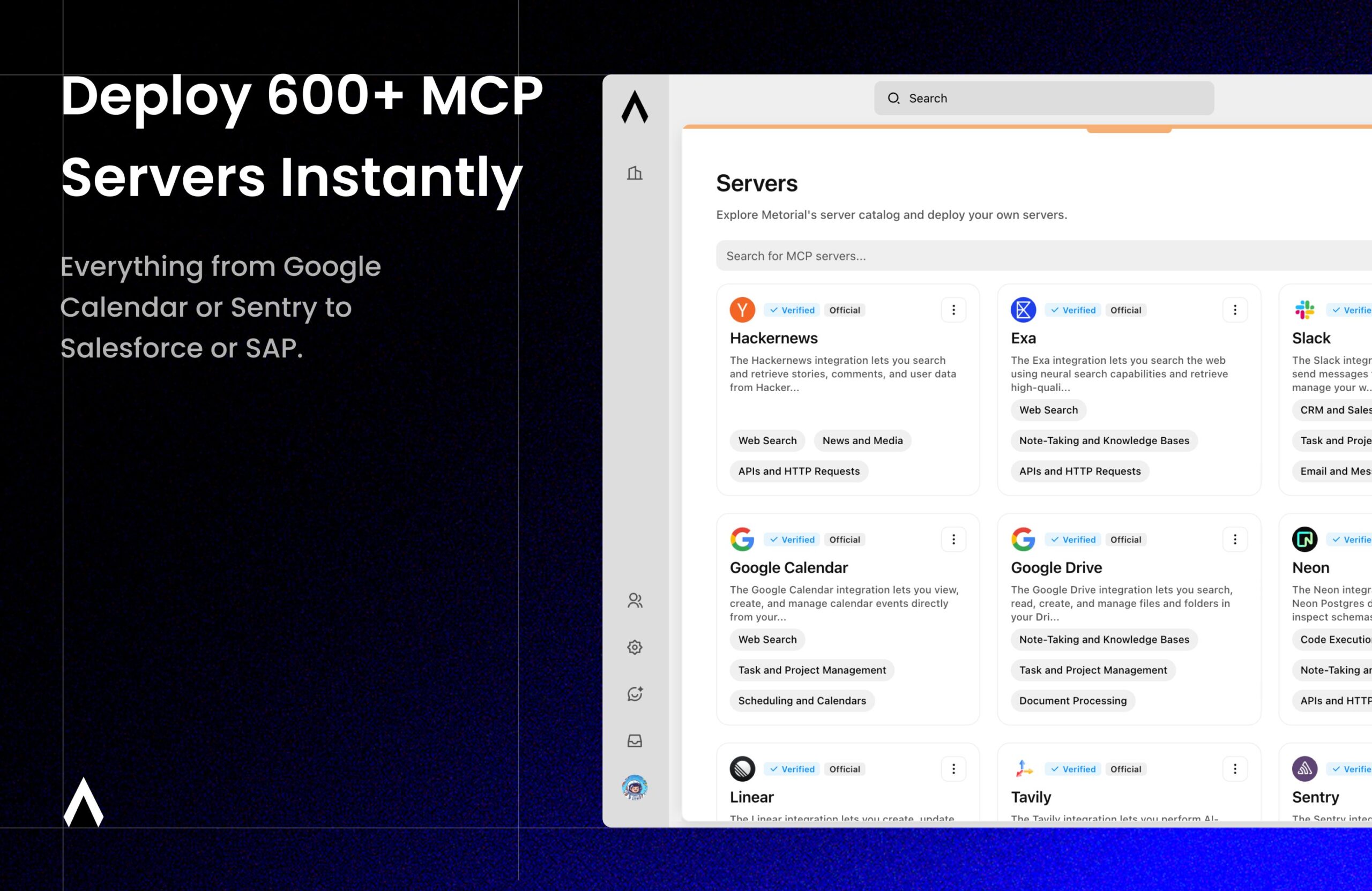
- Extensive Integration Catalog: Access over 600 pre-configured MCP servers connecting to enterprise systems including Slack, Gmail, Salesforce, HubSpot, GitHub, Notion, Linear, Google Drive, and hundreds more. The searchable catalog contains 5,000+ indexed servers spanning CRM platforms, communication tools, databases, cloud services, financial systems, and development tools.
- Simplified OAuth Authentication: Multi-tenant OAuth flows that traditionally require weeks of engineering reduce to single API calls. Metorial automatically generates user-specific OAuth URLs, handles token refresh, and maintains complete credential isolation between users—enabling secure, scalable deployments without custom authentication infrastructure.
- Complete Observability Infrastructure: Every MCP session logs to Metorial’s monitoring system with full request/response capture. Developers access real-time dashboards showing tool calls, latency metrics, error rates, and usage patterns. Session replay functionality enables debugging by reconstructing exact interaction sequences, while automated error detection surfaces integration failures immediately.
- Magic MCP for AI Coding Tools: One-click MCP integration for Cursor, GitHub Copilot, and Claude Code eliminates complex configuration. Developers select desired integrations from Metorial’s catalog and activate them instantly within their AI coding environment—no connection strings, no manual server setup, no restarts required.
- Developer-Focused SDKs: Python and TypeScript SDKs enable MCP server integration via single function calls. The SDKs abstract MCP protocol complexity, handle connection management, and provide type-safe interfaces for tool registration and execution. This reduces integration time from days to hours.
- Open-Source Foundation: Core platform components available on GitHub foster transparency and community contribution. Organizations can fork MCP servers, customize behavior, or deploy the entire platform on private infrastructure for air-gapped environments or strict compliance requirements.
- Enterprise Security Architecture: True per-user credential isolation ensures different users’ OAuth tokens, API keys, and session data never commingle. SOC 2 compliance, encryption at rest and in transit, and comprehensive audit logging support regulatory requirements for healthcare, finance, and government deployments.
How It Works
Metorial streamlines MCP deployment from complex infrastructure management to simple configuration and integration.
For developers building AI applications, the workflow begins with connecting to Metorial via Python or TypeScript SDKs. Developers browse the MCP server catalog through Metorial’s dashboard, selecting integrations relevant to their application—perhaps GitHub for code repository access, Slack for team communication, and Notion for documentation retrieval. With selections made, Metorial’s SDK connects the AI application to these MCP servers via a single function call, establishing authenticated connections without manual OAuth implementation.
When the AI application executes, tool calls route through Metorial’s serverless runtime. If an MCP server is hibernating (scaled to zero), Metorial’s proprietary wake-up mechanism activates it in under one second. The server processes the request, returns results, and hibernates again when idle. All interactions log to Metorial’s observability platform, providing real-time visibility into tool usage, latency, and errors.
For users of AI coding assistants (Cursor, GitHub Copilot, Claude Code), Magic MCP simplifies setup dramatically. Users access Metorial’s Magic MCP dashboard, authenticate their coding tool, and select desired integrations with checkboxes. Metorial generates the necessary configuration and injects it into the coding environment automatically. When developers write code, their AI assistant can now query Slack messages, search documentation in Notion, analyze GitHub repositories, or access any other connected system—all without leaving the development environment.
Multi-tenant deployments leverage Metorial’s OAuth automation. Applications generate user-specific OAuth URLs via API call, directing users through authentication flows. Metorial stores credentials with complete isolation, refreshes tokens automatically, and ensures each user’s tool calls execute with their specific permissions across connected systems.
Use Cases
Metorial’s MCP infrastructure supports diverse AI application patterns across enterprise and development scenarios:
- AI-Powered SaaS Development: Product teams building AI features into SaaS applications leverage Metorial to connect their AI to customer data sources, communication platforms, and business tools. A customer support AI might access Salesforce CRM for account history, query Zendesk for past tickets, and send Slack notifications—all through Metorial-managed MCP servers.
- Enterprise AI Agent Deployment: Organizations deploying autonomous agents for workflow automation connect those agents to internal systems via Metorial. An HR automation agent might read candidate information from Greenhouse, schedule interviews via Google Calendar, send communications through Gmail, and update Notion documentation—all managed through Metorial’s MCP infrastructure with comprehensive audit trails.
- Developer Tool Integration: Engineering teams enhance AI coding assistants by connecting them to development infrastructure. Through Metorial, Cursor can query Jira for requirements, analyze GitHub pull requests, retrieve API documentation, search Stack Overflow, and access internal knowledge bases—transforming coding assistants into comprehensive development companions.
- Large-Scale Agent Orchestration: Teams building multi-agent systems use Metorial to manage tool connectivity across agent fleets. Rather than implementing integration infrastructure separately for each agent, Metorial provides centralized MCP hosting with per-agent isolation, unified observability, and consistent authentication—simplifying orchestration of complex agent networks.
- API-Driven Automation: Business operations teams automate cross-system workflows by connecting AI to diverse APIs via MCP. Financial close processes might query Stripe for transaction data, retrieve QuickBooks accounting records, analyze discrepancies, and update spreadsheets—all orchestrated through AI with Metorial managing secure API connectivity.
- Compliance-Sensitive AI Deployments: Regulated industries deploy AI with Metorial’s audit logging and self-hosting capabilities. Healthcare AI accessing patient systems, financial AI connecting to trading platforms, or government AI querying sensitive databases benefit from complete session replay, credential isolation, and on-premises deployment options that support compliance mandates.
Advantages
- Sub-Second MCP Cold Starts: Metorial’s proprietary hibernation technology achieves MCP server wake-up in under one second, dramatically faster than container-based alternatives. This eliminates the cold start latency that makes serverless architectures impractical for real-time AI applications.
- Comprehensive Integration Ecosystem: Access to 600+ production-ready MCP servers spanning enterprise systems, developer tools, communication platforms, and data sources accelerates development. Teams avoid building custom integrations for each tool, focusing engineering effort on core AI capabilities instead.
- Automated Multi-Tenant OAuth: Generating per-user OAuth flows through single API calls reduces authentication implementation from weeks to hours. Automatic token refresh and credential isolation eliminate common security vulnerabilities while supporting scalable SaaS deployments.
- Production-Grade Observability: Complete MCP session recording with replay functionality provides debugging capabilities unavailable in custom implementations. Real-time dashboards, automated error detection, and detailed logging enable rapid issue resolution and performance optimization.
- Developer Productivity: SDK-based integration reducing MCP setup to single function calls dramatically accelerates time-to-market. Developers ship AI features faster by leveraging Metorial’s infrastructure rather than building MCP deployment systems from scratch.
- Enterprise Security Compliance: True per-user isolation, SOC 2 compliance, encryption standards, and comprehensive audit trails support deployment in regulated industries where security and compliance requirements traditionally block AI adoption.
- Deployment Flexibility: Open-source foundation with self-hosting option enables organizations to run Metorial on private infrastructure for air-gapped environments, data residency requirements, or maximum control over AI integration infrastructure.
Considerations
- Developer-Focused Platform: Metorial targets technical users comfortable with SDK integration and programmatic deployment. Non-technical teams may require developer involvement for initial setup, though Magic MCP simplifies configuration for supported AI coding tools.
- MCP Protocol Dependency: Platform value proposition centers on MCP standard adoption. Organizations using non-MCP integration approaches require migration effort. However, MCP’s backing by Anthropic and growing ecosystem adoption suggest long-term viability.
- SDK Configuration Requirements: While simplified, advanced use cases or custom MCP servers still require SDK setup and programmatic configuration. Teams seeking purely no-code integration may find initial learning curve steeper than visual workflow builders.
- Pricing Considerations: Enterprise-grade infrastructure comes with corresponding pricing tiers. Individual developers or small projects should evaluate cost-benefit relative to implementation effort of managing MCP infrastructure independently.
How It Compare
Metorial operates within the AI integration infrastructure landscape, positioned distinctly from both agent frameworks and general automation platforms:
AI Agent Frameworks (LangChain, CrewAI, Hugging Face Agents): These frameworks provide tools for building and orchestrating AI agents—defining agent behavior, managing conversation state, implementing reasoning loops, and coordinating multi-agent workflows. LangChain offers modular components for LLM applications with extensive ecosystem integrations; CrewAI specializes in role-based multi-agent collaboration with lean, high-performance architecture; Hugging Face Agents provides tool integration for models hosted on Hugging Face infrastructure. All excel at agent construction. Metorial addresses a different layer: reliable connectivity infrastructure for those agents to access external systems. While these frameworks may include basic tool-calling capabilities, Metorial provides production-grade MCP hosting with enterprise security, sub-second performance, and comprehensive observability that agent frameworks don’t natively offer.
General Workflow Automation Platforms (Zapier, Make.com, n8n): These platforms enable workflow automation through visual builders connecting thousands of applications. Zapier provides 8,000+ app integrations with AI Actions and recent MCP support for connecting AI assistants to its ecosystem; Make.com offers 3,000+ app connections with AI Agents and MCP Server for exposing workflows to AI tools; n8n delivers 400+ integrations with AI-native workflow building and MCP capabilities. All three excel at workflow orchestration—triggering actions based on events, routing data between systems, and implementing business logic. Metorial focuses specifically on MCP infrastructure—serverless hosting, hibernation technology, session replay, and developer SDKs for AI applications. The differentiation: workflow platforms enable humans (or AI) to automate tasks across applications; Metorial enables AI applications to reliably call tools at production scale through MCP standard.
Integration Platform as a Service (iPaaS) (MuleSoft, Dell Boomi): Enterprise iPaaS solutions provide comprehensive integration infrastructure for connecting disparate systems, managing data transformation, and orchestrating complex workflows. They excel in enterprise IT contexts with dedicated integration teams and months-long implementation cycles. Metorial targets a different user: developers building AI applications who need MCP connectivity without enterprise sales processes or extensive configuration. The platform delivers enterprise-grade reliability with developer-friendly simplicity—600+ integrations accessible via SDKs rather than months of professional services engagement.
Metorial’s competitive differentiation centers on three integrated capabilities unavailable elsewhere: MCP-specific serverless runtime with proprietary hibernation achieving sub-second cold starts (unique in MCP infrastructure space); complete MCP session observability with replay functionality for debugging and audit compliance (critical for production AI deployments); and developer-optimized SDKs reducing MCP integration to single function calls (dramatically accelerating development velocity). For teams building production AI applications requiring reliable tool connectivity through MCP standard—especially in regulated industries or complex enterprise environments—Metorial delivers specialized infrastructure that neither agent frameworks nor general automation platforms currently provide.
Final Thoughts
The Model Context Protocol represents a significant step toward standardized AI-tool connectivity, but protocol standards alone don’t deliver production infrastructure. Metorial transforms MCP from theoretical capability into operational reality through purpose-built hosting, observability, and security designed specifically for enterprise AI deployments. For developers building AI applications that interact with real-world systems—from AI coding assistants to autonomous business agents—Metorial eliminates months of infrastructure development while providing reliability, scale, and compliance capabilities that custom implementations struggle to achieve. As MCP adoption grows and AI applications increasingly require external tool access, specialized infrastructure platforms like Metorial become essential components of the AI development stack, much as Vercel transformed serverless deployment or GitHub Actions standardized CI/CD workflows. Organizations serious about production AI deployment will increasingly require infrastructure that bridges models and tools reliably—precisely the problem Metorial solves.