
Table of Contents
Overview
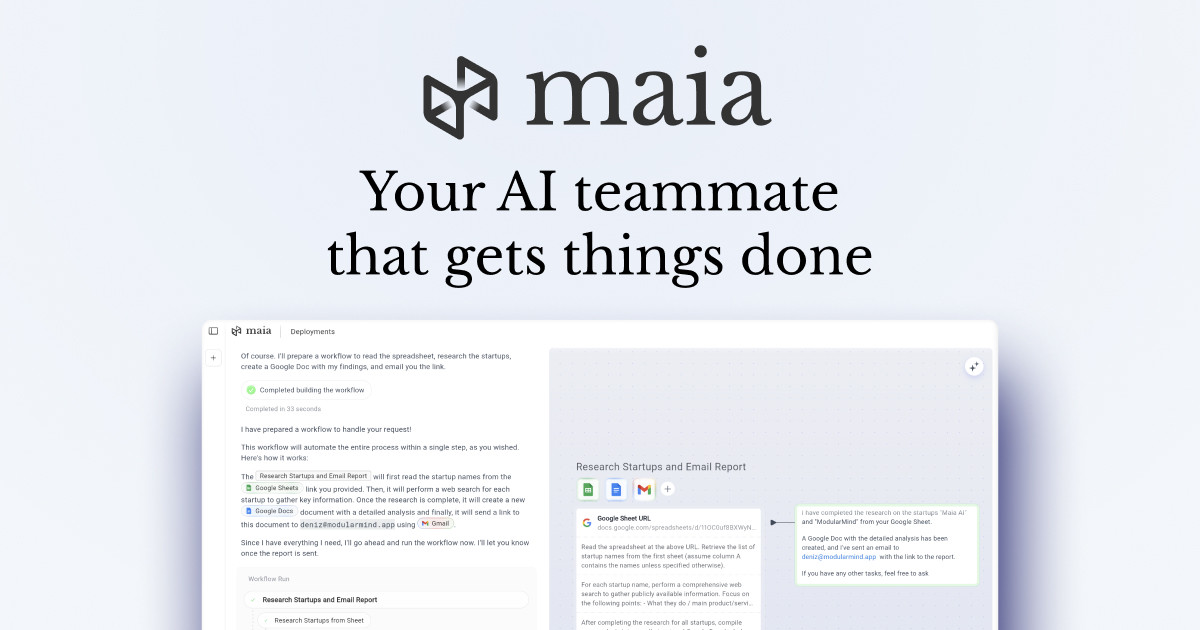
The modern professional landscape continues to evolve toward intelligent automation solutions that promise to streamline daily workflows through conversational interfaces. Maia represents an emerging AI productivity platform currently in development, designed to transform how individuals and teams approach task management through natural language automation. While the platform recently gained attention on Product Hunt in October 2025, it remains in early development stages with limited public access through a waitlist system, reflecting the broader trend of AI-powered productivity tools entering the market.
Key Features
Based on available information, Maia is being developed with several core capabilities intended to enhance professional productivity:
- Natural Language Task Processing: The platform aims to interpret work descriptions in conversational language, translating user requirements into actionable task sequences without requiring technical configuration or detailed step-by-step instructions.
- Automated Workflow Execution: The system is designed to identify recurring patterns and manage repetitive workflows, reducing manual oversight once user preferences and standard operating procedures are established.
- Team Integration Capabilities: Maia is being positioned as a collaborative AI assistant that embeds into existing team workflows, functioning as a proactive digital teammate rather than a standalone application.
- Early Access Development Program: Currently operating through a waitlist system, the platform offers early access to beta features, enabling pioneering users to experience and influence the development process.
How It Works
The conceptual framework behind Maia centers on intuitive, conversational interaction design. Users would describe their work requirements through natural language input, either via text or voice communication. The AI system would then analyze these descriptions to identify actionable components, task dependencies, and execution priorities. The platform aims to initiate autonomous task completion while monitoring progress and adapting to changing requirements without requiring detailed manual configuration, representing a shift from traditional productivity management toward intelligent delegation.
Use Cases
The planned versatility of Maia suggests application across diverse professional scenarios:
- Administrative Task Automation: Streamline meeting coordination, email management, and document organization through intelligent scheduling and communication processing, enabling professionals to focus on strategic initiatives rather than routine administration.
- Project Management Enhancement: Automate status reporting, progress tracking, and resource coordination for project managers, ensuring consistency while reducing administrative overhead and improving team communication.
- Research and Content Support: Facilitate information gathering, source verification, and preliminary content development for knowledge workers, accelerating research workflows and supporting creative processes.
- Multi-Context Productivity: Provide comprehensive support for entrepreneurs and distributed teams managing diverse responsibilities, serving as intelligent coordination hubs for complex professional environments.
Pros \& Cons
Advantages
The concept behind Maia offers several potential benefits for modern productivity enhancement:
- Conversational Automation Approach: The focus on natural language interaction could eliminate the learning curve associated with traditional productivity software, making advanced automation accessible to non-technical users.
- Adaptive Learning Potential: Machine learning capabilities could enable the system to understand user preferences and work patterns, becoming increasingly effective without explicit reprogramming or manual configuration.
- Broad Application Scope: Natural language processing could enable wide application across diverse professional functions, from creative work to analytical tasks and administrative coordination.
- Early Development Participation: Waitlist access provides opportunities for users to influence platform development and gain familiarity with emerging productivity technologies.
Current Limitations
The early development stage presents several considerations for potential users:
- Limited Availability: Access remains restricted to a waitlist system, preventing immediate adoption and limiting opportunities for comprehensive evaluation of actual capabilities versus marketing claims.
- Unverified Functionality: Core features and performance claims remain largely undemonstrated in real-world scenarios, requiring careful evaluation once the platform becomes more widely available.
- Development Stage Uncertainty: Privacy policies, security measures, and data handling practices have not been fully disclosed, necessitating careful consideration for professional use cases involving sensitive information.
How Does It Compare?
The AI productivity assistant category occupies an increasingly competitive position within the broader automation and productivity software landscape. Traditional project management platforms like Asana and ClickUp continue to excel in structured task organization, assignment tracking, and team coordination through established interfaces, requiring users to actively manage and update project information but offering proven reliability and comprehensive feature sets.
Enterprise automation solutions such as UiPath and Automation Anywhere maintain their focus on large-scale, rule-based process automation for structured business operations, typically requiring technical expertise for implementation but delivering robust performance for complex organizational workflows.
Current market leaders in AI-enhanced productivity include ChatGPT, Claude, and Microsoft Copilot, each offering distinct approaches to intelligent assistance. ChatGPT provides versatile conversational AI with extensive plugin ecosystem and customization options. Claude emphasizes careful reasoning and long-form content development with strong privacy considerations. Microsoft Copilot delivers deep integration within the Microsoft 365 ecosystem, enabling seamless productivity enhancement for existing enterprise users.
Specialized AI productivity tools like Motion, Notion AI, and various industry-specific solutions represent a middle ground, offering intelligent assistance within existing productivity frameworks while maintaining user control over task execution and providing demonstrated value in specific use cases.
The emerging category that includes platforms like Maia differentiates itself through promises of conversational interfaces that interpret natural language descriptions and execute complex, multi-step workflows autonomously. However, the actual implementation and effectiveness of such systems remain to be validated through real-world usage and comparative analysis once these platforms achieve broader market availability.
Final Thoughts
The concept of conversational AI productivity assistants represents a compelling direction for the future of professional work, addressing genuine challenges in task management and workflow optimization through natural language interaction. While platforms like Maia offer promising visions of autonomous task execution and intelligent workflow delegation, the current market landscape requires careful evaluation of actual capabilities versus marketing claims.
The success of such platforms will ultimately depend on their ability to deliver reliable performance, maintain robust privacy and security standards, and provide demonstrable value improvements over existing productivity solutions. As the AI productivity assistant category continues developing, the most effective solutions will likely combine powerful automation capabilities with transparent operational practices and proven reliability standards.
For professionals considering emerging AI productivity platforms, the key factors include realistic assessment of current technology limitations, careful evaluation of data handling practices, and strategic consideration of how such tools might integrate with existing workflows while maintaining professional standards and security requirements.