Table of Contents
Overview
Marble is a super simple headless CMS designed specifically for collaborative content management focusing on publishing articles, blogs, changelogs, and product updates launched December 8, 2025 on Product Hunt (achieving 283 upvotes and 43 comments). Created by co-founders Dominik Koch and Taqib Ibrahim as open-source project (GitHub: usemarble/marble), Marble addresses fundamental friction plaguing modern content publishing: traditional CMS platforms like WordPress overwhelm users with excessive features and complex configurations while enterprise headless CMS solutions create steep learning curves requiring technical expertise.
Marble targets the middle ground providing lightweight API-first architecture combining clean distraction-free editor, team collaboration capabilities, AI-powered writing assistance, and flexible REST API enabling seamless integration with modern frontend frameworks (Next.js, Astro, Nuxt, Gatsby) without bloated interfaces or unnecessary complexity. The platform serves developers building custom sites without monolithic CMS overhead, writers seeking intuitive content creation environments, and small teams needing fast collaborative publishing workflows without extensive technical configuration.
Selected as member of Vercel Open Source Fall 2025 Cohort, Marble represents new generation of focused headless CMS tools prioritizing developer experience, content creator satisfaction, and rapid content delivery over feature maximalism. By keeping scope deliberately narrow (blogs, articles, changelogs, product updates) rather than attempting universal content modeling, Marble optimizes specifically for text-driven publishing workflows achieving simplicity and speed impossible in general-purpose platforms. The open-source model ensures transparency, community contributions, and freedom from vendor lock-in appealing to developers and organizations valuing code access and customizability.
Key Features
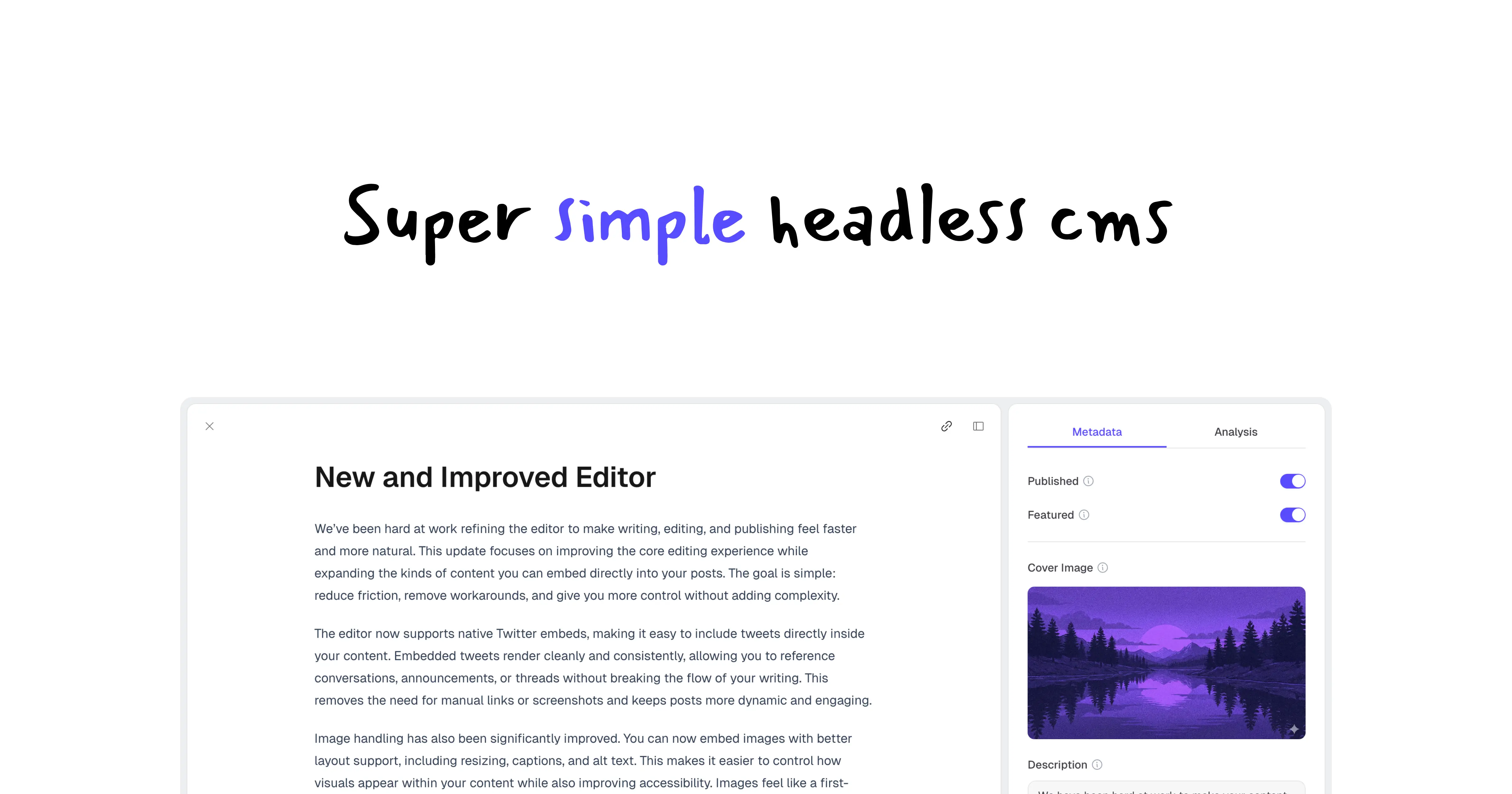
- Distraction-Free Editor with Markdown and AI Assistance: Marble provides clean, intuitive writing interface emphasizing content creation without cluttered toolbars or overwhelming options. The editor supports Markdown enabling efficient writing for technically-inclined authors while WYSIWYG functionality accommodates non-technical users. AI assistance offers real-time readability scores analyzing sentence complexity, paragraph length, and overall clarity providing optimization tips improving content quality. The editor’s minimalist philosophy keeps writers focused on ideas rather than fighting interface complexity characteristic of bloated traditional CMS platforms.
- Headless REST API for Framework-Agnostic Integration: Marble exposes all content through clean, well-documented REST API enabling developers fetching posts, pages, authors, tags, and media from any frontend framework or platform. The API design follows modern conventions with JSON responses, standard HTTP methods, and predictable endpoint structures. Developers integrate Marble with Next.js leveraging static site generation, Astro for content-focused sites, Nuxt for Vue-based applications, Gatsby for React ecosystems, or custom implementations matching specific technical requirements. This decoupled architecture future-proofs content enabling delivery to websites, mobile apps, or emerging platforms without backend constraints.
- Team Collaboration with Role Management: Multiple team members collaborate within shared workspaces with configurable user roles controlling access permissions. The Pro plan supports 5 team members enabling content teams, product managers, and marketing professionals collectively managing publications. Role management defines who can create drafts, publish content, manage media, or configure workspace settings preventing accidental changes while enabling efficient workflows. Draft sharing functionality (Pro plan) enables collaborative review and feedback cycles before publication improving content quality through team input.
- Global CDN Media Library with 1GB–10GB Storage: Centralized media management organizes images, videos, and documents with upload, search, and reuse capabilities. Uploaded assets automatically distribute through global CDN ensuring fast loading regardless of visitor geography critical for performance-sensitive sites and SEO rankings. The Hobby plan includes 1GB storage sufficient for hobbyist blogs, while Pro plan provides 10GB accommodating content-heavy publications. Alternatively, Marble supports external storage integration enabling users leveraging existing S3, Cloudflare R2, or custom storage solutions maintaining media flexibility.
- AI-Powered Readability Insights and SEO Tips: Real-time AI analysis evaluates content readability identifying complex sentences, passive voice usage, lengthy paragraphs, or jargon requiring simplification. The system provides actionable recommendations improving clarity and engagement aligning with best practices for web writing. SEO tips guide meta description optimization, keyword usage, heading structure, and content organization enhancing search engine visibility. These insights democratize content optimization making editorial best practices accessible without specialized SEO knowledge or expensive third-party tools.
- Webhook Events for Automated Workflows: Marble supports webhooks triggering custom automation when content events occur (post published, post updated, post deleted, media uploaded). Developers configure webhook endpoints receiving real-time notifications enabling integration with external systems: revalidating Next.js static pages ensuring freshness, triggering CI/CD pipelines rebuilding sites automatically, syncing content to third-party services, or sending notifications to Slack, Discord, or email. The Hobby plan includes 100 webhook events monthly, while Pro plan provides 1,000 events supporting production-scale automation.
- Simple Scheduling and Content Publishing: Schedule content publishing at specific future dates and times enabling editorial calendar management and coordinated content releases. This functionality supports marketing campaigns, product launches, or time-sensitive announcements where precise publication timing matters. Draft management enables authors creating, reviewing, and refining content before scheduling or immediate publication maintaining content quality through deliberate review processes.
- Content Export in Multiple Formats: Marble prevents vendor lock-in through comprehensive export capabilities delivering content in JSON (structured machine-readable format), HTML (formatted content preserving styling), or Markdown (plain-text format for portability). Users can export entire content libraries anytime maintaining ownership and enabling migration to alternative platforms if requirements change. This export freedom contrasts with proprietary CMS platforms creating exit friction through format limitations or incomplete export tools.
- Unlimited Posts Across All Plans: Both free Hobby and paid Pro plans support unlimited post creation eliminating artificial content limits characteristic of tier-based pricing models. This unlimited approach benefits growing publications, active blogs, or documentation sites where post volume scales naturally without triggering surprise upgrade requirements or content caps constraining publishing frequency.
- Fast Setup and Minimal Configuration: Marble emphasizes rapid onboarding enabling users creating accounts and publishing first posts within minutes without extensive configuration, theme selection, or technical setup. The opinionated defaults handle common requirements while allowing customization when needed. This “open and write” philosophy reduces friction compared to traditional CMS platforms requiring hours of configuration before productive content creation begins.
- Modern Tech Stack Built on Serverless Architecture: Marble’s infrastructure leverages cutting-edge technologies: Astro with Tailwind CSS for marketing site optimized for speed, Next.js powering admin dashboard providing interactive management interface, Hono serverless API deployed on Cloudflare Workers ensuring global low-latency responses, Neon serverless PostgreSQL with branching capabilities enabling safe schema migrations, Prisma ORM for type-safe database queries, and Cloudflare R2 for cost-effective media storage. This serverless-first architecture scales automatically, minimizes operational overhead, and keeps hosting costs low benefiting both Marble’s sustainability and user pricing.
How It Works
Marble operates through straightforward workflow combining intuitive content management with flexible API-based content delivery:
Step 1: Account Creation and Workspace Setup
Users visit marblecms.com creating account through email registration or social auth. Upon signup, Marble automatically creates default workspace representing organizational boundary for content, team members, and settings. Users can create multiple workspaces (each requires separate subscription if upgrading from Hobby to Pro) enabling separation between different projects, brands, or clients. Workspace configuration includes domain settings, webhook endpoints, API key management, and team invitations.
Step 2: Content Creation in Distraction-Free Editor
Within workspace dashboard, authors create new posts using clean editor interface. The writing environment provides rich-text formatting (headings, lists, links, bold, italic), Markdown support for keyboard-driven writing, image insertion from media library or external URLs, and embedded media (videos, embeds) through block system. As authors write, AI readability analysis runs in background providing real-time scores and suggestions improving clarity. The editor autosaves continuously preventing data loss ensuring drafts persist through browser crashes or accidental closures.
Step 3: Media Management and Asset Organization
The centralized media library enables uploading images, videos, or documents through drag-and-drop or file picker. Uploaded assets automatically optimize for web delivery and distribute through Cloudflare’s global CDN ensuring fast loading worldwide. The library provides search, filtering, and organizational capabilities helping content teams locating specific assets for reuse across multiple posts. External storage configuration (Pro feature) enables integrating custom S3-compatible storage if users prefer managing media infrastructure independently.
Step 4: Collaborative Review and Draft Sharing
For teams on Pro plan, draft sharing functionality enables collaborative review before publication. Authors share draft links with colleagues receiving feedback, suggestions, or approval without granting full workspace access. This workflow supports editorial review processes, stakeholder approvals, or quality control gates ensuring published content meets organizational standards. Role-based permissions prevent unauthorized publishing while enabling contribution from broader team.
Step 5: Publishing or Scheduling Content
When content ready, authors publish immediately making posts live and accessible via API, or schedule publication for specific future date/time coordinating with marketing campaigns or product launches. Published content becomes instantly available through Marble’s REST API endpoints returning JSON representing post metadata (title, slug, excerpt, publish date), content body (HTML or Markdown), author information, tags/categories, and featured images. Unpublished drafts remain private accessible only through dashboard not exposed via API preventing premature content leaks.
Step 6: API Integration with Frontend Framework
Developers integrate Marble content into websites or applications through REST API. Using provided API keys for authentication, developers call endpoints fetching posts (GET /api/posts), individual post details (GET /api/posts/:slug), authors, tags, or media. For static site generators like Next.js, developers fetch content at build time creating statically-generated pages optimized for performance and SEO. For dynamic applications, content loads at request time enabling real-time updates. Marble’s API documentation provides framework-specific quickstart guides and examples accelerating integration.
Step 7: Automated Revalidation via Webhooks
For static sites requiring fresh content without full rebuilds, developers configure webhooks triggering revalidation when content changes. When authors publish or update posts, Marble sends HTTP POST requests to configured webhook URLs containing event type and affected content identifiers. The receiving application (Next.js ISR endpoints, Netlify build hooks, Vercel revalidation APIs) processes notifications updating specific pages incrementally without full site regeneration. This architecture balances static performance benefits against content freshness requirements.
Step 8: Content Export and Migration
Users can export content anytime through dashboard in JSON (machine-readable structured format), HTML (formatted content with styling), or Markdown (portable plain-text format). Exports include all post metadata, content, authors, tags, and relationships enabling complete content backup or migration to alternative platforms. This export capability prevents vendor lock-in ensuring content ownership remains with users rather than trapped in proprietary formats.
Use Cases
Given its focused scope and simple architecture, Marble addresses specific publishing scenarios where lightweight headless CMS provides optimal solution:
Product Changelogs and Release Notes:
- Software companies publish product updates, feature releases, bug fixes, and version changelogs keeping customers informed about product evolution
- The changelog-specific workflow enables quick publishing of technical release information without wrestling with complex CMS configurations
- Webhook integration triggers automatic updates to changelog pages or in-app notification systems when new releases publish
- Historical changelog archive maintains complete product evolution timeline valuable for enterprise customers tracking feature availability
Lightweight Blogs and Articles for Startups:
- Early-stage startups establish content marketing presence publishing blog articles, thought leadership, industry insights, or company updates
- The free Hobby tier enables content marketing without upfront costs conserving runway while building audience
- Simple interface reduces onboarding friction for non-technical team members enabling marketing professionals publishing independently
- API integration with Next.js, Astro, or custom frontends matches startup’s existing technical infrastructure
Documentation Sites and Knowledge Bases:
- Developer tools, SaaS platforms, or technical products maintain documentation, tutorials, guides, or help articles
- Markdown support appeals to technical writers familiar with documentation-as-code workflows
- Version control through Git enables tracking documentation changes, reviewing updates, and maintaining consistency
- Search-friendly static generation (Next.js, Astro) optimizes documentation discoverability through organic search
Personal Blogs and Portfolio Sites:
- Independent writers, developers, designers, or professionals maintain personal blogs or portfolio content
- Unlimited posts on free tier eliminates constraints on publishing frequency or content volume
- Lightweight architecture reduces hosting costs for personal projects without enterprise requirements
- Export capabilities ensure content portability enabling future migration if requirements evolve
Content-Driven Marketing Sites:
- Marketing teams publish company blogs, case studies, whitepapers, or resources supporting lead generation
- AI readability insights improve content quality ensuring marketing materials communicate effectively
- Team collaboration enables content creation, review, and approval workflows matching organizational processes
- SEO optimization tips guide content structure maximizing organic search visibility driving qualified traffic
Multi-Brand Content Management:
- Agencies or holding companies managing multiple brands create separate workspaces for each client or property
- Consistent CMS interface reduces training overhead when onboarding team members across projects
- Workspace isolation prevents content mixing while enabling centralized billing and management
- API flexibility enables diverse frontend implementations matching each brand’s unique technical stack
Pros \& Cons
Advantages
- Simplicity and Speed Eliminating Configuration Overhead: Marble’s deliberately focused feature set and minimal configuration requirements enable rapid onboarding and immediate productivity. Users avoid weeks-long CMS learning curves or extensive technical setup characteristic of enterprise platforms, instead creating accounts and publishing content within minutes aligning with “open and write” philosophy prioritizing content creation over tool management.
- Open-Source Transparency and Community Contributions: Full code availability on GitHub (usemarble/marble) enables inspection, customization, and contribution fostering trust through transparency. Developers can audit security practices, fix bugs independently, or extend functionality matching specific requirements. The open-source model prevents vendor lock-in providing assurance Marble remains accessible regardless of commercial entity decisions. Community contributions accelerate feature development and bug resolution impossible for closed-source alternatives.
- Generous Free Tier Supporting Hobbyists and Small Projects: The Hobby plan provides unlimited posts, 1GB media storage, AI readability insights, 10k monthly API requests, and 100 webhook events without cost. This generous free offering democratizes modern headless CMS capabilities enabling students, hobbyists, personal bloggers, or early-stage startups establishing content presence without financial barriers. Unlike restrictive free tiers artificially limiting functionality to drive upgrades, Marble’s free plan delivers genuine value for appropriate use cases.
- Clean Distraction-Free Editor Improving Writing Experience: The minimalist interface emphasizing content over chrome reduces cognitive load enabling writers maintaining focus. AI-powered readability feedback provides immediate quality insights without interrupting creative flow. Markdown support accelerates input for keyboard-oriented writers while WYSIWYG functionality accommodates diverse user preferences. This editor philosophy contrasts with bloated traditional CMS interfaces overwhelming users with unnecessary controls and visual clutter.
- Flexible REST API Enabling Framework-Agnostic Integration: The headless architecture decouples content management from presentation enabling developers using preferred modern frameworks (Next.js, Astro, Nuxt, Svelte, Remix) or custom implementations. This flexibility future-proofs content investments enabling frontend technology evolution without backend migration. The predictable REST API design with JSON responses follows established conventions accelerating integration through familiar patterns.
- Webhook Automation Supporting Modern Workflows: Real-time webhook events enable sophisticated automation: revalidating static pages maintaining freshness, triggering CI/CD pipelines rebuilding sites automatically, syncing content to third-party services (CRMs, analytics, search indices), or sending notifications to team communication tools (Slack, Discord). This automation capability transforms Marble from isolated content storage into integrated component within broader technical ecosystems.
- Vercel OSS Partnership and Active Development: Selection for Vercel Open Source Fall 2025 Cohort signals active development, community investment, and partnership with leading edge computing platform. This affiliation provides resources, visibility, and ecosystem integration accelerating Marble’s maturation. Recent feature additions (webhooks, illustration generation interest, Neon branching adoption) demonstrate rapid iteration responding to user feedback.
- Content Ownership Through Comprehensive Export: JSON, HTML, and Markdown export capabilities prevent vendor lock-in ensuring users maintain complete content ownership. Unlike proprietary CMS platforms creating exit friction through incomplete exports or format limitations, Marble’s comprehensive export supports seamless migration if requirements evolve. This transparency contrasts with platforms economically incentivized trapping content preventing competitive switching.
Disadvantages
- Limited Advanced Features Versus Enterprise Platforms: Marble deliberately excludes sophisticated capabilities enterprise CMS platforms provide: complex content modeling with custom fields/relationships, advanced workflow automation with multi-stage approvals, granular role permissions beyond basic team management, multilingual content management with translation workflows, content versioning with rollback capabilities, or extensive plugin ecosystems. Organizations requiring these enterprise features must evaluate whether Marble’s simplicity suffices or necessitates more comprehensive alternatives.
- Recently Launched with Limited Production Track Record: Launched December 2025, Marble represents very new product lacking extensive production deployment, comprehensive user reviews, or proven reliability across diverse edge cases. Early adopters face potential undiscovered bugs, incomplete documentation, or workflow limitations becoming apparent through broader usage. Community size remains small compared to established platforms limiting peer support availability and third-party integration ecosystem.
- Scope Deliberately Narrow Focusing on Text Content: Marble optimizes specifically for blogs, articles, changelogs, and product updates—text-driven publishing workflows. Use cases requiring complex content structures (e-commerce product catalogs, real estate listings, event calendars, directory sites), rich media-heavy content (video platforms, podcasts), or specialized functionality (membership gating, commenting systems, community features) exceed Marble’s designed scope necessitating alternative solutions or extensive custom development.
- Team Collaboration Limited to 5 Members on Pro Plan: The Pro plan caps team members at 5 restricting Marble’s suitability for larger content organizations requiring dozens of contributors, editors, or reviewers. While adequate for small teams and startups, media companies, agencies serving multiple clients, or enterprise content operations require higher concurrency necessitating alternative platforms supporting expanded team sizes or creating workarounds through multiple workspaces increasing costs.
- API Rate Limits May Constrain High-Traffic Sites: The Hobby plan includes 10k monthly API requests supporting modest traffic levels but potentially constraining viral content, high-traffic sites, or frequent rebuild scenarios. Pro plan increases limits to 50k monthly requests expanding capacity but still finite. High-traffic production sites must monitor API usage ensuring limits accommodate actual demand or implement caching strategies reducing API dependency. Exceeding limits could result in service degradation or unexpected upgrade requirements.
- Minimal Built-In Media Processing or Optimization: While Marble provides CDN-backed media delivery, sophisticated image processing (automatic resizing, format conversion, quality optimization, responsive image variants) requires external services or custom implementation. Platforms like Cloudinary, Imgix, or Cloudflare Images provide richer media transformation capabilities Marble doesn’t replicate natively. Users requiring advanced media management may need integrating third-party services adding complexity and cost.
- Documentation and Ecosystem Still Maturing: As newly-launched platform, Marble’s documentation, tutorials, community resources, and third-party integrations remain under development compared to established platforms with years of accumulated knowledge, answered questions, and contributed guides. Users may encounter undocumented edge cases, limited troubleshooting resources, or sparse integration examples requiring self-service problem-solving or direct maintainer contact.
- No Native Commenting, Community, or Membership Features: Marble provides pure content management without built-in commenting systems, community features, membership gating, or subscription management. Sites requiring reader engagement, discussion forums, or premium content access must integrate third-party services (Disqus, Commento, Auth0, Memberstack) adding integration overhead and fragmentation. Competitors like Ghost include native membership and newsletter capabilities Marble intentionally excludes maintaining focused scope.
How Does It Compare?
Marble vs. Ghost (Open-Source Publishing Platform)
Ghost is mature open-source publishing platform built with Node.js launched 2013 providing professional publishing capabilities including native membership management, email newsletters, subscription payments via Stripe, and headless API capabilities serving 40,000+ publications.
Platform Maturity:
- Marble: Recently launched December 2025; early-stage product with limited production track record
- Ghost: Established since 2013 with 11+ years development, extensive production deployments, proven reliability
Primary Focus:
- Marble: Lightweight headless CMS emphasizing simplicity, speed, and developer experience for blogs, articles, changelogs
- Ghost: Full-featured professional publishing platform optimizing for independent publishers, media companies, newsletters, membership businesses
Monetization Features:
- Marble: Pure content management without native monetization, memberships, or email capabilities
- Ghost: Native membership tiers, Stripe payment integration, email newsletter delivery, subscription management enabling direct reader monetization
Editor Experience:
- Marble: Clean distraction-free editor with Markdown support and AI readability insights
- Ghost: Rich content editor with cards system (images, galleries, HTML, embeds, bookmarks, buttons) enabling sophisticated content layouts
Deployment Options:
- Marble: SaaS-only cloud platform (marblecms.com); no self-hosting currently available
- Ghost: Self-hosted open-source option (free) or Ghost(Pro) managed hosting (\$9-\$199+/month) providing flexibility
Pricing:
- Marble: Hobby free (unlimited posts, 1GB storage, 10k API requests); Pro \$20/month (10GB storage, 50k API requests, 5 members)
- Ghost: Ghost(Pro) Starter \$9/month (500 members), Creator \$25/month (1k members), Team \$50/month (10k members); self-hosted free
API Capabilities:
- Marble: REST API with straightforward JSON responses for posts, authors, tags, media
- Ghost: Content API (public content), Admin API (full CRUD), Members API (authentication/subscriptions); optional GraphQL via community plugins
When to Choose Marble: For lightweight headless CMS prioritizing simplicity, rapid integration, minimal configuration; ideal for developers wanting API-first content delivery without publishing platform complexity.
When to Choose Ghost: For professional publishing operations requiring memberships, newsletters, payment processing, or established platform with extensive themes, integrations, and community support.
Marble vs. Strapi (Leading Open-Source Headless CMS)
Strapi is leading open-source headless CMS built with Node.js and TypeScript serving 150,000+ developers providing fully customizable content modeling, multi-database support (PostgreSQL, MySQL, MariaDB, SQLite), and extensive plugin ecosystem.
Content Modeling:
- Marble: Fixed content types (posts, pages, media) optimized for blogging and article publishing; limited custom field creation
- Strapi: Flexible Content Types Builder enabling unlimited custom content models with diverse field types (text, rich text, media, relations, components, dynamic zones) supporting any content structure
Customization:
- Marble: Opinionated architecture with limited customization; focused on predefined blog/article workflows
- Strapi: Fully customizable APIs, routes, controllers, services, middlewares enabling bespoke business logic and workflow implementation
Admin Interface:
- Marble: Simple dashboard focused on writing and publishing; minimal configuration required
- Strapi: Comprehensive admin panel with Content Types Builder, Media Library, role permissions, plugin management; more complex but more powerful
Self-Hosting:
- Marble: SaaS-only currently; no self-hosting option available
- Strapi: Self-hosted open-source (free Community Edition) or Strapi Cloud managed hosting (starting \$29/month); full deployment control
Database Support:
- Marble: Neon serverless PostgreSQL (managed by Marble)
- Strapi: Multi-database support (PostgreSQL, MySQL, MariaDB, SQLite) with user-selected database infrastructure
Developer Experience:
- Marble: Focused on simplicity and speed; minimal learning curve; opinionated defaults
- Strapi: Powerful but complex; steeper learning curve; extensive documentation and CLI tools; TypeScript native
Target Users:
- Marble: Writers, bloggers, small teams publishing articles, changelogs, product updates with minimal technical configuration
- Strapi: Developers and technical teams building custom applications requiring flexible content modeling, API customization, complex data relationships
When to Choose Marble: For simple blogging and article publishing requiring minimal setup, clean editor, and rapid content delivery without complex content modeling needs.
When to Choose Strapi: For custom applications requiring flexible content structures, bespoke business logic, self-hosting control, or enterprise-grade features with extensive customization.
Marble vs. Payload CMS (TypeScript-First Headless CMS)
Payload is code-first headless CMS built entirely with TypeScript, Node.js, React, and MongoDB providing type-safe development experience with admin UI auto-generated from configuration code enabling developers defining content models programmatically.
Architecture Philosophy:
- Marble: SaaS platform with GUI-based content management; users interact through web dashboard
- Payload: Code-first CMS where content models defined in TypeScript configuration files auto-generating admin UI and APIs; configuration-as-code approach
Type Safety:
- Marble: JavaScript-based with standard API contracts; less emphasis on type safety
- Payload: TypeScript-native with automatic type generation for collections enabling compile-time type checking throughout application
Admin UI:
- Marble: Fixed dashboard optimized for blogging workflow; limited customization
- Payload: Auto-generated admin UI based on configuration; fully customizable with React components; extensible with custom views and fields
Database:
- Marble: Neon serverless PostgreSQL managed by platform
- Payload: MongoDB (with experimental PostgreSQL support); user manages database infrastructure
Self-Hosting:
- Marble: SaaS-only cloud platform
- Payload: Self-hosted Node.js application; full deployment control; integrates into existing codebases as library
Developer Workflow:
- Marble: Low-code approach; configure through dashboard; developer interaction primarily via API consumption
- Payload: Code-first approach; define collections in TypeScript; version control configuration; deploy as part of application codebase
Target Audience:
- Marble: Content creators, writers, small teams prioritizing simple publishing workflows over technical customization
- Payload: Developers building custom applications requiring type-safe development, code-first configuration, or CMS integrated into application logic
When to Choose Marble: For simple blog/article publishing with GUI-based management, minimal technical configuration, and rapid SaaS onboarding.
When to Choose Payload: For type-safe custom applications where CMS configuration lives in code, requiring full backend control, or integrating CMS deeply into application architecture.
Marble vs. Contentful (Enterprise Headless CMS)
Contentful is leading enterprise headless CMS serving major brands (Spotify, Shopify, Lyft) providing sophisticated content modeling, localization, workflow automation, and multi-channel content delivery with pricing starting \$300/month for teams.
Target Market:
- Marble: Hobbyists, small teams, startups requiring simple lightweight solution
- Contentful: Enterprise organizations, large content teams, global brands requiring sophisticated features and scale
Content Modeling:
- Marble: Fixed content types optimized for blogging (posts, pages, media); limited flexibility
- Contentful: Flexible content modeling with custom content types, complex field types, references, validation rules supporting any content structure
Localization:
- Marble: Single-language content; no native multilingual support
- Contentful: Native multilingual content management with locale fallbacks, translation workflows, content per market
Workflow and Governance:
- Marble: Simple draft/publish workflow; basic team collaboration
- Contentful: Advanced workflows with custom approval stages, scheduled publishing, content archiving, comprehensive audit logs
Pricing:
- Marble: Free tier available; Pro \$20/month for small teams
- Contentful: Team \$300/month (5 users, 3 locales); higher tiers for enterprises; free Community tier limited to developers
API Capabilities:
- Marble: REST API with JSON responses; straightforward endpoint structure
- Contentful: REST API and GraphQL API; Content Delivery API (cached read-only), Content Management API (full CRUD), Content Preview API
When to Choose Marble: For simple lightweight publishing with minimal budget requiring rapid setup and straightforward workflows.
When to Choose Contentful: For enterprise content operations requiring localization, sophisticated workflows, governance controls, or established vendor with extensive enterprise features and support.
Marble vs. Notion (All-in-One Workspace as CMS)
Notion is collaborative workspace platform serving 35+ million users providing databases, wikis, docs, and project management with unofficial headless CMS capabilities through third-party API services (Notion API, Super.so, Potion).
Primary Purpose:
- Marble: Purpose-built headless CMS specifically designed for content publishing workflows
- Notion: General-purpose collaborative workspace adapted for CMS use through workarounds; not native CMS
Content Management:
- Marble: Native blog/article management with publishing workflows, draft states, scheduled publishing
- Notion: Database entries serving as posts; less optimized for traditional publishing workflows; requires creative adaptation
Public API:
- Marble: Native REST API designed for content delivery; straightforward endpoint structure for frontend integration
- Notion: Notion API provides database access but requires transformation layers (Super.so, Potion, custom middleware) converting Notion content into public websites
Editor Experience:
- Marble: Clean writing-focused editor with AI readability insights and SEO tips
- Notion: Powerful block-based editor with databases, embeds, linked pages; more complex but more versatile
Team Collaboration:
- Marble: Content-focused collaboration (draft sharing, role management) within publishing context
- Notion: General workspace collaboration (comments, mentions, permissions) across all workspace types
Pricing:
- Marble: Free Hobby tier; Pro \$20/month (content management focused)
- Notion: Free personal tier; Plus \$10/user/month; Business \$18/user/month (workspace pricing not CMS-specific)
When to Choose Marble: For dedicated headless CMS with native publishing workflows, API-first architecture, and content-specific features.
When to Choose Notion: For teams already using Notion wanting to repurpose workspace content as website without separate CMS, accepting workarounds and limitations.
Final Thoughts
Marble represents meaningful contribution to headless CMS ecosystem by addressing persistent gap: existing solutions bifurcate between oversimplified website builders lacking headless capabilities and over-engineered enterprise platforms overwhelming small teams with unnecessary complexity. Marble’s focused simplicity, rapid onboarding, generous free tier, and clean developer experience provide genuine alternative for content creators and developers requiring straightforward publishing without feature bloat or expensive licensing.
The December 2025 launch positions Marble within emerging category of developer-friendly, content-focused headless CMS tools prioritizing ease-of-use and modern architecture over comprehensive feature coverage. While Ghost provides professional publishing with native monetization and newsletters, Strapi offers unlimited customization and flexible content modeling, Payload delivers type-safe code-first development, and Contentful serves enterprise requirements with sophisticated workflows—Marble deliberately avoids these complexities maintaining laser focus on simple, fast, collaborative article publishing.
The platform particularly excels for:
Independent developers and small teams building Next.js, Astro, or Nuxt sites requiring lightweight content backend without operational overhead, extensive configuration, or budget constraints
Early-stage startups establishing content marketing presence through blogs, changelogs, or product updates needing rapid deployment and minimal costs during resource-constrained growth phases
Personal bloggers and portfolio sites maintained by individuals prioritizing writing experience, clean interface, and content ownership without unnecessary enterprise features or complexity
Product teams publishing changelogs, release notes, or documentation requiring simple publishing workflows integrated with existing technical infrastructure through webhook automation
Agencies managing multiple client sites benefiting from consistent CMS interface, workspace isolation, and straightforward integration patterns reducing training overhead and technical complexity
For organizations requiring sophisticated content modeling beyond posts/pages, Ghost’s membership and newsletter capabilities, Strapi’s unlimited flexibility, or Contentful’s enterprise governance provide superior feature depth justifying higher complexity. For developers wanting type-safe code-first configuration, Payload’s TypeScript-native architecture offers compelling alternative. For teams already using Notion willing accepting workarounds, adapting existing workspaces as CMS avoids separate platform introduction.
But for the specific intersection of “simple lightweight headless CMS,” “clean writing experience,” “rapid API integration,” and “generous free tier,” Marble addresses capabilities optimized for small-to-medium publishing workflows without unnecessary feature weight. The platform’s primary limitations—recently-launched status with limited track record, deliberately narrow scope excluding complex content modeling, team size caps on Pro plan, and maturing documentation ecosystem—reflect expected constraints of young focused platform prioritizing core excellence over comprehensive coverage.
The critical value proposition centers on simplicity and speed: if content publishing currently requires navigating bloated WordPress interfaces, wrestling with complex Strapi configurations, or paying Contentful enterprise pricing for features exceeding needs—Marble provides focused alternative emphasizing essential capabilities executed excellently. The open-source model, Vercel OSS partnership, and active development signal sustainable trajectory with community investment and rapid iteration addressing user feedback.
For early adopters accepting recently-launched platform tradeoffs (limited production validation, evolving feature completeness, small community), Marble delivers on transformative promise: making headless CMS truly simple enabling developers and content creators focusing on building and writing rather than fighting configuration complexity—democratizing modern content architecture for everyone not requiring enterprise-grade sophistication or unlimited customization flexibility.