
Table of Contents
Overview
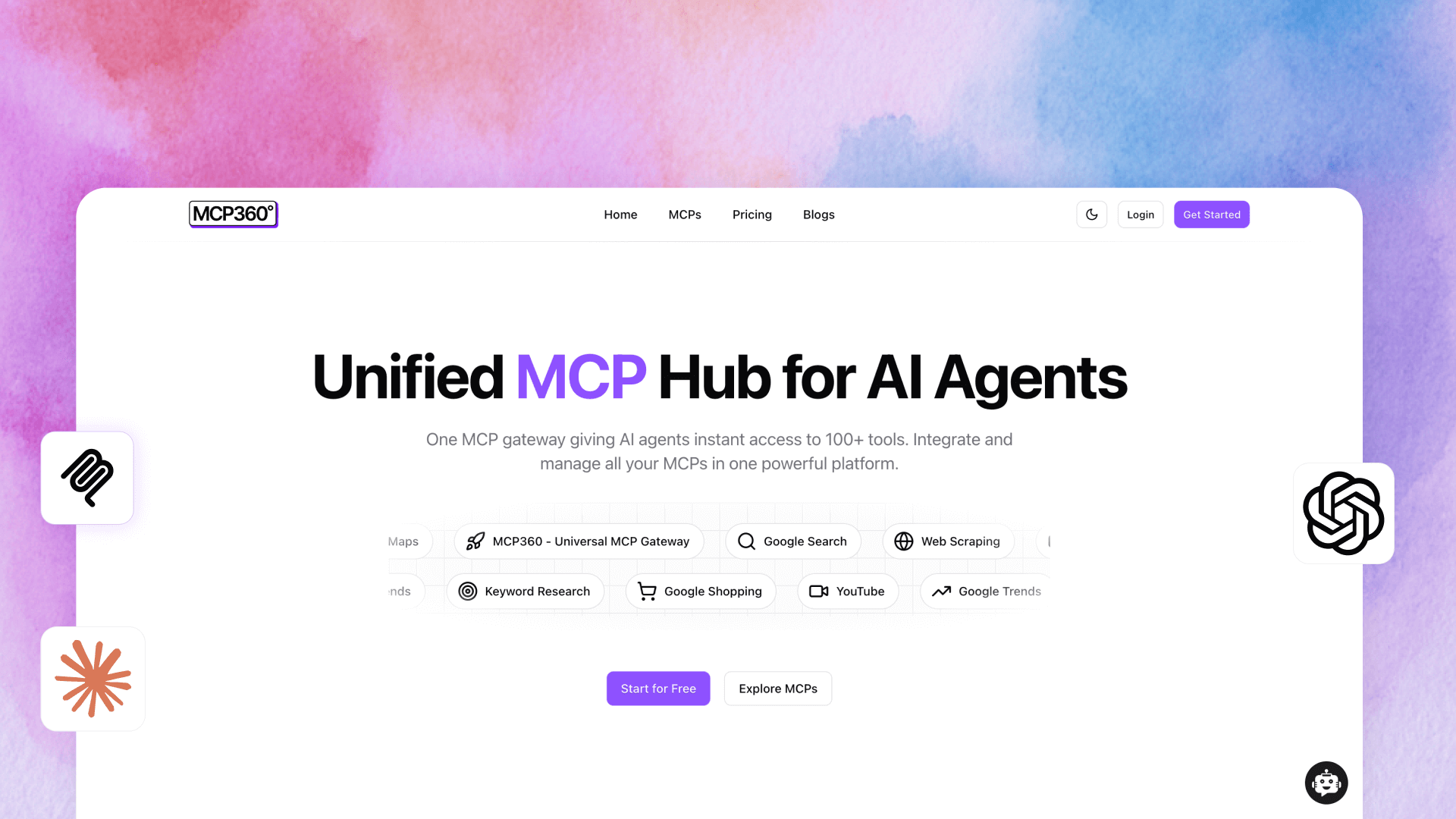
In the rapidly advancing landscape of AI agent development, equipping agents with comprehensive tool access presents significant integration complexity and maintenance burden. MCP360 emerges as an innovative solution addressing this fundamental challenge by functioning as a unified Model Context Protocol gateway—effectively serving as an “App Store for AI agents.” Developed by Delta4 and launched in October 2025, MCP360 fundamentally transforms tool integration by providing instant access to over 100 specialized tools through a single configuration, eliminating the traditional overhead of individual tool setup, separate authentication management, and ongoing maintenance coordination. This revolutionary platform leverages the Model Context Protocol standard to supercharge AI workflows, unlock new agent capabilities, and dramatically simplify the operational complexity associated with multi-tool AI systems.
Key Features
MCP360 delivers a comprehensive feature set specifically engineered to streamline AI agent tool access and eliminate integration friction:
- Unified Gateway to 100+ Specialized Tools: Gain instant access to an extensive, curated library of production-ready tools spanning SEO audit capabilities, SERP position tracking, advanced web scraping, comprehensive domain analysis, competitive market research, keyword discovery, e-commerce data extraction, and numerous other specialized functions, all accessible from a single centralized platform.
- Single Integration Point with Unified Authentication: Eliminate the complexity of managing multiple API keys, separate authentication systems, and diverse integration patterns by utilizing MCP360’s streamlined single integration point that handles authentication and access management for all tools transparently through one unified configuration.
- Broad Compatibility with Leading AI Development Platforms: Designed for maximum flexibility and interoperability, MCP360 seamlessly integrates with popular AI development environments including Claude Desktop, Cline code editor, N8N workflow automation, OpenAI Agent Builder, and any platform supporting the standardized Model Context Protocol, ensuring broad applicability across diverse development ecosystems.
- Automatic Tool Updates and Continuous Expansion: Benefit from MCP360’s continuously evolving platform that automatically updates existing tool capabilities, adds new tools to the library, and enhances functionality without requiring manual intervention, configuration updates, or code modifications, ensuring AI agents always maintain access to cutting-edge capabilities.
- Transparent Credit-Based Usage Management: Manage platform utilization effectively through a straightforward credit-based system featuring clear project and member limits per subscription tier, providing predictable costs, usage transparency, and flexible scaling options suited to various team sizes and operational requirements.
- Developer-Optimized Integration Experience: Implement comprehensive tool access through a single line of configuration code, dramatically reducing integration time from days or weeks of individual tool setup to mere minutes of streamlined deployment.
How It Works
MCP360 implements an elegantly simple integration architecture designed to maximize accessibility while minimizing implementation complexity:
Organizations begin by creating a single MCP360 account, eliminating the need for multiple service subscriptions, separate vendor relationships, and complex account management across disparate tool providers. Upon registration, MCP360 provides a concise, one-line configuration code that serves as the universal gateway to the entire tool ecosystem.
Developers then integrate this single configuration line into their compatible AI clients, agents, or development platforms—whether Claude Desktop for conversational AI development, Cline for AI-enhanced coding, N8N for workflow automation, OpenAI Agent Builder for custom agent creation, or any platform adhering to the Model Context Protocol standard. This integration process requires no complex SDK implementation, extensive documentation review, or specialized technical knowledge.
Once integrated, AI agents immediately gain transparent access to the complete suite of over 100 tools without individual tool configuration, separate authentication flows, or additional setup steps. Agents can dynamically invoke appropriate tools based on task requirements—performing complex data extraction, executing comprehensive market analysis, conducting technical SEO audits, tracking competitive positioning, or accessing specialized functions—all through the unified MCP360 gateway. The platform handles tool routing, authentication management, request formatting, and response processing transparently, allowing developers to focus on agent logic rather than integration plumbing.
Use Cases
MCP360’s comprehensive tool library and seamless integration architecture enable diverse practical applications across multiple business domains:
- Automated Competitive Intelligence and Price Monitoring: Deploy AI agents that continuously monitor competitor pricing strategies across major e-commerce platforms including Amazon, tracking price movements, identifying competitive positioning shifts, and generating real-time strategic insights for dynamic pricing optimization and market response strategies.
- Intelligent Travel Planning and Booking Automation: Leverage AI agents for sophisticated trip planning that incorporates real-time availability data, dynamic pricing information, personalized destination recommendations based on user preferences, automated booking coordination across multiple service providers, and adaptive itinerary adjustments responding to changing conditions or requirements.
- Comprehensive Website SEO Auditing and Optimization: Automate technical SEO analysis workflows through AI agents that systematically audit website structure, identify optimization opportunities, detect technical issues affecting search performance, analyze competitor strategies, and generate actionable recommendations for improving organic search visibility and rankings.
- Content Strategy Development and Trending Topic Discovery: Utilize AI agents to analyze keyword search volumes, monitor competitor content strategies, identify emerging trending topics, scrape relevant market data, and generate data-driven content ideas that resonate with target audiences while capitalizing on search demand patterns.
- Market Research and Competitive Analysis: Deploy agents that systematically gather market intelligence, analyze competitive positioning, track industry trends, extract product data from e-commerce platforms, and synthesize comprehensive market insights for strategic decision-making.
Advantages and Considerations
Advantages
- Dramatic Simplification of Multi-Tool Access: Eliminates the traditional complexity of managing dozens of separate tool subscriptions, individual API integrations, disparate authentication systems, and diverse billing relationships by consolidating all tool access through a single platform with unified authentication and billing.
- Substantial Productivity Enhancement Across AI Workflows: Significantly accelerates AI agent development and deployment by providing instant access to comprehensive tool capabilities without lengthy integration cycles, enabling teams to focus on building intelligent agent logic rather than managing infrastructure complexity.
- Continuously Expanding Capability Library: Benefits from MCP360’s commitment to platform evolution, with new tools and enhanced capabilities automatically becoming available to existing users without manual updates, additional integration work, or service interruptions, ensuring agents maintain access to cutting-edge functionality.
- Streamlined Developer Experience and Rapid Deployment: Offers remarkably simple integration requiring only a single configuration line, enabling developers to deploy fully equipped AI agents in minutes rather than the days or weeks typically required for individual tool integration and testing.
- Unified Billing and Cost Management: Simplifies financial management and budget forecasting by consolidating all tool usage into a single billing relationship with transparent credit-based pricing, eliminating the complexity of tracking multiple vendor invoices and reconciling disparate payment schedules.
Considerations
- Limited Public Validation and User Feedback: As a recently launched platform, MCP360 currently has limited publicly available user reviews, case studies, and community feedback, which may present challenges for organizations seeking extensive validation of platform capabilities and real-world performance before adoption.
- Model Context Protocol Compatibility Requirement: Platform effectiveness depends on compatibility with the Model Context Protocol standard, which may limit applicability for organizations using proprietary AI frameworks, custom agent architectures, or development environments that haven’t adopted MCP integration capabilities.
- Credit-Based Usage Economics for High-Volume Applications: Organizations with extremely high tool usage volumes or intensive data processing requirements should carefully evaluate credit consumption rates and tier limitations to ensure the credit-based pricing model aligns with budget expectations and operational needs.
- Dependency on Centralized Gateway Architecture: Utilizing MCP360 introduces dependency on the platform’s availability, reliability, and continued operation, requiring organizations to consider service level expectations, backup strategies, and vendor relationship management as part of adoption planning.
How Does It Compare?
The AI agent tooling landscape encompasses diverse solutions addressing different aspects of tool integration, agent development, and workflow automation. Understanding MCP360’s position requires examining appropriate comparison categories:
Model Context Protocol Ecosystem:
Anthropic MCP Servers: Official open-source MCP server implementations for popular services including Google Drive, Slack, GitHub, Postgres, and Puppeteer, providing reference implementations that developers can self-host and customize for specific organizational requirements.
Individual MCP Servers: Extensive ecosystem of specialized MCP servers developed by the community for specific tools and services, ranging from filesystem access and database connectivity to API integrations and custom business logic, each requiring separate setup and maintenance.
LangBase: Comprehensive platform for building AI applications with MCP support, memory management, and composable AI pipelines, focusing on developer experience and production deployment capabilities.
Google ADK MCP Tools: Google’s Agent Development Kit integration with Model Context Protocol, enabling Gemini-powered agents to leverage MCP servers within Google’s AI development ecosystem.
Semantic Kernel MCP Integration: Microsoft’s framework for integrating MCP tools with Semantic Kernel, enabling enterprise AI applications built on Azure infrastructure to access MCP capabilities.
AI Workflow and Agent Development Platforms:
Dify: Open-source LLM application development platform focusing on visual workflow design, prompt engineering, and application deployment, offering broader application development capabilities beyond pure tool integration.
Langflow: Visual programming environment for building LangChain-based AI applications through drag-and-drop interfaces, emphasizing accessible agent creation for users without extensive coding expertise.
n8n, Make.com, Zapier: Workflow automation platforms with AI integration capabilities, focusing on connecting various services and automating business processes rather than specifically optimizing for AI agent tool access.
LLM Development Frameworks:
LangChain: Comprehensive open-source framework for developing LLM-powered applications, providing extensive abstractions, integrations, and utilities for building sophisticated AI systems with significant development flexibility but requiring substantial coding expertise.
LlamaIndex: Data framework for LLM applications specializing in connecting custom data sources to language models through efficient indexing and retrieval mechanisms, optimized for RAG applications.
Haystack: Open-source NLP framework for building production-ready applications with language models, search, and question answering capabilities.
API Integration and Tool Platforms:
Activepieces: Open-source automation platform supporting AI integrations with emphasis on privacy and self-hosting capabilities.
Browserbase: Headless browser infrastructure for AI agents requiring web interaction and automation capabilities.
Firecrawl: Specialized web scraping API designed for AI and LLM use cases with intelligent content extraction.
E2B: Secure sandbox environment for AI agents to execute code and interact with computing resources safely.
Search and Data APIs:
Tavily AI, SerpAPI, Serper: Specialized search APIs optimized for AI agent use cases, providing structured search results and web data extraction capabilities.
MCP360 differentiates itself from all these categories through its unique value proposition as a unified MCP tool aggregator and gateway. Unlike individual MCP servers requiring separate setup, MCP360 provides centralized access to 100+ tools through single integration. Unlike comprehensive development frameworks like LangChain that require significant coding, MCP360 offers plug-and-play tool access. Unlike workflow platforms focusing on business process automation, MCP360 specifically optimizes for AI agent tool integration through MCP standard.
The platform’s core strength lies in consolidating the fragmented landscape of individual tool APIs, separate MCP servers, and disparate integration requirements into a unified, instantly accessible gateway that dramatically reduces the time, complexity, and ongoing maintenance burden associated with equipping AI agents with comprehensive capabilities. For organizations seeking rapid AI agent deployment with broad tool access through MCP standard, MCP360 offers compelling value by eliminating integration overhead that would otherwise require extensive development resources.
Pricing and Accessibility
MCP360 operates on a transparent, tier-based pricing model designed to accommodate varying organizational sizes and usage requirements:
Credit-Based Usage System: Primary pricing structure utilizes credits that are consumed based on tool usage, API calls, and data processing volumes, providing predictable cost management and flexible scaling aligned with actual utilization patterns.
Tiered Subscription Plans: Multiple subscription tiers offering different credit allocations, project limits, and team member allowances, enabling organizations to select appropriate capacity levels matching their operational scale and budget considerations.
Single Unified Billing: Consolidates all tool access, API usage, and platform features into one comprehensive billing relationship, eliminating the complexity of managing multiple vendor payments and reconciling disparate invoices.
Starter Plans with Usage Constraints: Entry-level plans provide access to core platform capabilities with credit and usage limitations suitable for evaluation, small-scale projects, or development environments requiring moderate tool interaction volumes.
Enterprise Scaling Options: Higher-tier plans accommodate extensive tool usage, larger team sizes, multiple concurrent projects, and greater credit allowances for organizations with substantial AI agent deployments and intensive tool utilization requirements.
Specific pricing details, credit rates, tier features, and subscription options are available through MCP360’s official website, with transparent cost calculators enabling organizations to project expenses based on anticipated usage patterns.
Final Assessment
MCP360 represents a significant innovation in AI agent tool integration, offering a compelling solution for organizations seeking to rapidly deploy capable AI agents without the traditional burden of complex tool setup, authentication management, and ongoing maintenance coordination. The platform’s unified gateway approach, leveraging the Model Context Protocol standard, addresses a genuine pain point in AI development by consolidating access to 100+ specialized tools through remarkably simple integration.
The platform’s primary strengths lie in its dramatic simplification of tool access, elimination of integration overhead, automatic capability expansion, and developer-optimized experience requiring only single-line configuration. For teams prioritizing rapid agent deployment, minimal integration complexity, and access to diverse tool capabilities without individual setup requirements, MCP360 delivers substantial value by transforming weeks of integration work into minutes of configuration.
As a newly launched platform, MCP360 currently presents limited public validation, making it challenging for prospective users to assess real-world performance, reliability, and customer satisfaction through extensive community feedback. Organizations considering adoption should factor this limited track record into risk assessment while weighing the compelling value proposition of unified tool access.
The platform’s dependency on Model Context Protocol compatibility ensures alignment with emerging AI standards while potentially limiting applicability for organizations using non-MCP development environments. The credit-based pricing model provides usage transparency but requires careful capacity planning for high-volume applications to ensure cost-effectiveness.
As the Model Context Protocol ecosystem continues maturing and AI agent development becomes increasingly mainstream, MCP360’s unified gateway approach positions it advantageously for organizations seeking to eliminate integration complexity while maintaining access to comprehensive tool capabilities. For developers and teams committed to MCP-based agent development, MCP360 offers a transformative simplification of tool integration that could become an essential component of modern AI development workflows.