Table of Contents
Overview
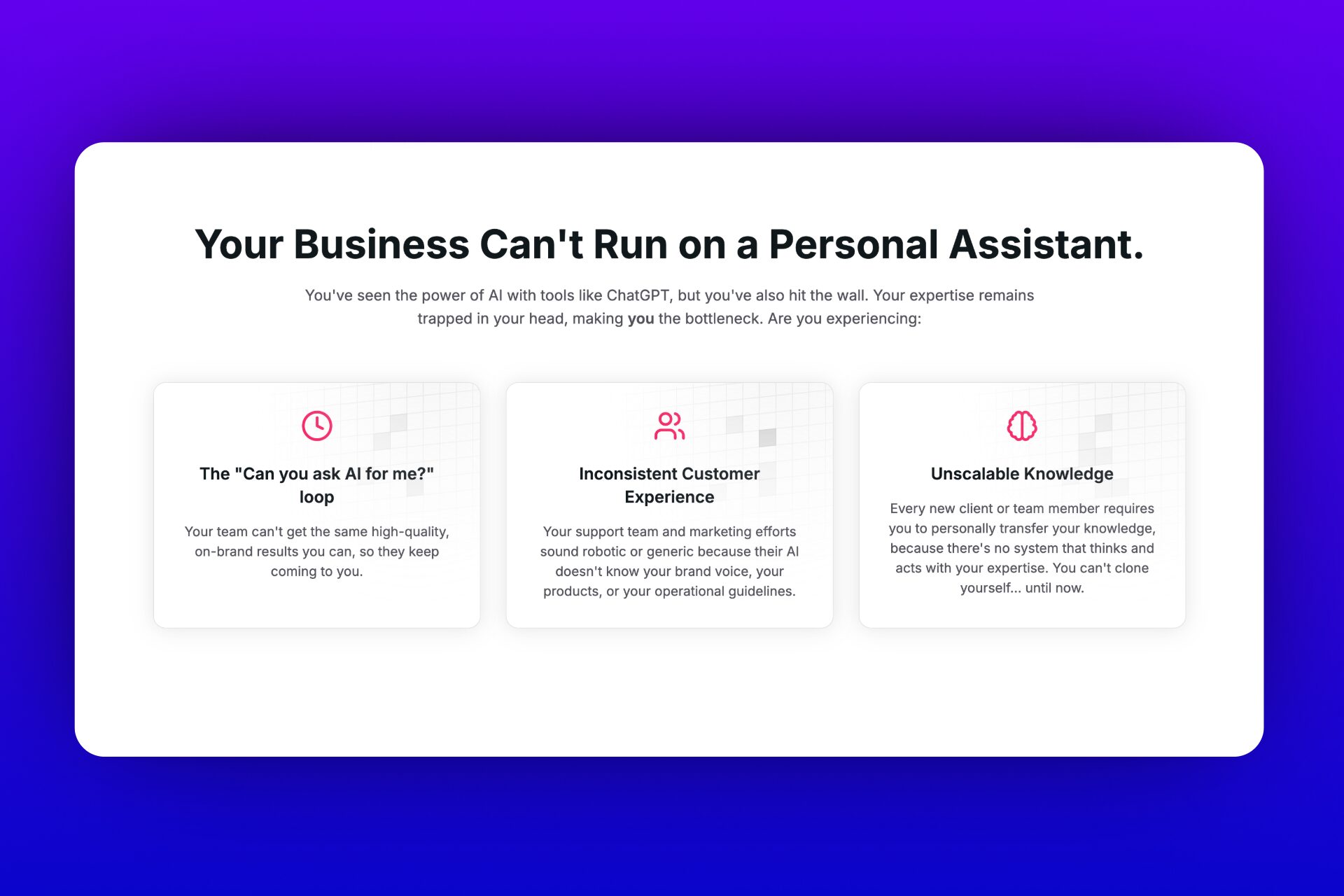
Expertise scaling represents a persistent business challenge: coaches deliver value through personalized guidance but reach limited clients; consultants complete projects sequentially constrained by hourly work capacity; agencies systematize processes through people rather than automatable systems; organizations rely on human expertise rather than codified decision logic. Traditional approaches—hiring staff, creating documentation, training teams—produce linear scaling requiring proportional resource investment.
MindPal addresses this through proprietary knowledge productization: transforming individual expertise, decision frameworks, and methodologies into autonomous AI agents and multi-agent workflows operating continuously across organizational and client touchpoints. Rather than packaging expertise as service delivery (billable hours, scheduled consultations) or generic documentation (PDFs, training materials), MindPal enables encoding expertise as executable AI agents that replicate decision-making patterns, incorporate domain-specific knowledge, and operate at organizational scale without direct expert involvement. The platform targets coaches, consultants, agencies, and expert-based businesses seeking to transform expertise from time-constrained service delivery into scalable, always-on AI assets.
Key Features
MindPal delivers comprehensive AI agent and workflow capabilities specifically designed for expertise productization and autonomous knowledge deployment:
- Proprietary Knowledge Encoding: Transform domain-specific frameworks, decision methodologies, and intellectual property into AI agent training data. Rather than generic AI models trained on broad internet data, MindPal agents learn from your specific processes—coaching methodologies, consulting frameworks, operational playbooks, quality standards—ensuring AI outputs reflect your unique expertise and competitive differentiation rather than generic recommendations.
- Multi-Agent Workflow Orchestration (AI Assembly): Design complex workflows where multiple specialized AI agents collaborate sequentially. While single agents excel at focused tasks, multi-agent workflows enable sophisticated problem-solving where one agent’s output feeds subsequent agents—research agent → analysis agent → recommendation agent → implementation planning agent. This sequential specialization produces higher-quality outputs than single-agent processing while maintaining logical workflow structure.
- Advanced Model Diversity: Access multiple large language models (GPT-4, Claude 3.7 Sonnet, DeepSeek R1, Gemini 2.5 Pro) rather than single-vendor lock-in. Select optimal models for specific agent roles—cost-efficient models for routine processing, advanced models for complex reasoning—and switch models without workflow restructuring.
- Comprehensive Knowledge Management System: Centralize all organizational knowledge—documents, frameworks, training materials, process documentation, case studies, client examples—in unified knowledge base with dynamic contextual search. Upload PDFs, Word documents, PowerPoint presentations, videos, audio files, websites, and Excel data; MindPal ingests diverse formats extracting relevant information for agent training.
- Intelligent Data Integration: Connect directly to Google Drive, Notion, Dropbox for automatic knowledge base synchronization. As organizational documentation updates, MindPal agents automatically access current information without manual knowledge base refreshes—ensuring agents always operate with latest organizational context.
- Brand Voice Consistency: Train agents to communicate using your specific tone, terminology, and communication style. Agents output content sounding authentically like your organization rather than generic AI responses—critical for maintaining client trust and brand consistency across thousands of interactions.
- Flexible Deployment Architecture: Deploy agents across diverse touchpoints including embedded website chatbots, API integrations for custom applications, scheduled automated workflows, internal team assistants, or client-facing interfaces. Single agent/workflow runs simultaneously across multiple channels without replication—one source of truth deployed everywhere.
- Supervision Mode for Quality Control: Run workflows with human approval gates where each agent step produces output reviewable before proceeding to next agent. Enable agents to operate autonomously during off-hours or high-volume processing while maintaining human oversight for sensitive decisions—balancing automation efficiency with quality assurance.
- Canvas Interface for Complex Interaction: MindPal’s Canvas infinite workspace enables simultaneous multi-agent chat, branching conversations maintaining separate contexts, visualization of complex workflows, and chaining outputs sequentially—matching how minds naturally work rather than forcing linear sequential thinking.
- Production-Grade Monitoring and Analytics: Track agent performance, output quality, usage patterns, cost per interaction, and user satisfaction. Granular analytics enable iterative improvement of prompts, training data, and workflow logic based on actual performance data rather than assumptions.
- Tiered Pricing with Transparent Scaling: Pro plan (\$39/month) serves solopreneurs and small practitioners; Advanced plan (\$149/month, chosen by 70% of customers) supports innovative teams with collaboration features; Ultra plan (\$374/month) enables growing businesses with unlimited scaling. Pricing includes AI credits (6,000-100,000 monthly), knowledge storage (5GB-100GB), editor seats, and user seat availability across tiers.
How It Works
MindPal transforms expertise from service-bound to scalable asset through systematic knowledge encoding, workflow design, and autonomous deployment.
The journey begins with knowledge documentation. Organizations compile expertise assets: coaching frameworks document the progression, coaching methodologies, underlying principles, and decision criteria coaches apply; consulting playbooks detail client engagement processes, analysis approaches, and recommendation frameworks; operational procedures codify decision logic, approval processes, and quality standards. This documentation uploads to MindPal’s knowledge management system as PDFs, Word documents, spreadsheets, or direct integration with Notion/Google Drive. MindPal ingests diverse formats extracting semantic meaning and contextual relationships.
With knowledge documented, expertise encoding proceeds. Create specialized AI agents representing different roles—one agent specializing in client intake and needs assessment, another in solution recommendation, another in implementation planning. Each agent training specifies its role, decision framework, knowledge sources, acceptable response formats, and brand voice characteristics. Unlike generic chatbots, these agents understand your specific frameworks and decision criteria because training explicitly encodes your methodologies.
Once agents are trained, workflow design connects them. Define sequential pipelines where outputs from one agent become inputs for subsequent agents. An intake agent collects client information and requirements; passes this context to analysis agent analyzing client situation against your frameworks; passes analysis to recommendation agent generating personalized suggestions; passes recommendations to planning agent developing implementation roadmap. Each agent specializes on one aspect while maintaining access to accumulated context from previous steps.
Deployment activates these workflows across multiple channels simultaneously. Embed on websites as client-facing chatbots answering questions and guiding through service delivery; integrate into internal systems as team assistants automating routine tasks; schedule automated batch processing of queued requests; connect via API to custom applications; run in supervision mode where humans approve each step before proceeding to next agent.
Throughout operation, MindPal logs all interactions creating learnable patterns. Review agent outputs identifying improvements to training data, prompt refinement, or workflow structure. Continuous learning loops enable agents to adapt based on accumulated interactions and feedback—gradually improving accuracy and relevance as system matures.
Use Cases
MindPal’s expertise productization capabilities address diverse scenarios where knowledge scalability creates value:
- Coaching and Consulting at Scale: Business coaches, executive coaches, consultants encode their methodologies into AI agents available 24/7. Clients access foundational coaching (core concepts, frameworks, common questions) through AI agents; coaches focus exclusively on high-touch personalized work, complex situations, and premium engagements. This transforms coaching from linear hourly model to hybrid where AI handles volume and repetition while experts focus on depth.
- Customer Success and Support Automation: Client success teams encode onboarding processes, best practices, troubleshooting frameworks, and domain knowledge into AI agents providing proactive support. Customers receive instant help regardless of time, availability, or team capacity—dramatically improving satisfaction metrics and reducing support costs.
- Sales Process Automation: Encode sales methodologies, qualification frameworks, proposal processes, and handling of objections into multi-agent workflows. Agents qualify leads based on company criteria, recommend solutions matching prospect needs based on your services, draft customized proposals incorporating prospect specifics, and schedule follow-up calls—accelerating sales cycles and freeing sales teams for relationship-building.
- Agency Service Delivery Productization: Agencies encode their service delivery playbooks enabling delivery at scale without proportional staffing increases. Design agency serves clients’ visual design needs through AI agents trained on agency aesthetics, client brand guidelines, and design frameworks; marketing agency provides content strategy consultation through agents trained on marketing methodologies and client contexts—transforming high-touch services into scalable offerings.
- Employee Onboarding Acceleration: HR teams encode company policies, procedures, culture, technical systems documentation, and organizational knowledge into AI agents guiding new employees. Onboarding AI answers policy questions, explains procedures, provides technical system training, and suggests best practices—reducing HR time spent on repetitive onboarding while improving new hire experience and reducing time-to-productivity.
- Proprietary AI Product Development: Experts develop entirely new AI products/services leveraging domain expertise as competitive moat. Domain-specific AI agents provide value unavailable from generic tools—legal expert creates AI legal research assistant trained on case law and legal methodologies; financial advisor creates AI wealth planning assistant trained on planning frameworks and market analysis approaches—creating new revenue streams.
Advantages
- Scalable Expertise Deployment: Transform individual genius into asset serving thousands without requiring direct expert involvement—coaches provide guidance to unlimited clients through AI; consultants solve unlimited client situations through agent replication; agencies deliver unlimited engagements through process automation.
- Intellectual Property Productization: Move expertise from service delivery (constrained by expert time availability) to product model (unlimited concurrent users). Expertise becomes income-generating asset rather than billable labor—creating new revenue streams and business model evolution.
- Team and Agency Focus: Platform specifically designed for teams and agencies standardizing collective expertise, ensuring consistency, and distributing knowledge across organizational scale. Newly hired team members access established playbooks; agencies maintain service quality across multiple practitioners; organizations distribute expertise regardless of which employee is available.
- Multi-Agent Workflow Capability: Advanced multi-step orchestration enables sophisticated automated processes impossible with single-agent systems. Sequential specialization produces higher-quality outputs than general-purpose agents while maintaining efficiency.
- Knowledge Base Centralization: Consolidate documentation, frameworks, and expertise into searchable system eliminating scattered expertise across multiple people, documents, and systems. New team members access organizational knowledge immediately; agents reference consistent information sources; expertise becomes organizational asset rather than individual possession.
- Continuous Learning and Iteration: Agents improve over time based on accumulated interactions and feedback. Monitor performance, refine prompts, enhance training data, and optimize workflows iteratively—enabling system maturation and capability expansion without redesign.
- No-Code Implementation: Visual workflow builder enables expertise encoding without technical backgrounds or programming expertise. Domain experts directly encode knowledge and workflows without requiring developer intermediaries.
Considerations
- Requires Clarity on Frameworks and Processes: Effective expertise encoding demands well-articulated frameworks and decision processes. Coaches must clearly define coaching methodology; consultants must document client engagement frameworks; agencies must systematize service delivery approaches. Tacit knowledge—intuition, experience-based judgment—requires explicit articulation for AI agent training.
- Initial Setup and Training Investment: Encoding expertise into agents requires upfront effort capturing frameworks, compiling knowledge, training agents, and iterating on performance. This investment precedes revenue generation and requires sustained effort improving agent quality and coverage.
- Ongoing Refinement Requirements: Agents trained once don’t maintain themselves. Continuous monitoring, prompt refinement, knowledge base updates, and workflow optimization become ongoing operational tasks. Organizations must commit resources to agent maintenance and improvement rather than treating automation as “set and forget.”
- Accuracy and Hallucination Concerns: AI agents may occasionally generate inaccurate information or contradict documented frameworks. Supervision mode and human approval gates mitigate risks but increase processing time. Organizations handling sensitive decisions (medical, legal, financial) should implement robust quality controls rather than relying exclusively on autonomous agent operation.
- Team Organization Requirements: Unlike solo practitioner businesses requiring single agent, team and agency use cases require clear role definition, responsibility allocation, and workflow management. Organizations lacking clear process documentation or established methodologies face steeper learning curves than those with documented playbooks.
- Model and Service Provider Dependency: MindPal’s capabilities depend on underlying LLM availability and quality. Changes to OpenAI, Anthropic, or Google models affect agent performance. Organizations with specific compliance or data residency requirements must verify platform meets requirements.
How It Compare
MindPal operates in the AI agent and workflow automation landscape positioned distinctly from both personal AI assistants and general workflow tools:
Personal AI Assistant Platforms (Motion, eesel AI, Sintra AI): These platforms assist individuals with productivity tasks—Motion optimizes scheduling combining calendars and task lists; eesel AI automates work support through knowledge base-powered assistance; Sintra AI provides specialized “AI Helpers” for different roles. These assistants augment individual productivity and decision-making. MindPal differs fundamentally: rather than assisting individual users, MindPal enables organizations to deploy expertise-driven agents serving unlimited end users. Personal assistants ask “how can I help this person work better?”; MindPal asks “how can this organization’s expertise serve unlimited clients/teams?”
General Workflow Automation Platforms (Zapier, n8n, Make): These excel at connecting disparate business tools (CRM, email, spreadsheets, databases) and automating task sequences between systems. Zapier offers 8,000+ app integrations; n8n provides 422+ integrations with workflow flexibility. Both handle business process automation at scale. MindPal differentiates through expertise-specific focus: rather than connecting systems and tools, MindPal encodes organizational knowledge into autonomous agents. The comparison: Zapier/n8n automate what tools do; MindPal automates what experts know.
AI Agent Building Platforms (VectorShift, LangFlow, no-code AI tools): VectorShift provides end-to-end AI automation platform with no-code interface, code SDK, and template library for applications like “research report generators” and “resume screeners.” LangFlow offers LangChain visual editor. These enable developers to build AI applications. MindPal targets different audience: business experts (coaches, consultants, agency leaders) rather than developers. VectorShift requires technical understanding of application architecture; MindPal enables business experts to encode frameworks without technical background.
Chatbot Builders (CustomGPT, Chatbase): These specialized tools focus on creating AI chatbots for websites and customer service. CustomGPT trains GPT models on uploaded documents creating domain-specific chatbots; Chatbase delivers similar functionality. Both create single-agent chatbots trained on documents. MindPal encompasses this capability (single-agent chatbots) but differentiates through multi-agent workflows enabling sophisticated orchestration impossible in basic chatbot builders.
Enterprise Knowledge Management + AI (integrated platforms combining knowledge bases with AI): Enterprise platforms increasingly combine document management with AI capabilities. MindPal specializes this combination specifically for expertise productization—knowledge management infrastructure designed for expert IP encoding and agent training rather than general organizational knowledge management.
MindPal’s competitive differentiation centers on expertise productization through knowledge encoding + multi-agent orchestration: enabling experts to transform methodologies and frameworks into scalable AI assets accessible 24/7 to unlimited users through coordinated agent workflows. For coaches, consultants, agencies, and expert-based businesses seeking to evolve beyond time-constrained service delivery toward scalable AI-powered expertise products—MindPal delivers specialized infrastructure bridging domain knowledge and operational automation. For developers building general AI applications (VectorShift), individuals improving personal productivity (Motion), or organizations automating generic workflows (Zapier)—general-purpose platforms remain more appropriate.
Final Thoughts
Expertise remains highly constrained asset: coaches reach limited clients; consultants complete projects sequentially; agencies scale linearly with headcount; organizations concentrate knowledge in individuals rather than systems. This scarcity drives billable-hour pricing, limiting accessibility while preventing scaling—customers wait months for availability; expertise holders work unsustainable hours; growth requires hiring rather than systematization.
MindPal represents paradigm shift: transforming expertise from scarcity constraint to scalable asset. By enabling codification of frameworks, methodologies, and decision logic into autonomous agents operating continuously across channels, MindPal enables experts to serve unlimited clients simultaneously while maintaining quality and consistency through systematic knowledge encoding.
For coaches ready to evolve coaching from hourly service to scalable hybrid model; consultants seeking to productize methodologies; agencies aiming to scale delivery without proportional headcount growth; organizations building proprietary AI services leveraging domain expertise—MindPal provides infrastructure for this transformation. The platform’s visual workflow builder, multi-agent orchestration, comprehensive knowledge management, and production-ready deployment lower technical barriers enabling business experts directly to encode and deploy their expertise.
Success requires genuine expertise clarity (frameworks articulated, methodologies documented, processes systematized) and ongoing optimization commitment (monitoring performance, refining agents, improving workflows). Organizations treating expertise encoding as one-time project rather than continuous process underrealize potential. For those committed to systematic knowledge productization, MindPal delivers tangible path transforming expertise from constrained individual asset into scalable organizational advantage.