
Table of Contents
- Overview
- Key Features
- How It Works
- Use Cases
- Pros & Cons
- How Does It Compare?
- Intercom Fin (Conversational AI with Task Execution)
- Zendesk AI Agents (Including Ultimate Platform)
- Ada (AI-Native Reasoning Engine)
- Forethought (Multi-Agent System for Support Operations)
- Ultimate AI (Conversational Automation and CRM Integration)
- Freshdesk AI (Freddy AI—Enterprise Ticketing with AI Layer)
- Specialized Competitors (Tidio, Kustomer, Drift, Capacity)
- MindX Service AI’s Distinct Positioning
- Final Thoughts
Overview
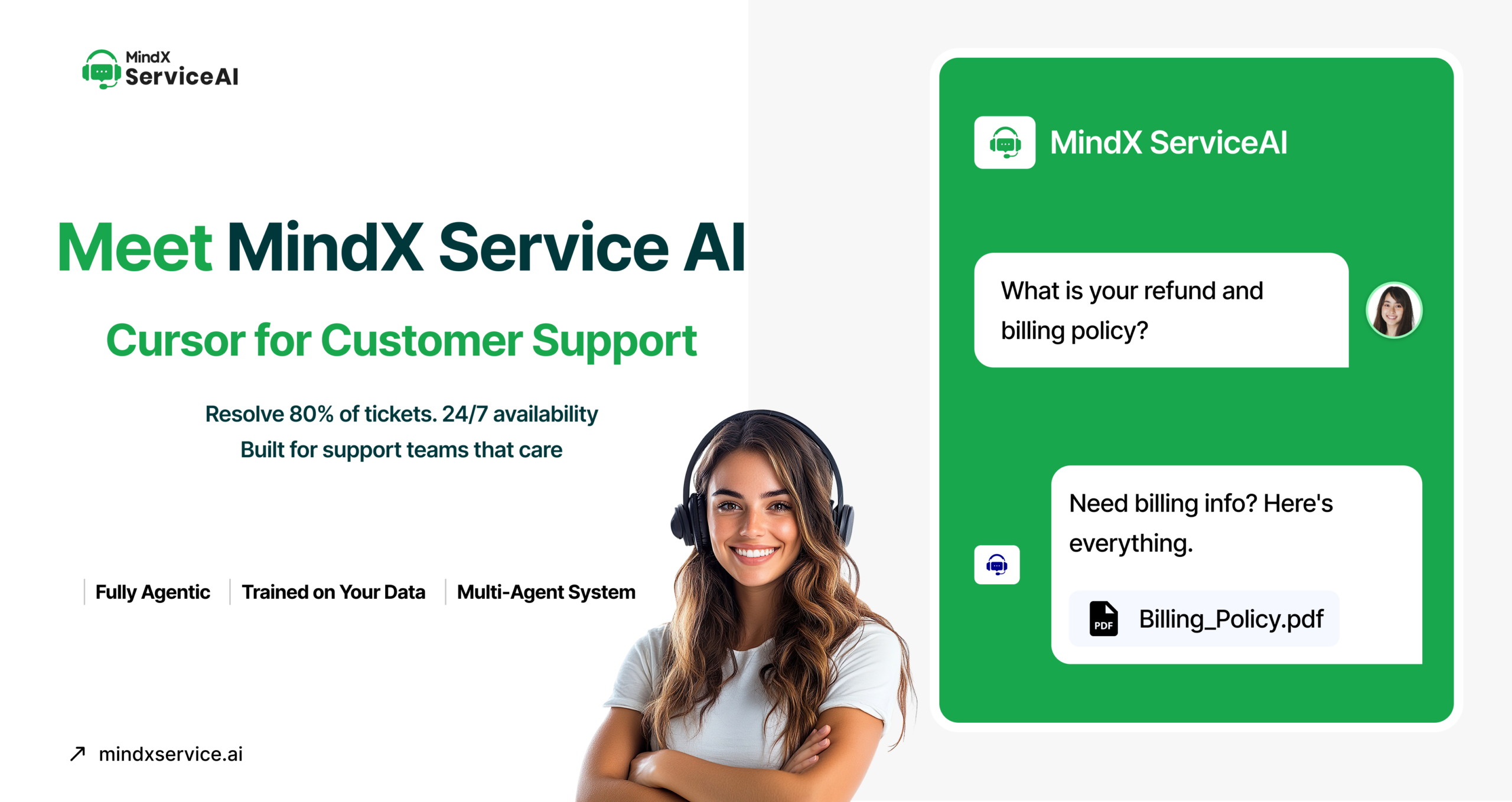
Customer support at scale represents a fundamental operational challenge for growing businesses—balancing customer expectations for instant resolution against the realities of hiring, training, and managing distributed support teams. MindX Service AI addresses this challenge through a fully autonomous AI agent designed to handle customer inquiries across chat and email channels with minimal human oversight. Powered by Nexa AI infrastructure, MindX combines three integrated capabilities—AutoResolve (autonomous ticket resolution), SmartRouting (intelligent agent assignment), and AgentAssist (human productivity enhancement)—within a unified platform targeting e-commerce, SaaS, IT services, and hospitality industries. The platform claims to achieve 80%+ auto-resolution rates, boost agent productivity by 20%, and deliver 90%+ first-contact resolution accuracy while maintaining 24/7 availability without additional hiring.
Key Features
MindX Service AI integrates autonomous resolution, intelligent routing, and agent assistance into a unified customer support platform.
- Fully Agentic AI for Autonomous Resolution: Intelligent system autonomously handles customer queries across chat and email channels, functioning as a true digital agent rather than a suggestion engine. Processes incoming tickets through natural language understanding to determine appropriate resolution without human intervention.
- AutoResolve with High Accuracy: Designed to efficiently address common inquiries and resolve approximately 80% of incoming tickets autonomously, with claimed 90%+ accuracy on first-contact resolution. Handles FAQs, order status inquiries, billing questions, password resets, and other routine requests without escalation.
SmartRouting for Complex Cases: Intelligently identifies tickets requiring human expertise and routes them to the most appropriate agent based on ticket content, agent specialization, workload, and historical performance. Includes context enrichment ensuring routed tickets include relevant customer history and suggested talking points.
AgentAssist for Productivity Enhancement: Real-time assistance for human agents handling complex or escalated tickets. Provides suggested responses, relevant knowledge base articles, customer context, and case history—enabling agents to respond faster and more accurately while handling more tickets per shift.
InsightIQ Analytics for Continuous Improvement: Built-in analytics dashboard aggregating support performance metrics, identifying automation opportunities, highlighting knowledge gaps, and tracking trends. Enables data-driven optimization of workflows, knowledge base content, and automation rules.
24/7 Coverage and Continuous Operation: Operates continuously without downtime, ensuring consistent support availability across time zones and eliminating customer frustration from business-hours-only support. Reduces need for expanding support teams across multiple geographic regions.
Multi-Channel Integration: Seamlessly integrates with existing support infrastructure including chat widgets, email inboxes, helpdesk tools (Zendesk, Freshdesk, Intercom, etc.), and CRM systems without requiring wholesale platform replacement.
Three-Agent System (Resolve, Assist, Proactive): Architecture separates autonomous resolution agents (handling routine tickets), assist agents (supporting human agents), and proactive agents (engaging customers before they submit tickets or reaching out based on patterns).
How It Works
MindX Service AI operates through a streamlined three-stage workflow beginning with ticket ingestion and proceeding through intelligent resolution or routing. Upon integration with existing support channels (chat widgets, email inboxes, helpdesk systems), all incoming customer queries are initially evaluated by MindX’s language understanding models. The system analyzes ticket content to determine intent, required resolution type, and complexity level.
For routine inquiries—order status, common FAQs, password resets, billing questions—the AutoResolve agent generates and delivers a response directly to the customer through the original channel. Resolution metrics are captured in real-time, enabling continuous model refinement through reinforcement learning from customer satisfaction signals and agent-validated resolutions.
For complex, nuanced, or sensitive issues requiring human judgment, MindX intelligently identifies the most appropriate human agent based on ticket routing rules, agent expertise, specialization, current workload, and historical resolution performance. Rather than simply passing the ticket, SmartRouting enriches it with customer context, recommended resolution approaches, relevant knowledge base articles, and relevant conversation history. When the human agent responds, AgentAssist provides real-time suggested responses powered by the knowledge base and historical similar resolutions.
Simultaneously, InsightIQ continuously analyzes all support interactions—successful resolutions, escalations, common issues, agent performance—transforming this data into actionable analytics. Support leaders use these insights to identify automation opportunities, discover knowledge gaps requiring new documentation, optimize routing rules, and track performance trends.
Use Cases
MindX Service AI addresses diverse support challenges where scale, efficiency, and 24/7 availability create competitive advantage.
- High-Volume Ticket Deflection and Cost Reduction: Ideal for businesses handling hundreds or thousands of daily support inquiries where manual handling creates prohibitive costs and unacceptable response times. AutoResolve handles bulk volume of routine requests, deflecting these from human agents entirely and enabling significant cost reduction per ticket.
24/7 Global Support Without Geographic Expansion: Enable continuous, always-on customer support across time zones without hiring distributed global support teams. Customers receive instant responses to routine questions at any time, reducing frustration and abandonment while improving perceived service quality.
Supporting Scaling Teams During Growth: As companies grow, support volume typically outpaces hiring velocity. MindX enables support teams to handle 3-5x volume growth without proportional team expansion, creating competitive advantage during high-growth periods where hiring lags demand.
Complex SaaS and E-commerce Operations: Particularly effective for e-commerce (order tracking, returns, payment issues), SaaS (account management, feature requests, technical issues), IT services (ticket routing, knowledge base delivery), and hospitality (booking confirmations, cancellations, special requests).
Productivity Boost for Existing Agent Teams: AgentAssist provides real-time support to existing human agents, enabling them to handle more complex tickets, reduce handle time, improve first-contact resolution rates, and shift toward higher-value customer interactions.
Meeting SLAs While Controlling Costs: Accelerates response times and first-contact resolution rates, enabling teams to meet increasingly stringent service level agreements without proportional budget increases.
Knowledge Extraction and Documentation: InsightIQ analytics identify frequently asked questions and recurring issues requiring documentation, enabling proactive knowledge base expansion that further improves future automation rates.
Pros & Cons
Advantages
- High claimed automation rates: 80%+ auto-resolution and 90%+ first-contact resolution accuracy represent substantial cost reduction and improvement over manual-only processes.
Unified platform eliminates tool fragmentation: Combines autonomous resolution, routing, agent assistance, and analytics in single interface rather than requiring coordination across separate chatbot, routing, and CRM systems.
Immediate productivity boost for existing teams: AgentAssist provides measurable improvements to agent efficiency without requiring team restructuring or extensive retraining.
24/7 availability enables competitive advantage: Particularly valuable for companies serving global customer bases, providing always-on support independent of business hours or geographic location.
Continuous improvement through analytics: Built-in analytics drive ongoing optimization rather than static, set-and-forget automation rules.
Multiple deployment options: Supports both integrated deployment within existing helpdesk systems and standalone operation, accommodating diverse tech stack requirements.
Transparent, claims-based positioning: Specific, quantifiable claims (80% resolution, 20% productivity boost, 90% accuracy) enable evaluation against actual results.
Disadvantages
Integration complexity and knowledge base dependency: Performance heavily dependent on quality of integrations with existing systems, comprehensiveness of knowledge base, and accuracy of historical ticket resolution data used for training.
Requires careful configuration and guardrail setting: Effective deployment necessitates thoughtful setup of resolution rules, escalation thresholds, and edge case handling to avoid inappropriate autonomous resolutions or customer frustration.
Customer preferences for human interaction: Certain customer segments, particularly for sensitive issues (account disputes, cancellations, complaints), may experience reduced satisfaction with initial AI resolution, preferring human contact regardless of technical capability.
Claims require independent verification: Stated 80% auto-resolution and 90% accuracy are company claims not independently verified by third parties; actual results may vary significantly by industry, use case, and ticket complexity distribution.
Early-stage company with limited track record: Founded 2024, limited published case studies or third-party reviews available compared to established competitors.
Regulatory and compliance considerations: Specific data residency policies, regulatory compliance (SOC 2, GDPR, industry-specific requirements), and liability allocation for autonomous decisions require thorough verification for regulated industries.
Potential for automation bias: Autonomous systems may develop patterns resolving certain customer segments or issue types more effectively than others, creating equity concerns if not actively monitored.
How Does It Compare?
MindX Service AI competes in the rapidly expanding AI customer support market against established enterprise platforms, emerging specialized solutions, and integrated CX suites. Understanding competitive positioning requires recognizing different strategic approaches and target markets:
Intercom Fin (Conversational AI with Task Execution)
Intercom’s Fin agent, powered by GPT technology, specializes in delivering human-quality conversational responses with claimed auto-resolution rates up to 86% of customer queries. Fin Copilot provides real-time suggestions to human agents. Fin Tasks enable bot execution of specific actions (order refunds, subscription changes) without human intervention. Intercom’s platform strengths include extensive integrations (1,800+), mature marketplace, and deep CRM/analytics capabilities.
Key differences from MindX: Intercom emphasizes conversational quality and naturalness; MindX emphasizes autonomous resolution rates. Intercom offers broader platform with sales, marketing, and support capabilities; MindX focuses exclusively on support. Fin is add-on to existing Intercom ecosystem; MindX operates standalone or integrated. Intercom pricing typically higher ($0.99+ per resolution). Best suited for: Existing Intercom users wanting to add AI; mid-market SaaS prioritizing seamless platform integration.
Zendesk AI Agents (Including Ultimate Platform)
Zendesk released new AI agents in 2025, including Ultimate, positioning autonomous resolution across 109 languages with claimed ability to automate approximately 60% of customer service. Answer Bot handles routine inquiries; Zendesk Copilot assists human agents. Zendesk emphasizes extensive integrations (1,800+), workflow automation, and large enterprise ecosystem.
Key differences from MindX: Zendesk claims 60% automation vs MindX’s 80%; Zendesk provides enterprise-scale infrastructure and compliance; MindX positions at mid-market segment. Zendesk offers comprehensive ticketing and reporting; MindX specializes in resolution and agent assist. Best suited for: Enterprise organizations with existing Zendesk infrastructure; teams requiring extensive customization and compliance capabilities.
Ada (AI-Native Reasoning Engine)
Ada positions as AI-native platform with claimed ability to resolve 70-83% of inquiries instantly using the Ada Reasoning Engine. Emphasizes reasoning from business data rather than scripted responses. Supports 50+ languages, multi-channel deployment, and integrations with Microsoft Azure and other enterprise platforms. Strong focus on safety, security, and compliance.
Key differences from MindX: Ada emphasizes reasoning from business data; MindX emphasizes autonomous resolution rates from existing knowledge bases. Ada positions as premium enterprise solution; MindX targets mid-market. Ada provides extensive customization; MindX emphasizes quick deployment. Best suited for: Enterprise teams prioritizing reasoning transparency and AI safety; organizations comfortable with premium pricing ($10k-50k+ monthly).
Forethought (Multi-Agent System for Support Operations)
Forethought deploys multi-agent system combining Discover (knowledge gap identification), Solve (autonomous resolution), Triage (ticket routing), and Assist (agent copilot). Claims autonomous resolution of approximately 80% of tickets, similar to MindX. Strong focus on ticket routing and operational efficiency. Raised $17M+ in funding, positioned as venture-backed growth platform.
Key differences from MindX: Forethought emphasizes multi-agent architecture with specialized roles; MindX uses three-agent approach (Resolve, Assist, Proactive). Both claim ~80% automation; Forethought emphasizes routing quality; MindX emphasizes customer-facing resolution. Forethought well-funded and established; MindX newer but bootstrapped approach. Best suited for: Growth-stage companies seeking venture-backed platform; teams prioritizing sophisticated ticket triage and routing optimization.
Ultimate AI (Conversational Automation and CRM Integration)
Ultimate AI (formerly part of Zendesk ecosystem) positions as customer support automation platform emphasizing generative AI bot building with rapid time-to-market (“in minutes”). Supports 109 languages, multi-channel deployment, and CRM integration. Claims ability to automate approximately 60% of customer service.
Key differences from MindX: Ultimate emphasizes rapid bot building and CRM integration; MindX emphasizes autonomous resolution and agent assist. Ultimate targets quick implementation; MindX targets resolution accuracy. Best suited for: Teams wanting rapid deployment with minimal setup; organizations heavily invested in specific CRM platforms.
Freshdesk AI (Freddy AI—Enterprise Ticketing with AI Layer)
Freshdesk provides rule-based automation native to platform, with Freddy AI Copilot offering suggestions to agents and Freddy AI Agent handling limited autonomous resolution. Positioned as enterprise ticketing solution with AI enhancement rather than AI-first platform. Strong in workflow automation, large enterprise customer base.
Key differences from MindX: Freshdesk is ticketing platform with AI add-on; MindX is AI-first platform. Freshdesk emphasizes enterprise scale and customization; MindX emphasizes simplicity and rapid deployment. Freddy AI features carry additional cost beyond base Freshdesk; MindX pricing more transparent. Best suited for: Existing Freshdesk customers wanting to add AI capabilities; enterprises requiring extensive customization within familiar platform.
Specialized Competitors (Tidio, Kustomer, Drift, Capacity)
Tidio offers affordable chat-focused solutions starting $26/month with Lyro AI providing conversational responses. Kustomer emphasizes 360-degree customer view with IQ automating routing. Drift combines sales and support AI. Capacity handles complex cross-functional workflows.
Key differences from MindX: Each specializes in different aspects (chat, customer view, sales-support bridge, cross-functional automation) rather than MindX’s focused support automation. MindX offers more aggressive automation positioning than these segment-focused competitors. Best suited for: Organizations with specific, narrow requirements (chat-only, sales-driven, etc.) rather than general support automation.
MindX Service AI’s Distinct Positioning
MindX carves out a specific niche emphasizing:
Autonomous Resolution Focus: Unlike platforms emphasizing agent assistance or conversational quality, MindX explicitly targets 80%+ autonomous resolution—shifting maximum volume away from human agents entirely.
Simplified, Purpose-Built Architecture: Three-agent system (Resolve, Assist, Proactive) is more specialized than enterprise platforms offering extensive customization but potentially more limited than established players. Simpler architecture may accelerate deployment and reduce configuration overhead.
Mid-Market Targeting: Positioned below enterprise platforms (Ada, Zendesk, Salesforce) in pricing and customization but offering more sophisticated automation than lightweight competitors (Tidio, Capacity).
Full-Stack Integration Without Platform Lock-In: Operates standalone or integrates with existing helpdesk systems, avoiding forced ecosystem adoption while providing complete support solution.
Fresh Approach to Support Automation: 2024 founding enables learning from established competitors’ approaches while potentially offering simplified, faster implementation than legacy platforms.
For mid-market organizations prioritizing rapid deployment, high autonomous resolution rates, and cost efficiency while maintaining flexibility with existing support infrastructure, MindX offers a compelling alternative to both heavyweight enterprise platforms and narrowly-focused specialized tools. Success depends on execution of claimed automation rates and customer experience quality during AI-handled resolutions.
Final Thoughts
MindX Service AI addresses a real, widespread challenge: modern customer support requires 24/7 availability, rapid response times, and consistent quality, yet these demands create unsustainable labor economics for many organizations. The platform’s positioning—combining autonomous resolution with intelligent routing and agent assistance—reflects genuine market opportunity for AI-driven support automation.
The claimed metrics (80%+ auto-resolution, 90%+ first-contact accuracy, 20% productivity improvement) are ambitious but plausible based on industry benchmarks where leading platforms achieve similar results. However, these represent company claims rather than independently verified third-party validation. Actual performance will depend significantly on specific implementation—knowledge base quality, integration care, and ticket complexity distribution substantially impact real-world automation rates.
MindX Service AI merits consideration for organizations with these characteristics: high volume routine support inquiries, desire to reduce per-ticket costs, global 24/7 support requirement, and openness to AI-handled resolutions for appropriate ticket categories. The platform’s unified architecture, simplified deployment approach, and focus on autonomous resolution (rather than just agent assistance) differentiate it meaningfully from some established competitors.
However, potential users should approach claimed metrics with appropriate skepticism, conduct proof-of-concept evaluation using their actual ticket volume and knowledge bases before committing to production deployment, and carefully consider customer experience implications of AI-handled resolutions for their specific customer base. Early-stage status means limited published case studies and third-party validation—making hands-on evaluation essential before large-scale commitment.
For organizations ready to meaningfully shift customer support from human-centric to AI-augmented models, MindX Service AI presents a focused, purpose-built platform worth evaluating alongside established enterprise competitors.