
Table of Contents
Overview
In the fast-paced world of software development, debugging, feature building, and optimizing AI tools often feel like searching for a needle in a haystack. What if you could capture every single interaction, every backend trace, and every log, all perfectly correlated and ready for AI analysis? Multiplayer addresses this challenge by offering a revolutionary approach to full-stack session recordings that transforms development workflows and enhances AI initiatives. It provides comprehensive context needed to fix bugs, build features, and enhance AI tools by capturing the entire technology stack, with all data correlated, enriched, and AI-ready.
Key Features
Multiplayer offers a robust suite of features designed to provide unparalleled visibility into application performance and user experience across the complete technology stack.
- Multiple Recording Modes: Offers flexible recording options including on-demand capture via browser extension or SDK, continuous background recording for automatic issue detection, and remote silent recording that captures user sessions without manual intervention.
- Comprehensive Full-Stack Data Capture: Records frontend screens, backend traces, metrics, logs, and complete request/response payloads and headers, providing holistic visibility from user interface to system processes.
- Intelligent Data Correlation: Automatically links frontend user actions with corresponding backend events, API calls, and system responses, creating a seamless narrative of user sessions for efficient debugging.
- Automatic Error Preservation: Saves critical session data automatically when issues, errors, or exceptions occur, ensuring comprehensive context is captured even for intermittent problems that might otherwise be missed.
- AI-Ready Annotations and Context: Enables detailed annotations directly on session recordings with sketches and notes, while feeding rich, correlated context to AI coding assistants through MCP (Model Context Protocol) integration for enhanced development workflows.
- Interactive Development Tools: Supports generation of reproducible test scripts from recorded sessions and provides real-time system architecture mapping automatically generated from actual system behavior.
How It Works
Multiplayer integrates seamlessly into development environments through multiple installation methods. Teams can deploy it via browser extensions, in-app widgets, or SDKs depending on their workflow preferences. Once integrated, the platform intelligently captures comprehensive session data including user interactions, screen recordings, backend traces, API calls, logs, and system metrics. The system automatically correlates this multi-layer data by session context, creating a unified timeline that spans from frontend user actions to backend system responses. Sessions are preserved either on-demand when developers need specific investigations, or automatically when errors and exceptions occur, ensuring critical debugging context is never lost.
Use Cases
Multiplayer’s comprehensive data capture and correlation capabilities make it valuable across numerous development and operational scenarios.
- Advanced Bug Resolution: Resolve complex, intermittent, and hard-to-reproduce issues by replaying complete full-stack sessions, eliminating the frustrating “cannot reproduce” scenarios that slow development teams.
- Accelerated Feature Development: Understand user interactions and system behavior comprehensively to build more robust, performant, and user-focused features with complete contextual awareness.
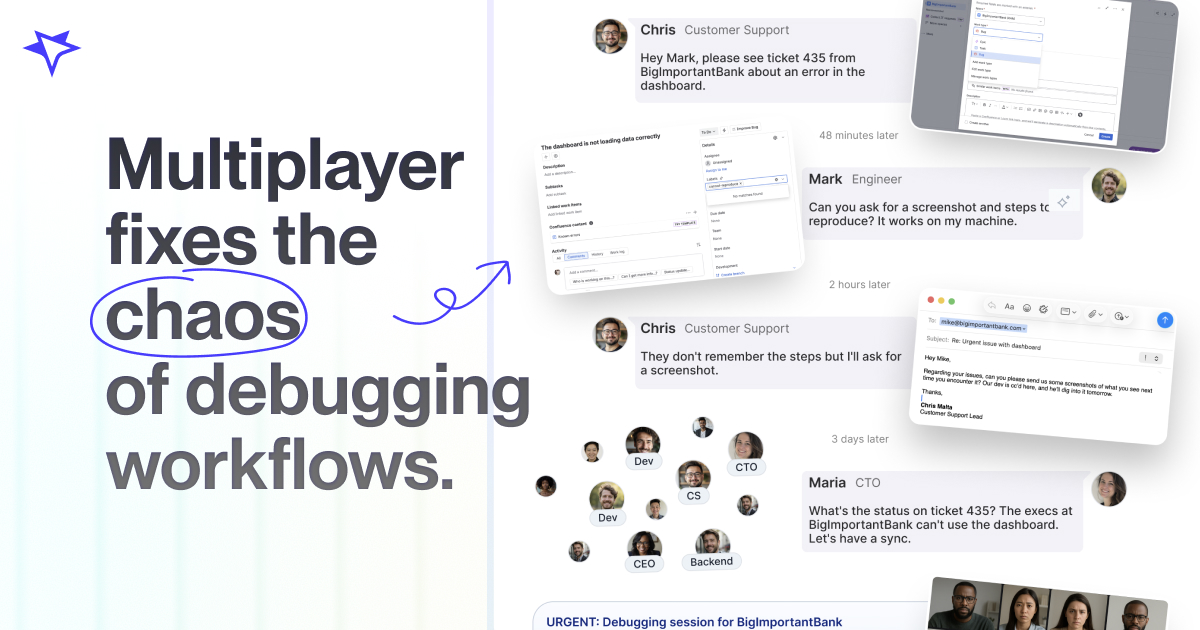
- Enhanced Customer Support: Provide faster issue resolution by reviewing customers’ exact sessions with complete technical context, reducing support ticket resolution times and improving user satisfaction.
- Automated Test Generation: Create comprehensive and interactive test scripts directly from recorded user flows, streamlining quality assurance processes and improving test coverage across development cycles.
- AI-Enhanced Development: Provide AI coding assistants with rich, correlated full-stack context through MCP integration, enabling more accurate code suggestions, bug fixes, and feature implementations with minimal developer prompting.
- System Architecture Documentation: Maintain automatically updated system architecture maps generated from real system behavior, helping teams understand complex distributed systems without manual documentation overhead.
Pros \& Cons
Understanding both the advantages and considerations helps teams make informed implementation decisions.
Advantages
- Complete visibility across technology stack: Captures comprehensive data from frontend interactions to backend processes, providing unmatched insight into application behavior and user experience.
- Eliminates reproduction challenges: Automatically preserves session context when issues occur, removing the time-consuming process of attempting to replicate bugs and system problems.
- Reduces debugging time significantly: With correlated full-stack data readily available, identifying and resolving issues becomes substantially faster and more efficient than traditional debugging approaches.
- Enhanced AI development workflows: MCP integration enables AI tools to provide more accurate and contextual assistance, accelerating development cycles through improved code suggestions and automated insights.
Disadvantages
- Increased storage requirements: Comprehensive full-stack data capture naturally requires more storage capacity compared to frontend-only session recording solutions, potentially impacting infrastructure costs.
- Initial backend integration setup: While powerful, implementing the backend components requires initial configuration effort to ensure proper data capture and correlation across system layers.
- Performance considerations: Capturing extensive system data may require careful configuration to balance comprehensive insights with application performance, particularly in high-traffic environments.
How Does It Compare?
In the evolving landscape of session recording and debugging tools, Multiplayer distinguishes itself through its comprehensive full-stack approach and AI-ready integrations.
Compared to OpenReplay, which offers excellent self-hosted session replay with developer tools, Multiplayer provides more extensive AI integration capabilities and simplified cloud deployment options. While OpenReplay excels in data ownership and customization, Multiplayer focuses on seamless AI workflow integration and reduced operational overhead.
Against PostHog’s all-in-one analytics platform, Multiplayer offers deeper session recording capabilities and more specialized debugging features, though PostHog provides broader product analytics and experimentation tools beyond session analysis.
When compared to Sentry’s error tracking with session replay, Multiplayer provides more comprehensive full-stack context correlation and AI-ready data formatting, while Sentry offers more mature error monitoring and alerting capabilities.
Relative to traditional tools like FullStory, which provides comprehensive digital experience intelligence primarily focused on user behavior analytics, Multiplayer offers deeper technical debugging capabilities and better integration with development workflows. LogRocket, while developer-focused with strong debugging features, lacks Multiplayer’s AI integration depth and full-stack correlation capabilities.
Unlike Datadog’s RUM (Real User Monitoring), which excels in performance monitoring and enterprise observability, Multiplayer specializes in actionable session recordings with AI enhancement, making it more suitable for development teams focused on rapid debugging and AI-assisted development workflows.
Final Thoughts
Multiplayer represents a significant advancement in session recording technology, particularly for development teams seeking to optimize debugging workflows and leverage AI assistance effectively. Its comprehensive full-stack data capture, intelligent correlation capabilities, and seamless AI integration position it as a powerful tool for modern development environments. While considerations around storage requirements and initial setup exist, the platform’s ability to eliminate reproduction challenges, accelerate debugging processes, and enhance AI development workflows makes it a valuable addition to sophisticated development toolchains. For teams prioritizing efficient debugging, rapid feature development, and AI-enhanced workflows, Multiplayer offers a compelling solution that bridges the gap between traditional session recording and next-generation development intelligence.