Overview
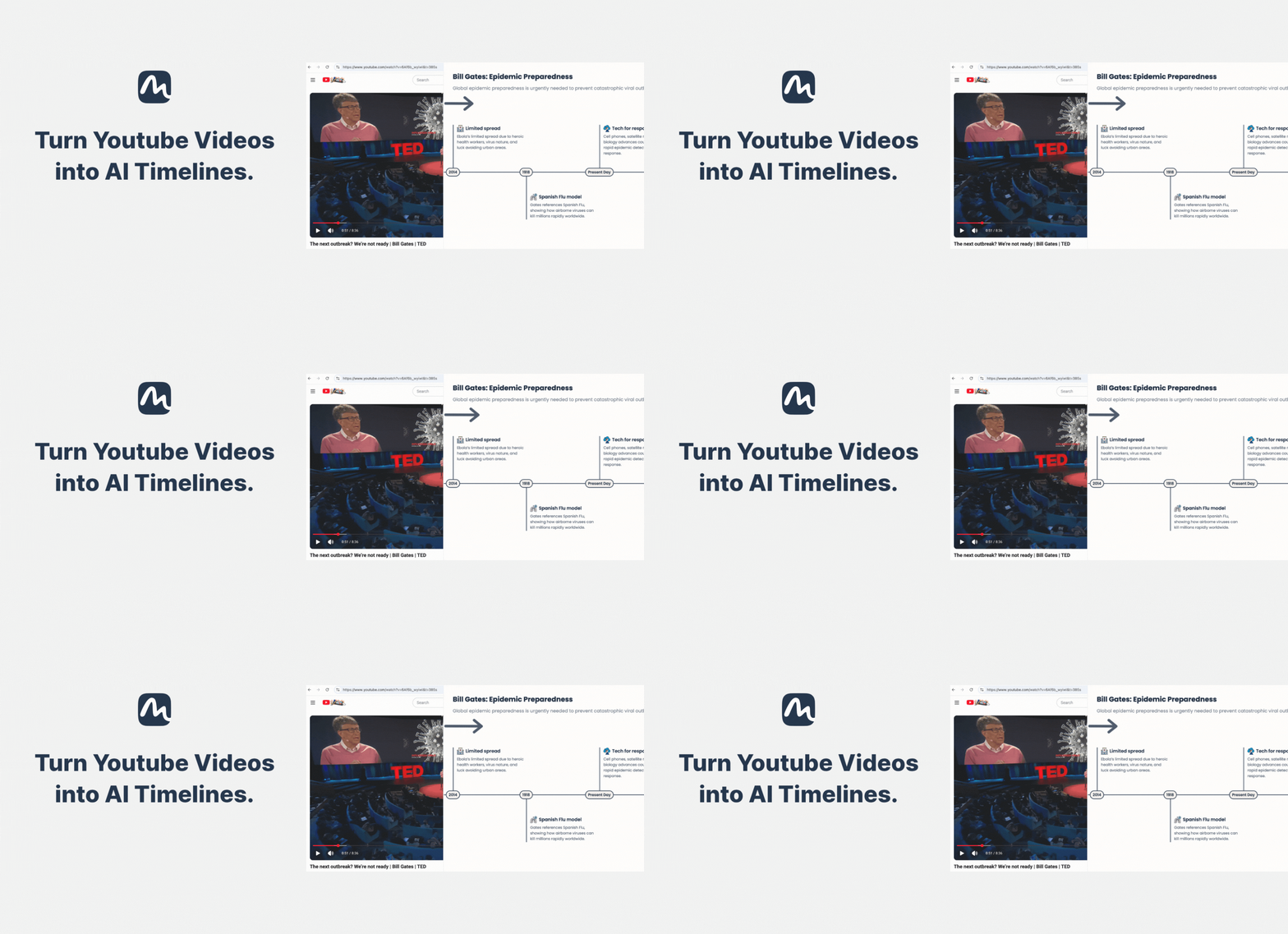
YouTube’s vast library of long-form content offers tremendous value, yet extracting key information efficiently remains a significant challenge for learners, professionals, and researchers. MyLens for YouTube addresses this by converting lengthy video content into navigable, interactive timelines powered by artificial intelligence. The tool instantly analyzes any YouTube video and structures it as an interactive timeline, enabling users to identify key moments instantly, navigate with precision, and extract maximum value from video content without time-consuming linear viewing.
Key Features
MyLens for YouTube delivers a thoughtfully designed set of capabilities that streamline video comprehension and information extraction.
- Intelligent identification of pivotal moments: The system analyzes video content to automatically detect and highlight the most significant segments, eliminating the need for manual scanning and note-taking.
- Interactive, clickable timeline interface: A visual timeline displays each key segment as an interactive element, enabling seamless navigation to specific moments with timestamp precision within the original YouTube video.
- Expandable content sections with AI-powered insights: Users can select any timeline segment to reveal additional context and detailed explanations generated by the AI system.
- Focus on reducing information overload: The tool prioritizes removing irrelevant material and surfacing only the most essential content, helping users achieve their information goals more efficiently.
How It Works
The MyLens platform simplifies video analysis through a straightforward, four-step workflow. Users begin by pasting a YouTube video link into the MyLens interface. The AI engine then processes the video content, detecting topics, structural transitions, and significant moments through multimodal analysis of audio and available transcription data. The system generates a structured, interactive timeline presentation that serves as the primary interface for content exploration. From this timeline, users can navigate directly to any moment of interest, request AI-powered context expansion, generate citations with exact timestamps for external sharing, or perform additional analysis actions without requiring sequential video playback.
Use Cases
MyLens for YouTube serves diverse user groups seeking to optimize their relationship with video content.
- Accelerated comprehension of lengthy educational and professional content: Ideal for students, educators, and knowledge professionals who need to efficiently extract information from lectures, conference talks, webinars, or technical tutorials spanning multiple hours.
- Structured research and information capture: Simplifies the process of identifying, documenting, and organizing key insights from video-based lectures, interviews, or expert discussions for academic or professional projects.
- Efficient content evaluation and discovery: Enables viewers to quickly assess whether long-form content—including news analysis, interviews, podcasts, and educational series—contains information relevant to their needs before committing significant viewing time.
- Precise information retrieval for review and retention: Supports active learning by allowing learners to systematically return to specific topics, arguments, or explanations for examination, study, or presentation preparation.
Pros \& Cons
Like all productivity tools, MyLens for YouTube offers distinct advantages alongside certain limitations.
Advantages
- Substantial time savings on long or information-dense content: Reduces viewing duration significantly by highlighting essential moments and enabling direct navigation to relevant segments.
- Improved navigation and sustained focus through visual structure: The interactive timeline provides a clear map of video content, helping users maintain concentration on relevant information while avoiding tangential material.
- Layered understanding through AI-assisted content expansion: Provides structured access to additional context and explanations for specific topics without requiring repeated video viewing or manual search through lengthy transcripts.
Disadvantages
- Dependent on video quality and transcript availability: Effectiveness relies on clear audio, accurate captions or transcription, and sufficient metadata—challenging for videos with poor production quality, heavy accents, or technical terminology.
- Potential gaps in subtle communication and visual elements: While excellent for identifying key topics and moments, the system may not capture nuanced body language, visual metaphors, on-screen graphics, or the broader narrative context that makes some video content distinctive.
- Additional workflow step outside native YouTube interface: Requires copying links and navigating to an external platform, adding a procedural step compared to accessing YouTube features directly within the video player.
How Does It Compare?
The market for AI-powered video tools has expanded considerably, with several established solutions addressing different aspects of video comprehension. MyLens for YouTube competes with purpose-built tools including Eightify (AI video summarization with timestamped navigation), Glasp (integrated highlighting and summarization with customizable AI models), and Tactiq (live and recorded transcription with one-click summaries). Emerging competitors in the broader video segmentation space include OpusClip (specialized in identifying viral moments across multiple modalities), HARPA AI (free summarization with chatbot capabilities), and Submagic (focused on clip extraction and social media formatting).
The meaningful distinction between MyLens and these alternatives centers on presentation and interaction model. Competitors prioritize transcript-based summaries, chronological timestamping, or automated clip extraction into social media formats. MyLens emphasizes visual hierarchy and interactive exploration through its timeline interface—presenting content structure as a navigable visual system rather than linear text summaries or clip sequences. This design philosophy prioritizes content comprehension and exploration over summarization or repurposing, offering a fundamentally different user experience within the broader video intelligence market.
Final Thoughts
MyLens for YouTube presents a compelling solution for individuals and organizations struggling with video information overload. Through intelligent content structuring and interactive visualization, it transforms passive video consumption into an active, directed learning experience. The tool demonstrates particular value for research, professional development, and educational contexts where systematic information extraction matters. While specific limitations exist—particularly around visual-only content and platform dependencies—the combination of interactive timeline functionality and AI-assisted exploration capabilities positions it as a distinctive tool within the video productivity landscape, particularly for knowledge workers and learners seeking efficient content comprehension strategies.