Table of Contents
Overview
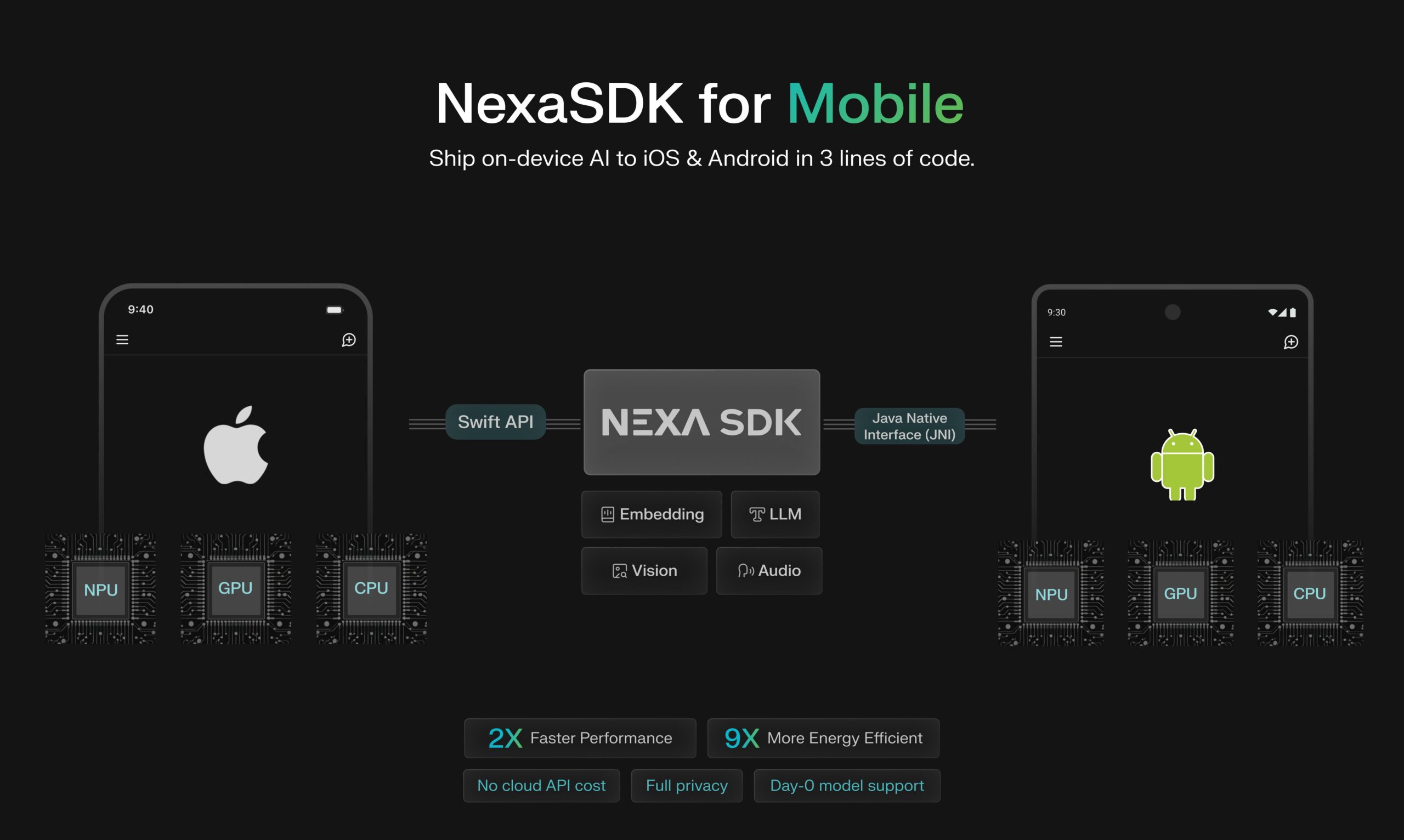
NexaSDK for Mobile is a cross-platform development kit that enables developers to deploy multimodal AI models directly on iOS and Android devices. The SDK leverages hardware acceleration through Apple Neural Engine (ANE) and Qualcomm Hexagon NPU to run AI models locally, eliminating cloud dependency. Developers can integrate chat, vision, audio, and search features with minimal code while achieving improved performance and energy efficiency.
Key Features
- On-Device Processing: Runs AI models locally on mobile devices without sending data to cloud servers
- NPU Acceleration: Supports Apple Neural Engine on iOS and Qualcomm Hexagon NPU on Android for hardware-accelerated inference
- Privacy-Focused: Complete data privacy since information never leaves the user’s device
- Multimodal Support: Enables text, vision, audio, and speech models including LLMs, VLMs, ASR, TTS, and embedding models
- Hardware-Aware Runtime: Automatic detection of available hardware (NPU, GPU, CPU) with intelligent backend routing and fallbacks
- Cross-Platform: Single SDK for both iOS and Android with unified API
- Minimal Integration: Advertised as requiring just 3 lines of code for basic implementation
- Performance Claims: Achieves approximately 2x faster inference and 9x better energy efficiency on supported NPUs compared to CPU/GPU processing
How It Works
Developers integrate the NexaSDK into their mobile applications through standard package managers. The SDK automatically detects available hardware accelerators on the device and routes AI model execution to the most efficient backend. For iOS devices, it leverages the Apple Neural Engine when available. For Android devices with Snapdragon processors, it utilizes the Hexagon NPU. The SDK includes pre-optimized models and supports custom model deployment through its model conversion tools.
Use Cases
- Mobile App Development: Build AI-powered features into iOS and Android applications without cloud infrastructure
- Offline AI Features: Create applications that function without internet connectivity using on-device intelligence
- Voice Assistants: Implement speech recognition and text-to-speech capabilities that work privately on-device
- Visual Search: Deploy image recognition and analysis features that process data locally
- Chat Applications: Integrate conversational AI that responds instantly without network latency
- Privacy-Sensitive Applications: Develop healthcare, finance, or enterprise apps where data must remain on-device
Pros \& Cons
Advantages
- Zero Cloud Cost: Eliminates ongoing API call expenses and infrastructure costs
- High Privacy: Data remains on-device, ensuring compliance with privacy regulations and user trust
- Low Latency: Near-instant responses without network round-trip delays
- Energy Efficiency: NPU acceleration provides 9x better battery life compared to CPU/GPU processing
- Offline Capability: Functions without internet connection, improving reliability
- Cross-Platform: Single SDK reduces development effort for iOS and Android
Disadvantages
- Hardware Dependency: Performance varies significantly based on device capabilities; older devices without NPUs rely on slower CPU/GPU
- Model Size Constraints: Limited by device storage and memory capacity compared to cloud solutions
- Setup Complexity: Requires activation token for certain NPU use cases and hardware-specific configuration
- Enterprise Features Cost: Advanced capabilities like NPU inference at scale and model conversion tools may require custom enterprise pricing
- Ecosystem Maturity: Newer platform with smaller community compared to established alternatives
How Does It Compare?
MediaPipe
- Key Features: Open-source cross-platform framework for building pipelines for face detection, hand tracking, pose estimation, object detection
- Strengths: Mature ecosystem with extensive pre-built solutions, strong Google ML expertise, excellent for computer vision tasks, Apache 2.0 license
- Limitations: Primarily focused on vision tasks, less emphasis on LLMs and multimodal models, steeper learning curve for custom models
- Differentiation: MediaPipe excels at vision-specific pipelines with optimized graphs; NexaSDK provides broader multimodal support including LLMs, audio, and vision with focus on model deployment rather than pipeline construction
CoreML
- Key Features: Apple’s native machine learning framework for iOS/macOS with model conversion tools, on-device inference, Neural Engine integration
- Strengths: Deeply integrated with Apple ecosystem, excellent performance on Apple devices, comprehensive model optimization tools, strong privacy features
- Limitations: iOS/macOS only (no Android support), requires Apple developer account, primarily focused on Apple-optimized models
- Differentiation: CoreML is Apple-exclusive and requires more manual model optimization; NexaSDK offers cross-platform support with unified API and automatic hardware detection
TensorFlow Lite
- Key Features: Lightweight solution for deploying TensorFlow models on mobile and embedded devices, GPU/NPU acceleration, quantization support
- Strengths: Mature framework, extensive documentation, large community, flexible model deployment, open source
- Limitations: Primarily designed for TensorFlow models, more complex integration for non-vision tasks, requires manual optimization for different hardware
- Differentiation: TensorFlow Lite is model conversion and deployment focused; NexaSDK provides higher-level abstraction with pre-optimized models and simpler integration
ONNX Runtime
- Key Features: Cross-platform inference engine for ONNX models, supports multiple hardware accelerators, broad framework compatibility
- Strengths: Framework-agnostic, excellent performance optimization, extensive hardware support, open source
- Limitations: Requires models in ONNX format, more developer overhead for integration, less focus on mobile-specific optimizations
- Differentiation: ONNX Runtime is a general-purpose inference engine; NexaSDK is mobile-focused with streamlined API and mobile-optimized models
Final Thoughts
NexaSDK for Mobile represents a significant advancement in democratizing on-device AI for mobile developers. The platform successfully addresses key barriers to on-device deployment by providing hardware-aware runtime, cross-platform support, and simplified integration. The performance claims of 2x speed improvement and 9x energy efficiency on NPUs are substantiated by benchmark results showing substantial gains over CPU/GPU processing.
The SDK is particularly valuable for developers building privacy-sensitive applications, offline-capable features, or seeking to reduce cloud infrastructure costs. While hardware dependency remains an inherent limitation of on-device AI, NexaSDK’s intelligent fallback system ensures functionality across device tiers. The freemium pricing model lowers adoption barriers, though enterprise features require custom negotiation.
For organizations prioritizing data privacy, latency reduction, and cost efficiency, NexaSDK offers a compelling alternative to cloud-based AI services. As mobile NPUs become more prevalent, tools like NexaSDK will become increasingly essential for competitive mobile AI development. Developers should evaluate their target device demographics and performance requirements when considering the platform, as benefits scale with hardware capabilities.