Table of Contents
Overview
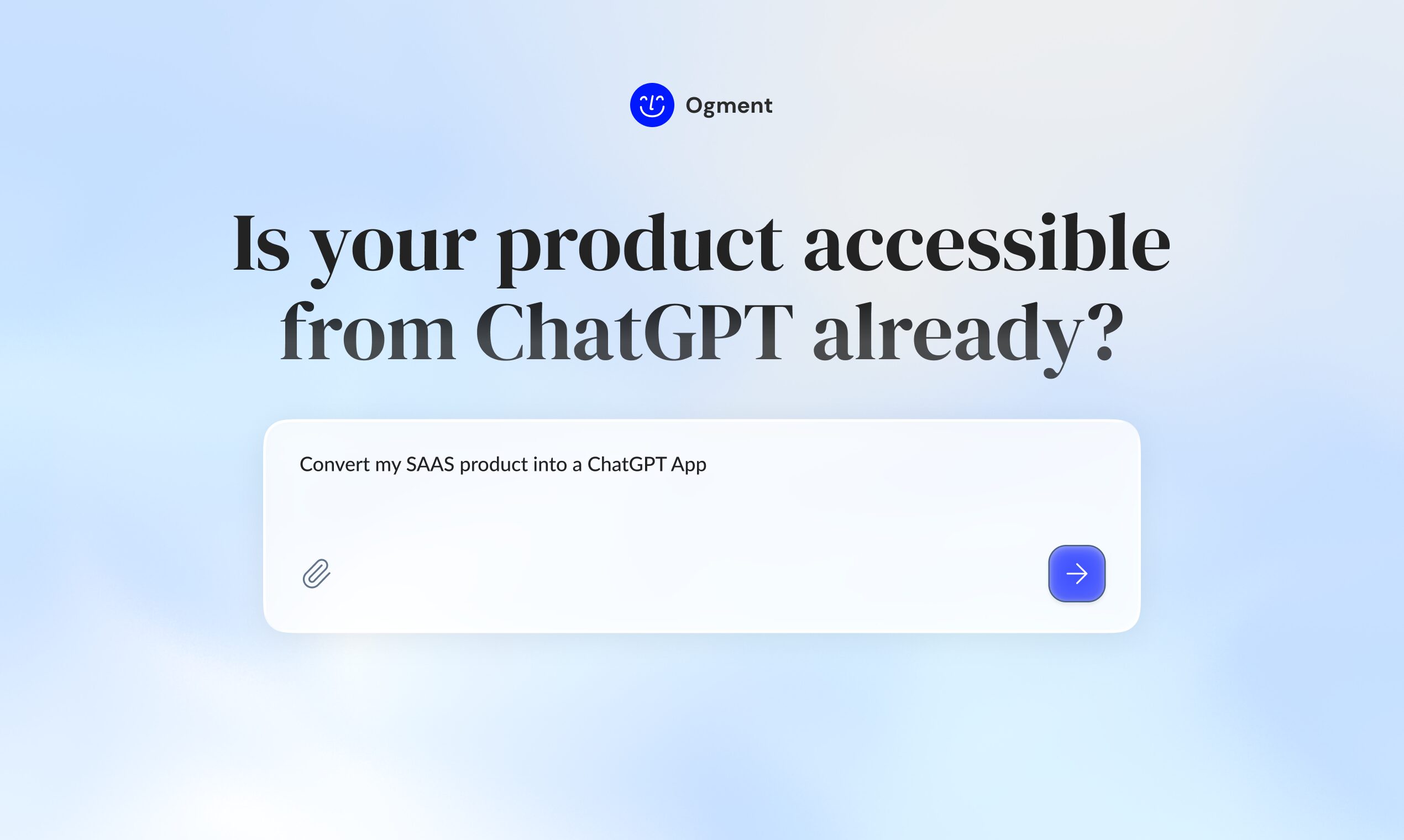
In the rapidly evolving world of AI integration, getting your product directly accessible within conversational AI platforms where users already spend significant time represents transformative distribution opportunity. Ogment MCP-Builder, launched on Product Hunt in November 2025, is specifically designed to solve this integration challenge by making your product, data, and APIs accessible directly inside conversational AI giants like ChatGPT (Pro/Business/Enterprise plans required), Claude, and other Model Context Protocol (MCP)-compatible AI assistants in minutes rather than months. It functions as a universal bridge converting your existing APIs, databases, documentation, and services into production-ready MCP servers that customers and internal teams can use reliably and intuitively through simple chat interfaces, eliminating complex custom integration development, authentication infrastructure, analytics implementation, and ongoing maintenance burden typically required for AI-native product distribution.
Key Features
Ogment MCP-Builder delivers comprehensive no-code platform for rapid MCP server creation enabling anyone to make products AI-accessible without engineering expertise.
Instant MCP Builder: At its core, Ogment leverages the Model Context Protocol (MCP)—open-source standard introduced by Anthropic in late 2024—to make your product understandable and usable by AI models through standardized interface. The platform automatically builds production-ready MCP servers from your assets, eliminating massive technical hurdle of learning JSON-RPC specifications, implementing MCP protocol correctly, and managing server infrastructure manually.
Seamless API and Data Integration: Easily connect your existing assets through intuitive visual configuration interface. Upload API specifications (OpenAPI/Swagger), connect databases, import documentation, or link existing services which Ogment transforms into functional, context-aware tools that AI assistants can reliably invoke on behalf of users.
Built-in Production Essentials: Platform comes production-ready with critical enterprise features including OAuth 2.1 and API-key authentication flows, comprehensive analytics dashboards tracking usage patterns and adoption metrics, automated evaluation testing ensuring reliable MCP performance, and security controls managing permissions and access scopes—eliminating months of custom infrastructure development.
True No-Code Platform: Requires zero coding expertise enabling product managers, marketers, sales teams, and other non-technical stakeholders to build and launch AI-native integrations without writing single line of code, dramatically democratizing AI distribution channel access.
Visual Endpoint Configuration: Visually configure API endpoints, operations, parameters, connector metadata, and tool descriptions through intuitive builder interface mirroring ChatGPT’s no-code GPT builder but extended to expose structured API functionality as AI-invocable tools.
Scoped Access Control: Enforce fine-grained access controls ensuring MCP servers only expose authorized endpoints to specific users, with tokens and credentials never shared with LLM providers maintaining security and compliance requirements.
Workplace Analytics: Monitor AI power users, endpoint call volumes, most-used tools, query timing and patterns, user-level usage tracking, and adoption trends over time through comprehensive analytics dashboards enabling ROI visibility and optimization opportunities.
Instant Publishing: Publish MCPs immediately to ChatGPT and Claude for authorized users with zero custom coding, complex deployment procedures, or infrastructure provisioning required—tools become instantly available in AI assistants after configuration.
Pricing
Ogment operates on freemium model with transparent tiered pricing enabling individuals through enterprises to access MCP building capabilities at appropriate scale.
Free Plan: \$0/month. Includes core MCP builder access, limited to 1 active MCP server, basic authentication support, community-level support, suitable for individual developers, students, and evaluation purposes testing platform capabilities.
Pro Plan: Pricing requires direct inquiry through ogment.ai. Typically includes unlimited MCP servers, advanced authentication options (OAuth 2.1, API keys), comprehensive analytics dashboard, priority support, and production-grade infrastructure suitable for small teams and growing companies.
Scale Plan: Enterprise-tier pricing with custom quotation. Includes white-label options, dedicated infrastructure, SLA guarantees, advanced security controls, team collaboration features, audit logging, and enterprise support suitable for large organizations with compliance requirements.
Note: As November 2025 Product Hunt launch represents early commercial availability, specific pricing details for Pro and Scale tiers require direct sales inquiry. Organizations should verify current pricing, plan comparisons, and available discounts through ogment.ai for accurate budget planning.
How It Works
Ogment’s operational flow emphasizes simplicity and speed through visual no-code builder transforming complex MCP server creation into accessible minutes-long process.
Users begin by creating Ogment account and initiating new MCP server project through the visual builder interface, selecting whether to build from API specification, database connection, documentation import, or custom service endpoint.
Users upload product assets including API specifications (OpenAPI/Swagger JSON/YAML), documentation files describing functionality, or direct database connections providing data context that Ogment will expose through the MCP server to AI assistants.
Ogment’s platform automatically analyzes uploaded assets, parsing API endpoints to understand operations, extracting parameters and data schemas, identifying authentication requirements, and generating initial MCP server configuration that users can review and customize.
Through visual configuration interface, users customize MCP server settings including endpoint selection (which APIs to expose), parameter configuration (required vs optional fields, data types, validation rules), authentication method selection (OAuth 2.1, API keys, or public), and tool descriptions that AI models use to understand when and how to invoke each capability.
Users configure access controls and permissions determining which users or teams can access the MCP server, what scopes and permissions apply, and any usage limits or rate throttling requirements ensuring security and compliance.
Once configuration completes, Ogment automatically provisions production infrastructure hosting the MCP server with authentication handling, analytics collection, evaluation testing, and monitoring—all managed by Ogment without user infrastructure responsibility.
Users publish the completed MCP server making it instantly available in ChatGPT (Pro/Business/Enterprise users), Claude, and other MCP-compatible AI clients. Authorized users can immediately begin invoking tools and accessing data through natural language conversation within their AI assistant.
The platform provides ongoing analytics dashboard showing usage patterns, most-invoked endpoints, user adoption tracking, response latencies, error rates, and optimization opportunities enabling data-driven improvements and demonstrating ROI to stakeholders.
The entire workflow from account creation through published, production-ready MCP server accessible in ChatGPT and Claude typically completes in minutes to hours versus traditional weeks or months required for custom AI integration development.
Use Cases
Ogment MCP-Builder serves diverse organizational scenarios where AI-native product distribution, internal tool accessibility, and conversational interface enablement drive business value.
SaaS and API Teams: For software and API companies, Ogment provides direct distribution channel embedding products into generative AI platforms where users increasingly conduct work. Allows customers to access your service, invoke functionality, and retrieve data without leaving chat environment, reducing friction and expanding addressable market through AI-first access patterns.
Internal Tools and Data Access: Empower internal teams by making company tools, databases, and operational systems directly accessible via chat interfaces. Employees can query internal databases, trigger workflows, retrieve customer information, or execute business processes through natural language eliminating application context switching and training overhead.
Customer-Facing AI Experiences: Build innovative, conversational product experiences where customers interact with your product, request support, make purchases, retrieve account information, or configure services through natural conversation within familiar AI assistants rather than learning custom UIs.
API Documentation to Interactive Tools: Transform static API documentation into live, interactive MCP servers enabling developers to test and integrate through natural language experimentation without SDK installation, authentication troubleshooting, or complex API navigation—dramatically reducing integration friction and accelerating developer adoption.
Data Products and Analytics: Publish datasets as MCP servers so customers can access, analyze, query, and interact with your data products directly in their favorite AI clients without custom integrations, dashboard logins, or data export procedures—enabling conversational data exploration and analysis.
Enterprise System Access: Convert internal APIs (CRM, ERP, HR systems, financial platforms) into MCP servers so teams can manage systems, retrieve information, or trigger workflows directly through AI assistants eliminating login fatigue and interface complexity characteristic of enterprise software.
Marketing Agency Workflows: Connect data from multiple databases (advertising platforms, analytics tools, CRM systems) enabling account teams to generate client reports, compile campaign metrics, and answer client questions directly in chat—reducing report preparation time by 70%+ through AI-powered data synthesis.
Developer Onboarding Acceleration: Provide new developers with MCP-based access to internal systems, documentation, and development tools enabling them to explore and interact with organizational infrastructure through conversational learning rather than extensive documentation review.
Pros and Cons
Understanding both advantages and considerations provides clarity for evaluating Ogment MCP-Builder’s fit for AI integration needs and organizational contexts.
Advantages
Fast AI-Native Product Launch: Ability to transform existing API into fully functional, AI-integrated MCP server accessible in ChatGPT and Claude within minutes represents massive advantage versus traditional months-long custom integration development, drastically reducing time-to-market for AI distribution channel.
Zero Code Required: No-code nature makes AI integration accessible to entire organization empowering product owners, business leaders, marketers, and sales teams to innovate and launch AI-accessible features without relying on scarce engineering resources or learning complex protocols.
Production-Ready Infrastructure Included: Built-in authentication, analytics, evaluation testing, security controls, and managed hosting eliminate need to build custom infrastructure handling OAuth flows, usage tracking, permission management, or server maintenance—significantly reducing development burden and ongoing operational overhead.
Unlocks New Distribution Channel: Enables product distribution through conversational AI platforms where users increasingly conduct daily work, creating powerful new channel for customer acquisition, engagement, and retention particularly valuable for SaaS businesses seeking enterprise adoption.
Democratizes AI Integration: Eliminates traditional barriers requiring JSON-RPC knowledge, MCP specification understanding, server infrastructure management, and complex authentication implementation—making AI-native product access achievable for organizations of all sizes and technical sophistication.
Comprehensive Analytics Visibility: Detailed usage analytics, adoption tracking, endpoint popularity metrics, and performance monitoring provide clear ROI visibility and optimization guidance impossible with custom integration approaches lacking instrumentation.
Disadvantages
ChatGPT Plan Requirements: ChatGPT MCP integration requires Pro (\$20/month), Business, Enterprise, or Edu plans—not available on free or Plus tier plans, potentially limiting addressable audience and requiring customers to upgrade subscriptions for MCP server access.
Not Ideal for Legacy Systems: Platform optimized for modern RESTful APIs, OpenAPI specifications, and standard authentication patterns. Organizations with monolithic legacy systems, proprietary protocols, SOAP APIs, or custom authentication schemes may require significant pre-work refactoring systems before Ogment integration becomes feasible.
Relies on AI Assistant Ecosystem: Tool functionality and availability inherently tied to ecosystems of large language models it integrates with—changes in ChatGPT or Claude capabilities, pricing, availability, or MCP support directly impact your MCP server viability and user experience.
MCP Ecosystem Maturity: Model Context Protocol introduced late 2024 by Anthropic represents relatively new standard with evolving specifications, limited third-party tooling ecosystem, and adoption uncertainty—early adoption carries risk of specification changes or reduced platform emphasis affecting long-term viability.
Customization Limitations: While no-code approach enables rapid deployment, organizations requiring highly custom authentication flows, complex business logic execution, or non-standard MCP server behaviors may encounter platform limitations requiring custom development outside Ogment.
Pricing Transparency Limited: Specific pricing for Pro and Scale tiers not publicly disclosed requires sales consultation for budget planning creating procurement friction and making advance cost-benefit analysis challenging versus competitors with transparent published pricing.
How Does It Compare?
The MCP server building and AI integration landscape features emerging tools and traditional development approaches ranging from custom coding to no-code platforms. Understanding Ogment’s positioning requires examining specific alternatives across different implementation strategies.
Custom MCP Development (Manual Coding)
Custom MCP development involves developers directly implementing Model Context Protocol servers using MCP SDKs (Python, TypeScript), managing JSON-RPC communication manually, implementing authentication flows from scratch, building custom hosting infrastructure, and maintaining servers independently. Requires comprehensive understanding of MCP specifications, JSON-RPC protocol, security best practices, and ongoing infrastructure management. Free in terms of tooling costs but expensive in terms of engineering time and expertise requirements.
Custom development and Ogment MCP-Builder serve different organizational capabilities and priorities. Custom development provides maximum flexibility, complete control over implementation details, ability to implement any authentication scheme, and optimization for specific performance requirements. Ogment provides dramatic speed advantage (minutes vs weeks/months), zero technical knowledge requirements, managed infrastructure eliminating operational burden, and built-in analytics/security without custom implementation.
Custom development suitable for organizations with strong engineering teams, highly specific requirements, unusual authentication needs, or desire for complete infrastructure control. Ogment suitable for organizations prioritizing speed-to-market, lacking specialized MCP expertise, requiring managed infrastructure, or enabling non-technical stakeholders to build integrations.
Traditional approach before tools like Ogment existed involved: understanding JSON-RPC and MCP specifications, correctly writing manifests, building and hosting custom servers, managing OAuth flows and tokens, overseeing rate limits and security, and manually deploying and maintaining everything—representing significant engineering investment Ogment eliminates.
AirOps
AirOps provides AI workflow automation platform emphasizing prompt engineering, LLM-powered workflows, and chat assistant building using AirOps Studio. Focuses on creating AI applications, automating content generation, building chatbots, and orchestrating multi-step LLM workflows. Does not specifically target MCP server creation or AI assistant integration—serves different primary use case around AI workflow automation rather than product distribution through conversational AI.
AirOps and Ogment address fundamentally different problems. AirOps enables teams to build custom AI applications and workflows leveraging LLMs for internal automation and content generation. Ogment enables teams to make existing products accessible inside existing AI assistants (ChatGPT, Claude) through MCP protocol. AirOps creates new AI applications; Ogment integrates existing products into AI platforms.
Organizations seeking to build custom chatbots, automate content workflows, or develop proprietary AI applications benefit from AirOps. Organizations seeking to distribute existing products through ChatGPT and Claude benefit from Ogment.
PromptLayer
PromptLayer provides prompt engineering platform focused on prompt management, version control, evaluation, deployment, observability, and analytics for LLM applications. Enables teams to collaboratively iterate on prompts, run evaluations against usage history, compare models, schedule regression tests, and review logs identifying edge cases. Targets prompt engineering optimization and LLM application development rather than MCP server creation or AI assistant integration.
PromptLayer and Ogment serve different aspects of AI development lifecycle. PromptLayer optimizes prompt engineering and LLM application monitoring—helping teams build better AI applications through prompt iteration and evaluation. Ogment focuses on making products accessible inside AI assistants through MCP integration—enabling product distribution through conversational platforms.
Teams building custom LLM applications requiring sophisticated prompt engineering, evaluation frameworks, and observability benefit from PromptLayer. Teams wanting to make existing products accessible in ChatGPT and Claude benefit from Ogment. Complementary rather than competing tools addressing different workflow phases.
Anthropic Claude API and OpenAI API
Claude API and OpenAI API provide direct access to large language models for building custom applications, enabling developers to integrate Claude or GPT models into their own products, create custom chatbots, build AI features, and develop proprietary applications. Require coding expertise, infrastructure management, and application development but provide maximum flexibility and control.
Direct APIs and Ogment serve different integration directions and use cases. Direct APIs enable developers to bring AI capabilities into their products (embedding Claude/GPT into custom apps). Ogment enables developers to bring their products into AI platforms (making products accessible inside ChatGPT/Claude). Direct APIs for building AI-powered applications; Ogment for distributing products through AI assistants.
Organizations building custom AI features, developing proprietary applications, or creating standalone AI products use direct APIs. Organizations seeking to make existing products accessible through conversational AI interfaces use Ogment.
Zapier and n8n
Zapier and n8n provide workflow automation platforms connecting different SaaS applications through triggers and actions, enabling no-code automation across hundreds of applications. While some overlap exists in connecting systems, these platforms focus on background automation triggered by events rather than conversational AI integration and MCP server creation.
Zapier/n8n and Ogment address different automation paradigms. Zapier/n8n automate background workflows triggered by events (when X happens, do Y) connecting traditional SaaS applications. Ogment enables conversational access to products through AI assistants where users interact via natural language rather than configuring automated workflows.
Organizations automating repetitive multi-app workflows benefit from Zapier/n8n. Organizations making products conversationally accessible inside ChatGPT and Claude benefit from Ogment. Different automation models serving different organizational needs.
Workato Enterprise MCP Platform
Workato Enterprise MCP Platform provides enterprise-scale integration and automation platform with MCP support added for AI agent workflows, emphasizing secure, scalable workflows for large organizations with strong security and governance requirements. Targets enterprise IT teams managing complex integration needs across organizational systems.
Workato and Ogment both support MCP but serve different organizational scales and use cases. Workato targets Fortune 500 enterprises requiring comprehensive integration platform, extensive governance controls, and enterprise-grade security. Ogment targets rapid MCP server creation for startups through mid-market companies prioritizing speed and simplicity.
Large enterprises requiring comprehensive integration governance and existing Workato deployments benefit from Workato MCP capabilities. Smaller organizations seeking rapid MCP deployment without enterprise platform complexity benefit from Ogment’s focused, accessible approach.
Key Differentiators
Ogment MCP-Builder’s unique positioning centers on several distinctive capabilities. Specialized focus exclusively on MCP server creation and ChatGPT/Claude integration differentiates from general-purpose AI platforms (AirOps, PromptLayer) or workflow automation tools (Zapier) addressing different problems entirely.
No-code visual builder specifically for MCP servers eliminates technical barriers requiring JSON-RPC knowledge, server infrastructure management, or authentication implementation—democratizing AI integration access beyond engineering teams to entire organization.
Production-ready infrastructure bundling authentication, analytics, evaluations, and hosting eliminates months of custom development creating enterprise-grade MCP deployment infrastructure that custom approaches require building from scratch.
Minutes-to-deployment timeline versus weeks or months for custom MCP development provides dramatic time-to-market advantage particularly valuable for competitive positioning and rapid customer feedback cycles.
For organizations requiring maximum customization, complex authentication schemes, or complete infrastructure control, custom MCP development provides superior flexibility. For enterprises seeking comprehensive integration platforms with extensive governance, Workato provides broader scope. For teams building custom AI applications or optimizing prompts, AirOps and PromptLayer address different needs.
However, for startups and growth companies seeking rapid product distribution through ChatGPT and Claude, organizations lacking MCP expertise but recognizing AI-native distribution opportunity, non-technical teams wanting to enable AI integration without engineering dependencies, and businesses prioritizing speed-to-market over maximum customization, Ogment MCP-Builder presents compelling specialized solution uniquely positioned at intersection of accessibility, speed, and production-readiness for MCP server deployment.
Final Thoughts
Ogment MCP-Builder addresses genuine market opportunity in rapidly emerging “Agentic Internet” where users increasingly conduct work through conversational AI assistants rather than traditional application interfaces. By dramatically simplifying MCP server creation from months-long engineering projects into minutes-long no-code configuration, it democratizes access to transformative AI distribution channel previously accessible only to well-resourced engineering teams.
The November 2025 Product Hunt launch positions Ogment strategically within nascent but rapidly growing Model Context Protocol ecosystem introduced by Anthropic late 2024. As ChatGPT, Claude, and other AI assistants increasingly support MCP integration enabling conversational access to external tools and data, businesses face strategic decision about participating in this distribution channel or risk competitive disadvantage as users consolidate workflows into AI-first environments.
Critical advantages include dramatic speed enabling rapid market experimentation and customer feedback, no-code accessibility empowering entire organization beyond engineering, production-ready infrastructure eliminating months of custom development, comprehensive analytics providing ROI visibility, and unlocking new distribution channel where users increasingly spend working time.
Legitimate considerations include ChatGPT plan requirements (Pro/Business/Enterprise only), MCP ecosystem relative newness with evolving standards and uncertain long-term adoption trajectory, platform limitations for legacy systems or highly custom requirements, reliance on AI assistant ecosystem availability and capabilities, and pricing transparency requiring direct sales inquiry for budget planning.
For SaaS companies seeking new distribution channels and customer acquisition strategies, startups needing rapid enterprise credibility through AI-native access, product teams wanting to experiment with conversational interfaces without engineering burden, and organizations recognizing conversational AI represents future of work interactions, Ogment MCP-Builder delivers compelling value through specialized, accessible platform removing traditional barriers to AI integration.
The platform’s unique positioning as “universal adapter” between products and AI assistants addresses genuine friction point where organizations recognize AI distribution opportunity but lack expertise, resources, or time to build custom MCP infrastructure. For teams ready to experiment with AI-native product distribution, comfortable with managed infrastructure approach, and prioritizing speed and accessibility over maximum customization, Ogment MCP-Builder absolutely warrants serious evaluation as innovative, purpose-built platform democratizing access to conversational AI distribution channel increasingly central to future software interaction paradigms.