
Overview
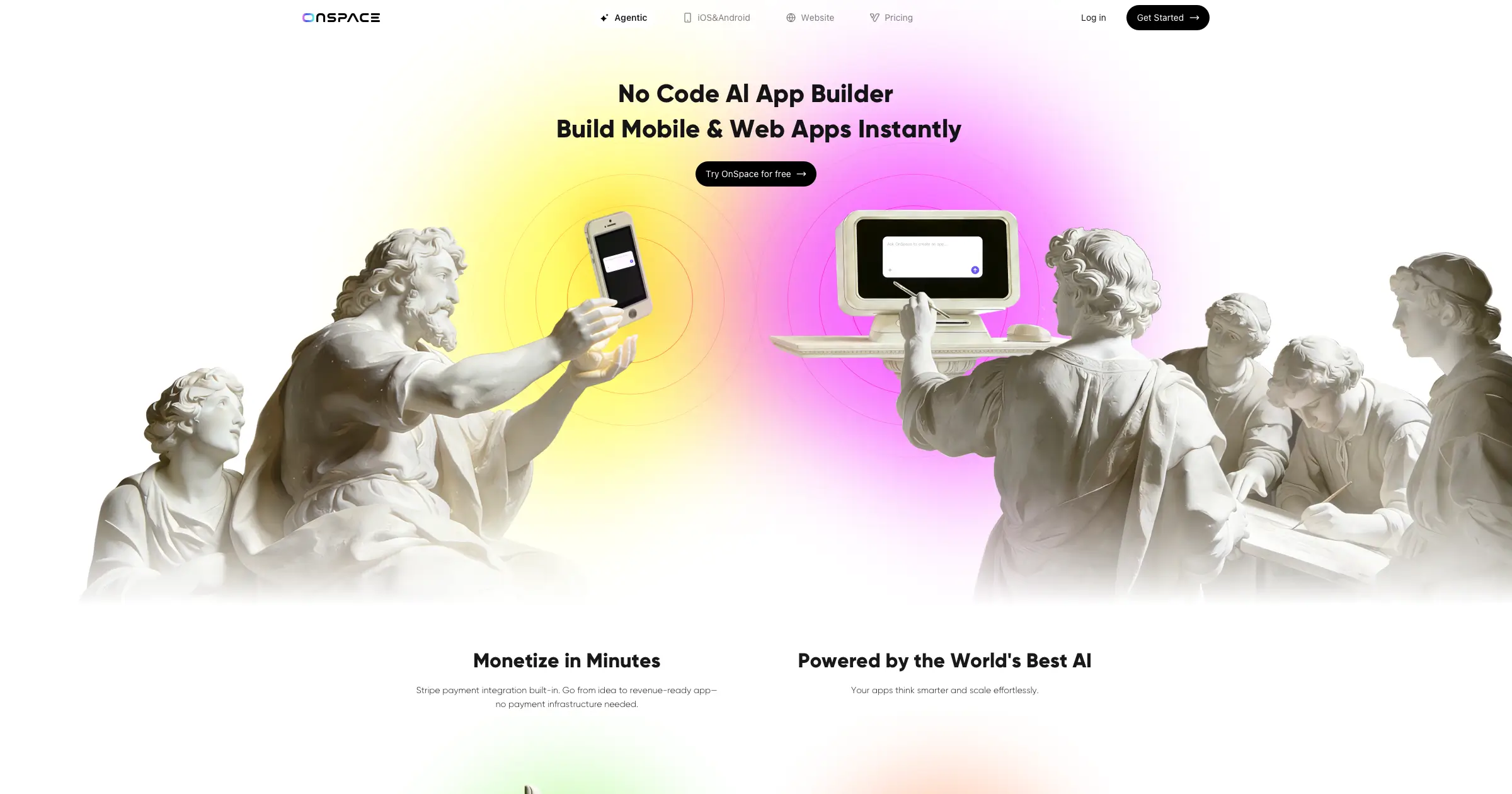
The landscape of app development continues evolving rapidly toward accessibility and speed, particularly for entrepreneurs and creators who lack extensive technical backgrounds. OnSpace AI addresses these challenges through an innovative conversational approach to no-code app building that transforms natural language descriptions into functional applications across Web, iOS, and Android platforms. Developed by Qianfan Hong Kong Limited and launched in app stores throughout September 2025, OnSpace AI distinguishes itself through its Context Engineering architecture, which processes requirements through specialized AI agents rather than relying on rigid templates like traditional no-code platforms. This multi-agent approach proves particularly beneficial for startup founders and business owners who need enterprise-level functionality without the complexity typically associated with advanced development tools.
Key Features
OnSpace AI provides a comprehensive suite of capabilities designed to streamline the entire app development lifecycle from initial concept through deployment and monetization.
- Conversational AI Development: Enables complete application creation through natural language descriptions, eliminating the learning curve associated with drag-and-drop interfaces while supporting complex feature requests through ongoing dialogue with specialized AI agents that understand context and user intent.
- Universal Cross-Platform Deployment: Simultaneously builds and deploys applications across web browsers, iOS App Store, and Google Play Store from a single project, ensuring consistent user experience and functionality while reducing development overhead and maintenance requirements.
- Real-Time Development Preview: Provides immediate visual feedback during conversational development sessions, allowing users to see their applications taking shape instantly and make iterative adjustments through continued dialogue, creating a collaborative development experience.
- Enterprise-Grade Backend Integration: Seamlessly integrates with Supabase to provide PostgreSQL database management, secure user authentication, file storage capabilities, and real-time data synchronization without requiring manual backend configuration or technical infrastructure management.
- Integrated Monetization Capabilities: Includes native Stripe payment processing integration, enabling immediate e-commerce functionality, subscription models, and revenue generation without requiring external payment gateway configuration or complex integration processes.
- Professional Development Workflow: Supports GitHub integration for version control and code export, enabling developers to download generated code directly, maintain project history, and transition to traditional development workflows when advanced customization becomes necessary.
How It Works
OnSpace AI operates through an innovative Context Engineering system that transforms conversational input into production-ready applications using multiple specialized AI agents. Users begin by describing their application concept in natural language through the platform’s web interface or mobile applications. The system’s AI agents analyze these descriptions, breaking down requirements into actionable development tasks while maintaining context about user preferences, feature relationships, and technical constraints. As users refine their specifications through continued conversation, OnSpace AI generates real-time application previews, allowing immediate testing and validation of functionality. The platform automatically handles backend infrastructure provisioning through Supabase integration, sets up authentication systems, configures databases, and establishes payment processing capabilities when requested. Throughout development, users can request modifications, add features, or adjust functionality using plain English instructions, while the AI maintains project coherence and suggests relevant enhancements based on application context and common usage patterns.
Use Cases
OnSpace AI’s conversational development approach and integrated infrastructure make it particularly valuable for scenarios requiring rapid development cycles and professional deployment capabilities.
- Rapid MVP Development and Market Validation: Enables entrepreneurs to transform business concepts into testable applications within hours rather than months, facilitating quick market validation, user feedback collection, and iteration cycles without significant upfront investment in development resources.
- Custom Business Application Creation: Supports internal tool development for small and medium businesses, including client portals, inventory management systems, and operational dashboards that integrate with existing business processes while requiring no technical team or ongoing development maintenance.
- AI-Enhanced Mobile Application Prototyping: Facilitates creation of sophisticated mobile applications with artificial intelligence features, real-time data processing, and complex user interactions that would typically require extensive development expertise and months of implementation time.
- E-commerce and Marketplace Development: Streamlines creation of online stores, service marketplaces, and subscription-based applications with integrated payment processing, user authentication, and database management that scale automatically with business growth requirements.
- Educational and Content Platform Creation: Supports development of learning management systems, content delivery platforms, and community applications with user-generated content capabilities, authentication systems, and engagement features optimized for educational and informational purposes.
Pros \& Cons
Understanding OnSpace AI’s advantages and current limitations helps users evaluate whether its conversational approach aligns with their development requirements and technical expectations.
Advantages
- Elimination of technical barriers: Complete removal of coding requirements and complex interface learning curves through natural language interaction, making professional app development accessible to non-technical entrepreneurs and creators without requiring programming education or development team hiring.
- Unprecedented development speed: Transformation of ideas into deployed applications within hours or days rather than traditional months-long development cycles, enabling rapid market entry, quick testing of business hypotheses, and responsive iteration based on user feedback.
- Comprehensive integrated infrastructure: Built-in enterprise-grade backend services, payment processing, authentication systems, and deployment capabilities eliminate the complexity of coordinating multiple third-party services and reduce ongoing maintenance overhead.
- Professional deployment capabilities: Direct publication to major app stores and web platforms with proper optimization, security measures, and scalability features that ensure applications meet professional standards for public use and commercial deployment.
Disadvantages
- Advanced customization limitations: While powerful for most use cases, highly specialized applications requiring custom algorithms, complex integrations, or unique architectural patterns may exceed the platform’s current conversational development capabilities and require traditional coding approaches.
- Learning curve for AI interaction: Effective use requires understanding how to communicate requirements clearly through natural language, structure complex feature requests appropriately, and iterate efficiently through conversational development sessions.
- Platform ecosystem dependency: Applications built on OnSpace AI benefit from integrated services but may face challenges if migration to completely independent infrastructure becomes necessary for advanced scaling or specific compliance requirements.
How Does It Compare?
OnSpace AI competes in the rapidly evolving AI-powered no-code development space, distinguishing itself through conversational development while facing established competitors with different approaches and market positioning.
Compared to Lovable, which offers natural language app building at \$21 monthly with strong GitHub integration and AI-powered iterations, OnSpace AI provides more comprehensive backend integration through Supabase and maintains a generous free tier with 6,000 monthly credits. While Lovable excels in design-focused applications and developer-friendly workflows, OnSpace AI emphasizes complete infrastructure integration and business-ready deployment capabilities.
Against Bolt.new by StackBlitz, which enables full-stack application development through AI prompts with immediate deployment capabilities, OnSpace AI offers more structured mobile app development and app store publishing workflows. Bolt.new provides broader flexibility for web applications and developer customization, while OnSpace AI specializes in cross-platform mobile applications with integrated business functionality.
Relative to v0.dev by Vercel, which focuses on UI component generation and frontend development with excellent design capabilities, OnSpace AI provides complete application development including backend infrastructure and mobile deployment. v0.dev excels in creating sophisticated user interfaces and component libraries, while OnSpace AI offers comprehensive end-to-end application development with business logic and data management.
When compared to traditional no-code leaders like Bubble, which offers visual development at \$29-349 monthly with extensive customization capabilities and mature enterprise features, OnSpace AI provides more accessible conversational development without requiring interface mastery. Bubble provides deeper customization control and advanced workflow capabilities, while OnSpace AI prioritizes development speed and accessibility for non-technical users.
Against Adalo, priced at \$45-200 monthly with native mobile app focus and strong template libraries, OnSpace AI offers more flexible conversational development and integrated AI capabilities. Adalo excels in mobile-first design and established publishing workflows, while OnSpace AI provides broader platform support and AI-enhanced development assistance.
Compared to FlutterFlow, which generates high-performance Flutter applications at \$30-70 monthly with professional code output and advanced customization options, OnSpace AI offers more accessible development through natural language rather than visual programming. FlutterFlow provides superior performance optimization and developer control, while OnSpace AI focuses on eliminating technical complexity for business users and entrepreneurs.
Final Thoughts
OnSpace AI represents a significant advancement in making professional app development accessible to non-technical entrepreneurs and creators through its innovative conversational development approach. The platform’s Context Engineering architecture and integrated infrastructure address real barriers that prevent many individuals from bringing their application concepts to market, while its proven success stories like AI Home Design demonstrate the potential for rapid deployment and market validation. While advanced customization limitations may restrict its applicability for highly specialized applications, OnSpace AI’s combination of natural language development, cross-platform deployment, and integrated business functionality positions it as a compelling choice for entrepreneurs seeking to validate business concepts quickly and cost-effectively. As the platform continues evolving its AI capabilities and expanding integration options, OnSpace AI’s conversational approach may establish new standards for accessible application development, particularly for users who prioritize speed and simplicity over extensive technical control. For individuals and small businesses seeking to transform ideas into deployed applications without technical barriers or significant upfront investment, OnSpace AI offers a promising pathway from concept to market that balances accessibility with professional deployment capabilities.