Table of Contents
Overview
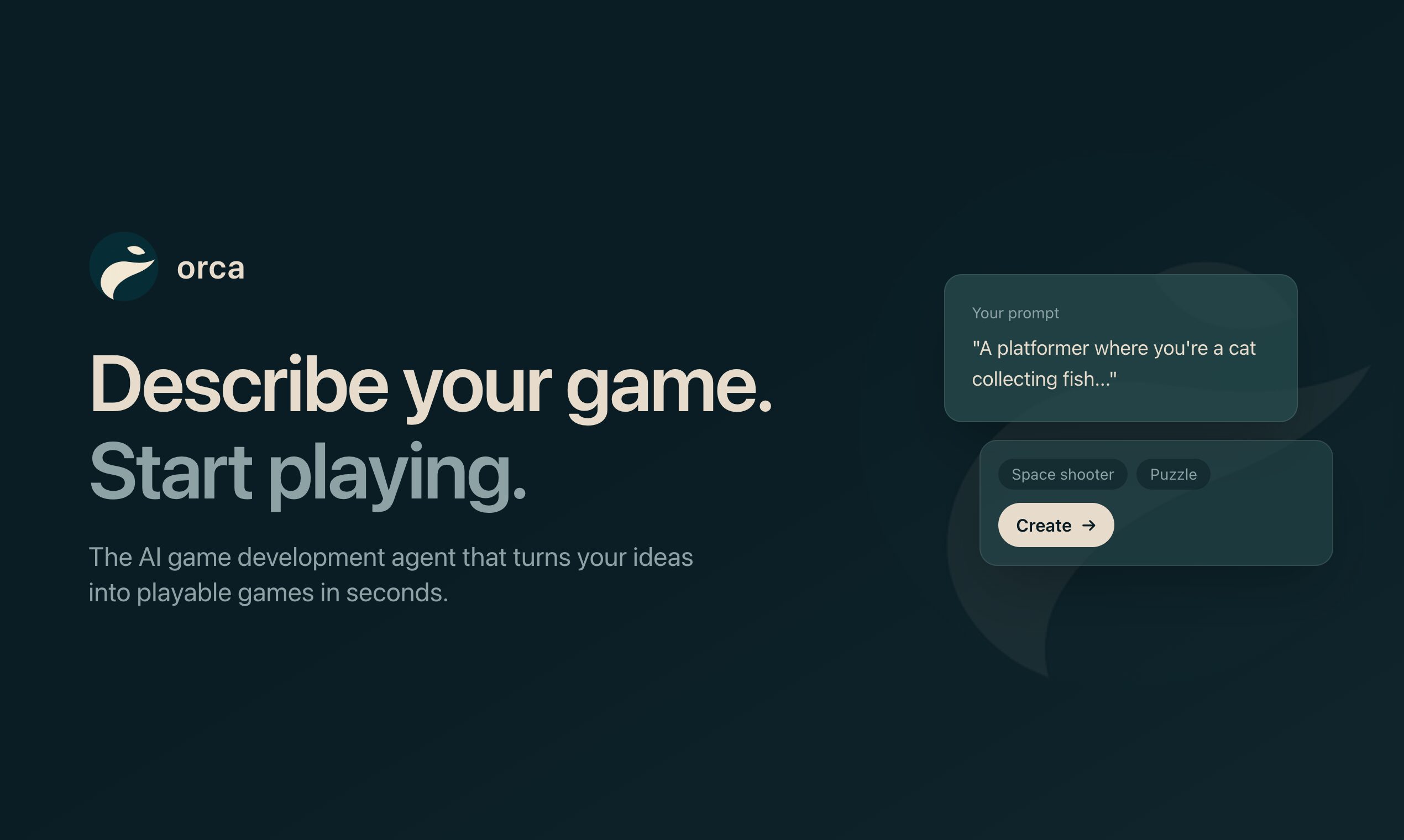
Ever dreamt of creating your own video game but felt daunted by the complexities of coding and asset creation? Enter Orca, a revolutionary web-based AI agent designed to transform your game ideas into playable prototypes with unprecedented ease. Announced by Y Combinator Summer 2024 startup Simplifine (founded by Oxford researchers and Rhodes Scholars) and launched on Product Hunt on December 5, 2025 (achieving 98 upvotes and 10 comments), Orca addresses a fundamental barrier in game development: the steep learning curve requiring mastery of programming languages, game engines like Unity or Unreal, and artistic skills for asset creation—expertise that takes years to acquire and prevents countless creative individuals from realizing their interactive visions.
Built on the open-source Godot game engine with complete access to its APIs, Orca integrates a conversational AI chatbot that can read, edit, create, and delete files; understand entire projects as context; generate 2D and 3D assets with visual consistency; create character animations; and edit Godot-native objects like nodes and scenes—all through natural language conversation. Forget steep learning curves and intricate setups; Orca lets you build games by simply chatting, making game development accessible to everyone, from aspiring designers to seasoned developers looking for faster prototyping workflows. The platform operates entirely in your web browser with no downloads, installations, or environment configuration required, enabling real-time mechanics assembly where you watch your game take shape as you describe it.
Key Features
Orca is packed with powerful capabilities designed to democratize game development:
- Chat-to-Game Creation Interface with Natural Language Understanding: Describe your game concept, mechanics, and desired outcomes in conversational English, and Orca’s AI translates your words into functional game code, architecture, and implementation. The system understands game development terminology (platformer mechanics, collision detection, scoring systems, enemy AI), interprets vague or high-level descriptions, and asks clarifying questions when ambiguity exists. Users iterate through conversation (“make the player jump higher”, “add a score counter in the top-right”, “create obstacles that move left to right”) watching real-time updates materialize in the game preview window.
- Automated Bug Fixing and Self-Debugging: Orca intelligently identifies and resolves code errors autonomously, ensuring smoother development processes with fewer manual troubleshooting headaches. When gameplay testing reveals issues (objects not colliding correctly, animations playing at wrong times, scoring logic failing), the AI analyzes error logs, traces execution flow, identifies root causes, and generates fixes—often before users notice problems. The self-debugging capability extends to contextual code changes based on gameplay descriptions, adapting game behavior dynamically as requirements evolve without requiring users to specify implementation details.
- Asset Generation for Visual Sprites, Characters, and Sound Effects: From visual sprites and character designs to essential sound effects and background music, Orca can create necessary game assets bringing your game world to life. The 2D asset generation produces sprites matching consistent art styles across multiple generations, creating cohesive visual identities for games. The platform recently added 3D model generation capabilities for low-poly assets integrated directly into Godot environments. Generated assets come with automatically removed backgrounds, appropriate sizing, and formats optimized for immediate game engine usage without manual post-processing.
- Real-Time Mechanics Assembly in Browser Environment: Watch as your game’s core mechanics are built and assembled in real-time directly within your web browser without waiting for compilation or deployment steps. The live preview updates instantly as Orca implements changes—adding player controls immediately enables testing, creating enemies shows their behavior patterns, implementing scoring displays current points. This real-time feedback loop accelerates iteration dramatically compared to traditional development requiring code-compile-test cycles.
- Complete Godot Engine Integration with Full API Access: Unlike simplified game builders with limited capabilities, Orca provides complete access to Godot’s comprehensive feature set including physics engines, animation systems, lighting and shaders, particle effects, UI systems, and audio management. The chatbot can manipulate Godot-native objects (nodes, scenes, resources), modify project structure, configure build settings, and access advanced engine features—enabling creation of sophisticated games beyond simple prototypes. This full-engine access means games created in Orca can be exported to production-ready formats for distribution on Steam, itch.io, mobile app stores, or web platforms.
- Contextual Project Understanding Across Entire Codebase: Orca maintains understanding of your entire project structure, existing code, asset relationships, and design decisions enabling contextually appropriate modifications. When you request “make the enemies harder,” the AI considers current enemy implementations, player capabilities, game difficulty progression, and overall design coherence rather than applying generic changes. This holistic understanding prevents breaking existing functionality when adding new features and ensures modifications align with established game architecture.
- Image Consistency Across Asset Generation: Unlike generic image generators producing varied styles with each prompt, Orca’s asset generation maintains visual consistency across multiple creations ensuring cohesive game aesthetics. Characters, environments, and objects share art styles, color palettes, and design languages creating professional-looking games rather than disjointed collections of mismatched assets. Users can establish style references and Orca generates subsequent assets matching established visual identities.
- 2D Character Animation Creation: Beyond static sprites, Orca generates animated character sequences including walk cycles, jump animations, attack movements, and idle poses. The system creates sprite sheets with appropriate frame sequences and timing information that Godot’s animation system can immediately utilize, eliminating need for separate animation software or frame-by-frame manual drawing.
- No Setup or Environment Configuration Required: Access Orca directly through your web browser at orcaengine.ai with zero downloads, installations, complex IDE configurations, SDK installations, or dependency management. This frictionless onboarding enables users to begin creating games within seconds of visiting the website rather than spending hours or days configuring development environments that often fail due to version conflicts, missing dependencies, or platform incompatibilities.
- Open-Source Foundation for Transparency and Extensibility: Orca’s engine code is available as open-source on GitHub (Simplifine-gamedev/orca-engine) enabling technically-inclined users to understand implementation details, contribute improvements, create custom extensions, or self-host instances. This transparency builds trust around how the AI operates and ensures long-term availability independent of commercial service continuity.
How It Works
The magic of Orca lies in its intuitive, conversational approach bridging natural language and game engine operations:
Step 1: Describe Your Game Idea in Natural Language
Users begin by articulating their game concept in a chat interface using plain English descriptions. The level of detail can vary from high-level concepts (“I want to make a platformer game like Mario”) to specific implementation requests (“create a player character that jumps when spacebar is pressed and can double-jump in mid-air”). Orca understands game development vocabulary (game loops, collision detection, sprite animations, enemy AI, scoring systems) and interprets vague descriptions by asking clarifying questions or making reasonable assumptions that users can refine iteratively.
Step 2: AI Translates Intent into Godot Code and Architecture
Orca’s AI agent processes natural language input determining required Godot components, code structure, asset needs, and implementation approaches. The system generates GDScript code (Godot’s primary scripting language), configures node hierarchies defining game object relationships, sets up scenes organizing game levels and reusable prefabs, establishes physics properties and collision detection, and wires event handlers connecting user inputs to game responses. This translation happens contextually considering existing project structure, established coding patterns, and overall game architecture rather than generating isolated code snippets.
Step 3: Real-Time Asset Generation When Needed
When your game description requires visual or audio assets that don’t exist, Orca’s generation capabilities create them on-demand. Describing “a blue dragon enemy that flies across the screen” triggers sprite generation producing appropriate visual assets. The system maintains style consistency matching previously generated assets, produces multiple variations when requested (idle stance, attack animation, hurt reaction), and formats outputs for immediate Godot integration including appropriate resolutions, transparent backgrounds, and sprite sheet configurations.
Step 4: Live Game Preview and Instant Iteration
As Orca implements your requests, a live game preview window updates in real-time showing current state. Users can immediately test gameplay, identify issues, and provide feedback through continued conversation. Iterative refinement happens conversationally: “make the jump higher” instantly adjusts physics parameters, “enemies should spawn more frequently” modifies timing logic, “add a health bar in the top-left” implements UI elements. This tight feedback loop compresses development cycles from hours to minutes.
Step 5: Automated Debugging and Error Resolution
When issues arise during development or testing—code errors, logic bugs, unexpected behaviors, performance problems—Orca’s automated debugging analyzes symptoms, traces root causes, and generates fixes autonomously. The system monitors game execution detecting runtime errors, examines code logic identifying logical flaws, tests edge cases revealing corner-case bugs, and validates fixes ensuring corrections don’t introduce new problems. Users often receive functional fixes before fully describing problems as the AI observes gameplay and proactively resolves detected issues.
Step 6: Export to Production-Ready Formats
Completed games can be exported from Orca to standard formats for distribution: HTML5 for web-based play, standalone executables for Windows/Mac/Linux, APK files for Android deployment, and project files that can be further developed in Godot Engine’s desktop editor. This export capability means Orca-created games aren’t trapped in proprietary platforms but become actual distributable products publishable on Steam, itch.io, mobile app stores, or personal websites.
Use Cases
Given its specialized conversational game creation capabilities, Orca addresses various scenarios where traditional development barriers prevent realization of interactive ideas:
Rapid Game Prototyping for Design Validation:
- Game designers quickly testing mechanic concepts without investing significant development time and resources
- Validating whether game ideas are fun, engaging, and worth full production investment through playable prototypes created in minutes rather than weeks
- Iterating through multiple design variations exploring different approaches to gameplay, difficulty curves, visual styles, and control schemes
- Presenting playable demos to stakeholders, publishers, or crowdfunding audiences demonstrating concrete implementations rather than abstract descriptions
Educational Game Creation for Interactive Learning:
- Educators building custom educational games teaching specific concepts (math practice, language learning, science simulations, history exploration) without programming expertise
- Students creating interactive projects demonstrating understanding of subject matter through game-based assignments
- Training and simulation development for corporate learning, safety procedures, or skill development using interactive scenarios
- Homeschooling parents creating personalized educational content tailored to individual children’s learning needs and interests
Indie Game Development Without Coding Expertise:
- Aspiring game developers with creative visions but limited programming skills bringing unique game concepts to life
- Artists and designers transitioning from other creative fields into game development without years-long coding education
- Hobbyists creating games as passion projects without professional development backgrounds
- Non-technical founders prototyping game ideas before recruiting technical co-founders or hiring development teams
Testing Game Mechanics Quickly During Pre-Production:
- Experimenting with gameplay elements testing whether mechanics feel satisfying, balanced, and engaging
- Prototyping control schemes determining optimal input mappings and responsiveness
- Iterating on difficulty curves validating that challenge progression maintains player engagement without excessive frustration
- A/B testing design alternatives comparing different implementations of core systems
Game Jam Participation and Rapid Competition Entries:
- Game jam participants creating playable games within tight timeframes (24-72 hours) focusing on creativity rather than technical implementation
- Competition entries for themed challenges where speed of execution determines success
- Prototyping ideas for rapid feedback from gaming communities and potential players
Client Demonstrations and Pitch Prototypes:
- Freelance developers creating quick playable prototypes demonstrating concepts to potential clients
- Studios pitching game ideas to publishers with functional demos rather than static presentations
- Crowdfunding campaigns showing backers playable content validating development capability
Pros \& Cons
Every powerful tool comes with its unique set of advantages and potential limitations:
Advantages
- Extremely Low Barrier to Entry Democratizing Game Creation: Makes game development accessible to individuals with zero coding background, no game engine experience, and limited artistic skills. The natural language interface eliminates years-long learning curves traditionally required for programming languages (C++, C#, JavaScript), game engine mastery (Unity, Unreal, Godot), and asset creation tools (Photoshop, Blender, animation software). This accessibility enables entirely new populations (educators, students, artists, writers, hobbyists) to create interactive experiences previously requiring technical specialists.
- Instant Results with Minutes from Idea to Playable Prototype: See game ideas materialize into playable prototypes very quickly—often within minutes for simple concepts versus weeks or months via traditional development. The real-time preview and iterative refinement compress development cycles dramatically, enabling rapid experimentation that would be prohibitively time-consuming manually. This speed proves especially valuable for prototyping, game jams, educational projects, and validating whether ideas merit further investment.
- All-in-One Integrated Platform Handling Code, Assets, and Mechanics: Unlike fragmented workflows requiring separate tools for programming (IDEs), asset creation (Photoshop, Blender), audio production (DAWs), and engine integration, Orca provides unified environment managing entire pipeline. Users never leave the conversational interface to accomplish game development tasks—code generation, sprite creation, animation, debugging, and testing happen within single cohesive workflow eliminating context-switching overhead.
- Built on Godot Providing Full Engine Capabilities: Unlike toy game builders with severely limited functionality, Orca leverages Godot’s comprehensive feature set enabling sophisticated games beyond simple prototypes. Full access to physics engines, lighting systems, particle effects, advanced UI, networking for multiplayer, and mobile deployment means Orca-created games can achieve production quality rather than remaining perpetual proof-of-concepts.
- Open-Source Transparency and Community Development: GitHub availability (Simplifine-gamedev/orca-engine) provides transparency around implementation, enables community contributions improving capabilities, allows technical users to customize or extend functionality, and ensures long-term availability independent of commercial service continuity. This openness builds trust and enables ecosystem growth beyond what closed proprietary systems achieve.
- Y Combinator Backing and Oxford Research Team: Orca benefits from YC mentorship, funding, and network effects while being built by Oxford researchers and Rhodes Scholars with academic rigor and domain expertise. This combination provides credibility, resources for continued development, and intellectual foundation ensuring capabilities rest on sound AI research rather than hype.
Disadvantages
- Limited Control Over Fine-Tuning Code for Advanced Optimization: While powerful for rapid prototyping and standard game implementations, direct manipulation and deep customization of generated code may prove challenging. Advanced developers seeking hand-tuned performance optimizations, unconventional architectural patterns, or precise control over every implementation detail may find conversational interfaces less efficient than direct coding. Generated code quality, while functional, may not match hand-optimized implementations by expert programmers.
- Subscription Costs with Tiered Pricing Model: Access to Orca’s full capabilities requires recurring subscription fees. Current pricing structure (based on available information from late 2025) includes free tier with essential features, Pro+ plan at \$60/month providing 1500 AI requests, and likely additional enterprise tiers. For hobbyists or students with limited budgets, subscription costs may prove prohibitive especially compared to free traditional game engines (Godot, Unity Personal, Unreal) where only time investment is required.
- Potentially Generic AI-Generated Asset Aesthetics: AI-generated sprites, characters, and environments may exhibit consistent, potentially generic aesthetic styles that don’t suit all artistic visions. While style consistency within projects maintains cohesion, the AI’s output range may lack the unique artistic expression that hand-crafted assets provide. Games requiring distinctive visual identities, unconventional art styles, or highly polished professional artwork may need supplementary traditional asset creation rather than relying solely on AI generation.
- Browser-Based Limitations for Complex Games: While web-based accessibility provides friction-free onboarding, browser execution may impose performance constraints for highly complex games requiring extensive processing, detailed 3D graphics, or large asset libraries. Very ambitious projects might benefit from traditional desktop-based engines with direct hardware access and fewer sandboxing restrictions.
- Early-Stage Product with Evolving Capabilities: As recently launched startup technology (YC S24, Product Hunt December 2025), Orca represents early-stage product development with expected limitations, undiscovered edge cases, evolving feature sets, and potential service interruptions. Early adopters accept risks around capability gaps, API changes requiring project adjustments, and uncertainty around long-term commercial viability compared to established engines backed by major corporations (Unity/Unity Technologies, Unreal/Epic Games).
- Godot-Specific Knowledge for Advanced Customization: While conversational interface eliminates coding requirements, users seeking deep customization or troubleshooting complex issues may eventually need Godot engine understanding. Exporting projects for continued development outside Orca requires Godot familiarity, potentially creating learning curve for users wanting to transition from AI-assisted creation to traditional development workflows.
How Does It Compare?
Orca vs. Unity Muse
Unity Muse (note: Unity Muse is being sunset/renamed “Unity AI” as of Unity 6.2 beta in 2025) was Unity’s AI platform accelerating real-time 3D application creation through text-based prompts, priced at \$30/month with 30-day free trial.
Scope:
- Orca: Complete game development from idea to playable prototype through conversational creation; handles code, assets, and full implementation
- Unity Muse: AI assistant within Unity Editor providing chat support, asset generation, and tooling enhancements; users still manually assemble games
Development Approach:
- Orca: Conversational game creation where AI writes entire game based on natural language descriptions; users rarely see code
- Unity Muse: AI-assisted traditional development where developers still write code, configure scenes, and manage implementation with AI suggestions/generation support
Asset Generation:
- Orca: Integrated 2D/3D asset generation with style consistency automatically incorporated into game projects
- Unity Muse: Separate tools (Sprite, Texture, Animate) generating assets users manually integrate into Unity projects
Target Audience:
- Orca: Non-programmers, educators, rapid prototypers, indie developers without coding skills seeking end-to-end game creation
- Unity Muse: Existing Unity developers seeking productivity enhancements, code assistance, and faster asset iteration
Engine Foundation:
- Orca: Built on open-source Godot providing free engine access and community-driven development
- Unity Muse: Requires Unity Engine with potential licensing costs for commercial projects beyond free tier thresholds
Setup Requirements:
- Orca: Zero setup; browser-based with no installations
- Unity Muse: Requires Unity Editor installation, package management, and environment configuration
Current Status:
- Orca: Active development, launched December 2025
- Unity Muse: Being sunset/transitioned to “Unity AI” as of Unity 6.2 beta (2025)
When to Choose Orca: For complete game creation without coding, rapid prototyping, educational projects, or when browser-based accessibility and zero setup matter.
When to Choose Unity Muse/Unity AI: For existing Unity developers seeking AI productivity enhancements, when Unity ecosystem integration is critical, or for production-scale games requiring Unity’s enterprise features.
Orca vs. Rosebud AI
Rosebud AI is an AI game development platform enabling users to create 2D and 3D games through natural language prompts with “vibe coding” approach.
Creation Philosophy:
- Orca: Conversational development through chat interface describing desired gameplay and receiving autonomous implementation
- Rosebud AI: Vibe coding where users prompt game elements, modify code directly in editor, and iterate through creative prompting
Game Types:
- Orca: Focused on 2D games with emerging 3D capabilities; full Godot feature set for diverse genres
- Rosebud AI: Supports 2D Playground, 3D Playground, Voxel Playground; specialized makers for Visual Novels, RPGs, Cozy Games, Interactive Stories
Asset Generation:
- Orca: Generates sprites, 3D models, animations with style consistency across project
- Rosebud AI: Sprite Sheet Generator, AI NPCs with dynamic dialogue, asset library with customization options
Code Access:
- Orca: AI-generated code runs behind scenes; users primarily interact through conversation rather than viewing/editing code directly
- Rosebud AI: Full code editor access enabling direct modification, viewing generated code, and manual implementation alongside AI assistance
Publishing:
- Orca: Export to web (HTML5), desktop (Win/Mac/Linux), mobile (Android APK), Godot project files for continued development
- Rosebud AI: Publish games on Rosebud platform, embed on personal websites, host for others to play within ecosystem
Game Hosting:
- Orca: Actively developing hosting capabilities; currently export-focused
- Rosebud AI: Integrated publishing platform where games are immediately playable and shareable within Rosebud ecosystem
Pricing:
- Orca: Free tier available; Pro+ \$60/month for 1500 AI requests
- Rosebud AI: Freemium model with free tier; paid plans with additional features and asset generation credits
When to Choose Orca: For conversational game creation with minimal code exposure, Godot engine flexibility, and export to standard formats for external distribution.
When to Choose Rosebud AI: For vibe coding with direct code editing, integrated game hosting/publishing platform, and specialized game type makers (Visual Novels, RPGs, Interactive Stories).
Orca vs. Ludo.ai
Ludo.ai is an AI-powered game research and design platform assisting with ideation, concept development, asset generation, and market analysis—not full game creation.
Primary Function:
- Orca: End-to-end game creation from idea to playable game with code generation and implementation
- Ludo.ai: Game design assistant for research, ideation, concept documentation, asset creation, and market validation—does not create playable games
Playable Output:
- Orca: Generates fully functional playable games executable in browser or exported to platforms
- Ludo.ai: Produces game design documents, concept art, 3D assets, game ideas, tutorials—but not playable games (note: Playable Generator creates interactive prototypes for testing mechanics, but not full games)
Development Assistance:
- Orca: Writes complete game code, implements mechanics, generates assets, and assembles functional games autonomously
- Ludo.ai: Provides Unity C# code generation for foundational scripts, personalized tutorial generation, 3D asset export, but developers implement actual games in game engines
Use Case Focus:
- Orca: Rapid game prototyping and creation for non-programmers, educators, hobbyists seeking playable outputs
- Ludo.ai: Professional game design workflow support including market research, competitive analysis, trend identification, concept development, and asset generation for production teams
Market Intelligence:
- Orca: No market analysis or competitive research capabilities; purely creative/implementation tool
- Ludo.ai: Comprehensive market analysis, top charts tracking, trend identification, game search/stats, competitive intelligence for data-driven design decisions
Asset Capabilities:
- Orca: Generates assets directly integrated into game projects with style consistency
- Ludo.ai: More extensive asset generation (concept art, 3D models with multiple export formats, image generation) for use across design documentation and external engines
Workflow Integration:
- Orca: Standalone game creation platform with Godot export
- Ludo.ai: Integrates with existing game development workflows (Unity, Unreal, other engines) providing assets and documentation inputs
When to Choose Orca: For creating playable games without programming, rapid prototyping, educational game creation, or when code-free implementation is priority.
When to Choose Ludo.ai: For professional game design processes requiring market research, competitive analysis, comprehensive documentation, asset generation for external engines, or when building production games in Unity/Unreal.
Orca vs. GDevelop + AI
GDevelop is an open-source, no-code game engine using visual event systems with AI assistance features for learning and building faster.
Development Paradigm:
- Orca: Conversational AI agent that writes code and implements games based on natural language descriptions
- GDevelop: Visual no-code event system where users create logic through graphical interfaces; AI assists with learning and suggestions
Technical Approach:
- Orca: AI-first architecture where LLM generates code, assets, and implementation autonomously
- GDevelop: No-code engine where users manually configure events, behaviors, and logic; AI provides guidance and explanations
Coding Requirements:
- Orca: Zero coding; purely conversational game creation
- GDevelop: Zero coding but requires understanding visual event logic, behaviors, and game structure concepts
Asset Generation:
- Orca: Built-in AI asset generation for sprites, 3D models, animations
- GDevelop: No built-in asset generation; users import external assets or use marketplace
AI Role:
- Orca: AI is primary developer creating entire game based on descriptions
- GDevelop: AI is tutor/assistant helping users learn engine, understand concepts, troubleshoot issues
Platform Maturity:
- Orca: Early-stage startup (YC S24, launched late 2025)
- GDevelop: Established open-source project with large community, extensive documentation, proven production game deployments
Publishing:
- Orca: Browser-based with exports to web, desktop, mobile
- GDevelop: Publish everywhere: iOS, Android, Steam, web, desktop with native export support
Learning Curve:
- Orca: Minimal learning curve; describe games in natural language
- GDevelop: Requires learning visual event system concepts, behaviors, and game development fundamentals despite no coding
When to Choose Orca: For fastest path from idea to prototype with zero learning curve, conversational creation, and AI-generated assets.
When to Choose GDevelop: For established no-code platform with proven production capabilities, extensive community resources, mature tooling, and when visual programming appeals over AI conversation.
Orca vs. Traditional Manual Game Development
Manual game development involves programmers writing code in engines (Unity, Unreal, Godot) using languages (C++, C#, GDScript) with traditional development workflows.
Development Speed:
- Orca: Minutes from concept to playable prototype through conversational creation
- Manual: Weeks to months for basic prototypes requiring coding, asset creation, debugging, iteration
Required Expertise:
- Orca: None; accessible to anyone who can describe game ideas conversationally
- Manual: Years of programming experience, game engine mastery, software architecture knowledge, debugging skills
Control and Customization:
- Orca: Limited fine-grained control; relies on AI interpretation of requests
- Manual: Complete control over every implementation detail, optimization, architectural decision
Code Quality:
- Orca: Functional but potentially non-optimized AI-generated code
- Manual: Hand-crafted code optimized by expert developers for performance, maintainability, scalability
Asset Creation:
- Orca: AI-generated assets with potential generic aesthetic
- Manual: Custom assets from artists/designers providing unique visual identity
Complex Game Support:
- Orca: Best for prototypes and simpler games; complex systems may challenge AI capabilities
- Manual: No limitations; can build games of any complexity given sufficient time and expertise
Production Readiness:
- Orca: Rapid prototyping focused; transition to production may require manual refinement
- Manual: Production-ready from start when developed by experienced teams
Cost Structure:
- Orca: Subscription costs (\$60/month Pro+) with minimal time investment
- Manual: Free engines but massive time investment or developer salary costs (\$80,000-150,000/year)
When to Choose Orca: For rapid prototyping, educational projects, non-programmers creating games, validating ideas quickly, or when speed matters more than optimization.
When to Choose Manual Development: For production games requiring optimization, complex systems, unique artistic vision, fine-grained control, or when building commercial releases.
Final Thoughts
Orca represents a watershed moment in democratizing game development by genuinely enabling anyone—regardless of technical background—to transform creative visions into playable interactive experiences. The December 2025 Product Hunt launch (98 upvotes) and Y Combinator backing validate market interest in conversational game creation tools addressing the fundamental accessibility barrier preventing millions of creative individuals from realizing game ideas due to years-long learning curves traditionally required for programming, game engines, and asset creation.
What distinguishes Orca from previous “no-code” game builders is the paradigm shift from visual programming interfaces (still requiring understanding of logic, events, and systems thinking) to pure natural language conversation. Earlier no-code tools like Construct, GameMaker, and GDevelop successfully eliminated coding syntax but retained conceptual complexity around event systems, behaviors, and game architecture—creating gentler learning curves but not eliminating them. Orca’s conversational approach collapses even these remaining barriers: describing “make a platformer where the player can double-jump and collect coins” requires zero understanding of game loops, collision detection, sprite management, or animation state machines—the AI translates intent into implementation autonomously.
The platform particularly excels for:
- Non-technical creatives including educators, artists, writers, designers seeking to create interactive experiences without years-long programming education
- Rapid prototyping scenarios including game jams, design validation, pitch demos, crowdfunding prototypes where speed dramatically outweighs optimization
- Educational contexts where students and teachers create custom learning games without technical barriers blocking pedagogical creativity
- Aspiring indie developers exploring whether game development appeals before investing years learning traditional tools
- Seasoned developers seeking faster iteration during pre-production phases when testing multiple mechanical approaches quickly informs design decisions
For production game development requiring optimization, complex systems, unique artistic vision, or commercial releases on major platforms, traditional engines (Unity, Unreal, Godot manual development) provide superior control, performance, and customization despite dramatically longer development cycles. For existing Unity developers, Unity Muse/Unity AI (despite being sunset/renamed) offers productivity enhancements within familiar workflows. For teams requiring market research, competitive analysis, and comprehensive design documentation alongside asset generation, Ludo.ai provides professional workflow support that Orca’s pure creation focus doesn’t replicate.
But for the specific intersection of “zero technical barrier,” “conversational creation,” and “playable output within minutes,” Orca addresses capabilities no alternative currently replicates. The platform’s primary limitations—subscription costs potentially excluding hobbyists, AI-generated asset aesthetics lacking unique artistic expression, early-stage product maturity with expected rough edges, and limited control for advanced optimization—reflect expected constraints of first-generation technology rather than fundamental design flaws.
The critical strategic insight Orca validates is that conversational AI has matured sufficiently to translate natural language descriptions into functional software implementations—not just suggesting code snippets or answering documentation questions, but autonomously architecting, implementing, and debugging complete applications. If this capability generalizes (as evidence suggests across coding assistants like Cursor, Replit Agent, v0.dev for web development), we’re witnessing the beginning of a paradigm shift where software creation becomes accessible to everyone who can describe desired functionality conversationally rather than remaining gated behind programming expertise.
If you’ve had game ideas that remained unrealized due to technical barriers, if you’re an educator seeking custom interactive learning experiences, if you’re exploring whether game development interests you before investing years learning traditional tools, or if you need rapid prototypes validating mechanical concepts before production investment—Orca provides accessible entry point worth exploring. The open-source foundation (GitHub: Simplifine-gamedev/orca-engine), Y Combinator backing, and Oxford research team credentials reduce adoption risks compared to unproven alternatives, while browser-based accessibility eliminates setup friction preventing immediate experimentation.
For early adopters accepting early-stage product limitations and conversational creation paradigm shifts, Orca delivers on the promise of making game development truly accessible—transforming “I wish I could make a game about…” into “here’s the game I made about…” within minutes rather than months. That capability alone warrants attention regardless of inevitable first-generation constraints.