Table of Contents
Overview
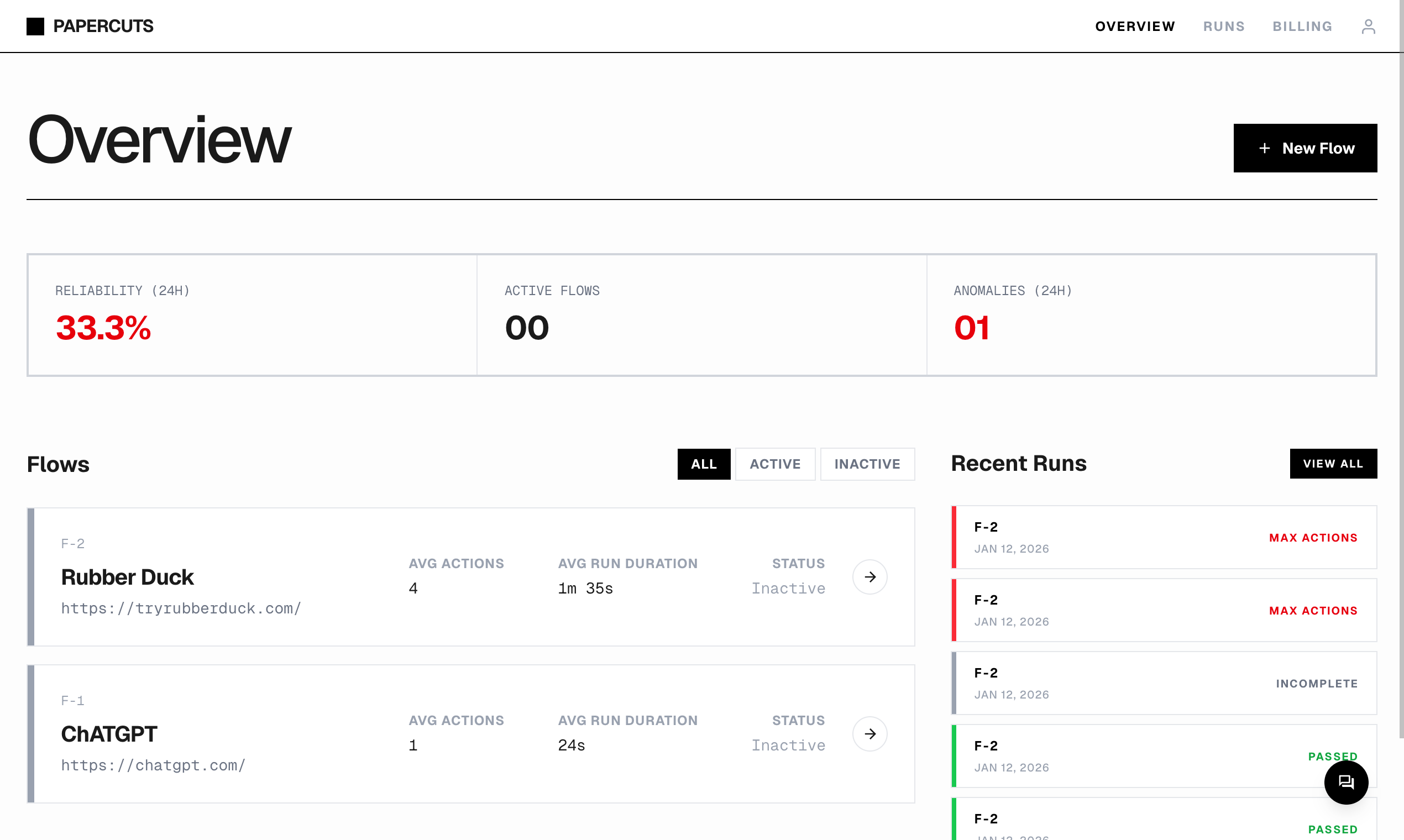
As the digital economy expands in 2026, the complexity of web applications has reached a point where deterministic scripts often fail to catch subtle user-facing regressions. Papercuts addresses this by deploying autonomous AI agents that “see” and interact with your application exactly like a human would. By moving away from fragile DOM-based selectors and focusing on semantic visual understanding, Papercuts ensures that critical business paths—such as checkouts and registrations—remain functional even when the underlying code changes. In an era where user experience is the primary differentiator, this vision-first approach provides a necessary safety net for modern engineering teams.
Key Features
- Vision-Driven Interaction: Uses advanced computer vision models to identify and interact with UI elements, meaning tests don’t break when CSS classes or IDs change.
- Production-Grade Monitoring: Designed to run continuously against your live application, providing real-time alerts when a user-visible flow is interrupted.
- No-Code Implementation: Requires zero SDK installation or code changes; teams can start testing immediately by providing a URL and a plain-English objective.
- Semantic Path Reasoning: AI agents can interpret high-level goals like “Add the blue shirt to the cart” and navigate the dynamic UI autonomously to complete the task.
- Adaptive Form Handling: Intelligently manages dynamic or conditional fields by observing visible context and responding based on visual feedback rather than pre-scripted steps.
- Intelligent Regression Alerts: Notifies teams via integrated channels (Slack, PagerDuty) only when a functional or visual break is confirmed, reducing the noise of traditional monitoring.
How It Works
Papercuts leverages a headless AI browser equipped with vision-language models. When you provide a target URL and a goal, the agent “looks” at the rendered page to identify interactive components. It reasons through the steps required to achieve the goal—such as clicking buttons, entering text, or navigating menus. Because it relies on visual pixels rather than the underlying DOM tree, it is uniquely capable of detecting issues that script-based tests miss, such as overlapping elements, broken styling, or third-party widget failures. The system records these sessions, providing developers with a clear visual audit trail of where a flow failed.
Use Cases
- Mission-Critical Flow Auditing: Ensures that revenue-generating paths like “Add to Cart” and “Subscription Renewal” are always operational in the production environment.
- Third-Party Integration Testing: Monitors flows that involve external components (e.g., Stripe, Intercom) which are difficult to mock in staging environments.
- Visual Regression Catching: Detects unintended layout shifts or broken assets that occur after a deployment but don’t necessarily trigger a standard error log.
- Continuous Accessibility Checks: Verifies that key interactive elements remain discoverable and usable as the UI evolves through rapid deployment cycles.
Pros & Cons
Advantages
- Resilience to Code Changes: Tests remain stable even after major front-end refactors, as long as the user-visible interface remains intuitive.
- Unrivaled Speed to Value: Zero-code setup allows product managers and non-technical QA teams to deploy monitoring agents in minutes.
- High-Fidelity Bug Detection: Catches “silent failures” where a page loads correctly according to the server but is visually broken or unusable for a human.
Disadvantages
- Production Risk Management: Care must be taken to ensure AI agents do not accidentally trigger real payments or unwanted database entries in a live environment.
- Agent Tuning Requirements: Complex or highly non-standard UIs may require initial “training” or goal refinement to ensure the agent follows the desired logic.
- Compute Intensity: Vision-based processing is more resource-heavy than standard script execution, which may lead to longer individual test run times.
How Does It Compare?
- Playwright & Cypress
- Use Case: Core deterministic integration and unit testing during the development cycle.
- Key Distinction: These tools rely on “selectors” (DOM) and break frequently during UI changes. Papercuts uses “vision” and is designed to supplement these tools by catching the visual regressions they miss.
- Datadog & New Relic (Synthetic Monitoring)
- Use Case: High-level availability monitoring and performance tracking.
- Key Distinction: Traditional synthetics usually check for status codes or specific text strings. Papercuts actively “uses” the app, providing a much deeper check of the actual user experience and business logic.
- Checkly
- Use Case: API and browser-based monitoring for critical workflows.
- Key Distinction: Checkly is highly reliable for scripted monitoring. Papercuts adds an “autonomous” layer that can explore paths and handle dynamic changes that rigid Checkly scripts might struggle with.
- Applitools Eyes
- Use Case: Specialized visual AI for pixel-by-pixel regression testing.
- Key Distinction: Applitools is primarily used for comparing snapshots to a “baseline.” Papercuts is an “agentic” tool that actually navigates the application flow, testing both function and form simultaneously.
- Mabl
- Use Case: Intelligent, low-code test automation for enterprise teams.
- Key Distinction: Mabl uses AI to self-heal DOM selectors. Papercuts bypasses the DOM entirely, offering a “pure vision” approach that requires even less setup and maintenance.
Final Thoughts
Papercuts represents the “last mile” of production quality assurance in the age of agentic AI. As our tools move faster, the risk of “breaking the glass” for users increases. By providing an autonomous observer that shares the human user’s perspective, Papercuts helps engineering teams sleep better at night. While it is not a replacement for traditional unit testing, it is an essential safety net for any brand that cannot afford a broken checkout or a failed login. For teams aiming for 99.9% functional uptime in 2026, Papercuts offers a low-effort, high-impact solution to the problem of silent regressions.