Table of Contents
Overview
Navigating the electronics component sourcing landscape presents a persistent challenge for hardware developers operating under stringent timelines and complex technical specifications. PartGenie emerges as an AI-powered partner specifically engineered to streamline component discovery and design optimization. This intelligent platform equips engineers and hardware development teams with capabilities to significantly compress development cycles by leveraging artificial intelligence for component evaluation, BOM refinement, and sophisticated technical problem-solving.
The platform addresses a critical gap in the hardware development workflow where component selection consumes disproportionate engineering time and introduces supply chain risks. By combining an extensive component database with natural language interaction, PartGenie transforms what traditionally requires weeks of research and specification analysis into streamlined, decisively informed selections.
Key Features
PartGenie delivers a comprehensive feature set engineered specifically for hardware engineering workflows:
Natural Language Component Search: Express your technical requirements in conversational language, and the system identifies matching components by understanding context, performance specifications, and engineering constraints.
AI-Powered Datasheet Interpretation: Access critical component specifications without manually reviewing extensive technical documentation, receiving AI-generated summaries of key parameters and design-relevant details.
Bill of Materials Optimization: Receive intelligent recommendations for cost reduction, supply chain risk mitigation, and component availability improvements across your entire BOM.
In-Stock Alternative Component Discovery: Navigate supply constraints by rapidly identifying compatible alternatives with current stock availability, reducing project delays.
Circuit and System Architecture Support: Obtain AI-informed design guidance for circuit optimization and system-level architecture decisions grounded in component compatibility and best practices.
Technical Question Resolution: Access immediate, evidence-based answers to complex hardware engineering questions, leveraging extensive component specifications and industry standards.
Hardware-Focused Workflow Integration: Purpose-built for hardware development teams, facilitating seamless collaboration and reducing friction in component selection processes.
Design File Analysis: Upload circuit diagrams, component photos, PCB layouts, or datasheets; the platform extracts component information and generates actionable insights from design artifacts.
How It Works
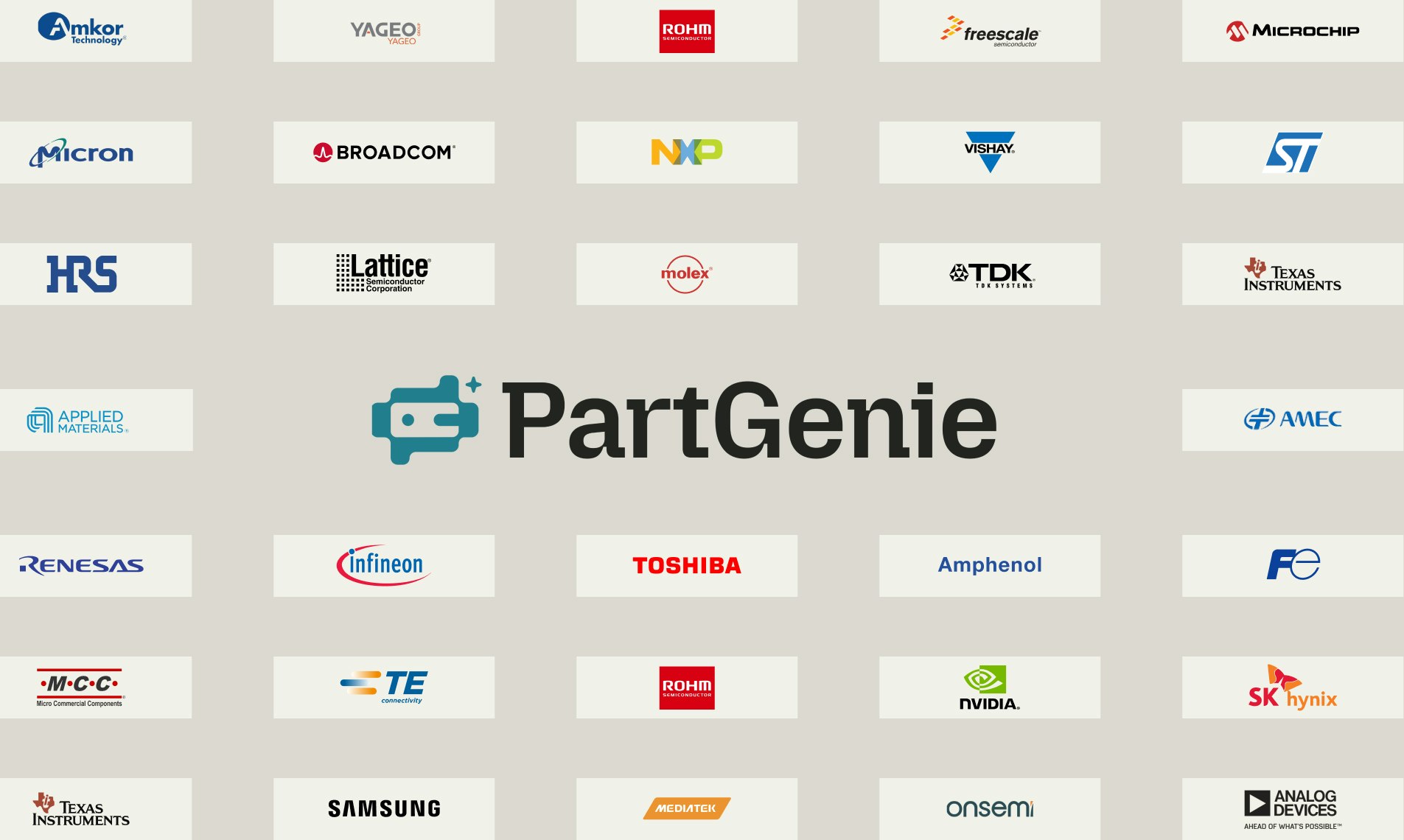
PartGenie operates through an intuitive process designed for practical engineering efficiency. Engineers begin by describing their component requirements, design constraints, or specific technical challenges through the platform’s natural language interface. The system immediately analyzes over 22 million components from 7,700 manufacturers and distributors, identifying options aligned with stated specifications.
Beyond initial selection, PartGenie provides detailed BOM analysis, flagging potential obsolescence risks, verifying availability across supply networks, and automatically suggesting cost-optimized alternatives. The platform functions as an accessible technical resource, answering nuanced hardware questions by synthesizing information from component datasheets and technical specifications without requiring manual datasheet review.
The verification process ensures data accuracy through systematic cross-referencing and source attribution, providing engineers with confidence in AI-generated recommendations. Real-time integration with distributor databases enables current pricing and lead time information, supporting informed procurement decisions.
Use Cases
PartGenie delivers substantial value across multiple hardware development scenarios:
Hardware Startups Operating Under Tight Development Timelines: Rapidly validate component selections and establish robust BOMs, compressing time-to-market for innovative products by eliminating extended component research phases.
Engineering Teams Addressing Supply Chain Disruptions: Quickly identify functionally compatible alternatives when preferred components become unavailable, maintaining production schedules despite market volatility.
Organizations Optimizing BOM Economics Before Production: Systematically identify cost reduction opportunities and verify component availability before committing to manufacturing, preventing expensive production delays.
R&D Teams Exploring Emerging Technologies and Design Approaches: Leverage AI-assisted datasheet analysis to efficiently understand component capabilities, enabling faster technology evaluation and implementation decisions.
Procurement Specialists Managing Complex Sourcing Requirements: Streamline the component discovery and evaluation process, reducing manual research and enabling faster procurement cycles.
Pros and Cons
Advantages
Specialized Electronics Expertise: Delivers insights precisely calibrated to hardware engineering requirements, providing substantially more relevant recommendations than generalist tools.
Significant Time Savings: Reduces hours of manual datasheet analysis and component comparison into minutes of focused AI-assisted decision making, accelerating design cycles.
Direct Supply Chain Problem-Solving: Specifically addresses component availability challenges and BOM cost optimization, helping teams navigate current supply market complexity.
Accessible Natural Language Interface: Supports engineers of varying experience levels with intuitive conversational interaction, eliminating the need for specialized search syntax or database expertise.
Design File Integration: Processes existing design documentation including schematics, PCB layouts, and component photos, extracting intelligence from artifacts already present in design workflows.
Disadvantages
Domain-Specific Applicability: Value proposition applies specifically to electronics hardware development, limiting utility for non-hardware engineering contexts.
Data Foundation Quality Dependency: Recommendation accuracy correlates directly with the quality, completeness, and currency of the underlying component database and manufacturer information.
Workflow Integration Considerations: Organizations with established EDA/PLM systems may require integration work to realize maximum benefit from the platform’s capabilities.
Post-Selection Implementation Gap: Platform excels at component identification and evaluation but does not automate actual procurement or supply chain execution activities.
Machine Learning Model Limitations: While generally reliable, AI-driven recommendations may occasionally contain inaccuracies requiring engineer verification, particularly for highly specialized or newly released components.
How Does It Compare?
PartGenie occupies a specialized position within the broader electronics sourcing ecosystem. The competitive landscape includes tools addressing different aspects of component sourcing and design workflows:
Versus Octopart
– Octopart provides lightweight, free BOM analysis with real-time distributor pricing and availability (83M+ parts)
– PartGenie differentiates through AI-native natural language interaction and FAE-level technical guidance rather than primarily search-focused component discovery
– Octopart remains optimal for quick part lookups; PartGenie excels at complex design decision support
Versus CalcuQuote
– CalcuQuote targets EMS providers with end-to-end quoting and procurement automation including RFQ management and supplier collaboration
– PartGenie focuses on the earlier design phase with component discovery and optimization, rather than manufacturing quotation
– Complementary tools addressing different workflow stages: CalcuQuote handles production quoting; PartGenie handles design-phase component selection
Versus Luminovo
– Luminovo emphasizes BOM management, PCB file analysis (Gerber/ODB++), and integration with 1,000+ distributor APIs for cost modeling
– PartGenie emphasizes AI-native natural language interaction and FAE-equivalent technical support
– Luminovo targets post-component-selection BOM optimization; PartGenie targets initial component discovery and evaluation
Versus Z2Data Part Risk Manager
– Z2Data offers 1.1B+ components with specialized lifecycle forecasting, compliance management (RoHS, REACH), and PCN management
– PartGenie emphasizes natural language access and technical question resolution rather than specialized compliance workflows
– Z2Data is optimal for compliance-heavy industries; PartGenie is optimal for rapid design iteration
Versus Wizerr BOM Optimizer
– Wizerr specializes in AI-driven cross-reference identification and pin-configuration compatibility verification for alternative parts
– PartGenie provides broader design support beyond component cross-referencing, including circuit guidance and system architecture consultation
– Wizerr focuses narrowly on part substitution; PartGenie addresses broader design challenges
Versus CircuitByte BOM Connector
– CircuitByte is the most complete traditional BOM tool for electronics manufacturing, featuring direct ERP integration and complex BOM processing
– PartGenie introduces AI-native natural language access and expert-level technical guidance rather than primarily data normalization and ERP connectivity
– CircuitByte optimizes for manufacturing teams managing complex existing BOMs; PartGenie optimizes for design teams in component discovery phases
Versus Supplyframe Intelligence Platform
– Supplyframe provides New Product Introduction (NPI) analytics, strategic sourcing optimization, and commodity forecasting at enterprise scale
– PartGenie emphasizes immediate, project-level component selection rather than strategic commodity-level supply chain planning
– Supplyframe serves enterprise supply chain strategy; PartGenie serves project-level design engineering decisions
Versus General Parts Search Engines (FindChips, DigiKey Parametric Search)
– Traditional search engines require keyword-based filtering and manual datasheet review for specification analysis
– PartGenie enables natural language requirements expression and automatic specification interpretation, eliminating manual search iterations
– PartGenie is substantially faster for complex, multi-parameter component selection scenarios
Versus Circuit Mind
– Circuit Mind automates complete circuit design from architecture specification through design option generation and automated technical reporting (FMECA, stress analysis)
– PartGenie provides component-focused support with design guidance, rather than end-to-end automated circuit generation
– Circuit Mind targets automated design synthesis; PartGenie targets design-informed component selection
Versus Cirkit Designer
– Cirkit Designer emphasizes real-time circuit simulation and Arduino/ESP32 ecosystem integration for embedded developers
– PartGenie emphasizes AI-assisted component discovery and professional-grade technical support for broader hardware ecosystems
– Cirkit Designer is optimized for prototyping; PartGenie is optimized for production-scale component decisions
Versus EDA-Integrated Part Selectors (Altium, Cadence, Siemens EDA)
– Embedded EDA component selectors provide integration with specific design tools but typically lack AI-native natural language access and external component database breadth
– PartGenie functions as a specialized, best-of-breed component discovery tool independent of specific EDA environments, enabling cross-platform utility
– EDA selectors optimize for design tool ecosystem integration; PartGenie optimizes for component discovery accuracy and speed
PartGenie’s core differentiator lies in combining AI-native natural language interaction with specialized electronics engineering expertise, enabling project teams to accomplish what traditionally required Field Application Engineer consultation or extensive manual research.
Important Considerations for Implementation
When evaluating PartGenie for adoption, consider the following practical factors:
Data Freshness and Accuracy: While the platform provides verified component data, the accuracy of AI recommendations depends on the timeliness of manufacturer and distributor information. Components with limited market penetration or very recent release dates may require verification against primary sources.
Complementary Tools: PartGenie optimizes component discovery and BOM optimization but does not replace ERP integration, procurement automation, or manufacturing management systems. Optimal implementation includes PartGenie as part of a broader hardware development toolkit rather than as a standalone solution.
Domain Specialization: Maximum utility requires application to electronics hardware projects. Software, mechanical, or cross-discipline development projects benefit less from PartGenie’s specialized focus on electronic component intelligence.
Learning Curve and Team Adoption: While the natural language interface reduces training requirements, team adoption accelerates when organizations establish clear processes for integrating PartGenie insights into existing design workflows and decision-making processes.
Final Thoughts
PartGenie addresses a genuine efficiency gap in hardware engineering by automating the historically time-consuming component discovery process. Through combining comprehensive component data with natural language AI access, the platform delivers substantial value for hardware startups, engineering teams optimizing supply chains, and organizations seeking to accelerate design cycles.
For any engineering team engaged in hardware development under timeline constraints or managing supply chain complexity, PartGenie represents a meaningful advancement in component sourcing workflows. The platform’s ability to provide FAE-equivalent technical guidance through accessible natural language interaction makes it particularly valuable during high-stakes design phases where engineering expertise directly influences project outcomes. While not a replacement for comprehensive ERP or PLM systems, PartGenie serves as a powerful, specialized optimization layer that elevates the sophistication and speed of component selection decisions—a critical factor in hardware project success.