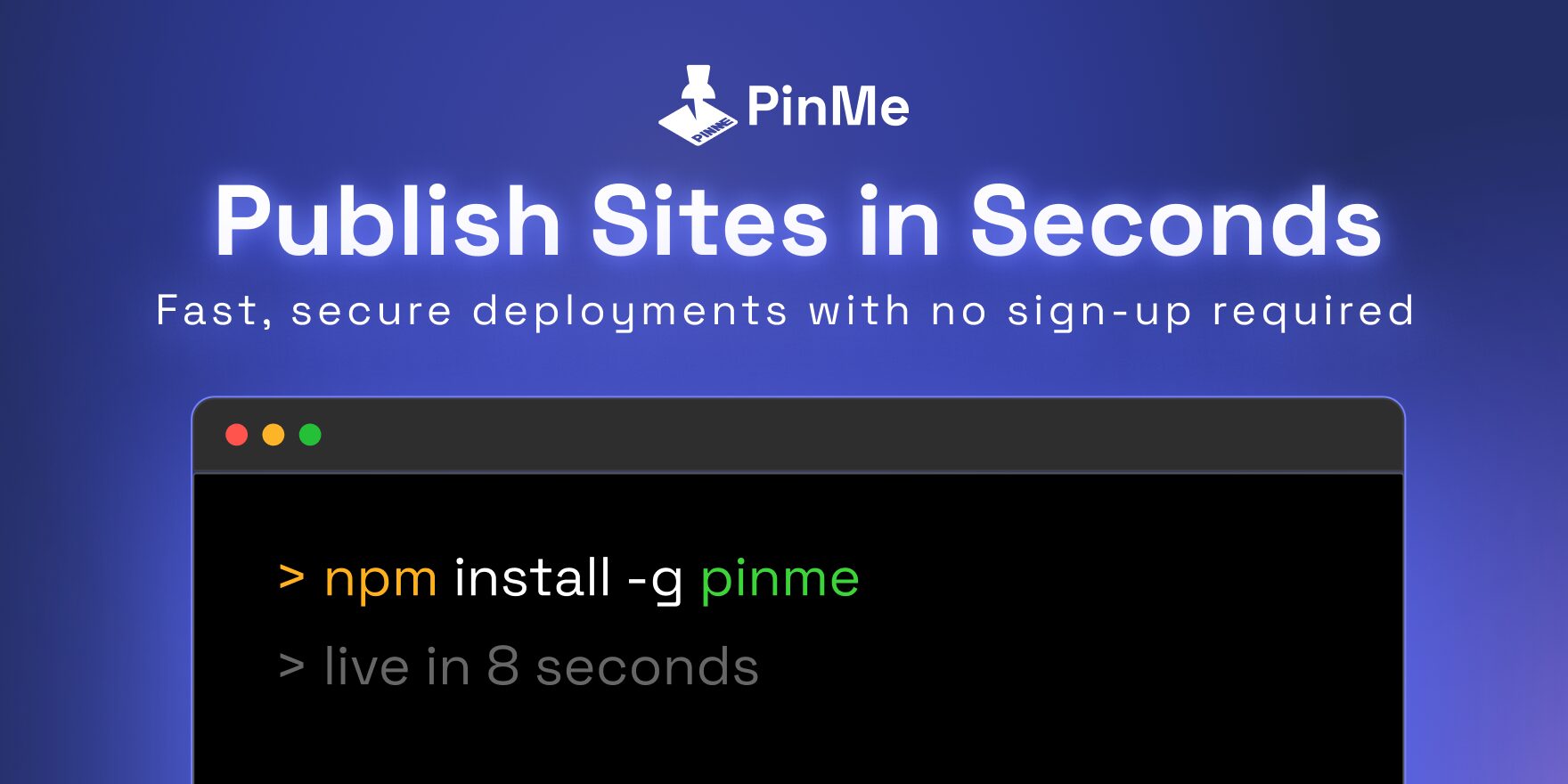

PinMe
PinMe is a zero-config static site deployment tool that publishes frontend projects to IPFS with ENS domain names. Built by the Glitter Protocol team, it lets you go from a local folder to a live URL in seconds. You can upload files through the browser with drag and drop, or deploy from your terminal with a single CLI command. No accounts, no signups, no logins, and no payments are required to get started.
What It Does
- Instant static site publishing: Upload a folder of frontend files and receive a shareable link immediately
- Browser-based deployment: Drag and drop your project files in the web interface at pinme.eth.limo
- CLI deployment: Install globally with npm (
npm install -g pinme) and deploy withpinme upload dist - Content-addressed hosting: Every deployment gets a unique IPFS content hash (CID), making the content tamper-evident
- ENS domain integration: Sites are accessible via .eth.limo gateway URLs
- Filecoin persistence: Long-term storage is backed by the Filecoin network to keep content available
- GitHub Actions support: Automate deployments through CI/CD workflows
- Custom domain binding: Available with a Plus membership through AppKey authentication
- AI assistant compatibility: Includes deployment protocols for use with AI coding tools like Claude
Who It Is For
PinMe is designed for frontend developers, designers, and creators who want to publish static content quickly without managing servers or cloud infrastructure. Common use cases include deploying vibe-coded pages, portfolios, landing pages, project demos, frontend prototypes, and open-source documentation. It works well for anyone building with frameworks like Vite, React, Vue, Next.js, or Angular, as well as plain HTML/CSS/JS projects.
Strengths
- True zero-config experience with no account creation required
- Extremely fast deployment workflow from build to live URL
- Decentralized content delivery through IPFS reduces single-point-of-failure risk
- Cryptographic content verification prevents silent tampering
- Open source under MIT license with 2.6k GitHub stars
- Free to use with reasonable upload limits (200MB per file, 1GB per directory)
- Works with any static site generator or frontend framework
Limitations
- Frontend-only hosting with no support for server-side rendering, API routes, or backend logic
- Content persistence depends on IPFS pinning and gateway availability
- Custom domains require Plus membership and AppKey setup
- IPFS gateway access can have higher latency compared to traditional CDNs
- Removing content from IPFS is not guaranteed network-wide after unpinning
- Smaller ecosystem and community compared to established platforms like Vercel or Netlify
Pricing
- Free tier: No account needed, 200MB single file limit, 1GB total directory limit
- Plus membership: Required for custom domain binding via AppKey (pricing details on pinme.eth.limo)
- No usage-based bandwidth charges on the free tier
How Does It Compare?
Fleek (fleek.xyz)
Fleek is a Web3-native hosting platform that supports IPFS, Filecoin, and Arweave storage. It offers Git-based continuous deployment, ENS and DNS domain support, dedicated IPFS gateways, and a CDN. Fleek provides a more full-featured development workflow with build pipelines and project management. The free tier includes $5 in monthly usage credits, while the Pro plan uses usage-based pricing starting at $0.07/GB for bandwidth. Fleek is better suited for teams needing CI/CD integration and multi-protocol storage options, while PinMe focuses on single-command simplicity.
4EVERLAND (4everland.org)
4EVERLAND is a Web3 cloud computing platform supporting deployment to IPFS, Arweave, Dfinity, and BNB Greenfield. It provides a hosting dashboard with Git repository syncing, automatic IPFS pinning, dedicated gateways with global acceleration, and custom domain support with free SSL. The platform also offers AI solutions, RPC services, and storage beyond just site hosting. 4EVERLAND provides a broader infrastructure stack compared to PinMe, making it more suitable for developers who need multi-chain deployment and additional cloud services.
Surge.sh
Surge is a centralized static site hosting platform with CLI-based deployment. Like PinMe, it offers a fast command-line workflow for publishing static files. Surge provides free hosting with custom domain support and unlimited site deployments on the free tier. The Professional plan costs around $30/month and adds features like custom SSL and password protection. Unlike PinMe, Surge uses traditional centralized infrastructure rather than IPFS, which means faster and more predictable performance but without decentralization benefits.
Vercel
Vercel is an enterprise-grade frontend deployment platform known for its tight integration with Next.js and other modern frameworks. It offers automatic Git-based deployments, serverless functions, edge rendering, preview deployments, and advanced analytics. The free tier includes 100GB bandwidth and 100K daily serverless function invocations. Vercel supports server-side rendering and API routes, which PinMe does not. It is a centralized platform focused on performance and developer experience rather than decentralization.
Netlify
Netlify is a comprehensive frontend platform offering Git-based continuous deployment, serverless functions, form handling, identity management, and split testing. The free tier includes 100GB bandwidth and 300 build minutes per month. Like Vercel, Netlify supports dynamic functionality through serverless functions and edge handlers. Netlify provides a richer feature set for full-stack frontend applications, while PinMe targets users who want the simplest possible path from local files to a live decentralized URL.
Cloudflare Pages
Cloudflare Pages is a JAMstack deployment platform built on Cloudflare’s global edge network. It offers Git integration, unlimited free-tier bandwidth, Cloudflare Workers for serverless functions, and an optional IPFS integration for serving pages on the decentralized web. Cloudflare Pages provides enterprise-grade DDoS protection and a massive CDN. Its IPFS integration makes it a hybrid option that bridges centralized performance with decentralized availability, though the IPFS feature is not universally available.
Pinata (pinata.cloud)
Pinata is the largest IPFS pinning service, focused on file storage and retrieval rather than site deployment. It provides APIs, SDKs, dedicated gateways with custom domains, and CI/CD pipeline integrations for automating IPFS uploads. Pinata is primarily a storage and pinning infrastructure provider, while PinMe is a deployment tool. Developers often use Pinata as a backend service for IPFS content management, whereas PinMe handles the full deploy-and-share workflow in a single step.
Final Thoughts
PinMe fills a specific niche in the deployment tool landscape by offering the fastest path from a local static project to a live, decentralized URL. Its zero-config, no-account approach removes friction that other platforms introduce through signup flows and dashboard configurations. The trade-off is a narrower feature set: no server-side rendering, no build pipelines, and no dynamic functionality. For developers who prioritize simplicity, censorship resistance, and content verifiability over advanced hosting features, PinMe delivers a compelling experience. For production applications that need CI/CD, serverless functions, or SSR, platforms like Vercel, Netlify, or Fleek are better fits. PinMe is at its best when used for rapid prototyping, sharing demos, publishing portfolios, or deploying any static frontend where getting online in seconds matters more than infrastructure control.