Table of Contents
Overview
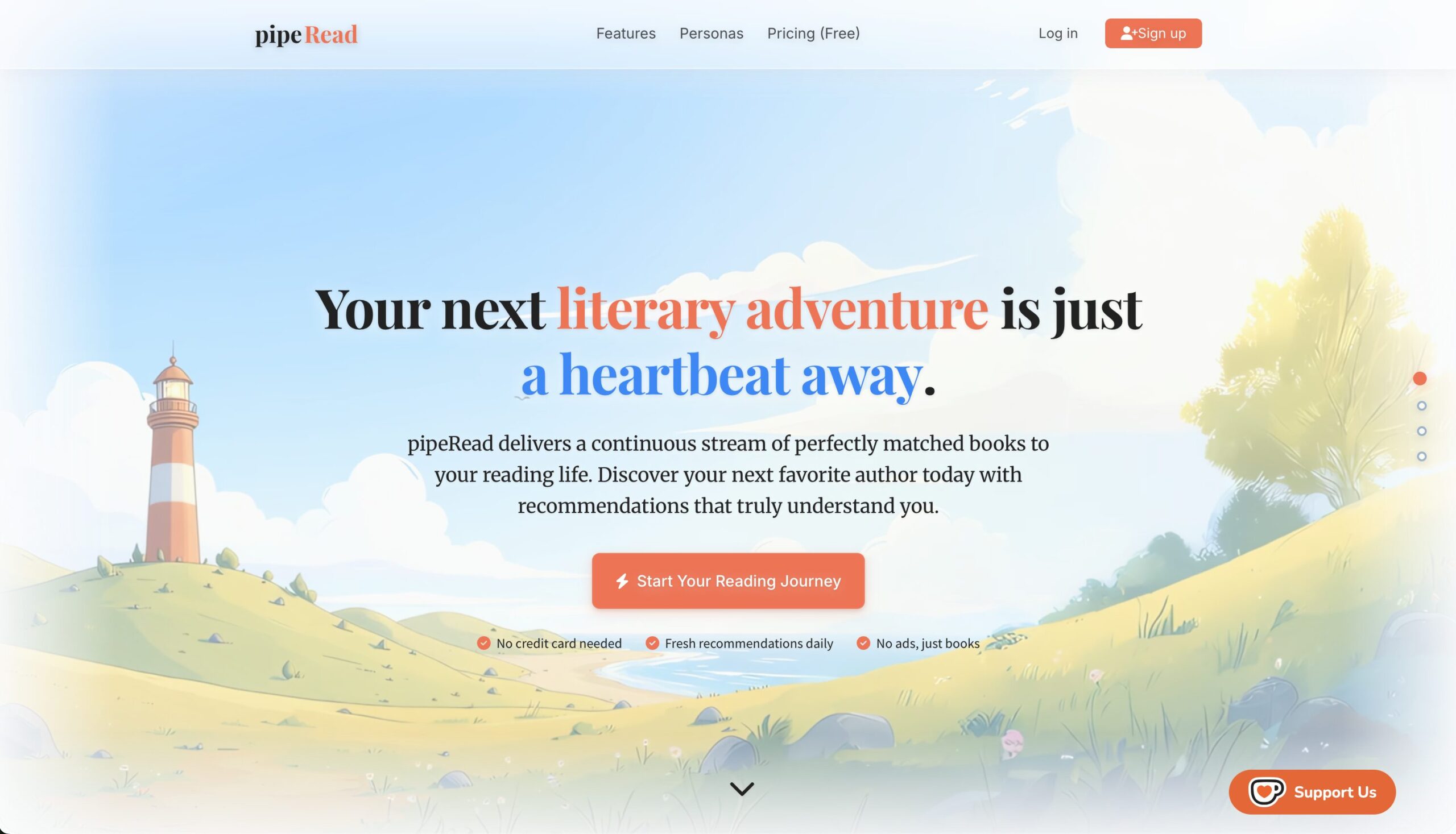
Tired of scrolling endlessly through generic “Thrillers” or “Fantasy” categories, hoping to stumble upon your next great read? Enter pipeRead, the AI-powered librarian designed to change how you discover books. Launched on Product Hunt on December 2, 2025, and featured on Hacker News (Show HN) the same day, the platform introduces a refreshingly unique approach: persona-based recommendations.
Instead of relying on broad genre tags, pipeRead uses specialized reading personas such as History Enthusiast, Adventure Seeker, Mystery Enthusiast, Romance Reader, Sci-Fi Enthusiast, Fantasy Lover, and General Reader to generate contextually relevant book suggestions. It’s like having a helpful, smart, and decidedly non-grumpy librarian who instantly understands the exact vibe you’re looking for. With no paywalls, no subscription fees, and zero advertisements, pipeRead delivers a continuous stream of perfectly matched books to your reading life through a lightweight, ad-free interface designed exclusively for book discovery.
Key Features
pipeRead packs innovation into a streamlined package. Here are the standout features that make it a compelling tool for any reader:
- Persona-Based Recommendations: This is the core of pipeRead. Instead of genres, you choose from seven specialized reading personas (History Enthusiast, Adventure Seeker, Mystery Enthusiast, Romance Reader, Sci-Fi Enthusiast, Fantasy Lover, and General Reader), and the AI finds books that match that specific energy, mood, and thematic preference. These personas are dynamically tuned to individual reading habits, current moods, and long-term literary goals through machine learning algorithms that continuously refine suggestions based on interaction patterns.
- Swipe-Based Discovery Interface: The platform features an intuitive Tinder-style swipe mechanism where users swipe right to save books to their personal library or swipe left to skip unwanted recommendations. Each swipe action provides real-time feedback to the AI system, which immediately processes these signals to refine subsequent suggestions through an active learning loop that improves recommendation accuracy with every user interaction.
- Six-Question Onboarding Quiz: Upon first login, users answer six targeted questions that establish initial preference profiles: reading frequency (Daily, Weekly, Monthly), reading goals (Entertainment \& Escape, Personal Development), favorite genres (Sci-Fi, Memoirs, etc.), preferred page count (Under 200 pages, 200-400 pages, etc.), desired experience (Thought-provoking ideas, Action-packed), and language preferences. The AI uses these responses to generate the first set of tailored recommendations before the swipe-training begins.
- Smart Collections \& Reading History: pipeRead automatically maintains a personalized library of saved books and tracks complete reading history across all sessions. It generates smart collections organized by user behavior patterns and persona preferences without manual input, creating longitudinal profiles that track taste evolution across months of usage.
- Daily Refreshed Recommendations: The system delivers fresh AI-curated recommendations daily through its lightweight infrastructure, ensuring zero performance lag and a constant supply of new discovery opportunities.
- Multi-Language Support: Book recommendations are available in 12+ languages including English, Turkish, Spanish, French, German, Italian, Portuguese, Russian, Japanese, Chinese, and Arabic, making it accessible to a global audience.
- Non-Grumpy Librarian Interface: The user experience is designed to be friendly, approachable, and helpful with a focus-optimized UI that dynamically hides non-essential interface elements, removing the intimidation factor of traditional book searching platforms.
- Completely Free Model: Access to all recommendations and features is 100% free with no subscription fees, no paywalls, and zero advertisements. The service operates through optimized infrastructure rather than advertising or data monetization, ensuring sustainable free access.
- Cross-Device Synchronization: All data synchronizes across devices upon login, with privacy-focused local caching for offline access to saved libraries.
How It Works
So, how does pipeRead deliver these unique recommendations? The process is refreshingly simple and intuitive, designed for rapid discovery.
Stage 1: Initial Preference Capture
Users register for a free account (registration is required to access any features). Upon first login, the platform presents a six-question onboarding quiz covering reading frequency, goals, genres, preferred page count, desired experience, and language preferences. These responses establish the baseline preference profile.
Stage 2: Persona Selection
As a user, you simply select a specific “persona” or character type that piques your interest from seven curated options: History Enthusiast, Adventure Seeker, Mystery Enthusiast, Romance Reader, Sci-Fi Enthusiast, Fantasy Lover, or General Reader. Each persona generates recommendations tuned to specific reading styles and can be freely switched depending on mood.
Stage 3: AI Analysis \& Generation
Once you’ve made your persona choice, the AI analyzes this preference combined with your onboarding responses to generate a curated list of books that perfectly match that specific vibe. The system employs psychological reader profiles rather than similarity clustering, incorporating temporal dimensions that adjust recommendations based on time-sensitive reading moods unavailable in competitor systems.
Stage 4: Swipe-to-Train Feedback Loop
The AI presents results in a swipeable format through visual book cards with cover art and author information. You swipe right to add interesting books to your “Favorites” list and swipe left to discard them. The algorithm updates your profile logic with every swipe, creating an active learning loop where the AI continuously refines understanding of your taste beyond the initial quiz responses.
Stage 5: Continuous Refinement
You can modify your preferences at any time through Profile settings (adjusting frequency, goals, genres, page length, experiences, language). The system maintains separate preference profiles for each persona when you use multiple simultaneously, ensuring contextually appropriate suggestions. All actions are reversible through the reading history dashboard.
Use Cases
The unique approach of pipeRead opens up several exciting possibilities for readers. Here are some of the best ways to use the tool:
Mood-Based Reading Discovery:
- Perfect for when you know the feeling or vibe you want from a book but not the specific genre or author
- Switch between personas based on current mood—dark and thrilling (Mystery Enthusiast) versus light and romantic (Romance Reader)
- Use temporal persona selection to match weekend historical fiction binges or travel adventure reading
Genre Exploration \& Niche Literature:
- Uncover hidden gems and unique stories that don’t fit neatly into mainstream categories through curated entry points into unfamiliar territory
- Discover indie titles and lesser-known authors through AI that considers psychological reader profiles beyond bestseller lists
Reading Slump Recovery:
- When you feel like you’ve read everything, a new discovery method can reignite your passion for reading
- Cycle through multiple personas to rediscover engagement through tailored suggestions that break out of established reading patterns
Gift Recommendations:
- Find the perfect book for a friend or family member by choosing a persona that matches their personality and reading style
- Explore recommendations across multiple personas to find books appealing to diverse preferences for book club selections
Post-Book Discovery:
- Readers who just finished a book can get instant recommendations matching the themes, style, or emotional tone of what they just read
- Request contextual suggestions through persona searches (type a book title or describe reading goals in the persona’s search field)
Personalized Library Management:
- Track reading history and completed books across genres through the persistent reading ecosystem
- Build curated collections of books matching specific moods or future reading intentions without manual organization
Pros \& Cons
Like any tool, pipeRead has its strengths and weaknesses. Here’s a balanced look at what to expect.
Advantages
- Completely Free with Zero Ads: There are no hidden costs, subscription fees, paywalls, or advertisements to worry about—100% free access to all features through optimized infrastructure.
- Simple User Interface: The platform is clean, straightforward, and incredibly easy to navigate with a swipe-based mechanism that makes browsing rapid and engaging.
- Highly Personalized: The persona-based system offers a more nuanced and personalized discovery experience than generic genre filters, establishing psychological reader profiles through continuous AI learning from explicit user feedback.
- Granular Control: Users can specify page counts (Under 200 pages, 200-400 pages, 400+ pages) and specific reading “experiences” (suspense, relaxation, thought-provoking ideas, action-packed), providing control beyond simple genre tags.
- Multiple Languages: Support for 12+ languages makes it accessible to a global audience and enables discovery of translated works.
- No Social Pressure: Unlike Goodreads-style platforms, pipeRead focuses exclusively on discovery without social features, eliminating performance anxiety around reading goals or public reviews.
- Fast Discovery Workflow: Swipe mechanic and daily refreshed stacks create higher engagement cycles than static recommendation engines, enabling rapid exploration.
Disadvantages
- Limited Utility: The tool is laser-focused on book recommendations and doesn’t offer other features like reading trackers, social networking, user-generated reviews, reading challenges, or community discussions found in comprehensive platforms.
- Registration Required Immediately: You must create an account before seeing any recommendations, creating an initial friction barrier for users wanting to test the service before committing.
- Unknown Database Depth: Compared to established giants like Goodreads, the full extent and diversity of its book database are not yet clear. The library may not include every obscure indie title or newly released books immediately.
- Web-Only Platform: No dedicated mobile app exists currently, limiting convenience for users preferring native iOS/Android experiences with offline access.
- Limited Personalization Context: The six-question onboarding provides less context than platforms analyzing extensive reading histories, potentially limiting initial recommendation accuracy until sufficient swipe data accumulates.
- No Social Discovery: Lacks friend recommendations, book club features, or community-curated lists that help discovery through trusted social connections.
How Does It Compare?
pipeRead vs. Goodreads
Goodreads is the dominant social cataloging platform with 90+ million members, extensive reviews, reading challenges, and book club features.
Core Focus:
- pipeRead: Pure AI-driven discovery engine using persona-based matching with real-time swipe training
- Goodreads: Social network for readers combining cataloging, reviews, friend recommendations, and reading challenges
Recommendation Approach:
- pipeRead: Persona-driven AI analyzing psychological reader profiles with temporal mood adjustments
- Goodreads: Collaborative filtering (what users who liked Book A also liked) combined with user-generated lists and social recommendations
Feature Set:
- pipeRead: Streamlined for fast discovery—swipe interface, persona selection, smart collections, reading history
- Goodreads: Comprehensive platform—shelves, reviews, ratings, reading challenges, author Q\&As, book clubs, giveaways, friend activity feeds
Social Layer:
- pipeRead: No social features; focuses exclusively on individual discovery
- Goodreads: Extensive social networking—friend connections, activity feeds, reading challenges, community groups
Business Model:
- pipeRead: 100% free with no ads or subscriptions
- Goodreads: Free with advertisements; owned by Amazon with some promotional content
When to Choose pipeRead: For fast, personalized discovery without social pressure; when you want mood-based recommendations; when simple swipe interface appeals more than catalog management.
When to Choose Goodreads: For tracking extensive reading history, participating in reading challenges, reading user reviews before purchasing, joining book clubs, or when social discovery through friends matters.
pipeRead vs. The StoryGraph
The StoryGraph is a modern alternative to Goodreads emphasizing data-driven recommendations, mood tracking, and detailed content warnings.
Recommendation Engine:
- pipeRead: Persona-based AI with swipe-to-train active learning loop
- The StoryGraph: Data-driven algorithm analyzing pace, mood, character-driven vs. plot-driven preferences, and extensive metadata tags
Mood \& Personalization:
- pipeRead: Seven predefined personas with six-question onboarding; temporal mood selection
- The StoryGraph: Granular mood tracking with detailed preferences (pace, character vs. plot focus, genres, themes, content warnings)
Tracking Features:
- pipeRead: Reading history and smart collections; focused on discovery over tracking
- The StoryGraph: Comprehensive reading statistics, year-in-books reports, detailed progress tracking, reading goals
Content Warnings:
- pipeRead: Not a primary feature
- The StoryGraph: Extensive crowdsourced content warnings for sensitive topics
Business Model:
- pipeRead: 100% free with no ads
- The StoryGraph: Free tier with premium subscription (Plus at \$4.99/month or \$50/year) for advanced features
When to Choose pipeRead: For simplest possible discovery workflow; when swipe interface appeals; when completely free access is priority; for casual readers avoiding tracking complexity.
When to Choose The StoryGraph: For data-driven readers wanting detailed statistics, comprehensive tracking, content warnings, and willing to invest in premium features for advanced analytics.
pipeRead vs. Readow.ai
Readow.ai is another AI-powered book recommendation tool leveraging artificial intelligence for personalized suggestions.
Input Method:
- pipeRead: Persona selection combined with swipe-based training; six-question onboarding
- Readow.ai: Type in titles of books you like to see AI-generated recommendations
Interaction Model:
- pipeRead: Active swipe interface creating continuous feedback loop
- Readow.ai: Search-based input requiring users to remember and type specific book titles
Persona System:
- pipeRead: Seven specialized reading personas with psychological profiling
- Readow.ai: Similarity-based recommendations without persona framework
When to Choose pipeRead: For exploration through mood/persona rather than similar-to-existing-books; when swipe discovery interface appeals; for free daily-refreshed recommendations.
When to Choose Readow.ai: When you have specific favorite books and want similar recommendations; when text-based input is preferred over swipe interface.
pipeRead vs. Shepherd
Shepherd is a book recommendation platform featuring curated lists from authors and experts recommending books on specific topics.
Curation Approach:
- pipeRead: AI-driven persona-based recommendations through machine learning
- Shepherd: Human-curated lists created by authors recommending books on topics they’re experts in
Authority:
- pipeRead: Algorithm-driven discovery based on psychological reader profiles
- Shepherd: Expert-driven recommendations leveraging author credibility and subject-matter expertise
Discovery Method:
- pipeRead: Swipe interface with real-time AI adaptation
- Shepherd: Browse curated lists organized by topic and recommender
When to Choose pipeRead: For AI-powered, mood-based discovery; when rapid swipe-based exploration appeals; for completely free access.
When to Choose Shepherd: When you value expert human curation over algorithms; for topic-specific deep dives into niche subjects; when author recommendations carry weight.
pipeRead vs. Literal Club
Literal Club is a modern, beautifully designed book tracking and social reading platform emphasizing aesthetics and community.
Core Focus:
- pipeRead: Pure discovery engine with minimal tracking
- Literal Club: Comprehensive tracking, journaling, and social reading with aesthetic-first design
Social Features:
- pipeRead: No social layer
- Literal Club: Book clubs, friend activity, sharing reading progress, community discussions
Journaling:
- pipeRead: Basic reading history
- Literal Club: Extensive reading journal with notes, highlights, and reflections
When to Choose pipeRead: For fast discovery without social or tracking overhead; when simple swipe interface is priority; for completely free access.
When to Choose Literal Club: For aesthetic-first design, comprehensive journaling, social reading community, and when visual presentation matters.
Final Thoughts
pipeRead is an innovative tool for any reader looking to break free from traditional genre-based book discovery methods. Its unique persona-based system combined with the swipe-to-train interface is both fun and surprisingly effective at unearthing books that match specific moods or character archetypes beyond what generic genre tags can provide.
The December 2, 2025 Product Hunt and Hacker News launches demonstrate market validation for AI-powered, persona-driven discovery as an alternative to social cataloging giants. The platform’s 100% free model with zero advertisements addresses a genuine gap: users seeking rapid, personalized discovery without the complexity of comprehensive tracking platforms or the noise of social networks.
The system’s continuous learning through swipe feedback creates an active improvement loop that collaborative filtering cannot replicate, particularly for temporal mood-based reading where your current preference (cozy mystery) differs from your typical profile (epic fantasy). The six-question onboarding combined with persona selection provides faster cold-start recommendations than platforms requiring extensive manual tagging or reading history imports.
While it may not replace comprehensive platforms like Goodreads or The StoryGraph for tracking extensive reading history, managing reading challenges, or engaging with book communities, it excels as a specialized discovery engine. The laser focus on discovery rather than feature bloat creates a streamlined experience for the specific use case: “What should I read next?”
However, prospective users should consider: the registration requirement creates initial friction for testing; the database depth and coverage of newly released or obscure indie titles remain unclear; web-only availability limits mobile convenience; and the lack of user reviews means you’ll need to consult other sources before purchasing.
If you’re in a reading slump, tired of algorithm fatigue on mainstream platforms, or just want a fresh, creative way to find your next literary adventure through mood-based personas and a fun swipe interface, pipeRead is absolutely worth a try. The completely free model removes all risk, making it an easy complement to existing reading platforms rather than a replacement.
The tool particularly excels for casual readers seeking rapid discovery without tracking overhead, mood-based readers whose preferences vary by context, and users frustrated by genre limitations in traditional recommendation systems. For these users, pipeRead’s persona-driven approach offers a genuinely novel discovery experience that feels more intuitive than browsing endless genre lists or waiting for algorithmic recommendations to catch up with shifting preferences.