
Table of Contents
Overview
In the complex landscape of online marketplace development, entrepreneurs often face significant barriers including technical complexity, high development costs, and lengthy deployment timelines. Prometora is an AI-powered marketplace generation platform that transforms natural language descriptions into fully functional, multi-vendor marketplaces within hours. Founded by Rasmus, a marketplace development specialist, and launched on Product Hunt in November 2025 with 58 upvotes, Prometora addresses the fundamental challenge of democratizing marketplace creation for non-technical founders, creators, and agencies. By eliminating traditional template selection and coding requirements, the platform enables rapid idea validation and market testing without the substantial upfront investment typically associated with custom marketplace development.
Key Features
Prometora delivers a comprehensive feature set specifically engineered to accelerate marketplace deployment:
AI-Powered Prompt-to-Marketplace Generation: Converts detailed natural language descriptions into complete, operational marketplace platforms without requiring template selection or code writing. Users describe their marketplace concept including target niche, user personas, monetization models, and desired functionality, and the AI orchestrates the entire build process autonomously.
Complete Marketplace Infrastructure: Generates fully integrated platforms including unlimited product listings, advanced search and filtering capabilities, multi-gateway payment processing via Stripe and PayPal, real-time user-to-user messaging systems, dual-sided review mechanisms, vendor-specific dashboards, and comprehensive user account management systems.
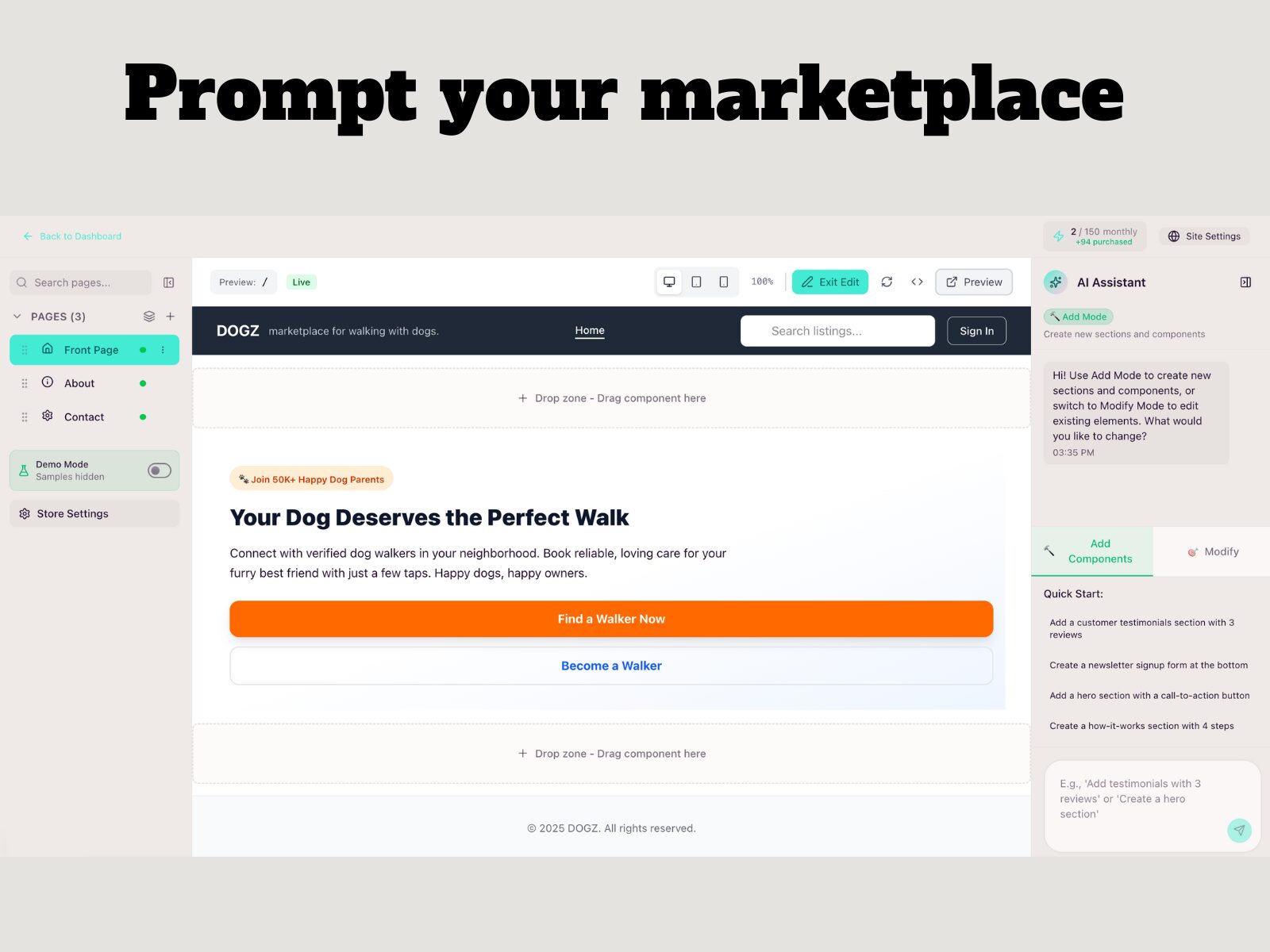
Drag-and-Drop Customization Interface: Provides intuitive visual editing tools enabling users to refine branding elements, adjust page layouts, modify navigation flows, and customize design aesthetics after AI generation without touching code. The component library includes pre-built marketplace elements that can be added or repositioned through simple drag-and-drop actions.
Tiered Subscription Architecture: Offers three distinct pricing tiers designed to support different business stages. The Starter plan provides 15 AI generations per month at \$33/month for MVP testing. The Professional plan delivers 60 generations monthly at \$75/month with custom domain support, white-label branding removal, and priority support. The Business plan includes 150 generations at \$135/month plus API access, custom webhooks, dedicated account management, and optional white-glove setup services where Prometora’s technical team handles complete marketplace configuration.
Multi-Vendor Operational Framework: Supports complex marketplace operations including vendor onboarding workflows, commission tracking and management, automated order routing to appropriate vendors, inventory synchronization, seller payout automation, and marketplace-wide or vendor-specific shipping method configuration.
SEO and Analytics Integration: Includes built-in search engine optimization tools, performance analytics dashboards tracking revenue metrics, user engagement data, conversion rate monitoring, and geographic targeting capabilities for location-based marketplace expansion.
How It Works
Prometora’s deployment methodology follows a streamlined three-phase workflow optimized for speed and simplicity. The process begins with prompt creation, where users compose a comprehensive natural language description of their marketplace vision. Unlike traditional platform builders requiring technical specifications or wireframe designs, Prometora accepts conversational descriptions covering marketplace type (product sales, services, rentals, digital goods), target audience demographics, intended monetization approach (commission structures, listing fees, subscription models), required features (booking calendars, auction functionality, subscription management), and desired visual style or industry context. For example, a prompt might state: “Create a sustainable fashion marketplace connecting eco-conscious consumers with verified ethical clothing brands, featuring carbon footprint tracking for each product, material certification upload capabilities, and 10% commission on sales.”
Following prompt submission, Prometora’s AI engine analyzes the description and dynamically generates the marketplace architecture. This includes backend logic configuration establishing database relationships, user role definitions, transaction workflows, and payment splitting mechanisms. The AI simultaneously constructs frontend interfaces with industry-appropriate design patterns, generates all system pages (homepage, listing repositories, individual listing views, seller dashboards, checkout flows, user profiles), integrates third-party services (payment processors, analytics tracking, email systems), and establishes marketplace rules (commission calculations, shipping zone configurations, review moderation settings). This generation process typically completes within minutes, delivering a functional marketplace accessible via temporary Prometora subdomain.
The final phase involves visual refinement and launch preparation. Users access the generated marketplace through Prometora’s dashboard and utilize the drag-and-drop editor to adjust branding (logos, color schemes, typography), reorganize page layouts, modify content sections, add or remove components from the pre-built library, and configure operational settings (commission rates, payment methods, shipping options, user permissions). For production deployment, paid plan users connect custom domains with included SSL certification and DNS configuration assistance. Professional and Business tier subscribers can remove Prometora branding for fully white-labeled experiences. The platform includes API access on Business plans enabling integration with external CRM systems, marketing automation tools, or custom-built extensions. From initial prompt to live marketplace capable of accepting real transactions, the complete process can be accomplished within hours rather than the weeks or months required by traditional development approaches.
Use Cases
Prometora serves diverse marketplace creation scenarios across multiple user segments:
Startup Founders Conducting Market Validation: Entrepreneurs with marketplace concepts can rapidly deploy minimum viable products to test demand hypotheses without committing to expensive custom development. Examples include niche service marketplaces like specialized tutoring platforms connecting credentialed experts with students in specific subjects, local service networks for dog walking or pet care providers, or rental platforms for professional equipment like camera gear or audio recording equipment. The rapid deployment enables founders to gather real user feedback, validate pricing models, and demonstrate traction to potential investors before scaling.
Content Creators and Influencer Communities: YouTubers, podcasters, artists, and community leaders can establish dedicated commerce platforms for their audiences. Use cases include fan merchandise marketplaces where community members sell fan art, custom products, or collectibles; digital product stores for selling exclusive content, courses, or memberships; and collaborative platforms where creators can offer services like commissioned artwork, personalized videos, or consulting sessions directly to their follower base without relying on third-party platforms that charge high fees.
Digital Agencies and Development Studios: Marketing agencies and web studios can leverage Prometora to rapidly prototype marketplace solutions for clients, significantly reducing proposal-to-delivery timelines. Agencies can generate functional marketplace demonstrations during sales processes, deliver client projects in days rather than months, and offer ongoing marketplace management services without maintaining large technical teams. This enables smaller agencies to compete for marketplace projects traditionally requiring enterprise development resources.
E-Commerce Brands Expanding Business Models: Established online retailers can test multi-vendor marketplace models to expand product selection without inventory investment. Brands can invite complementary vendors to sell through their platform, curate product catalogs while outsourcing fulfillment to individual sellers, and generate additional revenue through commissions while leveraging existing customer bases and brand trust.
Non-Technical Entrepreneurs Entering E-Commerce: Individuals without programming knowledge or technical backgrounds can launch marketplace businesses in sectors they understand deeply. Examples include regional artisan hubs connecting local craftspeople with consumers, sustainable product marketplaces curating eco-friendly goods from verified vendors, or specialized B2B marketplaces serving niche industries like construction materials, restaurant supplies, or healthcare equipment.
Educational and Nonprofit Organizations: Schools, universities, and nonprofit groups can create internal marketplaces for textbook exchanges, equipment rentals, volunteer service matching, or community resource sharing without requiring institutional IT departments to build custom solutions.
Pros and Cons
Advantages
Exceptional Development Speed: Dramatically compresses marketplace deployment timelines from typical 3-6 month custom development cycles to hours, enabling rapid market entry and competitive advantage through speed-to-market. This acceleration allows entrepreneurs to test multiple marketplace concepts sequentially rather than committing extensive time to single ideas.
Eliminated Technical Barriers: Removes requirements for technical co-founders, software development knowledge, or relationships with development agencies. Non-technical founders can independently build, launch, and iterate on marketplace platforms without learning programming languages or understanding complex technical architectures.
Comprehensive Feature Integration: Delivers production-ready marketplaces with enterprise-grade infrastructure including secure payment processing, messaging systems, review mechanisms, vendor management tools, and analytics capabilities that would typically require months of integration work and ongoing maintenance when building custom solutions.
Cost-Effective Market Testing: Enables low-risk marketplace validation at subscription costs substantially lower than custom development (which typically starts at \$10,000-50,000 for basic marketplace MVPs). The monthly subscription model allows founders to test ideas without large capital commitments, discontinuing easily if concepts don’t validate.
Flexible Scalability Options: Supports growth through tiered pricing accommodating expanding generation needs, custom domain deployment for professional branding, API access enabling third-party integrations, and the ability to export and migrate to custom platforms as businesses mature and require specialized functionality beyond Prometora’s capabilities.
Active Development and Support: Benefits from ongoing platform improvements, feature additions, and responsive founder-led support evidenced by recent V2 updates and Product Hunt community engagement, suggesting commitment to long-term platform evolution rather than static tool maintenance.
Disadvantages
AI Generation Constraints: Output quality and feature sophistication remain bounded by underlying AI capabilities and Prometora’s generation algorithms. Highly unique design requirements, complex custom workflows, or industry-specific compliance features (like HIPAA for healthcare marketplaces or PCI DSS for financial services) may not be fully achievable through AI generation alone.
Per-Generation Cost Structure: Each marketplace generation consumes subscription allocation, potentially increasing costs for users who need extensive iteration or want to test multiple marketplace variations. Unlike unlimited-use platforms, experimentation requires careful prompt formulation to maximize value from limited monthly generations.
Limited Deep Customization: While visual customization is extensive, fundamental architectural changes to backend logic, database structures, or transaction flows may not be possible without custom development. Users requiring sophisticated vendor tiering systems, complex commission calculation formulas, or specialized fulfillment workflows may encounter limitations.
Platform Dependency: Marketplaces remain hosted on Prometora’s infrastructure (except potentially at Business tier with custom arrangements), creating vendor lock-in concerns and ongoing subscription requirements for continued operation. Migration to self-hosted or fully custom solutions requires rebuilding rather than simple export.
Early-Stage Maturity: As a recently launched platform (November 2025), users should anticipate evolving features, potential workflow changes, and the possibility that certain capabilities may undergo modification as the platform matures based on user feedback and technical improvements.
Success Requires Business Execution: Platform provides infrastructure but doesn’t solve fundamental marketplace challenges including vendor acquisition, demand-side user growth, marketplace liquidity (sufficient buyers and sellers), quality control, dispute resolution, and competitive differentiation. Technology alone doesn’t guarantee marketplace success.
How Does It Compare?
Prometora occupies a distinctive position in the 2025 marketplace creation ecosystem, differentiating through its AI-first generation approach versus template-based builders, code-focused platforms, or enterprise solutions.
No-Code Marketplace Builders
Sharetribe: A purpose-built marketplace platform offering Sharetribe Go (no-code SaaS starting at \$39/month) and Sharetribe Flex (API-based solution with custom code access). Sharetribe provides deep marketplace functionality including user types configuration, transaction engine customization, and extensive integration options. It excels at delivering proven marketplace patterns with strong vendor management, supports scaling to substantial transaction volumes, and offers both hosted SaaS and self-hosted deployment. However, Sharetribe requires users to configure marketplace structure, select transaction models, and build frontend experiences even in Go. Prometora differentiates through single-prompt generation eliminating configuration complexity, though Sharetribe provides more mature scalability infrastructure and proven enterprise deployments.
Kreezalid: A no-code marketplace builder starting at \$299/month focusing on rapid deployment without coding. Kreezalid offers pre-built marketplace templates for products, services, and rentals with built-in payment processing, shipping management, and vendor dashboards. It provides faster setup than traditional development and reasonable customization depth through visual editors. Compared to Prometora, Kreezalid requires template selection and manual configuration of marketplace features, while Prometora generates complete platforms from descriptions. Kreezalid may offer more established stability and marketplace-specific workflows, while Prometora provides more innovative AI-driven generation and faster initial deployment.
Arcadier: An enterprise-grade SaaS platform offering white-label marketplace solutions with tiered pricing from \$1,500/month for basic features to \$2,500+/month for advanced capabilities. Arcadier supports product, service, rental, and B2B marketplaces with pre-built templates enabling rapid deployment (weeks rather than months), advanced vendor onboarding, commission management, and multi-gateway payouts. It targets established businesses and enterprise clients requiring robust vendor management and custom workflow automation. Prometora operates at substantially lower price points (\$33-135/month) targeting earlier-stage founders and rapid MVP testing rather than Arcadier’s enterprise-focused deployments.
Development Platform-Based Solutions
Bubble.io: A comprehensive no-code application development platform enabling complex web application creation including marketplaces. Bubble provides complete control over database design, visual interfaces, workflow logic, API integrations, and third-party plugin connections. It excels at building highly customized marketplace applications with unique features, complex user flows, and specialized functionality, evidenced by successful marketplace examples like Flexiple (freelance recruiting) and SWOP (peer-to-peer trading). Bubble requires substantial platform learning, database architecture understanding, and significant build time (typically weeks to months). Prometora trades Bubble’s unlimited customization flexibility for dramatically faster deployment through AI generation, serving users prioritizing speed over deep customization capabilities.
Webflow + Extensions: Webflow’s visual web design platform combined with marketplace extensions from apps like Wized, Whalesync, or custom integrations enables marketplace creation with exceptional design control. This approach provides unmatched frontend design flexibility, powerful CMS capabilities, and integration options with backend services like Airtable or Xano. However, building functional marketplaces requires technical understanding of integrations, API configurations, and workflow automation, plus substantial time investment in connecting disparate tools. Prometora offers integrated marketplace generation eliminating tool orchestration complexity, though Webflow-based solutions provide superior design customization for brands prioritizing visual differentiation.
E-Commerce Platform Extensions
Shopify Multi-Vendor Apps: Shopify’s ecosystem includes marketplace apps like Webkul MultiVendor Marketplace, Shipturtle, and Multivende that transform standard Shopify stores into multi-vendor platforms. These solutions leverage Shopify’s mature e-commerce infrastructure, payment processing, and app ecosystem. They excel for businesses already on Shopify wanting to add marketplace functionality, benefit from Shopify’s reliability and support, and integrate with extensive third-party apps. However, Shopify’s single-merchant architecture creates limitations for true multi-vendor marketplaces including checkout constraints, order splitting challenges, and vendor fulfillment complexities. Prometora is purpose-built for marketplaces from inception, providing more native marketplace workflows than Shopify retrofitted with apps, though Shopify offers broader e-commerce feature depth and established credibility.
Self-Hosted Marketplace Solutions
CS-Cart Multi-Vendor: An open-source, self-hosted marketplace platform with lifetime licensing starting at \$1,450 providing complete code access and extensive customization capabilities. CS-Cart includes 500+ features covering vendor management, product catalogs, order processing, SEO tools, and multi-storefront support. It serves businesses requiring full platform ownership, complex customization through code access, and freedom from recurring subscription costs. CS-Cart demands technical expertise for deployment, ongoing maintenance, and customization, plus infrastructure management responsibilities. Prometora eliminates technical requirements and maintenance burdens through fully managed SaaS, though CS-Cart provides ownership and unlimited customization for technically capable organizations.
Yo!Kart: A self-hosted multi-vendor marketplace software offering one-time licensing (starting around \$499-999) with native mobile apps, extensive vendor management tools, and support for B2B, B2C, and C2C models. Yo!Kart provides lifetime ownership, no recurring fees after purchase, and scalability for high-traffic operations. Like CS-Cart, it requires technical setup, hosting infrastructure, security management, and ongoing maintenance. Prometora’s managed SaaS approach trades ownership for simplicity, immediate deployment, and eliminated technical overhead, serving different buyer priorities.
Enterprise Marketplace Platforms
Mirakl: An enterprise-level marketplace platform serving major retailers and brands with custom pricing typically starting around \$90,000 annually. Mirakl delivers API-first architecture, AI-powered vendor matching, enterprise-grade scalability, and comprehensive seller operations management. It targets Fortune 500 companies and established retailers launching marketplace channels. Prometora operates in an entirely different market segment serving entrepreneurs, small businesses, and early-stage marketplaces at a fraction of Mirakl’s cost and complexity.
Vendo: An all-in-one SaaS marketplace platform launched in 2022 specializing in automated vendor onboarding from Shopify, WooCommerce, and Magento stores. Vendo automates catalog synchronization, order fulfillment routing, seller payouts, and marketplace tax management with built-in storefronts or headless API integration options. It focuses on rapid marketplace launch with automated operations, differentiating through deep integrations with existing e-commerce platforms. Pricing details vary but target serious marketplace businesses rather than early validation stages. Prometora emphasizes AI-driven generation and broader marketplace types, while Vendo specializes in multi-platform vendor aggregation and dropshipping models.
Emerging AI-Powered Platform Risk
As of November 2025, major AI companies including OpenAI, Google (with Gemini), and Anthropic are developing increasingly sophisticated code generation capabilities that could potentially enable similar prompt-to-application generation. Future releases from these well-resourced organizations could commoditize Prometora’s core value proposition if they develop marketplace-specific generation capabilities. Prometora’s competitive advantage depends on marketplace-specific optimization, integrated hosting infrastructure, and continuous feature development that generic AI code generators may not match.
Final Thoughts
Prometora represents a meaningful innovation in marketplace development accessibility, addressing the fundamental friction preventing non-technical entrepreneurs from testing marketplace concepts: the requirement for technical expertise, substantial capital, and extended timelines. By applying generative AI to marketplace infrastructure creation rather than simple website building, Prometora enables idea validation at unprecedented speed and cost efficiency. The platform is particularly well-suited for founders in the exploration phase who need to quickly determine whether their marketplace concept resonates with potential users before committing to serious investment, creators building commerce platforms for existing communities, and agencies requiring rapid client delivery capabilities.
The platform’s effectiveness should be evaluated within appropriate context. Prometora excels at generating functional marketplace MVPs that can process real transactions, onboard vendors, and validate demand hypotheses. It dramatically lowers the barrier to entry for marketplace entrepreneurship, potentially unleashing marketplace concepts that would never launch under traditional development requirements. For early-stage validation where speed and cost efficiency are paramount, Prometora’s value proposition is compelling.
However, founders should recognize that marketplace success depends far more on execution than technology. Prometora solves the platform problem but doesn’t address marketplace liquidity challenges (attracting sufficient buyers and sellers), quality control systems, competitive differentiation, or go-to-market strategy. The most sophisticated marketplace platform fails without vendor acquisition, demand generation, and operational excellence. Additionally, businesses requiring deep customization, industry-specific compliance features, complex backend logic, or preparing for substantial scale may eventually require migration to more robust platforms or custom development.
Prometora’s recent Product Hunt launch with modest but engaged traction (58 upvotes, active discussions) suggests early validation rather than mainstream adoption. As an early-stage platform, users should anticipate evolving features and potential workflow changes as the founder incorporates feedback and refines capabilities. The platform would benefit from public case studies demonstrating successful marketplace launches, transparent pricing tiers beyond current subscription models, and clear guidance on scaling paths for businesses outgrowing the platform.
For non-technical founders wanting to test marketplace ideas before hiring developers, creators monetizing communities through commerce, or anyone valuing deployment speed over deep customization, Prometora offers a genuinely differentiated approach worth evaluation. The 30-day money-back guarantee provides risk-free testing opportunity. As the marketplace creation landscape becomes increasingly competitive with both specialized builders and emerging AI capabilities, Prometora’s success will depend on continuous innovation, marketplace-specific feature depth, and demonstrated customer success stories proving that AI-generated marketplaces can achieve real business outcomes.