
Table of Contents
Overview
PrompTessor Reverse Prompt revolutionizes prompt discovery through reverse-engineering capabilities that analyze existing content to uncover the likely prompts that generated them. Launched publicly in October 2025, with Reverse Prompt feature shipping October 9, 2025, PrompTessor evolved from traditional prompt optimization tool to comprehensive prompt engineering platform combining prompt creation, optimization, and reverse-engineering capabilities. Rather than only helping users create prompts from scratch, PrompTessor enables teams to learn from successful outputs—analyzing images, text, and web content to extract underlying prompts, then refine those prompts for specific AI models. The platform serves prompt engineers, content creators, and AI teams seeking to understand prompt effectiveness, recreate successful content, and systematize prompt engineering processes across teams.
Key Features
PrompTessor combines multi-directional prompt engineering with optimization and collaboration tools:
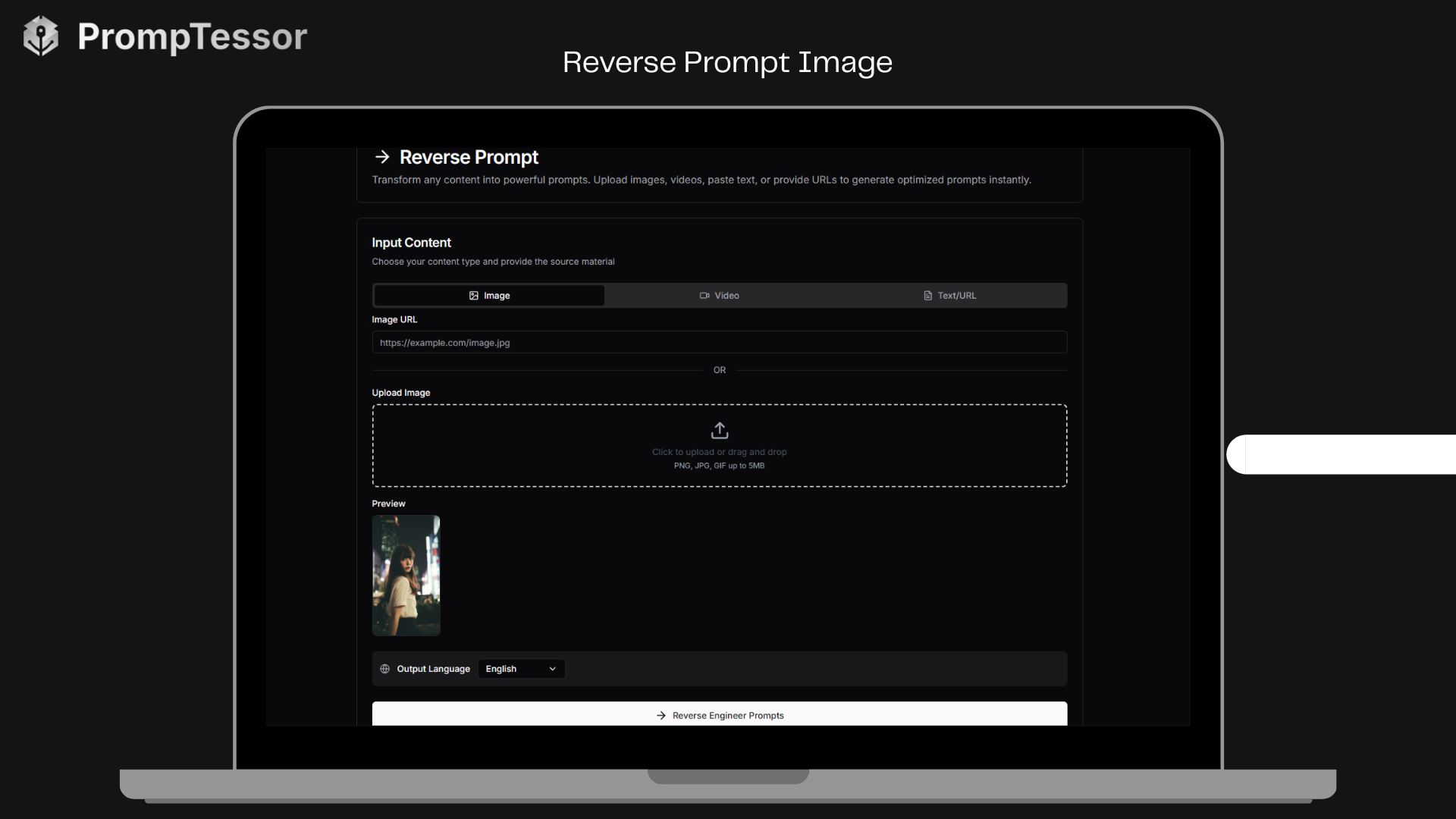
- Reverse Prompt Engineering: Analyzes existing content—images, text, or web URLs—to generate probable prompts that created that output. Process uses vision-language models (VLMs) and large language models (LLMs) to understand content structure and style, then generates candidate prompts through iterative refinement and CLIP similarity optimization.
- Smart Metrics Scoring: Evaluates prompt quality and effectiveness through multiple metrics including prompt fidelity (CLIP similarity between prompt embeddings and reference content) and image fidelity (similarity between reference and recreated images). Helps users understand prompt effectiveness objectively.
Prompt Optimization with Multiple Variants: Generates multiple optimized prompt variations targeting specific AI models—ChatGPT, Midjourney, DALL-E, Stable Diffusion, etc. Each optimization adjusts tone, structure, and model-specific parameters for maximum effectiveness.
Refine with Feedback: Interactive refinement capability enabling users to adjust optimized prompts using natural language feedback—”make it more minimalist,” “adjust for Midjourney,” “shorter version.” System updates prompts based on feedback without requiring regeneration.
Performance Tracking: Monitors how well generated prompts perform across different AI models. Tracks which prompts yield best results, enabling data-driven prompt engineering decisions.
Prompt Version Control and History: Maintains complete history of all prompts and optimizations. Users track changes, compare versions, and roll back to previous iterations. Essential for collaborative prompt development and auditing.
Multi-Language Support: Optimizes prompts across 100+ languages, not just English. Generates language-specific prompt variations maintaining effectiveness across linguistic contexts.
Content Analysis with Reasoning: When reverse-engineering content, provides detailed analysis explaining why specific prompts work and what makes them effective. Includes breakdown of style, structure, and key elements.
Integration with Popular AI Platforms: Seamless compatibility with ChatGPT, GPT-4, Midjourney, DALL-E, Stable Diffusion, Claude, and others. Optimizations reference platform-specific requirements and preferences.
Actionable Improvements and Quick Wins: Suggests immediate, implementable improvements users can apply right away. Beyond just metrics, provides concrete recommendations for enhancement.
How It Works
PrompTessor operates through integrated prompt creation and reverse-engineering workflows:
Reverse Engineer Existing Content: Upload an image, paste text, or provide web URL. PrompTessor analyzes content using vision-language models to understand style, structure, and key elements. System generates candidate prompts that could have created similar output.
Receive Candidate Prompts with Analysis: Platform presents probable prompts ranked by likelihood and effectiveness. Includes detailed reasoning explaining which elements the prompt addresses and why it would create similar content.
Optimize for Your Needs: Select candidate prompts or provide your own. PrompTessor generates multiple optimized variants targeted toward specific AI models—ChatGPT, Midjourney, DALL-E, etc. Each variant adjusts tone, structure, and model-specific parameters.
Refine with Feedback: Use natural language to refine prompts without regenerating—”make it shorter,” “optimize for Midjourney,” “more creative tone.” System updates prompts iteratively based on feedback.
Track and Monitor Performance: Monitor how different prompt variants perform. Track metrics, compare results, and identify which prompts yield best results with specific models.
Version Control and History: Maintain complete history of all prompts and iterations. Roll back to previous versions, compare changes, and audit prompt development over time.
Collaborate and Share: Share prompts with teams, manage access levels, and coordinate prompt engineering efforts across organization.
Use Cases
PrompTessor serves diverse prompt engineering scenarios:
- Learning from Successful Outputs: Analyze impressive AI-generated content you encounter online or in tools, reverse-engineer underlying prompts, and learn what makes them effective. Accelerates learning curve for prompt engineering.
Content Recreation and Adaptation: When you find compelling AI output, reverse-engineer the prompt, optimize it for your specific needs, and use it to recreate similar content or explore variations.
Prompt Template Development: Build library of reusable prompt templates by reverse-engineering successful examples. Document effective prompts and standardize across teams.
Competitive Analysis: Reverse-engineer competitors’ content to understand their prompt strategies and messaging approaches. Identify effective prompts they use and adapt for your context.
Cross-Model Optimization: Test same prompt across multiple AI models using PrompTessor’s optimization variants. Understand which models perform best for specific tasks.
Team Prompt Standardization: Reverse-engineer and optimize successful prompts created by top performers, then standardize across entire team. Ensures consistent quality and efficiency.
Marketing and Brand Content: Reverse-engineer high-performing marketing content, extract underlying prompts, and refine for your brand voice and messaging. Systematize creative content production.
Educational and Training Content: Learn prompt engineering principles by analyzing successful examples. Build curated library of effective prompts for training new team members.
Pros & Cons
Advantages
- Unique Reverse-Engineering Capability: Unlike other prompt tools, PrompTessor can analyze existing content and uncover likely prompts. This learning-from-examples approach accelerates prompt engineering expertise.
Comprehensive Prompt Lifecycle Tool: Handles complete prompt workflow—creation, optimization, reverse-engineering, version control, and team collaboration. Eliminates need for multiple tools.
Multi-Model Optimization: Generates optimized variants for different AI models (ChatGPT, Midjourney, DALL-E, etc.) with model-specific adjustments rather than one-size-fits-all.
Detailed Performance Metrics: Provides objective evaluation of prompt quality through CLIP similarity and other metrics, moving beyond subjective assessment to data-driven optimization.
Interactive Refinement: Refine prompts using natural language feedback without regenerating from scratch. Faster iteration and more intuitive process than traditional configuration.
Multi-Language Support: Works across 100+ languages, enabling global teams to optimize prompts regardless of language.
Complete History and Version Control: Track all prompt iterations and changes, enabling rollback, auditing, and collaborative development.
Disadvantages
Reverse-Engineering Accuracy Limited: Reverse-engineered prompts are educated guesses based on content analysis—not guaranteed to be original prompts. Complex or unique outputs may generate less accurate reconstructions.
Requires Quality Input for Optimization: Effectiveness depends on input quality. Vague content or unusual outputs may produce less useful reverse-engineered prompts.
Advanced Features in Paid Plans: While basic functionality available in free/freemium options, sophisticated reverse-engineering, optimization variants, and advanced metrics reserved for paid subscriptions.
Emerging Platform Stage: Reverse Prompt feature launched October 2025—relatively new functionality still undergoing refinement. Edge cases and advanced scenarios continue evolving.
Specific to Prompt Engineering Only: Focuses exclusively on prompt optimization and reverse-engineering. Does not handle model API calls, content generation, or broader LLM application development.
How Does It Compare?
PrompTessor occupies distinct position within prompt engineering landscape, emphasizing reverse-engineering and multi-directional prompt development rather than single-direction optimization or general management.
PromptPerfect specializes in forward-direction prompt optimization—taking user-provided prompts and enhancing them for specific AI models. PromptPerfect excels at refinement and sophistication improvement through Chain-of-Thought insertion, instruction tuning, and self-consistency optimization. However, PromptPerfect starts with user-provided prompts rather than analyzing existing outputs. PromptPerfect optimizes what you give it; PrompTessor discovers prompts from outputs. PromptPerfect is optimization-focused; PrompTessor is learning-from-examples-focused. Organizations use both—PromptPerfect to refine existing prompts, PrompTessor to discover new ones from successful examples.
PromptLayer functions as enterprise-grade prompt management platform emphasizing storage, versioning, collaboration, and monitoring. PromptLayer excels at teams managing large prompt libraries, maintaining version histories, and coordinating development across stakeholders. PromptLayer focuses on infrastructure and team coordination rather than prompt quality improvement or reverse-engineering. PromptLayer is management platform; PrompTessor is analysis and optimization platform. PromptLayer serves teams managing prompt libraries; PrompTessor serves teams improving individual prompts through learning and analysis.
LangChain provides comprehensive LLM application framework emphasizing modular workflows, chaining operations, and complex logic. LangChain focuses on building applications rather than optimizing prompts specifically. LangChain is application framework; PrompTessor is prompt engineering tool. Organizations use both—LangChain for application architecture, PrompTessor for prompt optimization within LangChain applications.
Traditional Prompt Engineering remains baseline comparison—manual trial-and-error optimization without systematic analysis or metrics. PrompTessor delivers significant efficiency through reverse-engineering, metrics analysis, and multi-model optimization.
PrompTessor’s distinctive positioning emerges through: reverse-prompt-engineering capability (unique ability to analyze outputs and uncover prompts), multi-directional development (creation, optimization, and analysis), multi-model optimization (generating variants for different platforms), performance metrics (objective evaluation of prompt quality), and learning-from-examples approach (systematizing prompt engineering through analysis). While PromptPerfect optimizes existing prompts and PromptLayer manages prompt libraries, PrompTessor uniquely learns from successful examples to improve prompt quality systematically.
Final Thoughts
PrompTessor represents meaningful evolution in prompt engineering by introducing reverse-analysis capabilities that enable learning from successful outputs rather than solely manual trial-and-error. Its combination of reverse-engineering analysis, multi-model optimization, performance metrics, and version control transforms prompt engineering from art into systematic discipline.
For prompt engineers seeking to understand effectiveness principles, content creators wanting to recreate compelling outputs, or teams standardizing prompt approaches, PrompTessor delivers practical value through analysis and optimization capabilities unique in the prompt engineering landscape.
However, teams requiring comprehensive LLM application frameworks, those managing enterprise prompt infrastructure at scale, or those seeking basic prompt optimization without reverse-engineering should evaluate complementary tools. PrompTessor optimizes specifically for learning-from-examples prompt engineering rather than providing broader LLM application development infrastructure.