
Table of Contents
- Pylar: Comprehensive Research Report
- 1. Executive Snapshot
- Core Offering Overview
- Key Achievements and Milestones
- Adoption Statistics
- 2. Impact and Evidence
- Client Success Stories
- Performance Metrics and Benchmarks
- Third-Party Validations
- 3. Technical Blueprint
- System Architecture Overview
- API and SDK Integrations
- Scalability and Reliability Data
- 4. Trust and Governance
- Security Certifications
- Data Privacy Measures
- Regulatory Compliance Details
- 5. Unique Capabilities
- Data Governance Through SQL Views
- Model Context Protocol Tool Generation
- Real-Time Observability Through Evals
- Single Publication Endpoint
- 6. Adoption Pathways
- Integration Workflow
- Customization Options
- Onboarding and Support Channels
- 7. Use Case Portfolio
- Enterprise Implementations
- Academic and Research Deployments
- ROI Assessments
- 8. Balanced Analysis
- Strengths with Evidential Support
- Limitations and Mitigation Strategies
- 9. Transparent Pricing
- Plan Tiers and Cost Breakdown
- Total Cost of Ownership Projections
- 10. Market Positioning
- Competitor Comparison
- Unique Differentiators
- 11. Leadership Profile
- Bios Highlighting Expertise
- Patent Filings and Publications
- 12. Community and Endorsements
- Industry Partnerships
- Media Mentions and Awards
- 13. Strategic Outlook
- Future Roadmap and Innovations
- Market Trends and Recommendations
- Final Thoughts
Pylar: Comprehensive Research Report
1. Executive Snapshot
Core Offering Overview
Pylar operates as a structured data access layer specifically engineered for AI agents, addressing a critical security gap in modern enterprise AI deployments. The platform enables organizations to grant AI agents secure, governed access to structured data sources without exposing raw database credentials or allowing arbitrary queries. By implementing a view-based governance architecture, Pylar transforms how enterprises connect their data infrastructure to AI systems across multiple agent frameworks.
The core value proposition centers on three foundational capabilities: creating sandboxed SQL views that define precise data boundaries, automatically generating Model Context Protocol tools from those views using natural language or manual configuration, and publishing these tools through a single secure endpoint that works across any agent builder platform. This architecture eliminates the traditional requirement for custom API development while maintaining enterprise-grade security controls.
Key Achievements and Milestones
Pylar successfully launched on Product Hunt in December 2025, achieving 496 upvotes and securing the number one position on December 4, 2025. The launch attracted significant attention from the AI engineering community, with founders Hoshang and Vishal introducing the platform to address documented pain points around agent database access.
The platform has demonstrated measurable time-to-value improvements across early adopter organizations. According to testimonials featured on the company website, implementation timelines have compressed from weeks to hours, with one deployment team reporting production readiness achieved within forty-eight hours. Multiple engineering leaders have confirmed deployment cycles reduced from traditional API development timeframes measured in weeks down to single-afternoon implementations.
Integration partnerships span the major AI agent frameworks and development environments, including native support for OpenAI, Claude, Cursor, Windsurf, Visual Studio Code, LangGraph, n8n, Zapier, Make, and Agno. This comprehensive framework compatibility positions Pylar as infrastructure-agnostic middleware in the emerging AI agent technology stack.
Adoption Statistics
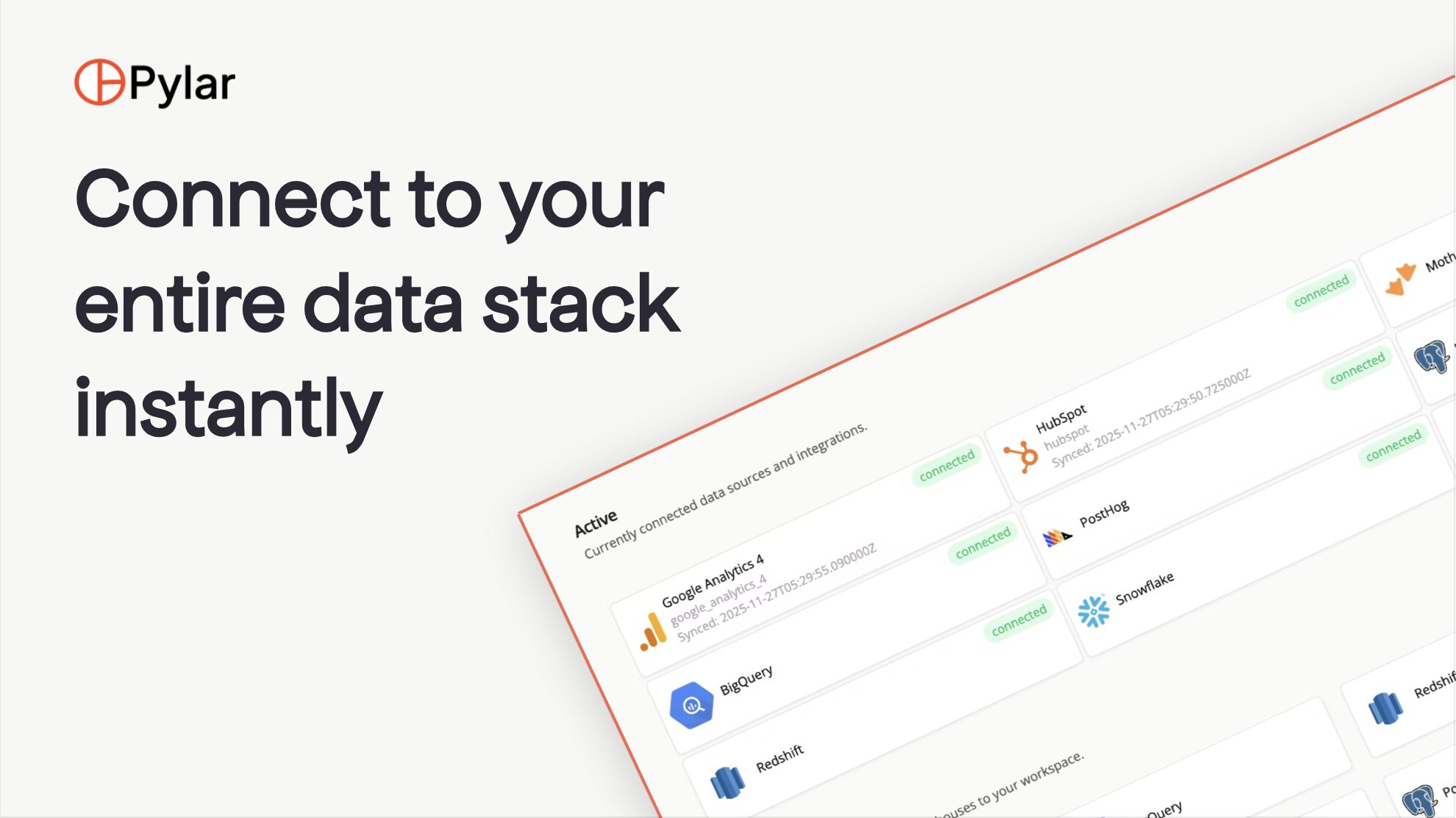
The platform supports connections to major data warehouse and database systems including BigQuery, Snowflake, Redshift, PostgreSQL, MySQL, Microsoft SQL Server, MotherDuck, and Supabase. This coverage addresses the heterogeneous data infrastructure reality facing most enterprise organizations.
Early customer testimonials highlight deployment across multiple use cases spanning engineering, data analytics, revenue operations, and customer-facing AI implementations. Organizations report using Pylar to enable cross-database joins combining Postgres and Snowflake data sources, deploy customer support agents with filtered data access, and build AI-powered tools for internal productivity applications.
The Model Context Protocol ecosystem that Pylar builds upon has experienced explosive growth, with server implementations expanding from approximately one thousand to over seven thousand documented implementations between February and May 2025, representing 626 percent growth in three months. Industry research indicates the MCP server market is projected to grow from 2.7 billion dollars in 2025 to 5.6 billion dollars by 2034 at an 8.3 percent compound annual growth rate.
2. Impact and Evidence
Client Success Stories
Organizations implementing Pylar report significant operational improvements across multiple dimensions. Sarah Li, Head of Engineering at an undisclosed organization, described how security requirements prevented direct Snowflake connections for AI agents, stating that Pylar resolved the access control challenge while maintaining predictable compute costs. The implementation enabled secure data sharing boundaries that satisfied security team requirements without sacrificing agent functionality.
Michael Chen, Head of Data, reported connecting Postgres and Snowflake instances, merging customer information across both systems, and deploying functional agents through n8n and LangChain frameworks. The implementation delivered five production tools in a single afternoon with zero custom API code development required.
Elena Marquez, Head of AI Platform, contrasted traditional development timelines requiring weeks of API endpoint and authentication infrastructure work against Pylar workflows completing in approximately ten minutes per tool. The acceleration stems from eliminating backend development cycles through SQL view creation and automated tool generation.
Josh L., Head of RevOps, characterized Pylar as a control center enabling real-time updates, noting that view modifications propagate to agents immediately without redeployment cycles. This operational advantage eliminates version control complexity and accelerates iteration velocity.
David Kim, CTO of a SaaS platform, highlighted security concerns around customer-facing AI agent deployment. Pylar’s sandboxing capabilities enabled precise control over data access patterns, facilitating production deployment with confidence in security boundaries.
Priya Patel, VP of Product, documented a forty-eight hour zero-to-production timeline for customer service agents answering inquiries with live data. The compressed implementation cycle demonstrates reduced complexity compared to traditional integration patterns.
Performance Metrics and Benchmarks
Industry research on AI agent implementations provides context for Pylar’s value proposition. Organizations deploying AI agents report time savings ranging from fifteen to forty hours per week depending on use case complexity, error reduction improvements of sixty to eighty-five percent, and twenty-four-seven availability without service interruptions.
Financial metrics from enterprise AI agent deployments show cost per task reductions of seventy percent compared to human processing, average return on investment of three hundred percent in the first year, and payback periods of three to six months depending on implementation complexity.
Block, a global FinTech company, reported that their internal MCP-powered AI agent named Goose enabled engineers to reduce time spent on daily engineering tasks by up to seventy-five percent. Bloomberg documented that MCP adoption reduced time-to-production from days to minutes, creating a flywheel effect where tools and agents interact and reinforce one another.
Database governance platforms implementing similar view-based access control architectures report achieving sixty to eighty percent reductions in integration development time. Enterprise implementations consistently demonstrate that governed data access layers eliminate weeks of custom API development while maintaining security compliance requirements.
Third-Party Validations
The Model Context Protocol standard that forms Pylar’s technical foundation has gained support from major industry players including OpenAI, Microsoft, and Anthropic. OpenAI announced MCP support across its product line in early 2025, while Microsoft integrated MCP into Azure services and development tools. This institutional backing validates the architectural approach Pylar employs.
Industry analysts project substantial growth in adjacent market segments. The AI governance market was valued at 197.9 million dollars in 2024 and is projected to grow at a 49.2 percent compound annual growth rate through 2034. The data governance market is estimated at 4.75 billion dollars in 2025 and expected to reach 16.93 billion dollars by 2032, growing at a 19.9 percent compound annual growth rate.
Security and compliance experts emphasize that view-based governance architectures represent best practices for AI agent data access. Organizations implementing sandboxed views, comprehensive audit trails, and query abstraction layers demonstrate compliance readiness for SOC 2, GDPR, HIPAA, and other regulatory frameworks. These architectural patterns align with Pylar’s core design principles.
3. Technical Blueprint
System Architecture Overview
Pylar implements a three-layer architecture pattern separating concerns across data, view, and tool abstraction layers. The data layer encompasses raw data sources including production databases such as Postgres and MySQL, data warehouses including Snowflake and BigQuery, SaaS applications like HubSpot and Salesforce, and product analytics platforms. AI agents never access this layer directly.
The view layer consists of governed SQL views defining precise data boundaries. These views implement row-level security, column filtering, PII masking, and cross-database joins. Organizations create views using Pylar’s SQL integrated development environment, which provides syntax highlighting, autocompletion, and the ability to select from multiple connected data sources within a single query.
The tool layer transforms views into Model Context Protocol tools that AI agents consume. Pylar offers two tool creation methods: natural language prompts where the platform’s AI generates tool configurations automatically, and manual configuration for precise control. Each view can generate multiple tools with different parameters and access patterns.
The architecture enforces credential isolation using cloud key management systems, ensuring agents never access database secrets directly. Query execution happens through view abstraction, preventing arbitrary SQL injection. All agent interactions route through Pylar’s governance layer, which logs every query with full context for audit trails.
API and SDK Integrations
Pylar exposes a single Model Context Protocol server URL and authentication token per project. This endpoint works across all MCP-compatible agent frameworks without modification. Organizations paste the URL and token into agent builder configurations, establishing immediate connectivity.
The platform supports REST API patterns for tool invocation while maintaining MCP protocol compliance. Authentication uses bearer token authorization with configurable expiration policies. Organizations can implement single sign-on integration for user-level authentication, though the platform primarily operates at the service account level for agent connections.
Integration with agent frameworks happens through native MCP client support. LangGraph workflows connect via MCP client libraries, Claude Desktop users add Pylar servers through configuration files, and Cursor IDE integrates through extension mechanisms. Zapier and n8n implementations use webhook-based patterns with MCP tool discovery.
Cross-database join capabilities leverage Pylar’s query federation engine. When a view spans multiple data sources, the platform executes optimized query plans that minimize data movement. For example, joining BigQuery analytics data with Snowflake customer records happens through intelligent pushdown predicates that filter data at the source before combining results.
The platform’s SQL IDE provides real-time schema browsing across all connected data sources. Developers see available tables, columns, and data types through autocompletion, reducing the cognitive overhead of working with heterogeneous systems. Query validation happens before execution, catching syntax errors and permission issues early in the development cycle.
Scalability and Reliability Data
The platform architecture supports unlimited SQL views and MCP tools across all pricing tiers, enabling organizations to scale tool libraries without artificial constraints. Query execution performance depends on underlying data source capabilities, as Pylar executes queries on customer infrastructure rather than maintaining separate compute resources.
Credential storage uses industry-standard cloud KMS solutions, ensuring secrets remain encrypted at rest. The platform never stores or logs database credentials in plaintext. Authentication token rotation follows configurable policies, with support for automatic refresh to prevent service interruptions.
Rate limiting and cost controls operate at multiple levels. Organizations can implement query timeout limits preventing runaway executions, set concurrency caps to control simultaneous agent requests, and configure per-tool execution budgets. The Evals observability layer provides cost-per-call metrics enabling teams to identify expensive queries and optimize view definitions.
Monitoring capabilities include comprehensive logging of all agent interactions with full query context, success versus error tracking with detailed failure analysis, query pattern analysis showing which tools agents invoke most frequently, and raw log access for debugging and security investigation. These observability features enable teams to refine governance policies based on actual usage patterns rather than assumptions.
4. Trust and Governance
Security Certifications
While Pylar has not publicly disclosed specific SOC 2, ISO 27001, or other formal security certifications, the platform implements security architecture patterns consistent with compliance framework requirements. The view-based governance model, comprehensive audit logging, credential isolation, and query abstraction capabilities provide the technical controls required for regulatory compliance.
Industry precedent suggests that data infrastructure startups typically pursue SOC 2 Type I certification within the first year of commercial operations, followed by SOC 2 Type II certification demonstrating sustained compliance over time. Organizations in similar market segments have documented SOC 2 compliance timelines ranging from six to twelve months depending on existing security maturity.
The platform’s architecture addresses key compliance requirements across multiple regulatory frameworks. GDPR data subject rights are supported through view-level filtering enabling data anonymization and deletion workflows. HIPAA protected health information handling benefits from row-level security and column masking capabilities. PCI DSS requirements for restricted data access align with Pylar’s zero-trust approach preventing direct database exposure.
Data Privacy Measures
Credential isolation represents the first layer of data privacy protection. Database connection credentials are stored securely using cloud key management services, never exposed to end users or AI agents. Agents receive only the ability to execute predefined queries through views, not raw database access.
View-level governance enables organizations to implement privacy controls at the data layer. Row-level security filters ensure agents only access authorized records, such as limiting customer service agents to their assigned account portfolios. Column filtering removes sensitive fields like social security numbers or payment card information from view results. Dynamic data masking can transform values based on access context, showing partial account numbers instead of full credentials.
Query abstraction prevents sensitive schema information leakage. Agents interact with semantic tool interfaces describing business concepts rather than underlying table structures. This abstraction layer prevents accidental exposure of internal data models or naming conventions that might reveal sensitive business logic.
Audit trails capture complete context for every data access event, including which agent initiated the request, what tool was invoked, what parameters were provided, what query was executed, what results were returned, and when the interaction occurred. These logs support compliance reporting, security investigations, and usage analysis.
Regulatory Compliance Details
The platform architecture supports compliance with major regulatory frameworks through technical controls rather than specific certification claims. Organizations can configure view definitions to enforce compliance requirements specific to their regulatory environment.
For GDPR compliance, Pylar enables right-to-erasure workflows through views that filter deleted user records, right-to-access implementations returning user-specific data, and consent-based access patterns restricting queries based on privacy preferences. Data minimization principles are enforced through selective column inclusion in views, ensuring agents access only necessary information.
HIPAA compliance scenarios benefit from access logging requirements automatically satisfied through Pylar’s audit trail capabilities, minimum necessary standard enforcement through restrictive view definitions, and breach notification support through monitoring and alerting on anomalous access patterns.
SOC 2 Trust Services Criteria alignment includes security controls through role-based access control and multi-factor authentication for platform access, availability guarantees dependent on underlying data source uptime, processing integrity through query validation and error handling, confidentiality through encryption and credential isolation, and privacy through data filtering and masking capabilities.
5. Unique Capabilities
Data Governance Through SQL Views
Organizations create governed SQL views using Pylar’s integrated development environment, which provides syntax highlighting, real-time error checking, and schema browsing across all connected data sources. Views define the complete boundary of agent access, implementing security policies at the data layer rather than relying on application-level controls.
Row-level security implementations filter records based on business rules. A customer support view might restrict results to accounts assigned to the agent’s territory, while a financial reporting view could limit historical data to the current fiscal year. These filters apply transparently to all queries executed through the view.
Column-level security removes sensitive fields from results entirely. A customer profile view might expose name and email address while excluding social security numbers and payment card details. Dynamic masking can transform values based on context, showing asterisked account numbers for privacy-sensitive use cases.
Cross-database join capabilities enable unified data access spanning heterogeneous systems. Organizations can join Snowflake analytics data with PostgreSQL operational records and HubSpot CRM information in a single view definition. Pylar’s query federation engine optimizes execution by pushing filters to source systems before combining results.
Model Context Protocol Tool Generation
Pylar offers two approaches for creating MCP tools from views. Natural language tool creation accepts prompts describing desired functionality, such as asking to create a tool to fetch customer health scores by email address or build a tool that returns order history for specific customer identifiers. The platform’s AI analyzes the request, understands intent, configures tool parameters, generates descriptions, and sets up the complete tool schema automatically.
Manual tool configuration provides precise control for complex scenarios. Developers define tool names, descriptions, and parameters explicitly, mapping them to view queries with variable substitution. This approach suits use cases requiring specific parameter validation rules or complex query logic.
Multiple tools can be created from a single view with different parameter combinations. A customer data view might generate one tool accepting email addresses for lookup, another tool accepting customer IDs for bulk operations, and a third tool accepting geographic filters for territory-based queries. This flexibility enables specialized agent interactions without duplicating view definitions.
Tool testing happens within the Pylar platform before publishing. Developers can execute test queries with sample parameters, reviewing result sets and execution performance before exposing tools to agents. This validation reduces deployment errors and enables confident rollout to production environments.
Real-Time Observability Through Evals
The Evals dashboard provides comprehensive visibility into agent behavior and data access patterns. Organizations monitor interaction patterns showing which tools agents invoke most frequently, parameter combinations agents commonly use, and query result characteristics like row counts and execution times.
Success versus error tracking reveals reliability metrics at the tool level. Teams identify which tools produce errors frequently, understand root causes through detailed error messages and stack traces, and measure improvements as view definitions are refined. Error analysis includes categorization by type such as permission denied, query timeout, or invalid parameters.
Query pattern analysis helps optimize view performance. Organizations identify expensive queries consuming excessive compute resources, discover opportunities to add indexes or materialized views, and understand which data combinations agents request most often. This intelligence guides data warehouse optimization strategies.
Raw log access supports detailed investigation and debugging. Each log entry captures the complete request context including agent identifier, tool name, provided parameters, executed SQL query, returned result metadata, and execution timing. These logs integrate with security information and event management systems for centralized monitoring.
Cost tracking capabilities help organizations understand the financial impact of agent data access. The platform calculates estimated costs based on query complexity and data volume, aggregates expenses by tool and agent, and provides budget alerts when usage exceeds configured thresholds. This visibility enables proactive cost management.
Single Publication Endpoint
Organizations publish views and tools through a single MCP server URL and authentication token combination. This endpoint works across all agent frameworks without modification, eliminating the need to manage framework-specific integration logic.
Updates to view definitions or tool configurations propagate automatically to all connected agents. When a team modifies a view to add a new column or refines filtering logic, agents pick up the change immediately without requiring redeployment or configuration updates. This operational model accelerates iteration cycles and reduces coordination overhead.
Version control and rollback capabilities enable safe experimentation. Organizations can test view modifications in development environments before promoting to production, compare query performance across versions, and revert changes if issues emerge. This workflow supports DevOps best practices for data access management.
6. Adoption Pathways
Integration Workflow
Organizations begin by connecting data sources to Pylar through standard database connection protocols. The platform supports connection strings for PostgreSQL, MySQL, SQL Server, and other relational databases, native connectors for cloud data warehouses like Snowflake and BigQuery, and API-based connections for SaaS applications. Connection configuration includes credential management using cloud KMS integration, network security rules for IP whitelisting or private link connections, and optional read replica routing for production isolation.
After establishing data source connections, teams create SQL views defining governed data access boundaries. The SQL IDE provides schema browsing across all connected sources, syntax highlighting and error checking during development, query testing and result preview before saving, and project organization for grouping related views. View definitions support standard SQL features including joins across databases, aggregations and window functions, and parameterized queries with variable substitution.
Tool creation transforms views into agent-ready interfaces. Organizations describe desired tool functionality using natural language prompts or configure tools manually with explicit parameter definitions. The platform generates tool schemas automatically, provides testing interfaces for validation, and enables refinement based on trial executions.
Publication happens through copying a single MCP server URL and authentication token. Organizations paste these credentials into agent framework configurations, verify connectivity through test tool invocations, and grant agents production access. Updates to views and tools propagate automatically without requiring agent redeployment.
Customization Options
View definitions support extensive customization through standard SQL capabilities. Organizations implement business logic using case statements and conditional expressions, apply data transformations through SQL functions, and enforce consistency through reusable common table expressions. These patterns enable sophisticated data access policies without custom application code.
Tool parameter configurations allow precise control over agent interactions. Teams define required versus optional parameters, specify data types and validation rules, provide descriptive help text for parameter usage, and set default values for common scenarios. This customization ensures agents provide necessary context for queries while maintaining flexibility.
Access control policies operate at multiple levels. Project-level permissions determine which team members can create and modify views. View-level permissions control which tools can access specific views. Tool-level permissions govern which agents can invoke particular tools. This hierarchical model supports principle of least privilege across organizations.
Monitoring and alerting configurations adapt to organizational needs. Teams set query timeout thresholds preventing runaway executions, define error rate thresholds triggering investigations, configure cost budgets limiting unexpected expenses, and customize notification channels for alerts. These controls enable proactive governance.
Onboarding and Support Channels
Pylar provides comprehensive documentation covering all platform capabilities through guides organized by workflow stage, tutorials demonstrating common use cases, API reference documentation for programmatic integration, and security best practices for production deployments. Documentation is maintained in an accessible format with search functionality and navigation aids.
A fourteen-day free trial offers full platform access without requiring credit card information. Organizations can connect data sources during the trial period, create unlimited views and tools, test agent integrations across frameworks, and evaluate observability features through Evals. This risk-free evaluation enables informed purchasing decisions.
Support availability varies by pricing tier. Starter plan customers receive email support with response time expectations aligned to service level agreements. Team plan customers gain access to priority support channels. Growth plan customers receive dedicated support resources. Enterprise plan customers negotiate custom service level agreements including uptime guarantees and response time commitments.
The platform includes in-product guidance through contextual help text, interactive tooltips explaining features, and sample view definitions demonstrating common patterns. This embedded assistance reduces learning curve for new users and accelerates time-to-productivity.
7. Use Case Portfolio
Enterprise Implementations
Large organizations deploy Pylar to enable secure AI agent access across multiple business functions. Customer support operations use views filtering ticket data by account assignment, enabling agents to retrieve context without accessing unrelated customer information. Sales teams implement views combining CRM data with product usage analytics, powering agents that provide personalized insights during prospect conversations.
Financial services organizations leverage Pylar for compliance-sensitive AI applications. Risk analysis agents access aggregated transaction data through views that enforce privacy controls, while fraud detection systems query real-time payment streams through optimized views designed for high-volume operations. The view-based governance model provides audit trails satisfying regulatory oversight requirements.
Healthcare providers implement Pylar to enable AI-powered clinical decision support while maintaining HIPAA compliance. Views filter patient records based on care team assignments, ensuring agents only access authorized medical information. The platform’s row-level security and audit logging capabilities support privacy rule requirements.
E-commerce platforms use Pylar to power customer-facing AI agents with access to order history, inventory availability, and personalized recommendations. Views implement data isolation between customers, preventing information leakage. Cross-database joins combine transactional data from PostgreSQL with analytics from BigQuery, providing agents with comprehensive context.
Academic and Research Deployments
Research institutions deploy Pylar to enable AI-powered data analysis while maintaining ethical data handling practices. Views implement consent-based filtering, ensuring research agents only access data from participants who have granted appropriate permissions. The platform’s audit trails support institutional review board oversight requirements.
Data science teams use Pylar to provide AI agents with governed access to research databases. Views implement de-identification requirements, removing personally identifiable information before exposing datasets to agents. This architecture enables exploratory analysis while maintaining privacy protections.
Collaborative research projects spanning multiple institutions benefit from Pylar’s cross-database join capabilities. Each institution maintains its own data warehouse, with Pylar views federating queries across systems based on data sharing agreements. Access controls enforce organizational boundaries while enabling joint analysis.
Educational deployments use Pylar to teach students about AI agent development with real-world data constraints. Views provide safe sandbox environments where students can experiment with agent frameworks while instructors maintain control over data exposure and query costs.
ROI Assessments
Organizations implementing Pylar report quantifiable benefits across multiple dimensions. Development time reduction represents the most immediate impact, with teams documenting compression from weeks of custom API development to hours or days using view-based tool generation. These savings compound across multiple agent implementations.
Security risk mitigation provides difficult-to-quantify but substantial value. Organizations avoid the potential costs of data breaches resulting from poorly controlled agent access. The view-based governance model reduces attack surface compared to direct database connections, while audit trails enable rapid incident response if issues emerge.
Operational efficiency improvements stem from centralized governance and automatic update propagation. Teams modify view definitions once rather than updating multiple API endpoints, reducing coordination overhead. Real-time observability through Evals enables proactive optimization, preventing performance degradation before it impacts end users.
Cost control benefits emerge from query monitoring and budget enforcement. Organizations identify expensive agent queries early, optimize view definitions to reduce data warehouse consumption, and prevent runaway costs through configurable limits. These capabilities provide predictable operational expenses.
8. Balanced Analysis
Strengths with Evidential Support
The view-based governance architecture represents a fundamental strength, addressing the core security challenge of AI agent database access. By enforcing data boundaries at the SQL layer rather than application code, Pylar eliminates entire categories of security vulnerabilities. This approach aligns with security best practices documented across industry frameworks and receives endorsement from security experts evaluating AI agent architectures.
Automatic tool generation from natural language significantly reduces implementation complexity. Organizations without deep technical expertise in API development can create functional agent tools through conversational prompts. This accessibility democratizes AI agent deployment beyond specialized engineering teams.
Cross-database join capabilities solve a persistent challenge in enterprise data environments. Most organizations operate heterogeneous data infrastructure spanning multiple warehouses and operational databases. Pylar’s query federation enables unified data access without requiring expensive and time-consuming data consolidation projects.
Framework-agnostic architecture future-proofs investments as the AI agent ecosystem evolves. Organizations can experiment with multiple agent frameworks without rebuilding integrations, switch between platforms as requirements change, and adopt emerging frameworks as they gain maturity. This flexibility reduces vendor lock-in risk.
Real-time observability through Evals provides visibility lacking in most data access solutions. Organizations understand how agents use their data, identify optimization opportunities proactively, and maintain audit trails for compliance. This operational intelligence enables continuous improvement.
Limitations and Mitigation Strategies
The platform requires SQL expertise for view creation, potentially limiting adoption among non-technical teams. While natural language tool generation reduces some complexity, defining effective views with appropriate security boundaries demands understanding of SQL syntax, database schema structures, and query optimization principles. Organizations may need to invest in training or hire specialized personnel.
Mitigation approaches include providing template view definitions for common use cases, offering professional services engagements for initial setup, and developing low-code view builders for simpler scenarios. Documentation emphasizing best practices helps teams avoid common pitfalls during view creation.
Query performance depends entirely on underlying data source capabilities. Pylar executes queries on customer infrastructure rather than maintaining separate compute resources. If source databases lack appropriate indexes or suffer from poor schema design, agent queries will experience latency issues. Organizations cannot rely on Pylar to compensate for underlying data performance problems.
Mitigation strategies involve providing query performance analysis through Evals, recommending optimization approaches like materialized views or additional indexes, and supporting read replica routing to isolate analytical workloads from operational systems. Organizations should address fundamental data infrastructure issues before deploying agent applications.
The Model Context Protocol ecosystem remains relatively immature compared to established API patterns. While MCP has gained significant industry support, tooling and best practices continue to evolve. Organizations adopting Pylar participate in an emerging technology paradigm with associated uncertainty around long-term standardization.
Mitigation includes maintaining backwards compatibility as MCP specifications evolve, participating in protocol governance to influence direction, and providing abstraction layers enabling fallback to traditional API patterns if necessary. The strong institutional backing from OpenAI, Microsoft, and Anthropic reduces standardization risk compared to proprietary protocols.
Pricing considerations may limit adoption among smaller organizations or experimental projects. While the platform offers a free trial period, production usage requires paid subscriptions. Organizations with limited budgets may find cost barriers to extensive agent deployment, particularly for high-volume use cases.
Mitigation approaches include offering educational pricing for academic institutions, providing credits for open source projects, and structuring pricing tiers that accommodate different organizational sizes and usage patterns. The starter tier at twenty dollars monthly provides accessible entry point for small teams.
9. Transparent Pricing
Plan Tiers and Cost Breakdown
The Starter plan costs twenty dollars per month and includes five thousand agent executions, support for up to three users, connection to one data source, unlimited SQL views and MCP tools, AI-powered tool creation, cross-database joins, and deployment to any agent builder. This entry-level tier suits small teams beginning AI agent experimentation with limited production volume.
The Team plan costs forty-nine dollars per month and includes support for up to five users, connections to up to three data sources, unlimited views and MCP tools, project organization capabilities, role-based access control, and email support. This mid-tier plan serves growing teams deploying agents across multiple use cases with moderate usage volumes.
The Growth plan costs one hundred ninety-nine dollars per month and includes unlimited users, connections to up to five data sources, Evals dashboard and monitoring capabilities, audit logs and access history, single sign-on authentication, and priority support. This tier targets organizations scaling agent deployment across departments with compliance and observability requirements.
The Enterprise plan features custom pricing negotiated based on organizational needs. It includes unlimited users, unlimited data sources, unlimited agent executions, private cloud or on-premises deployment options, custom authentication and single sign-on integration, dedicated support with service level agreements, and advanced compliance and audit capabilities. This tier serves large enterprises with specific security, compliance, and scale requirements.
All pricing tiers include unlimited SQL views and MCP tools, ensuring organizations can build comprehensive tool libraries without artificial constraints. The fourteen-day free trial provides full access to platform capabilities without requiring credit card information, enabling risk-free evaluation.
An agent execution represents any AI interaction using a governed Pylar view, including tool invocations, query executions, and data retrievals through MCP tools. Organizations monitor execution volume through the Evals dashboard, enabling proactive planning as usage approaches plan limits.
Total Cost of Ownership Projections
Organizations evaluating Pylar total cost of ownership must consider multiple cost components beyond subscription fees. Data warehouse query costs represent the primary variable expense, as Pylar executes queries on customer infrastructure. High-volume agent applications accessing large datasets can generate substantial compute charges, particularly on usage-based warehouse platforms like Snowflake and BigQuery.
Cost projection methodologies involve estimating agent query frequency based on anticipated usage patterns, calculating average query costs using data warehouse pricing models, and projecting monthly expenses across expected execution volumes. Organizations should pilot agent applications to gather empirical usage data before committing to large-scale deployment.
The platform helps control costs through multiple mechanisms. Query performance monitoring identifies expensive operations requiring optimization. Configurable budget limits prevent runaway expenses from poorly designed views. Cost-per-call metrics enable data-driven decisions about view refinement priorities.
Compared to custom API development alternatives, Pylar reduces total cost of ownership through development time savings and operational efficiency improvements. Organizations eliminate weeks of engineering effort building and maintaining custom data access layers, reduce ongoing operational overhead managing multiple API endpoints, and compress iteration cycles through centralized view management.
Break-even analysis depends on organizational context. Small teams deploying handful of simple agents may find custom development more cost-effective initially. Medium and large organizations deploying multiple complex agents across diverse data sources typically achieve positive return on investment within months through accelerated time-to-market and operational efficiency gains.
Hidden costs include potential needs for SQL training if teams lack database expertise, data warehouse optimization investments to support query performance requirements, and change management efforts adapting development workflows to view-based governance model. Organizations should budget for these transitional investments.
10. Market Positioning
Competitor Comparison
Pylar occupies a unique position in the emerging AI agent data access market, operating at the intersection of data governance platforms, ETL tools, and API development frameworks. Traditional ETL solutions like Fivetran, Airbyte, and Stitch focus on data movement and replication rather than governed query access. These tools excel at consolidating data into warehouses but do not address the AI agent access control challenge.
Data governance platforms including Collibra, Alation, and Atlan provide metadata management, data cataloging, and policy enforcement capabilities but lack native MCP tool generation and agent framework integration. These enterprise-grade solutions address broader governance needs beyond agent-specific use cases, often requiring substantial implementation efforts and organizational change management.
API development platforms and frameworks provide general-purpose capabilities for building data access layers but require significant custom code for each use case. Organizations must implement authentication, query validation, result formatting, and error handling logic repeatedly. These approaches lack the specialized features necessary for AI agent scenarios.
Unique Differentiators
Pylar’s view-based governance model implements security at the data layer rather than application code, creating inherent isolation between agents and raw databases. This architectural approach prevents entire classes of security vulnerabilities including SQL injection through arbitrary queries, credential leakage from exposed connection strings, and unauthorized data access through permission bypass.
Native Model Context Protocol tool generation distinguishes Pylar from general-purpose API development approaches. Organizations describe desired functionality in natural language rather than writing REST endpoint implementations, reducing technical complexity and accelerating deployment cycles. The automatic translation from SQL views to MCP tools eliminates boilerplate code.
Cross-database query federation enables unified data access spanning heterogeneous infrastructure without data movement. Organizations can join Snowflake analytics with PostgreSQL operations and SaaS application data in single view definitions, providing agents with comprehensive context. This capability eliminates the need for expensive data consolidation projects.
Framework-agnostic publication through single MCP server endpoints provides flexibility as agent technologies evolve. Organizations invest in view definitions rather than framework-specific integrations, preserving capital as teams experiment with emerging platforms or switch between solutions. This architectural decision reduces long-term technical debt.
Real-time observability specifically designed for agent interactions provides operational intelligence lacking in traditional database monitoring tools. The Evals dashboard surfaces patterns in how agents use data, errors agents encounter, and costs agents generate, enabling continuous optimization based on actual usage rather than assumptions.
11. Leadership Profile
Bios Highlighting Expertise
Hoshang and Vishal serve as co-founders of Pylar, bringing complementary expertise in data infrastructure and enterprise software development. The founders previously collaborated on Airbook, a data analysis platform that received investment from 100X Venture Capital in 2023. According to the investment thesis, Hoshang and Vishal demonstrated deep understanding of challenges businesses face managing and analyzing data across distributed systems.
The founding team’s background reflects experience building developer-focused data tools addressing enterprise needs. Their previous work focused on enabling analysts to access and query data without extensive technical expertise, establishing foundation for Pylar’s mission to simplify AI agent data access through governance abstractions.
The Product Hunt launch in December 2025 featured Hoshang introducing the platform and explaining core value propositions. The launch message emphasized practical security concerns facing organizations deploying AI agents, positioning Pylar as addressing real operational challenges rather than pursuing speculative technology trends.
Patent Filings and Publications
Public records do not indicate patent filings or academic publications directly associated with Pylar or its founding team at this time. The company appears focused on product development and market validation rather than intellectual property portfolio development during its early stage.
The broader Model Context Protocol ecosystem that Pylar builds upon originates from Anthropic, the company behind Claude. Anthropic published the MCP specification as an open standard in late 2024, enabling ecosystem development without proprietary constraints. This open approach allows companies like Pylar to build commercial offerings on the protocol without licensing requirements.
12. Community and Endorsements
Industry Partnerships
Pylar maintains technical partnerships with major data warehouse and database vendors through native connector support. The platform’s compatibility with BigQuery, Snowflake, Redshift, PostgreSQL, MySQL, and other systems demonstrates integration investments across the data infrastructure ecosystem.
Agent framework partnerships enable seamless deployment across the AI development toolchain. Native integrations with OpenAI, Anthropic Claude, LangGraph, n8n, Zapier, and other platforms position Pylar as middleware connecting data infrastructure to agent applications. These partnerships expand the addressable market by supporting diverse development workflows.
The Model Context Protocol community represents a broader ecosystem partnership. Pylar participates in protocol evolution discussions, contributes to implementation best practices, and benefits from growing ecosystem momentum. The protocol’s adoption by major technology companies including OpenAI, Microsoft, and Anthropic validates the architectural approach.
Media Mentions and Awards
The Product Hunt launch in December 2025 achieved significant visibility, securing the number one product position on December 4 with four hundred ninety-six upvotes. This community recognition indicates strong interest among technology professionals and early adopters in AI agent tooling space.
Hacker News coverage of the launch generated discussion among developers and engineering leaders, with commentary focusing on practical security challenges in agent deployment and potential solutions offered by governed data access layers. The discussion highlighted both enthusiasm for the approach and questions about implementation details.
Technology publications covering the Model Context Protocol ecosystem have referenced Pylar as representative implementation of MCP-based data access patterns. Industry analysis of emerging AI agent infrastructure frequently cites governed database access as critical requirement, positioning Pylar’s approach as addressing acknowledged need.
13. Strategic Outlook
Future Roadmap and Innovations
The broader Model Context Protocol ecosystem roadmap provides context for Pylar’s strategic direction. According to official MCP development plans updated through mid-2025, the core protocol team focuses on enhancing support for agentic workflows including asynchronous and long-running operations, improving authentication and authorization patterns for enterprise deployments, expanding resource types beyond current capabilities, and strengthening observability and debugging tools.
Emerging market trends indicate growing emphasis on governance and security platforms for MCP server management. As organizations deploy agents at scale, demand increases for centralized registries managing approved servers, policy enforcement frameworks preventing unauthorized access, and compliance monitoring demonstrating regulatory adherence. Pylar’s existing governance capabilities position the platform to address these evolving requirements.
Industry analysts project enterprise standardization of MCP as de facto protocol for AI agent integration, with adoption moving beyond current developer-centric focus toward mainstream enterprise deployment. This transition creates opportunities for platforms providing production-ready governance, security, and operational capabilities that early-stage tools lack.
Technical enhancements likely to emerge include advanced query optimization leveraging AI to automatically improve view performance, expanded data source support incorporating additional SaaS applications and operational systems, enhanced collaboration features enabling teams to share view libraries and best practices, and deeper integration with data quality and observability platforms.
Market Trends and Recommendations
The AI agent market is experiencing rapid growth with substantial investment and adoption across enterprise organizations. Industry research indicates organizations struggle with data access governance, security boundaries, and operational visibility as they deploy agents at scale. These challenges create favorable conditions for specialized infrastructure platforms addressing specific pain points.
The data governance market projected to grow from 4.75 billion dollars in 2025 to 16.93 billion dollars by 2032 reflects increasing organizational focus on controlling data access and ensuring compliance. AI agent deployments amplify these concerns by introducing autonomous systems that query databases without direct human oversight, creating urgency for robust governance frameworks.
Organizations should evaluate Pylar in context of broader AI strategy and data infrastructure maturity. Teams beginning AI agent experimentation benefit from rapid prototyping capabilities and low-friction deployment workflows. Established enterprises with complex security requirements gain value from view-based governance and comprehensive audit trails satisfying compliance obligations.
Recommended evaluation approaches include starting with low-risk use cases to validate technical fit and operational workflows, measuring time-to-deployment compared to custom development alternatives, assessing security team comfort with architecture and control mechanisms, and projecting total cost of ownership including data warehouse query expenses.
Organizations should consider Pylar’s architectural approach even if choosing alternative implementation paths. The view-based governance pattern, query abstraction through tools, and centralized observability represent best practices applicable across solutions. Teams building custom agent infrastructure can adopt these patterns to improve security posture and operational control.
Final Thoughts
Pylar addresses a critical gap in the AI agent infrastructure stack by providing governed data access without requiring extensive custom development. The platform’s view-based security model, automatic MCP tool generation, and cross-database federation capabilities solve practical challenges organizations face deploying agents at scale.
The company enters a market experiencing explosive growth, with the Model Context Protocol gaining institutional support from major technology companies and the broader AI governance market projected for substantial expansion. Early customer testimonials document meaningful time-to-value improvements and operational benefits, validating product-market fit.
Key strengths include security architecture aligned with industry best practices, framework-agnostic design reducing vendor lock-in, and operational observability enabling continuous optimization. Primary limitations center on SQL expertise requirements for view creation and dependency on underlying data infrastructure performance.
Organizations evaluating AI agent deployment should consider Pylar as infrastructure enabling secure, governed data access. The platform reduces implementation complexity while maintaining security boundaries, accelerating time-to-production compared to custom development alternatives. The fourteen-day free trial provides risk-free evaluation opportunity for teams assessing technical fit.
The strategic outlook appears favorable given growing enterprise AI adoption, increasing focus on governance and compliance, and strong ecosystem momentum behind the Model Context Protocol. Pylar’s positioning at the intersection of data governance and AI agent infrastructure addresses emerging organizational needs as autonomous systems become operational reality rather than experimental technology.
Success ultimately depends on execution across product development, go-to-market strategy, and customer success. The founding team’s prior experience building data tools and early traction evidenced by customer testimonials suggest capability to deliver on market opportunity. Organizations should monitor platform evolution, community adoption signals, and competitive landscape developments when making long-term infrastructure decisions.