Quash
What Is Quash?
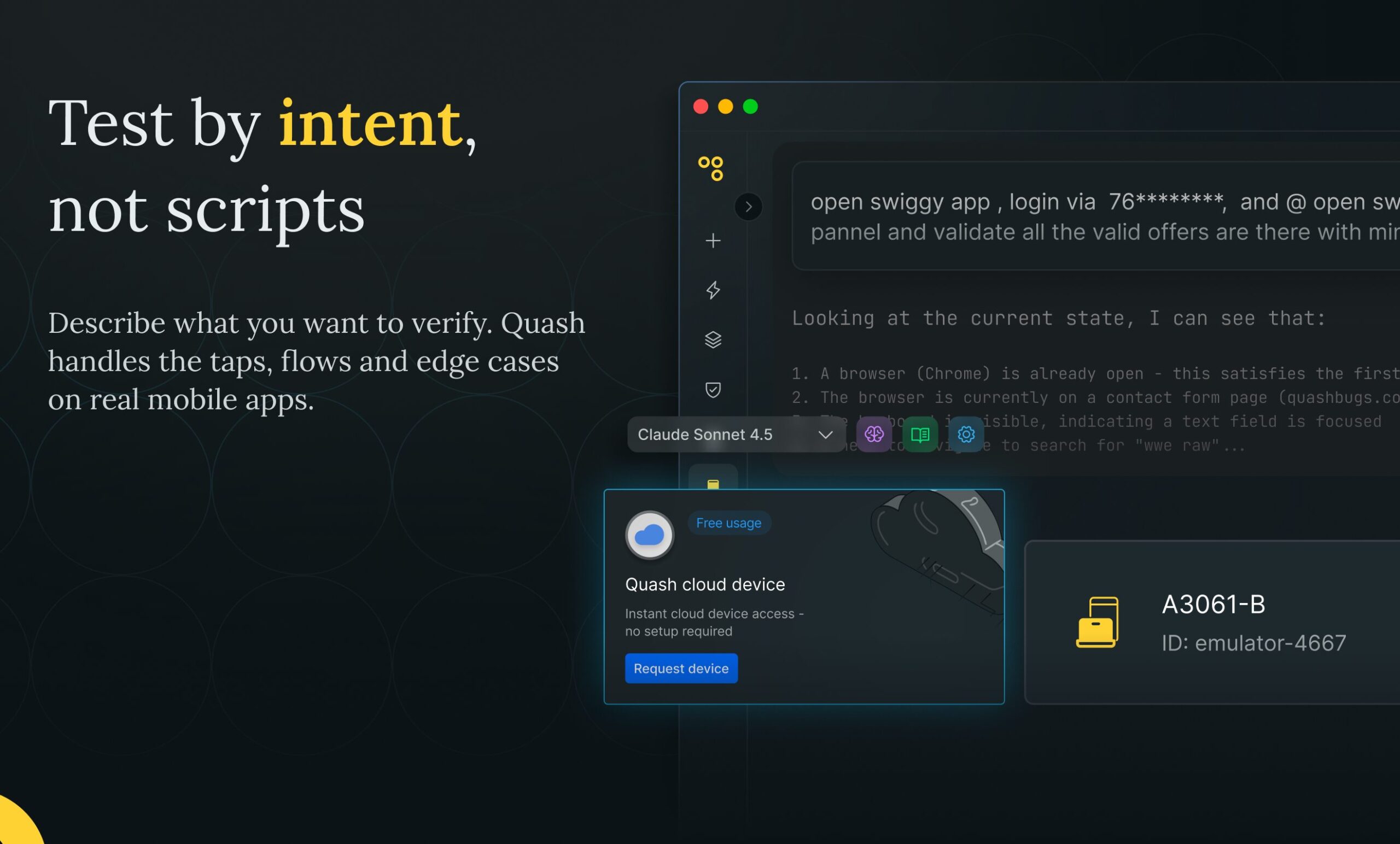
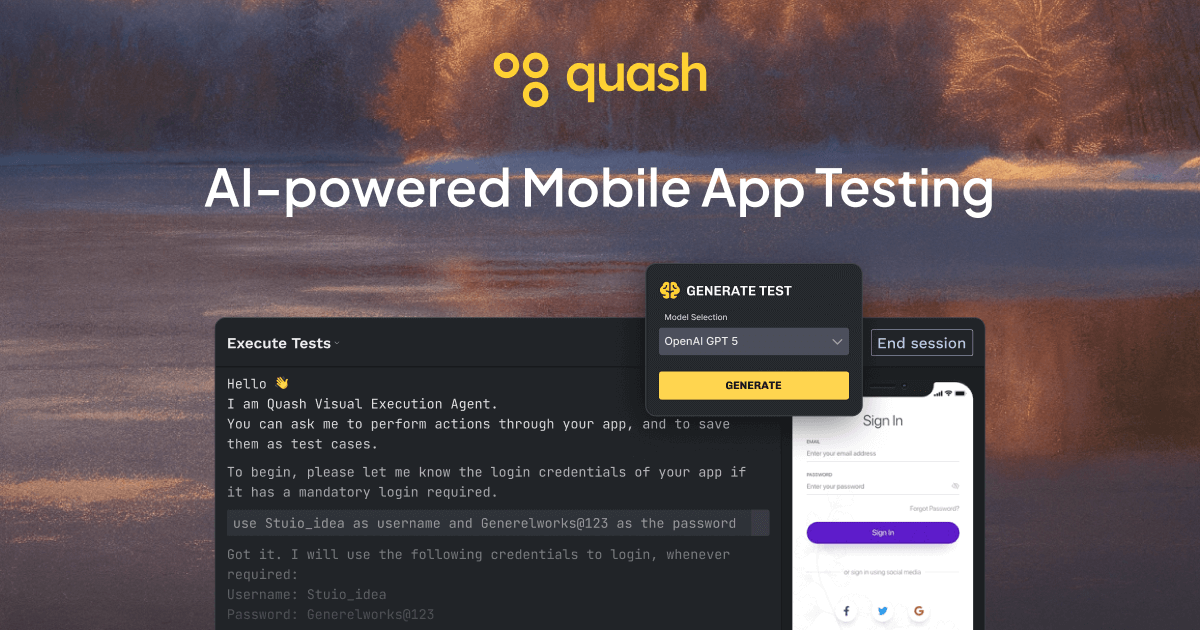
Quash is an intent-driven mobile testing agent that lets teams write and run tests in plain language instead of code or scripts. Rather than relying on brittle selectors or scripted step sequences, Quash converts natural language prompts into executable actions on real mobile apps. It supports testing on real devices, cloud devices, and local emulators across both iOS and Android, including cross-platform frameworks like Flutter and React Native.
The platform uses built-in self-healing to adapt when the UI changes between builds, reducing the test maintenance burden that plagues traditional automation. Quash also validates backend responses alongside UI flows in a single run, supports reusable test data, test suites, and parallel execution across multiple devices. Every run generates detailed execution reports with step-level intent, actions taken, screenshots, and device recordings.
Quash launched on Product Hunt on February 7, 2026, and is built by a Bangalore-based team focused on making mobile QA accessible to developers, QA engineers, and product managers alike.
Key Features
- Intent-driven execution: describe app flows in plain language and the AI agent handles taps, swipes, typing, and navigation automatically
- Self-healing tests: adapts to UI changes, loading states, and dynamic screens without manual maintenance
- UI and backend validation: verify backend responses and system behavior during mobile test execution in a single run
- Cross-platform support: works with iOS, Android, Flutter, React Native, and hybrid apps
- Flexible device execution: run tests on local devices, emulators, simulators, or cloud-hosted real devices
- Parallel execution: scale testing across multiple devices and OS versions simultaneously
- Context-rich reporting: step-level reports with intent, actions, screenshots, device recordings, and backend validation results
- Test suites and reusable data: group related tests and reuse test data across runs without rewriting prompts
- Role-based access: manage team permissions with admin and user roles
- CI/CD integration: fits into existing deployment workflows with API access and scheduled regression runs
How It Works
You describe an app flow in plain language, such as “log in, search for a product, add it to the cart, and check out.” The AI agent interprets the intent behind each step and executes it on the actual app, handling navigation, pop-ups, and form interactions automatically. Tests run against real app behavior rather than mocked or scripted environments. When the UI changes between builds, the agent adapts its execution path without requiring updates to the test definition.
Use Cases
- Mobile app functional testing
- Regression testing across releases
- Visual testing and layout validation
- Pre-production bug detection
- Cross-platform compatibility testing
- Backend validation during mobile flows
Pricing
Quash offers a free tier that is available permanently for solo developers and small teams. It includes AI test generation, prompt-to-execution, detailed test reports, projects and workspaces, core integrations, and one seat.
For teams that need advanced capabilities, Quash offers a Custom/Enterprise Pro plan that includes multi-context awareness (PRD, Figma, code), intelligent test generation, scheduled regression runs, debug-ready reports with insights, agentic app monitoring, smart test suites, multi-user roles and permissions, device farms and emulators, major workflow integrations, and CI/CD with APIs. The pay-as-you-go model starts at $0.20 per task, with $10 in free credit and 60 minutes of cloud device time included at no cost.
Pros and Cons
Pros:
- No scripting or coding required to create and run tests
- Self-healing reduces test maintenance significantly
- Natural language input makes testing accessible to non-technical team members
- Comprehensive reporting with full execution context
- Supports both iOS and Android with cross-platform framework compatibility
- Free tier available for getting started
Cons:
- Newer platform with a smaller community compared to established tools like Appium
- Complex multi-app flows crossing system boundaries may require tuning
- Enterprise features require custom pricing discussion
- Limited public documentation on advanced configuration compared to open-source alternatives
How Does It Compare?
Appium
- Type: Open-source mobile automation framework
- Approach: Code-based scripting in Java, Python, Ruby, JavaScript, C#, and other languages
- Platforms: iOS, Android, web apps (native, hybrid, web)
- Self-healing: Not built in (available via third-party plugins)
- Learning curve: High — requires programming expertise and environment setup
- Pricing: Free and open source
- Key difference: Appium offers maximum flexibility and language support but demands significant coding skills and manual maintenance. Quash eliminates scripting entirely with natural language input and built-in self-healing
Maestro
- Type: YAML-based mobile testing framework (open source)
- Approach: Human-readable YAML test definitions — no programming required
- Platforms: iOS, Android, React Native, Flutter, web
- Self-healing: Yes — automatic element waiting and synchronization
- Learning curve: Very low
- Pricing: Free locally; cloud execution at $250/device/month
- Key difference: Maestro uses structured YAML syntax while Quash uses freeform natural language. Maestro is open source with strong community support. Quash provides an AI agent that interprets intent and adapts execution dynamically
BrowserStack
- Type: Cloud-based testing platform with real device infrastructure
- Approach: Provides access to 30,000+ real iOS and Android devices for manual and automated testing
- Platforms: iOS, Android, web (desktop and mobile)
- Self-healing: Not built in (relies on integrated frameworks)
- Learning curve: Low for manual testing; moderate for automation
- Pricing: Starts at $199/month annually for App Automate; App Live plans also available
- Key difference: BrowserStack excels at device coverage and infrastructure but does not generate or execute tests from natural language. Quash provides the test intelligence layer while BrowserStack provides the device layer — some teams may use both
Sofy.ai
- Type: No-code AI-powered mobile testing platform
- Approach: AI-driven test generation from plain English; no coding required
- Platforms: iOS, Android
- Self-healing: Yes — reinforcement learning adapts to UI changes
- Learning curve: Very low
- Pricing: Starts at approximately $599/month
- Key difference: Sofy.ai offers similar no-code AI testing with a broader set of UX and accessibility validation features. Quash differentiates with intent-driven agentic execution and a free tier for getting started
Kobiton
- Type: AI-augmented real device testing platform
- Approach: Manual, scripted, and scriptless automation on real devices
- Platforms: iOS, Android
- Self-healing: Yes — AI-driven self-healing scripts
- Learning curve: Low to moderate
- Pricing: Starts at $83/month (Startup plan with 500 minutes)
- Key difference: Kobiton combines device lab management with AI-powered scriptless testing and offers the most affordable entry point. Quash focuses specifically on intent-driven execution with natural language rather than scriptless recording
Katalon Studio
- Type: Low-code test automation IDE
- Approach: Record/playback with optional Groovy scripting; visual test creation
- Platforms: Web, mobile, API, desktop
- Self-healing: Yes — smart locator updates
- Learning curve: Low
- Pricing: Freemium (free tier available; paid plans for advanced features)
- Key difference: Katalon is a comprehensive multi-platform IDE that covers web, API, and desktop testing in addition to mobile. Quash is mobile-focused with a simpler natural language interface rather than a full IDE
Firebase Test Lab
- Type: Google’s free cloud testing infrastructure
- Approach: Automated testing using Espresso, UI Automator, and Robo tests on real devices in Google data centers
- Platforms: Android only (iOS support limited)
- Self-healing: No
- Learning curve: Low
- Pricing: Free for Android testing within quota limits
- Key difference: Firebase Test Lab is the best free option for Android-only teams with its Robo testing for automated exploration. Quash covers both platforms with AI-driven test generation rather than framework-dependent scripts
Functionize
- Type: Agentic AI testing platform
- Approach: Plain English test creation using NLP; autonomous test execution with ML engine
- Platforms: Web, mobile, API
- Self-healing: Yes — ML-based with approximately 200 data points per UI element
- Learning curve: Low
- Pricing: Enterprise (custom pricing)
- Key difference: Functionize offers a similar NLP-based approach with broader web and API coverage. Quash is mobile-first and more accessible for smaller teams with its free tier, while Functionize targets larger enterprises
Final Thoughts
Quash addresses one of the most persistent problems in mobile QA: the gap between how humans think about testing and how traditional tools require tests to be written. By converting natural language intent into executable actions on real devices, it removes the scripting barrier that slows down many mobile teams.
The platform is well-suited for teams that want to move fast without maintaining fragile test scripts, especially those working across both iOS and Android. The free tier makes it easy to evaluate without commitment, and the self-healing capability reduces the ongoing maintenance cost that often makes test automation unsustainable.
As a newer entrant in the market, Quash is still building out its ecosystem and community. Teams with complex enterprise requirements or deep CI/CD integration needs should evaluate whether the current feature set meets their workflow. For teams prioritizing speed, simplicity, and reduced maintenance in mobile testing, Quash offers a compelling alternative to traditional script-based and framework-dependent tools.